 Reconstruction's Legacy
What were the main factors, in both the North and South, for the overthrow of Reconstruction?
THE OVERTHROW OF RECONSTRUCTION
Reconstruction’s Opponents
The South’s traditional leaders—planters, merchants, and Democratic politicians—bitterly opposed the new governments. “Intelligence, virtue, and patriotism” in public life, declared a protest by prominent southern Democrats, had given way to “ignorance, stupidity, and vice.” Corruption did exist during Reconstruction, but it was confined to no race, region, or party. The rapid growth of state budgets and the benefits to be gained from public aid led in some states to a scramble for influence that produced bribery, insider dealing, and a get-rich-quick atmosphere. Southern frauds, however, were dwarfed by those practiced in these years by the Whiskey Ring, which involved high officials of the Grant administration, and by New York’s Tweed Ring, controlled by the Democrats, whose thefts ran into the tens of millions of dollars. (These are discussed in the next chapter.) The rising taxes needed to pay for schools and other new public facilities and to assist railroad development were another cause of opposition to Reconstruction. Many poor whites who had initially supported the Republican Party turned against it when it became clear that their economic situation was not improving.
More information
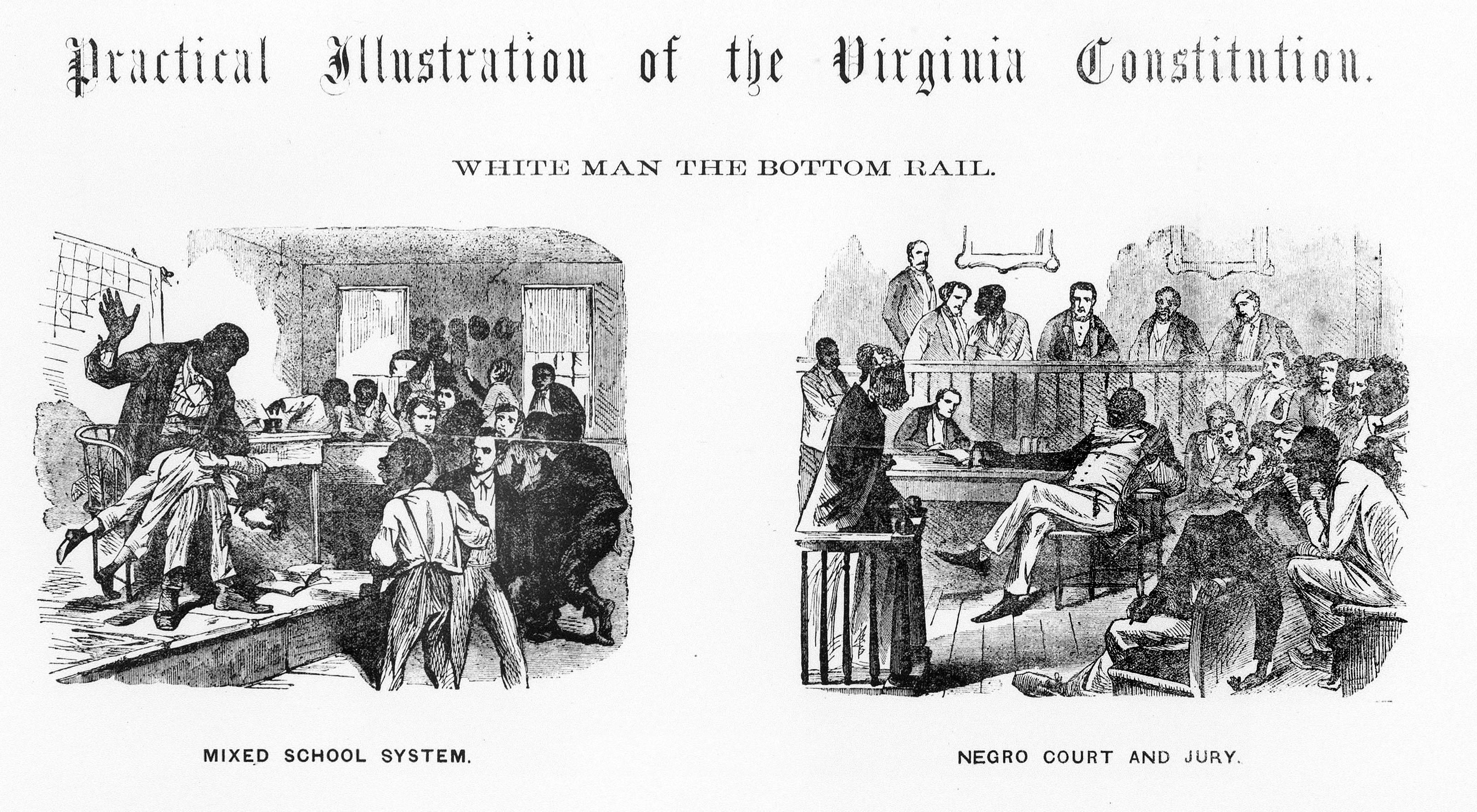
“A cartoon from around 1870 illustrates a key theme of the racist opposition to Reconstruction�that blacks had forced themselves upon whites and gained domination over them. A black school teacher inflicts punishment on a white student in an integrated classroom, and a racially mixed jury judges a white defendant.”
A cartoon from around 1870 illustrates a key theme of the racist opposition to Reconstruction—that Blacks had forced themselves upon whites and gained domination over them. A Black schoolteacher inflicts punishment on a white student in an integrated classroom, and a racially mixed jury judges a white defendant.
The most basic reason for opposition to Reconstruction, however, was that most white southerners could not accept the idea of former slaves voting, holding office, and enjoying equality before the law. Opponents launched a campaign of violence in an effort to end Republican rule.
“A Reign of Terror”
The Civil War ended in 1865, but violence remained widespread in large parts of the postwar South. In the early years of Reconstruction, violence was mostly local and unorganized. Blacks were assaulted and murdered for refusing to give way to whites on city sidewalks, using “insolent” language, challenging end-of-year contract settlements, and attempting to buy land. The violence that greeted the advent of Republican governments after 1867, however, was far more pervasive and more directly motivated by politics. In wide areas of the South, secret societies sprang up with the aim of preventing Blacks from voting and destroying the organization of the Republican Party by assassinating local leaders and public officials.
The most notorious such organization was the Ku Klux Klan, which in effect served as a military arm of the Democratic Party in the South. The Klan was a terrorist organization. It committed some of the most brutal criminal acts in American history. In many counties throughout the South, it launched what one victim called a “reign of terror” against Republican leaders, Black and white.
The Klan’s victims included white Republicans, among them wartime Unionists and local officeholders, teachers, and party organizers. But African Americans—local political leaders, those who managed to acquire land, and others who in one way or another defied the norms of white supremacy—bore the brunt of the violence. Black schoolhouses, tangible evidence of African American freedom, were frequent targets of anti-Reconstruction violence. One historian has identified over 600 schools destroyed.
More information
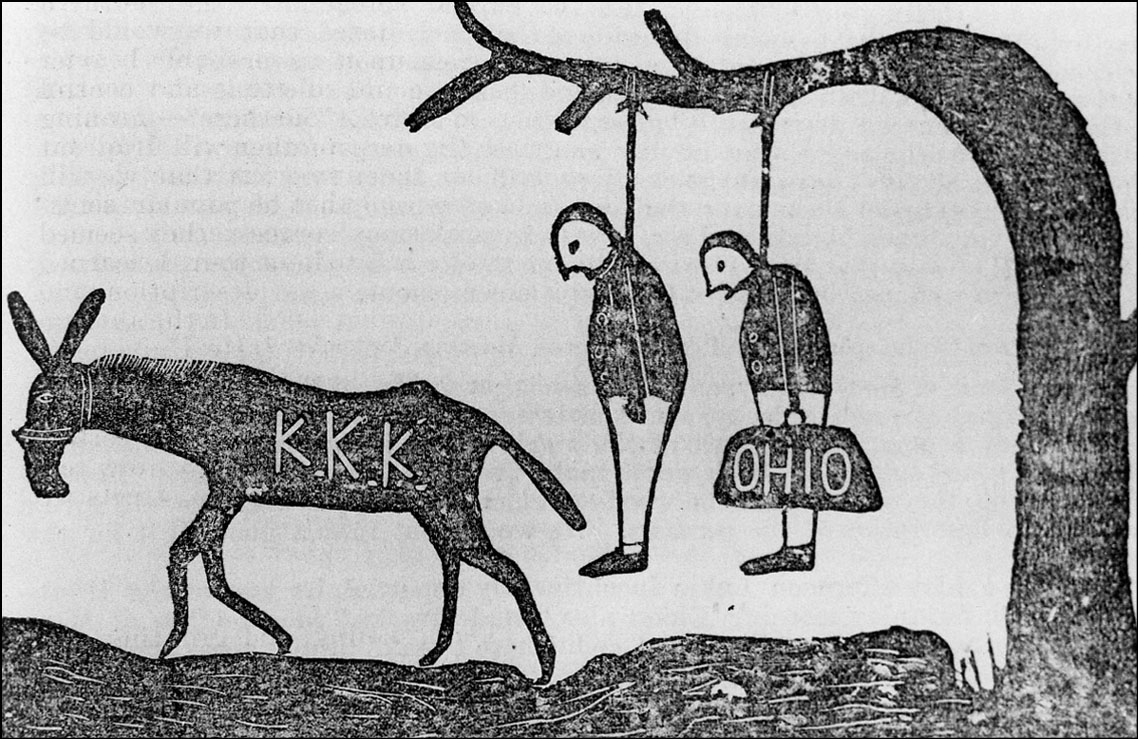
“A Prospective Scene in the City of Oaks, a cartoon in the September 1, 1868, issue of the Independent Monitor, a Democratic newspaper published in Tuscaloosa, Alabama. The image shows two men hanging from a tree branch. One of the men is holding a bag labeled “Ohio.” A donkey labeled “KKK” walks away from the men. The cartoon sent a warning to the Reverend A. S. Lakin, who had moved from Ohio to become president of the University of Alabama, and Dr. N. B. Cloud, a southern-born Republican serving as Alabama’s superintendent of public education. The Ku Klux Klan forced both men from their positions.”
A Prospective Scene in the “City of Oaks”, a cartoon in the September 1, 1868, issue of the Independent Monitor, a Democratic newspaper published in Tuscaloosa, Alabama. The cartoon sent a warning to the Reverend A. S. Lakin, who had moved from Ohio to become president of the University of Alabama, and Dr. N. B. Cloud, a southern-born Republican serving as Alabama’s superintendent of public education. The Ku Klux Klan forced both men from their positions. While most of the Klan’s victims were Black, the two men pictured here are white.
On occasion, violence escalated from assaults on individuals to mass terrorism and even local insurrections. The bloodiest act of violence during Reconstruction took place in Colfax, Louisiana, in 1873, where armed whites assaulted the town with a small cannon. Scores of former slaves were murdered, including fifty members of a Black militia unit after they had surrendered.
In 1870 and 1871, Congress adopted three Enforcement Acts, outlawing terrorist societies and allowing the president to use the army against them. These laws continued the expansion of national authority during Reconstruction. In 1871, President Grant dispatched federal marshals, backed up by troops in some areas, to arrest hundreds of accused Klansmen. Many Klan leaders fled the South. After a series of well-publicized trials, the Klan went out of existence. In 1872, for the first time since before the Civil War, peace reigned in most of the former Confederacy.
The Liberal Republicans
Despite the Grant administration’s effective response to Klan terrorism, the North’s commitment to Reconstruction waned during the 1870s. Northerners increasingly felt that the South should be able to solve its own problems without constant interference from Washington. The federal government had freed the slaves, made them citizens, and given them the right to vote. Now, Blacks should rely on their own resources, not demand further assistance.
In 1872, an influential group of Republicans, alienated by corruption within the Grant administration and believing that the growth of federal power during and after the war needed to be curtailed, formed their own party. They included Republican founders like Lyman Trumbull and prominent editors and journalists such as E. L. Godkin of the Nation. Calling themselves Liberal Republicans, they nominated Horace Greeley, editor of the New York Tribune, for president.
Democratic criticisms of Reconstruction found a receptive audience among the Liberals, who became convinced that the “best men” of the South had been excluded from power while “ignorant” voters controlled politics, producing corruption and misgovernment. Greeley had spent most of his career denouncing the Democratic Party. But with the Republican split presenting an opportunity to repair their political fortunes, Democratic leaders endorsed Greeley as their candidate. But many rank-and-file Democrats stayed at home on election day. As a result, Greeley suffered a devastating defeat by Grant, whose margin of more than 700,000 popular votes was the largest in a nineteenth-century presidential contest. But Greeley’s campaign placed on the northern agenda the one issue on which the Liberal reformers and the Democrats could agree—a new policy toward the South.
More information
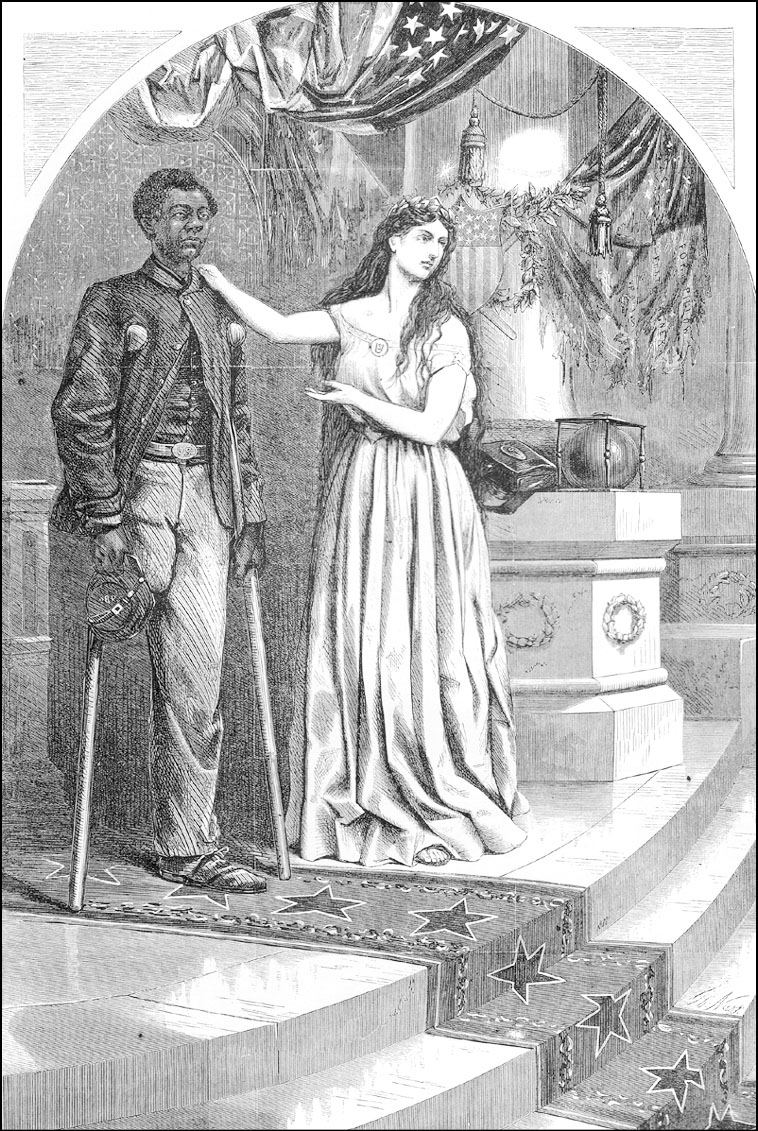
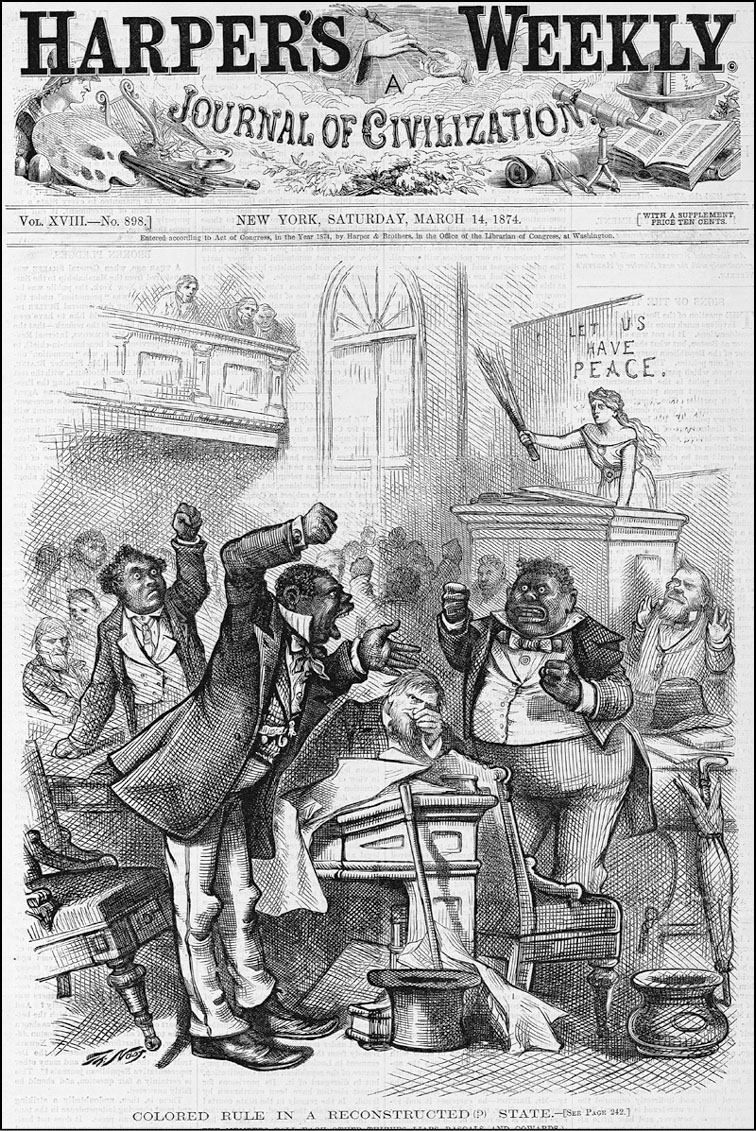
“Changes in graphic artist Thomas Nast’s depiction of blacks in Harper’s Weekly mirrored the evolution of Republican sentiment in the North. And Not This Man? August 5, 1865, shows the black soldier as an upstanding citizen deserving of the vote. Colored Rule in a Reconstructed (?) State, March 14, 1874, suggests that Reconstruction legislatures had become travesties of democratic government.”
More information
“Changes in graphic artist Thomas Nast’s depiction of blacks in Harper’s Weekly mirrored the evolution of Republican sentiment in the North. And Not This Man? August 5, 1865, shows the black soldier as an upstanding citizen deserving of the vote. Colored Rule in a Reconstructed (?) State, March 14, 1874, suggests that Reconstruction legislatures had become travesties of democratic government.”
Changes in graphic artist Thomas Nast’s depiction of Blacks in Harper’s Weekly mirrored the evolution of Republican sentiment in the North. And Not This Man?, August 5, 1865, shows the Black soldier as an upstanding citizen deserving of the vote. Colored Rule in a Reconstructed (?) State, March 14, 1874, suggests that Reconstruction legislatures had become travesties of democratic government.
More information
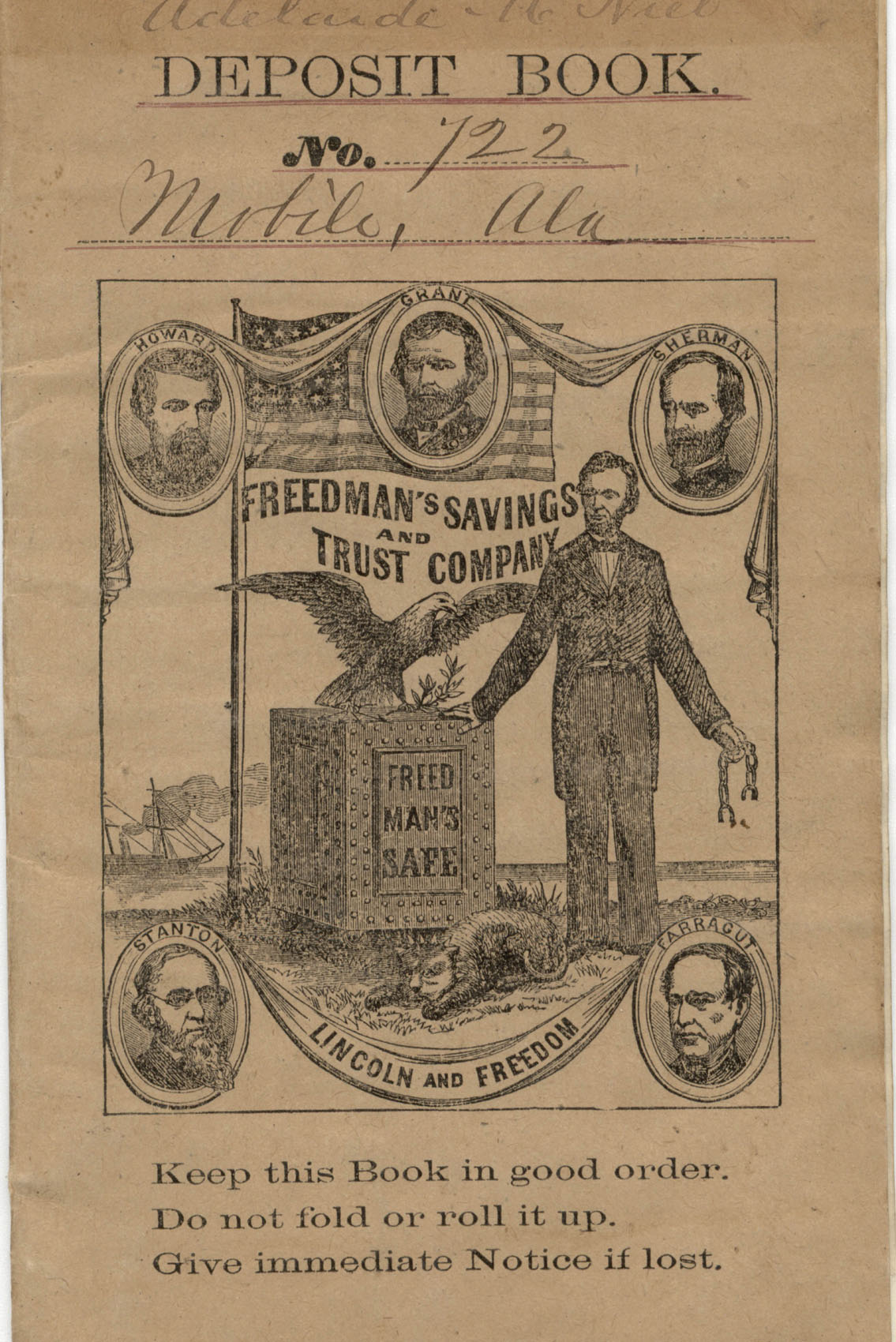
Freedman’s Savings and Trust Company deposit book. This was a private corporation established by Congress in 1865 to promote thrift among the former slaves. Black individuals, families, church groups, and civic organizations deposited nearly two million dollars in branches across the South, but the bank failed in 1874 due to bad management and thousands of depositors lost their savings.
A bankbook issued by the Freedman’s Savings and Trust Company, a private corporation established by Congress to promote thrift among the former slaves. Black individuals, families, church groups, and civic organizations deposited nearly $2 million in branches scattered across the South. The bank failed in 1874 because of mismanagement, and thousands of depositors lost their savings.
The North’s Retreat
The Liberal attack on Reconstruction, which continued after 1872, contributed to a resurgence of racism in the North. Journalist James S. Pike, a leading Greeley supporter, in 1874 published The Prostrate State, an influential account of a visit to South Carolina. The book depicted a state engulfed by political corruption and under the control of “a mass of Black barbarism.” Resurgent racism offered Blacks’ alleged incapacity as a convenient explanation for the “failure” of Reconstruction. The solution, for many, was to restore leading whites to political power.
Other factors also weakened northern support for Reconstruction. In 1873, the country plunged into a severe economic depression. Distracted by economic problems, Republicans were in no mood to devote further attention to the South. Democrats made substantial gains throughout the nation in the elections of 1874. For the first time since the Civil War, their party took control of the House of Representatives. Before the new Congress met, the old one enacted a final piece of Reconstruction legislation, the Civil Rights Act of 1875. This outlawed racial discrimination in places of public accommodation like hotels and theaters. But it was clear that the northern public was retreating from Reconstruction.
The Supreme Court whittled away at the guarantees of Black rights Congress had adopted. In the Slaughterhouse Cases (1873), the justices ruled that the Fourteenth Amendment had not altered traditional federalism. Most of the rights of citizens, it declared, remained under state control. Three years later, in United States v. Cruikshank, the Court gutted the Enforcement Acts by throwing out the convictions of some of those responsible for the Colfax Massacre of 1873.
RECONSTRUCTION IN THE SOUTH, 1867–1877
More information
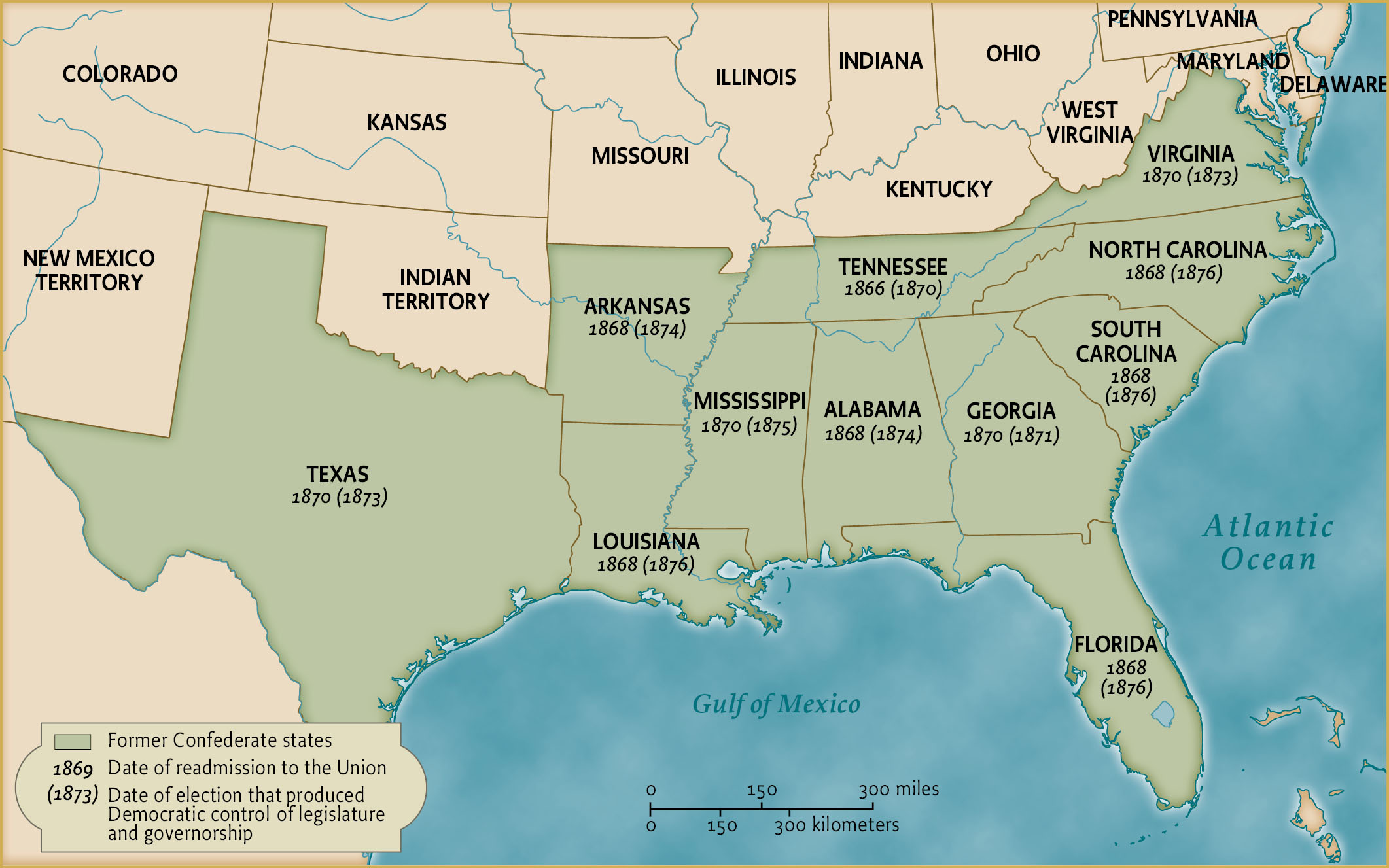
RECONSTRUCTION IN THE SOUTH, 1867–1877, Former confederate states are highlighted on the map and include Virginia, North Carolina, South Carolina, Tennessee, Georgia, Florida, Alabama, Mississippi, Arkansas, Louisiana, and Texas. Each state is labeled with two dates. The first date is the date of readmission to the Union; the second date is the date of the election that produced Democratic control of the state legislature and governorship. Virginia’s first date is 1870; its second date is 1873. North Carolina’s first date is 1868; its second date is 1876. South Carolina’s first date is 1868; its second date is 1876. Tennessee’s first date is 1866; its second date is 1870. Georgia’s first date is 1870; its second date is 1871. Florida’s first date is 1868; its second date is 1876. Alabama’s first date is 1868; its second date is 1874. Mississippi’s first date is 1870; its second date is 1875. Arkansas’s first date is 1868; its second date is 1874. Louisiana’s first date is 1868; its second date is 1876. Texas’s first date is 1870; its second date is 1873.
The Triumph of the Redeemers
By the mid-1870s, Reconstruction was clearly on the defensive. Democrats had already regained control of states with substantial white voting majorities such as Tennessee, North Carolina, and Texas. The victorious Democrats called themselves Redeemers, since they claimed to have “redeemed” the white South from corruption, misgovernment, and northern and Black control.
More information
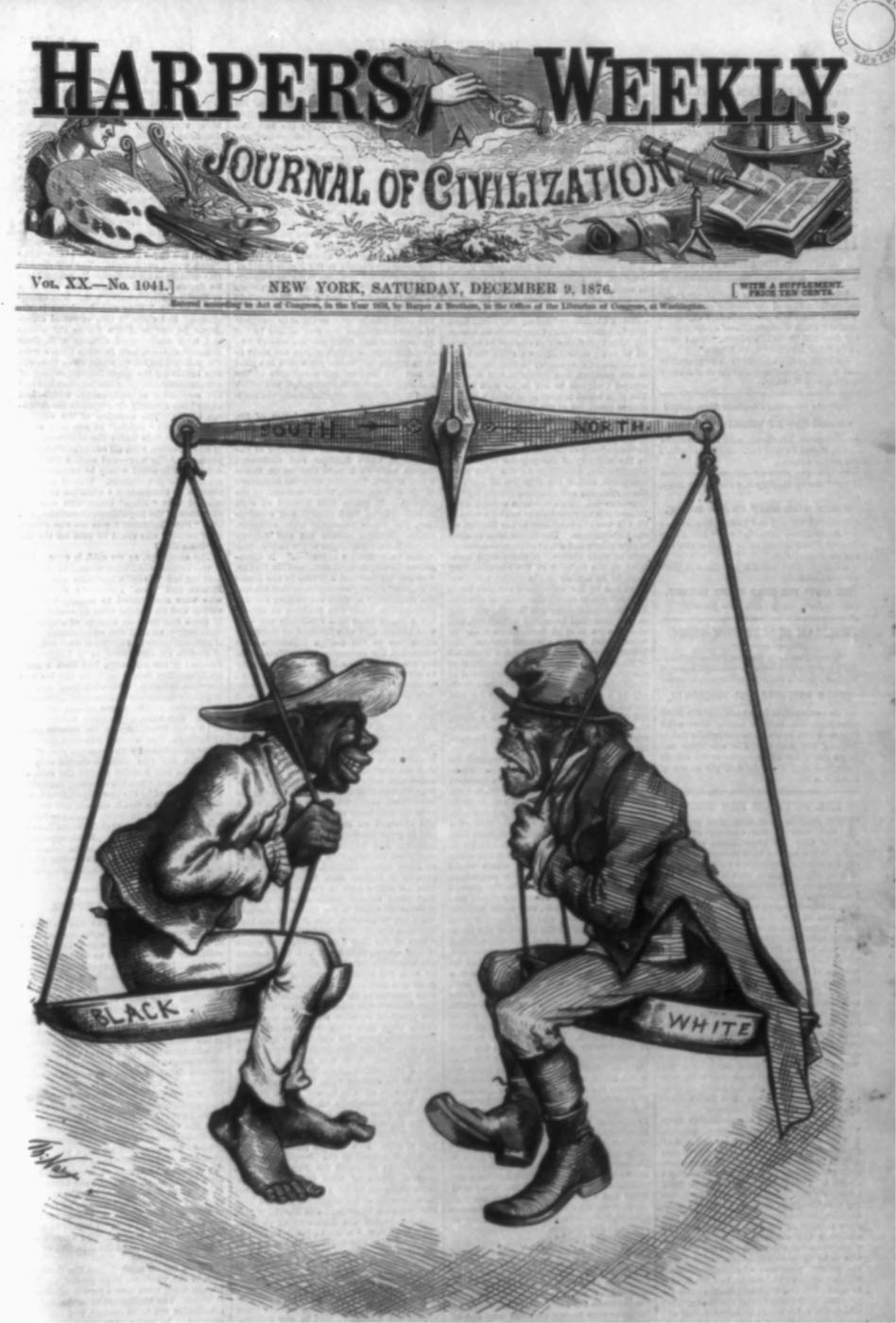
“The Ignorant Vote,” a famous cartoon by�Thomas Nast in Harper’s Weekly, December 9, 1876, equates blacks and Irish immigrants as unworthy of participation in democracy by showing caricatures of each on either side of a balanced scale. The black man is wearing a straw hat and no shoes. The Irish man is wearing a drooping tophat, a long coat, and boots. He has a large, sneering face. They are both made to look animalistic and less than human.
The Ignorant Vote, a famous cartoon by Thomas Nast in Harper’s Weekly, December 9, 1876, equates Blacks and Irish immigrants as unworthy of participation in democracy. It reflects a growing reaction against universal manhood suffrage in both North and South.
In those states where Reconstruction governments survived, violence again erupted. This time, the Grant administration showed no desire to intervene. In Mississippi, in 1875, armed Democrats destroyed ballot boxes and drove former slaves from the polls. The result was a Democratic landslide and the end of Reconstruction in Mississippi. Similar events took place in South Carolina in 1876. Democrats nominated for governor former Confederate general Wade Hampton. Hampton promised to respect the rights of all citizens of the state, but his supporters, inspired by Democratic tactics in Mississippi, launched a wave of intimidation.
The Disputed Election and Bargain of 1877
Events in South Carolina directly affected the outcome of the presidential campaign of 1876. To succeed Grant, the Republicans nominated Governor Rutherford B. Hayes of Ohio. The Democrats chose as his opponent New York’s governor, Samuel J. Tilden. By this time, only South Carolina, Florida, and Louisiana remained under Republican control in the South. The election turned out to be so close that whoever captured these states—which both parties claimed to have carried—would become the next president.
Unable to resolve the impasse on its own, Congress in January 1877 appointed a fifteen-member Electoral Commission, composed of senators, representatives, and Supreme Court justices. Republicans enjoyed an 8-7 majority on the commission, and to no one’s surprise, the members decided by that margin that Hayes had carried the disputed southern states and had been elected president.
Even as the commission deliberated, however, behind-the-scenes negotiations took place between leaders of the two parties. Hayes’s representatives agreed to recognize Democratic control of the entire South and to avoid further intervention in local affairs. For their part, Democrats promised not to dispute Hayes’s right to office and to respect the civil and political rights of Blacks.
Thus was concluded the Bargain of 1877. Hayes became president and quickly ordered federal troops to stop guarding the state houses in Louisiana and South Carolina, allowing Democratic claimants to become governors. (Contrary to legend, Hayes did not remove the last soldiers from the South—he simply ordered them to return to their barracks.) The triumphant southern Democrats failed to live up to their pledge to recognize Blacks as equal citizens.
THE PRESIDENTIAL ELECTION OF 1876
More information
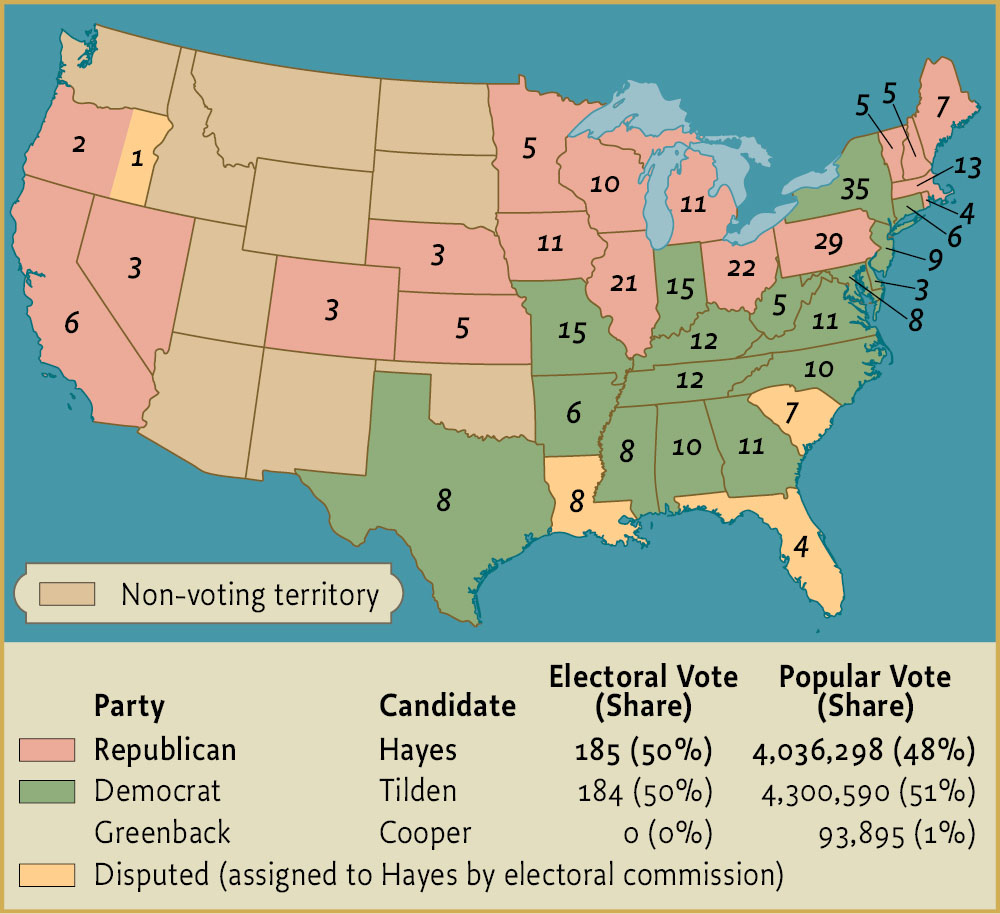
The number of electoral votes of the Republicans in each state were as follows. Oregon: 2. California: 6. Nevada: 3. Colorado: 3. Nebraska: 3. Kansas: 5. Minnesota: 5. Iowa: 11. Wisconsin: 10. Illinois: 21. Michigan: 11. Ohio: 22. Pennsylvania: 29. Maine: 7. Vermont: 5. New Hampshire: 5. Massachusetts: 13. Rhode Island: 4. The number of electroal votes of the Democrats in each state were as follows. Texas: 8. Missouri: 15. Arkansas: 6. Indiana: 15. Tennessee: 12. Kentucky: 12. Mississippi: 8. Alabama: 10. Georgia: 11. West Virginia: 5. Virginia: 11. North Carolina: 10. New York: 35. Connecticut: 6. New Jersey: 9. Maryland: 8. Delaware: 3. The disputed regions that were then assigned to Hayes by electoral commission were as follows. Oregon: 1. Louisiana: 8. South Carolina: 7. Florida: 4. The other states are non-voting territories. The data from the table below the map are as follows. Row 1. Party: Republican. Candidate: Hayes. Electoral vote and share: 185 and 50 percent. Popular vote and share: 4,036,298 and 48 percent. Row 2. Party: Democrat. Candidate: Tilden. Electoral vote and share: 184 and 50 percent. Popular vote and share: 4,300,590 and 51 percent. Row 3. Party: Greenback. Candidate: Cooper. Electoral vote and share: 0 and 0 percent. Popular vote and share: 93,895 and 1 percent. The Republicans won the election.
The End of Reconstruction
As a historical process—the nation’s adjustment to the destruction of slavery—Reconstruction continued well after 1877. Blacks continued to vote and, in some states, hold office into the 1890s. But as a distinct era of national history—when Republicans controlled much of the South, Blacks exercised significant political power, and the federal government accepted the responsibility for protecting the fundamental rights of all American citizens—Reconstruction had come to an end. Despite its limitations, Reconstruction was a remarkable chapter in the story of American freedom. Nearly a century would pass before the nation again tried to bring equal rights to the descendants of slaves. The civil rights era of the 1950s and 1960s would sometimes be called the Second Reconstruction.
Glossary
- Ku Klux Klan
- Group organized in Pulaski, Tennessee, in 1866 to terrorize former slaves who voted and held political offices during Reconstruction; a revived organization in the 1910s and 1920s that stressed white, Anglo-Saxon, fundamentalist Protestant supremacy; revived a third time to fight the civil rights movement of the 1950s and 1960s in the South.
- Enforcement Acts
- Three laws passed in 1870 and 1871 that tried to eliminate the Ku Klux Klan by outlawing it and other such terrorist societies; the laws allowed the president to deploy the army for that purpose.
- Civil Rights Act of 1875
- The last piece of Reconstruction legislation, which outlawed racial discrimination in places of public accommodation such as hotels and theaters. Many parts of the act were ruled unconstitutional by the Supreme Court in 1883.
- Redeemers
- Post–Civil War Democratic leaders who supposedly saved the South from Yankee domination and preserved the primarily rural economy.
- Bargain of 1877
- Deal made by a Republican and Democratic special congressional commission to resolve the disputed presidential election of 1876; Republican Rutherford B. Hayes, who had lost the popular vote, was declared the winner in exchange for the withdrawal of federal troops from involvement in politics in the South, marking the end of Reconstruction.