In what ways did the Progressive presidents promote the expansion of American power overseas?
AN ERA OF INTERVENTION
Just as they expanded the powers of the federal government in domestic affairs, the Progressive presidents increasingly projected American power outside the country’s borders. At first, they confined their interventions to the Western Hemisphere, whose affairs the United States had claimed a special right to oversee ever since the Monroe Doctrine of 1823. Between 1901 and 1920, U.S. marines landed in Caribbean countries more than twenty times. Usually, they were dispatched to create a welcoming economic environment for American companies that wanted stable access to goods like bananas and sugar, and for bankers nervous that their loans to local governments might not be repaid.
THE UNITED STATES IN THE CARIBBEAN, 1898–1941
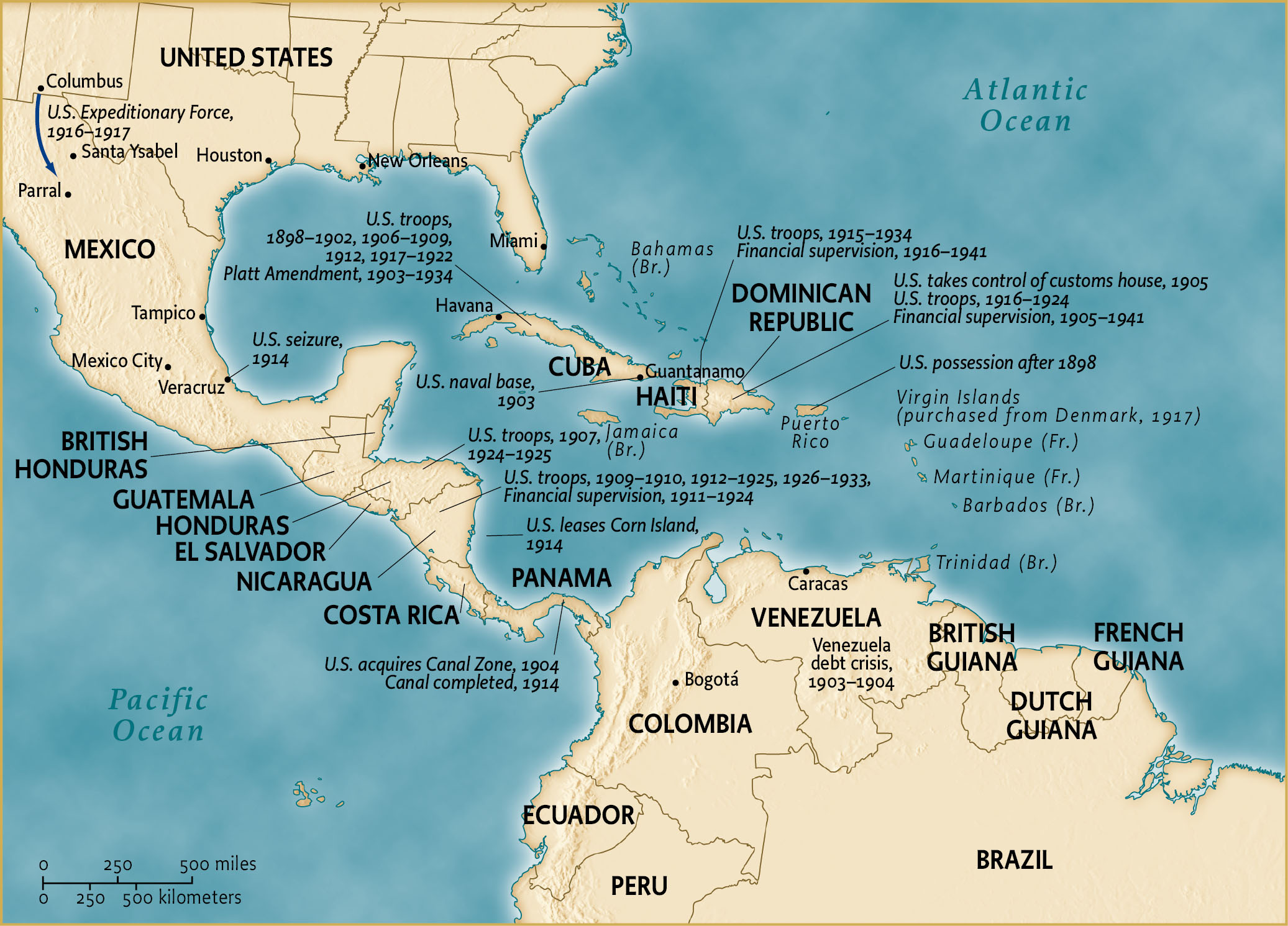
More information
A map of the Panama Canal Zone. Locks are located near Gatun on the northern side, and on either side of Lake Miraflores, including the Miraflores Locks on the southern end of the lake. The Madden Dam is shown at the southwestern side of the Madden Lake. The Locks Dam is south of the locks near Gatun. The canal is travels southeast from Limon Bay to the Gulf of Panama. The Navigation Channel of the canal travels through Gatun Lake. A railroad is shown running along the canal from Colon to Gatun, through Darien, and Gamboa to Balboa and Panama City. The Panama Canal Zone is highlighted and includes from the coast along Limon Bay down to the coast around Panama City and Balboa and the area around Gatun and Madden Lakes.
Between 1898 and 1941, the United States intervened militarily numerous times in Caribbean countries, generally to protect the economic interests of American banks and investors.
“I Took the Canal Zone”
Theodore Roosevelt became far more active in international diplomacy than most of his predecessors, helping, for example, to negotiate a settlement of the Russo-Japanese War of 1904–1905, a feat for which he was awarded the Nobel Peace Prize. Closer to home, his policies were more aggressive. “I have always been fond of the West African proverb,” he wrote, “ ‘Speak softly and carry a big stick.’ ”
The idea of a canal across the fifty-one-mile-wide isthmus of Panama had a long history. A longtime proponent of American naval development, Roosevelt was convinced that a canal would facilitate the movement of naval and commercial vessels between the two oceans. In 1903, when Colombia, of which Panama was a part, refused to cede land for the project, Roosevelt helped set in motion an uprising by Panamanian conspirators. An American gunboat prevented the Colombian army from suppressing the rebellion.
Upon establishing its independence, Panama signed a treaty giving the United States both the right to construct and operate a canal and sovereignty over the Panama Canal Zone, a ten-mile-wide strip of land through which the route would run. A remarkable feat of engineering, the canal was the largest construction project in American history to that date. Like the building of the transcontinental railroad in the 1860s and much construction work today, it involved the widespread use of immigrant labor. Most of the 60,000 workers came from the Caribbean islands of Barbados and Jamaica, but others hailed from Europe, Asia, and the United States. When completed in 1914, the canal reduced the sea voyage between the East and West Coasts of the United States by 8,000 miles. “I took the Canal Zone,” Roosevelt exulted. But the manner in which the canal had been initiated, and the continued American rule over the Canal Zone, would long remain a source of tension. In 1977, President Jimmy Carter, as a symbol of a new, noninterventionist U.S. attitude toward Latin America, negotiated treaties that led to turning over the canal’s operation and control of the Canal Zone to Panama in the year 2000 (see Chapter 26).
The Roosevelt Corollary
Roosevelt’s actions in Panama anticipated the full-fledged implementation of a principle that came to be called the Roosevelt Corollary to the Monroe Doctrine. This held that the United States had the right to exercise “an international police power” in the Western Hemisphere—a significant expansion of James Monroe’s pledge to defend the hemisphere against European intervention. In 1904, Roosevelt ordered American forces to seize the customs houses of the Dominican Republic to ensure payment of that country’s debts to European and American investors. In 1906, he dispatched troops to Cuba to oversee a disputed election; they remained in the country until 1909.

VISIONS OF FREEDOM
The World’s Constable
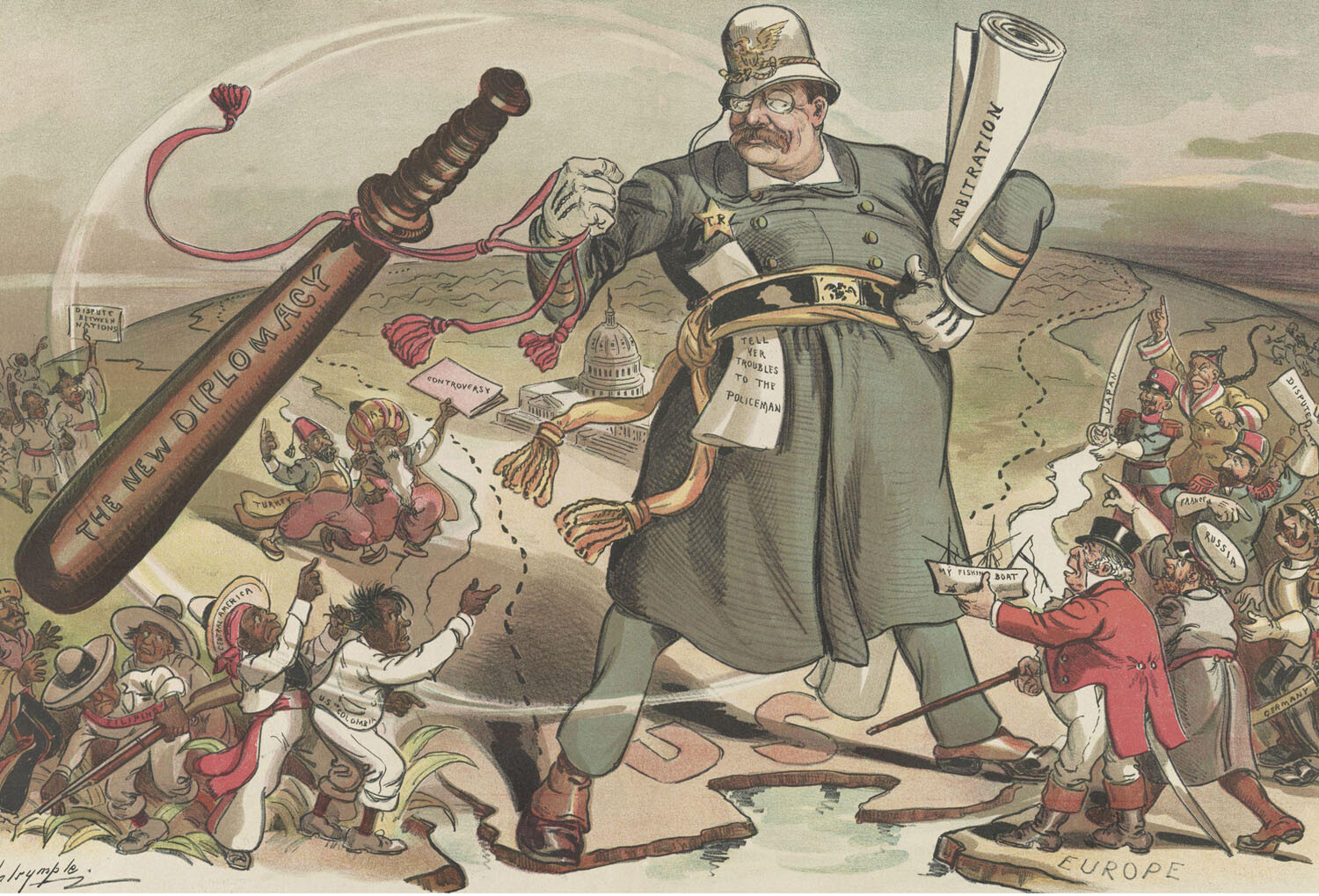

Roosevelt’s successor, William Howard Taft, landed marines in Nicaragua to protect a government friendly to American economic interests. In general, however, Taft emphasized economic investment and loans from American banks, rather than direct military intervention, as the best way to spread American influence. As a result, his foreign policy became known as Dollar Diplomacy.
Moral Imperialism
The son of a Presbyterian minister, Woodrow Wilson brought to the presidency a missionary zeal and a sense of his own and the nation’s moral righteousness. He appointed as secretary of state William Jennings Bryan, a strong anti-imperialist. Wilson promised a new foreign policy that would respect Latin America’s independence and free it from foreign economic domination.
But Wilson’s moral imperialism produced more military interventions in Latin America than the foreign policy of any president before or since. In 1915, he sent marines to occupy Haiti after the government refused to allow American banks to oversee its financial dealings. The United States seized control of Haitian finances, forced the dissolution of its national assembly, and rewrote the Haitian Constitution. American military rule would last until 1934. In 1916, Wilson established a military government in the Dominican Republic as well. American soldiers remained there until 1924. Wilson’s foreign policy underscored a paradox of modern American history: the presidents who spoke the most about freedom were the most likely to intervene in the affairs of other countries.
Wilson and Mexico
Wilson’s major preoccupation in Latin America was Mexico, where in 1911 a revolution led by Francisco Madero overthrew the government of dictator Porfirio Díaz. Two years later, without Wilson’s knowledge but with the backing of the U.S. ambassador and of American companies that controlled Mexico’s oil and mining industries, military commander Victoriano Huerta assassinated Madero and seized power.
Wilson was appalled. He would “teach” Latin Americans, he added, “to elect good men.” When civil war broke out in Mexico, Wilson ordered American troops to land at Vera Cruz to prevent the arrival of weapons meant for Huerta’s forces. But to Wilson’s surprise, Mexicans greeted the marines as invaders rather than liberators.
Huerta resigned in 1914 and fled the country. Meanwhile, various Mexican factions contended for power. A peasant uprising in the southern part of the country, led by Emiliano Zapata, demanded land reform. The Wilson administration offered support to Venustiano Carranza, a leader devoted to economic modernization. In 1916, several hundred men loyal to Francisco “Pancho” Villa, the leader of another peasant force, raided Columbus, New Mexico, a few miles north of the border, leading to the death of seventeen Americans. With Carranza’s approval, Wilson ordered 10,000 troops under the command of General John J. Pershing on an expedition into Mexico that unsuccessfully sought to arrest Villa. Violence in Mexico continued—within the next few years, Zapata, Carranza, and Villa all fell victim to assassination. Mexico was a warning that it might be difficult to use American might to reorder the internal affairs of other nations.
Glossary
- Panama Canal Zone
- The small strip of land on either side of the Panama Canal; the Canal Zone was under U.S. control from 1903 to 1979 as a result of Theodore Roosevelt’s assistance in engineering a coup in Colombia that established Panama’s independence.
- Roosevelt Corollary
- 1904 announcement by President Theodore Roosevelt, essentially a corollary to the Monroe Doctrine, stating that the United States could intervene militarily to prevent interference from European powers in the Western Hemisphere.
- Dollar Diplomacy
- A foreign policy initiative under President William Howard Taft that promoted the spread of American influence through loans and economic investments from American banks.
- moral imperialism
- The Wilsonian belief that U.S. foreign policy should be guided by morality and should teach other peoples about democracy. Wilson used this belief to both repudiate Dollar Diplomacy and justify frequent military interventions in Latin America.