 Wilsonianism and the Versailles Treaty
Why was 1919 such a watershed year for the United States and the world?
1919
A Worldwide Upsurge
Militant hopes for social change and disappointment with the war’s outcome were evident far beyond the Black community. In the Union of Soviet Socialist Republics (or Soviet Union), as Russia had been renamed after the revolution, Lenin’s government had nationalized landholdings, banks, and factories and proclaimed the socialist dream of a workers’ government. The Russian Revolution and the democratic aspirations unleashed by World War I sent tremors of hope and fear throughout the world. General strikes demanding the fulfillment of wartime promises of “industrial democracy” took place in Belfast, Glasgow, and Winnipeg. In Spain, anarchist peasants began seizing land. Crowds in India challenged British rule, and nationalist movements in other colonies demanded independence.
The worldwide revolutionary upsurge produced a countervailing mobilization by opponents of radical change. Despite Allied attempts to overturn its government, the Soviet regime survived, but in the rest of the world the tide of change receded. By the fall, the mass strikes had been suppressed and conservative governments had been installed in central Europe.
Upheaval in America
In the United States, 1919 also brought unprecedented turmoil. Racial violence, as noted above, was widespread. In June, bombs exploded at the homes of prominent Americans, including the attorney general, A. Mitchell Palmer, who escaped uninjured. Among aggrieved American workers, wartime language linking patriotism with democracy and freedom inspired hopes that an era of social justice and economic empowerment was at hand. In 1917, Wilson had told the AFL, “While we are fighting for freedom, we must see to it among other things that labor is free.” Labor took him seriously—more seriously, it seems, than Wilson intended.
In 1919, more than 4 million workers engaged in strikes—the greatest wave of labor unrest in American history. There were walkouts, among many others, by textile workers, telephone operators, and Broadway actors. They were met by an unprecedented mobilization of employers, government, and private patriotic organizations.
The wartime rhetoric of economic democracy and freedom helped to inspire the era’s greatest labor uprising, the 1919 steel strike. Centered in Chicago, it united some 365,000 mostly immigrant workers in demands for union recognition, higher wages, and an eight-hour workday. Before 1917, steel mill managers arbitrarily established wages and working conditions and suppressed union organizing. During the war, workers won an eight-hour day. “For why this war?” asked one Polish immigrant steelworker at a union meeting. “For why we buy Liberty bonds? For the mills? No, for freedom and America—for everybody.”
In response to the strike, steel magnates launched a concerted counterattack. Employers appealed to anti-immigrant sentiment among native-born workers, many of whom returned to work, and conducted a propaganda campaign that associated the strikers with the IWW, communism, and disloyalty. With middle-class opinion having turned against the labor movement and the police assaulting workers on the streets, the strike collapsed in early 1920.
The Red Scare
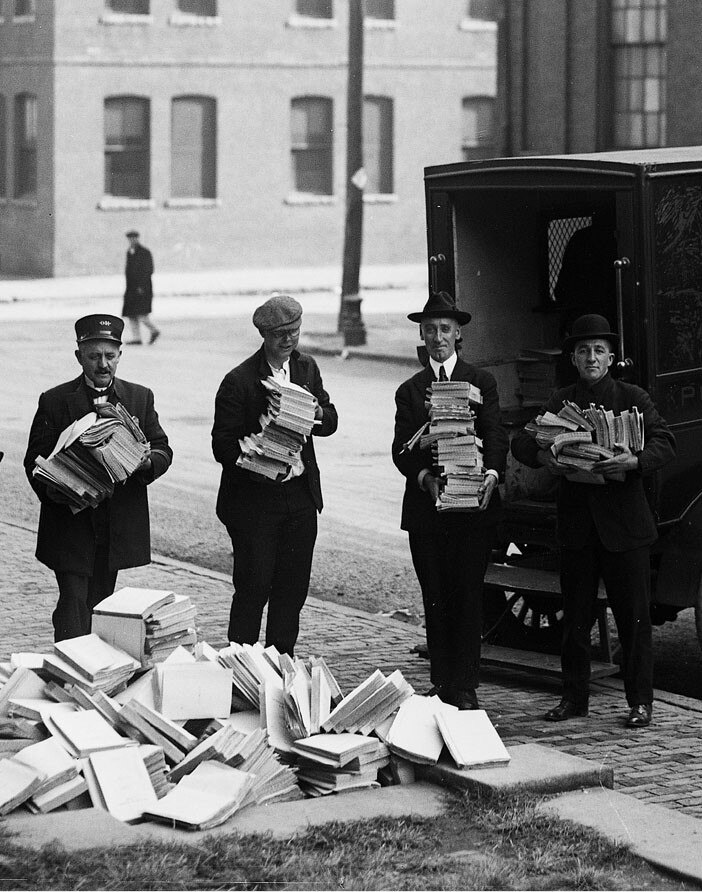
Wartime repression of dissent reached its peak with the Red Scare of 1919–1920, a short-lived but intense period of political intolerance inspired by the postwar strike wave and the social tensions and fears generated by the Russian Revolution. Convinced that episodes like the steel strike were part of a worldwide communist conspiracy, Attorney General A. Mitchell Palmer in November 1919 and January 1920 dispatched federal agents to raid the offices of radical and labor organizations throughout the country. More than 5,000 persons were arrested, most of them without warrants, and held for months without charge. The government deported hundreds of immigrant radicals, including Emma Goldman.
The abuse of civil liberties in early 1920 was so severe that Palmer came under heavy criticism from Congress and much of the press. Even the explosion of a bomb outside the New York Stock Exchange in September 1920, which killed forty persons, failed to rekindle the repression of the Red Scare. (The perpetrators of this terrorist explosion, the worst on American soil until the Oklahoma City bombing of 1995, were never identified.)
More information
“Local police with literature seized from a Communist Party office in Cambridge, Massachusetts, November 1919.”
Local police with literature seized from a Communist Party office in Cambridge, Massachusetts, November 1919.
The reaction to the Palmer Raids planted the seeds for a new appreciation of the importance of civil liberties that would begin to flourish during the 1920s. But in their immediate impact, the events of 1919 and 1920 dealt a devastating setback to radical and labor organizations of all kinds and kindled an intense identification of patriotic Americanism with support for the political and economic status quo. The IWW had been effectively destroyed, and many moderate unions lay in disarray. The Socialist Party crumbled under the weight of governmental repression (the New York legislature expelled five Socialist members, and Congress denied Victor Berger the seat to which he had been elected from Wisconsin) and internal differences over the Russian Revolution.
Wilson at Versailles
The beating back of demands for fundamental social change was a severe rebuke to the hopes with which so many Progressives had enlisted in the war effort. Wilson’s inability to achieve a just peace based on the Fourteen Points compounded the sense of failure. Late in 1918, the president traveled to France to attend the Versailles peace conference. But he proved a less adept negotiator than his British and French counterparts, David Lloyd George and Georges Clemenceau.
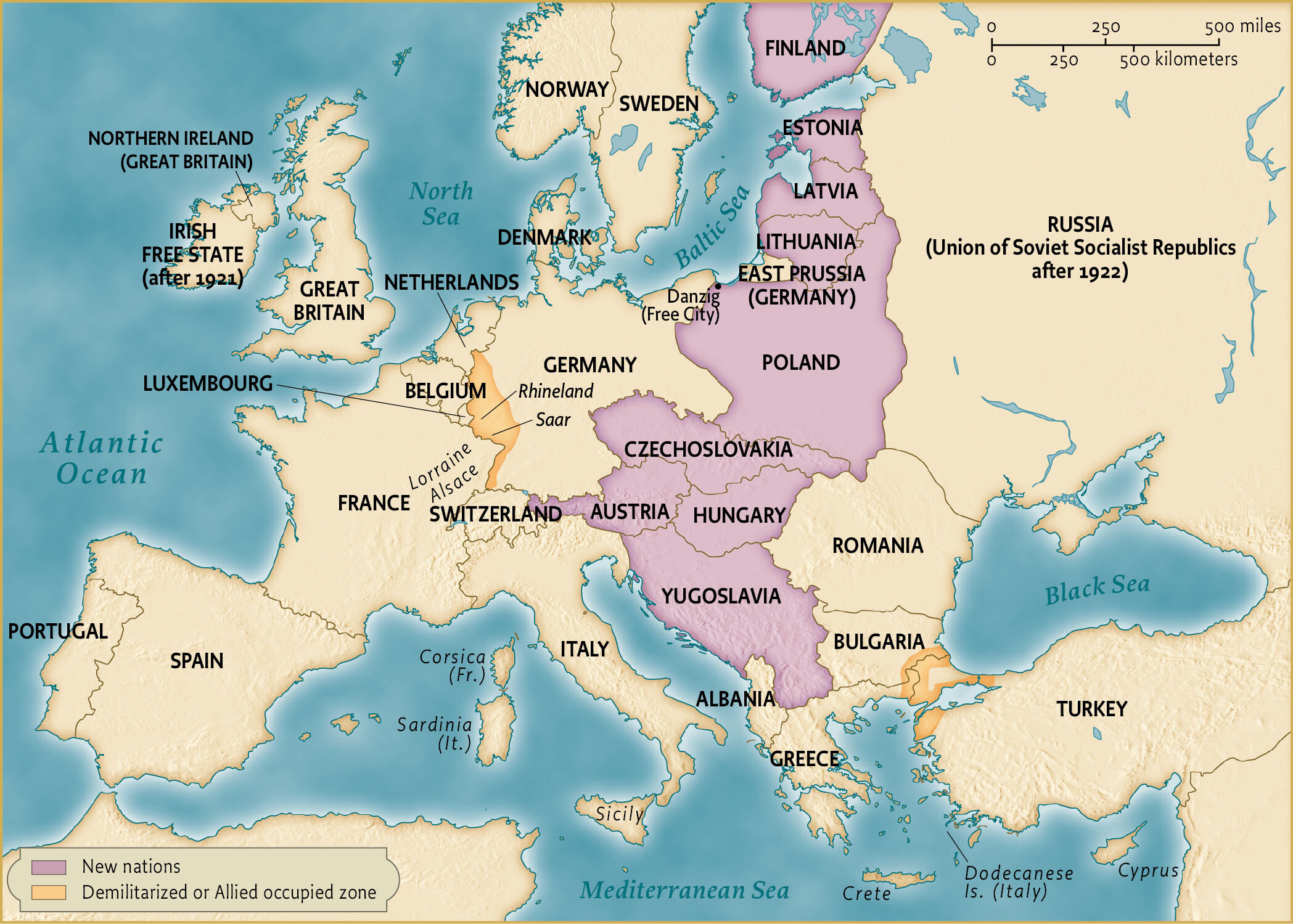
Although the Fourteen Points had called for “open covenants openly arrived at,” the negotiations were conducted in secret. The resulting Versailles Treaty did accomplish some of Wilson’s goals. It established the League of Nations, the body central to his vision of a new international order. It applied the principle of self-determination to Eastern Europe and redrew the map of that region. From the ruins of the Austro-Hungarian empire and parts of Germany and czarist Russia, new European nations emerged from the war—Finland, Poland, Czechoslovakia, Austria, Hungary, Latvia, Lithuania, Estonia, and Yugoslavia. Some enjoyed ethno-linguistic unity, whereas others comprised unstable combinations of diverse nationalities.
Despite Wilson’s pledge of a peace without territorial acquisitions or vengeance, the Versailles Treaty was a harsh document that all but guaranteed future conflict in Europe. Lloyd George persuaded Wilson to agree to a clause declaring Germany morally responsible for the war and setting astronomical reparations payments (they were variously estimated at between $33 billion and $56 billion), which crippled the German economy.
The Wilsonian Moment
Like the ideals of the American Revolution, the Wilsonian rhetoric of self-determination reverberated across the globe, especially among colonial peoples seeking independence. In fact, they took Wilson’s rhetoric more seriously than he did. Despite his belief in self-determination, he believed that colonial peoples required a long period of tutelage before they were ready for independence.
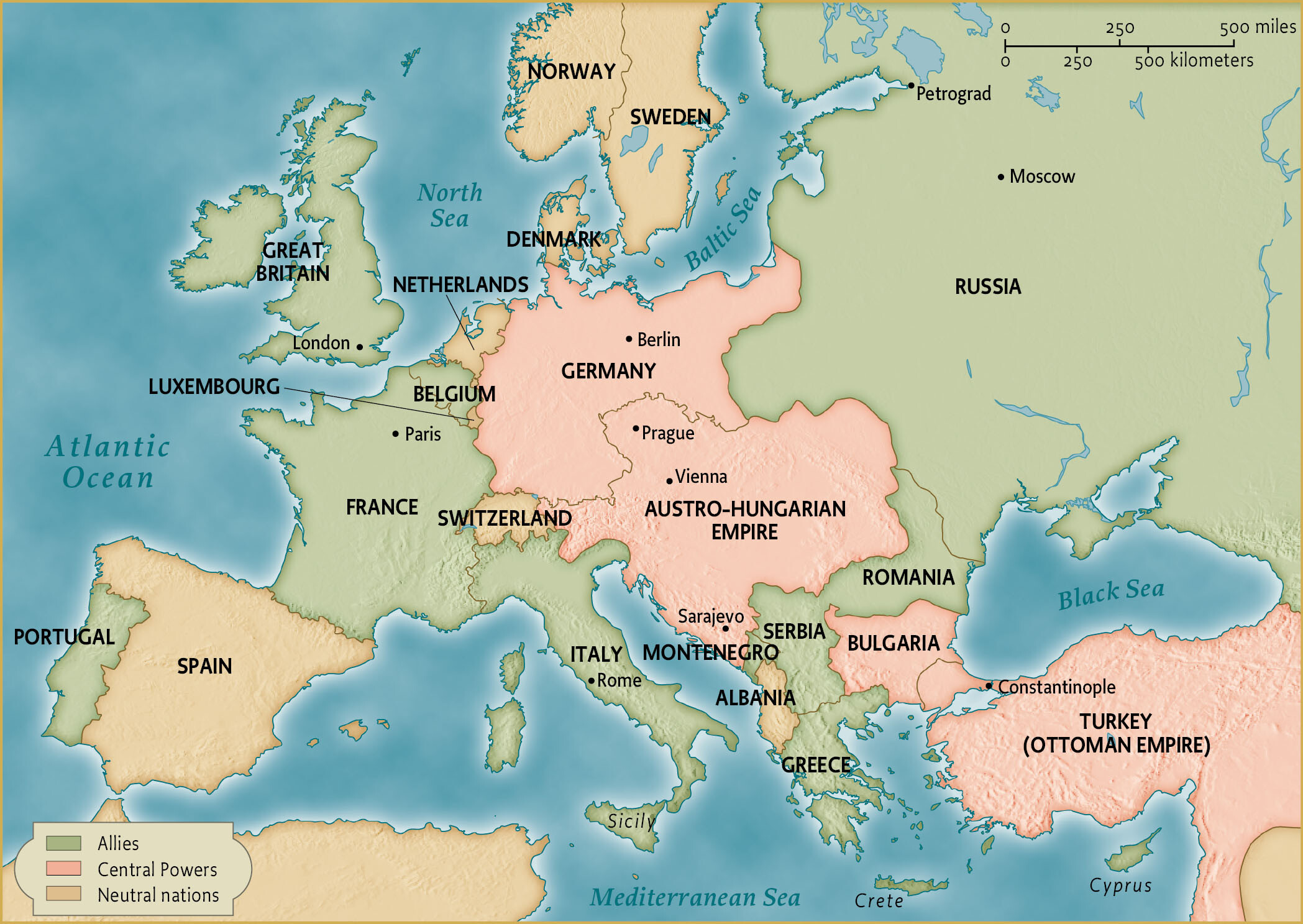
EUROPE IN 1914
More information
A map of the colonial possessions of countries around the world in 1900. The United States’ possessions included: the continental U.S., Alaska, Hawaii, Puerto Rico, and the Philippines. Belgian possessions included: Belgium and the Belgian Congo in central Africa. British possessions included: Canada, Great Britain, British Guiana in South America, British Honduras, the Union of South Africa, Rhodesia, Nigeria, Sierra Leone, the Gold Coast, Anglo-Egyptian Sudan, Egypt, Uganda, Oman, India, Burma, part of Papua New Guinea, Australia, and New Zealand. Danish possessions included: Denmark, Iceland, Liberia, and Greenland. Dutch possessions included: Holland, Dutch Guiana in South America, the Dutch East Indies and part of Papua New Guinea. French possessions included: France, French Guiana in South America, French Indochina, French West Africa, and French Equatorial Africa. German possessions included: Germany, Cameroon, German Southwest Africa, German East Africa, and part of the island of Papua New Guinea called Kaiser Wilhelmsland. Italian possessions included: Italy, Libya, Eritrea, and Italian Somaliland. Ottoman possessions included: the Ottoman Empire in present day Turkey and much of the Arabian Peninsula. Portuguese possessions include Portugal, Angola, and Mozambique. Russian possessions included: the Russian Empire, which covers most of Europe from Germany eastward and most of Asia to China in the south. Spanish possessions included: Spain and Rio de Oro which is just below Morocco.
World War I and the Versailles Treaty redrew the map of Europe and the Middle East. The Austro-Hungarian and Ottoman empires ceased to exist, and Germany and Russia were reduced in size. A group of new states emerged in eastern Europe, embodying the principle of self-determination, one of Woodrow Wilson’s Fourteen Points.
Nonetheless, Wilsonian ideals quickly spread around the globe. In Eastern Europe, whose people sought to carve new, independent nations from the ruins of the Austro-Hungarian and Ottoman empires, many considered Wilson a “popular saint.” The leading Arabic newspaper, Al-Ahram, published in Egypt, then under British rule, gave extensive coverage to Wilson’s speech asking Congress to declare war in the name of democracy, and to the Fourteen Points. In Beijing, students demanding that China free itself of foreign domination gathered at the American embassy shouting, “Long live Wilson.” Japan proposed to include in the charter of the new League of Nations a clause recognizing the equality of all people, regardless of race.
Outside of Europe, however, the idea of “self-determination” was stillborn. When the Paris peace conference opened, Secretary of State Robert Lansing warned that the phrase was “loaded with dynamite” and would “raise hopes which can never be realized.” As Lansing anticipated, advocates of colonial independence descended on Paris to lobby the peace negotiators. Arabs demanded that a unified independent state be carved from the old Ottoman empire in the Middle East. Nguyen That Thanh, a young Vietnamese patriot working in Paris, appealed unsuccessfully to Wilson to help bring an end to French rule in Vietnam. W. E. B. Du Bois organized a Pan-African Congress in Paris that put forward the idea of a self-governing nation to be carved out of Germany’s African colonies. Koreans, Indians, Irish, and others also pressed claims for self-determination.
EUROPE IN 1919
More information
An Allied victory in the Argonne Forest in France is marked on the map. Arrows indicate major offensives including the U.S. Somme offensive from August 19, 1918 to November 11, 1918 from southeast of Amiens, France, to southeast of Cambrai, France; the U.S. Meuse-Argonne offensive from September 1918 to November 1918 from east of Reims, France, to southeast of Sedan, France; the German Aisne-Marne offensive from July 18, 1918 to August 6, 1918 from southwest of Sedan, France, above the Aisne River to northwest of Reims, France; a German offensive from north of Soissons, France, to south of Amiens, France; the German Lys offensive from August 19, 1918 to November 11, 1918 from southeast of Ypres, Belgium, to south of Ypres along the Lys River. Highlights on the map show that the Allies controlled England, Belgium, and France; the Central Powers controlled Germany; and neutral nations were the Netherlands, Luxembourg, and Switzerland. A line labeled “Armistice Line November 11, 1918” on the map runs from north of Ghent, Belgium, along the Belgium border, near Sedan, France, and along the German-French border to just south of Belfort, France. A line showing the stabilized front runs south from Nieuport, Belgium, to Arras, France, down to north of Reims, France, close to the border of France and Germany, and down to just south of Belfort, France. A line showing the maximum advance of the Central Powers in 1918 runs south from just north of Ypres, Belgium, to Arras, France, down to near Amiens, France, over to near Soissons, France, and slightly northeast to just above Reims, France.
The British and French, however, had no intention of applying this principle to their own empires. During the war, the British had encouraged Arab nationalism as a weapon against the Ottoman empire and had also pledged to create a homeland in Palestine for the persecuted Jews of Europe. In fact, the victors of World War I divided Ottoman territory into a series of new territories, including Syria, Lebanon, Iraq, and Palestine, controlled by the victorious Allies under League of Nations “mandates.” South Africa, Australia, and Japan acquired former German colonies in Africa and Asia. Nor did Ireland achieve its independence at Versailles. Only at the end of 1921 did Britain finally agree to the creation of the Irish Free State while continuing to rule the northeastern corner of the island. As for the Japanese proposal to establish the principle of racial equality, Wilson, with the support of Great Britain and Australia, engineered its defeat.
The Seeds of Wars to Come
Disappointment at the failure to apply the Fourteen Points to the non-European world created a pervasive cynicism about Western use of the language of freedom and democracy. Wilson’s apparent willingness to accede to the demands of the imperial powers helped to spark a series of popular protest movements across the Middle East and Asia and the rise of a new anti-Western nationalism. Some leaders, like Nguyen That Thanh, who took the name Ho Chi Minh, turned to communism, in whose name he would lead Vietnam’s long and bloody struggle for independence. With the collapse of the Wilsonian moment, Lenin’s reputation in the colonial world began to eclipse that of the American president. But whether communist or not, these movements announced the emergence of anticolonial nationalism as a major force in world affairs, which it would remain for the rest of the twentieth century.
More information
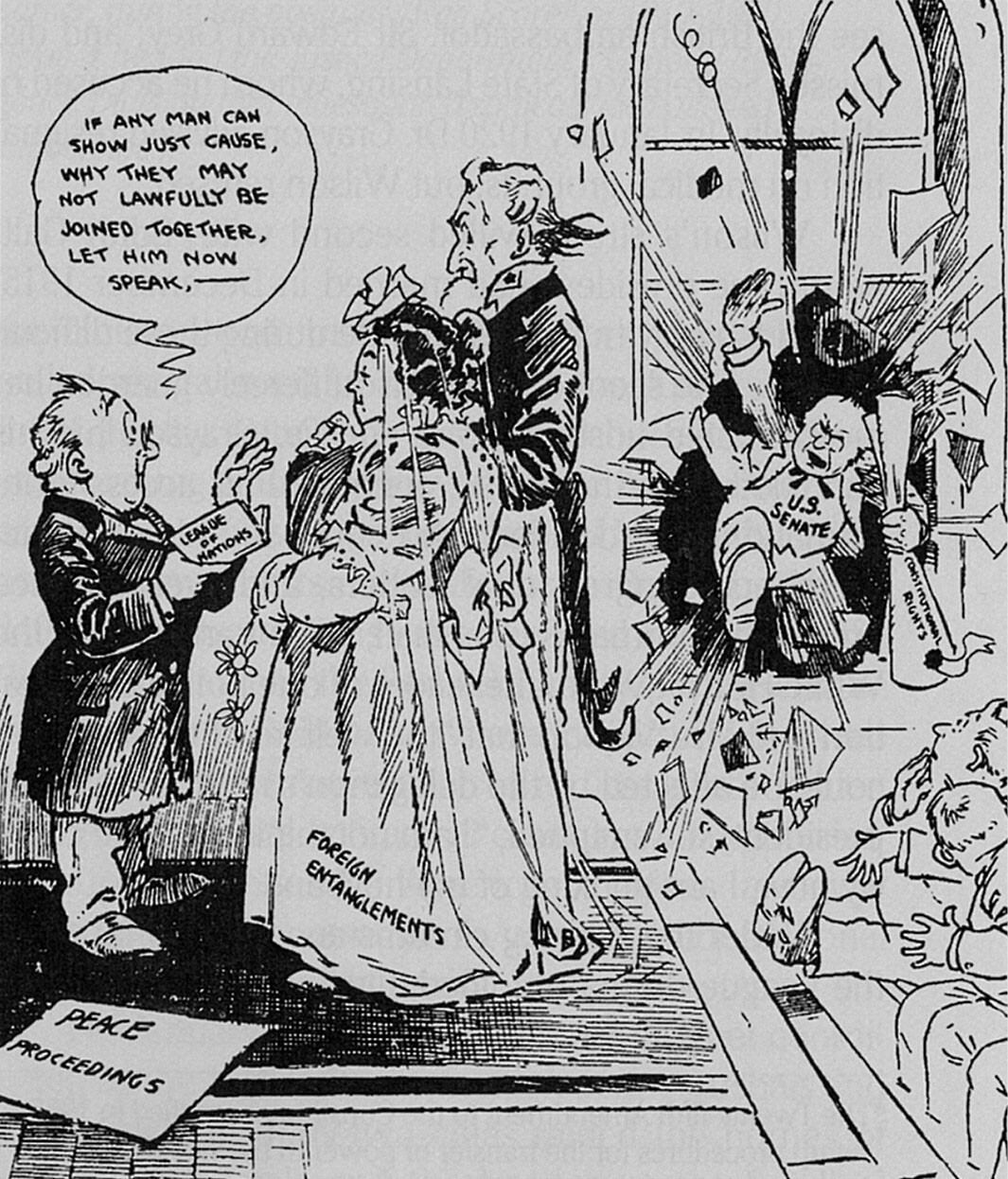
“Interrupting the Ceremony, a 1918 cartoon from the Chicago Tribune, depicts Senate opponents of the Versailles Treaty arriving just in time to prevent the United States from becoming permanently ensnared in “foreign entanglements” through the League of Nations.”
Interrupting the Ceremony, a 1918 cartoon from the Chicago Tribune, depicts Senate opponents of the Versailles Treaty arriving just in time to prevent the United States from becoming permanently ensnared in “foreign entanglements” through the League of Nations.
“Your liberalness,” one Egyptian leader remarked, speaking of Britain and America, “is only for yourselves.” Yet ironically, when colonial peoples demanded to be recognized as independent members of the international community, they would invoke the heritage of the American Revolution—the first colonial struggle that produced an independent nation.
World War I sowed the seeds not of a lasting peace but of wars to come. German resentment over the peace terms would help to fuel the rise of Adolf Hitler and the coming of World War II. In the breakup of Czechoslovakia and Yugoslavia, violence over the status of Northern Ireland, and seemingly unending conflicts in the Middle East, the world of the late twentieth century was still haunted by the ghost of Versailles.
The Treaty Debate
World War I: Treaty of Versailles' Continued Harm
One final disappointment awaited Wilson on his return from Europe. He viewed the new League of Nations as the war’s finest legacy. But many Americans feared that membership would commit the United States to an open-ended involvement in the affairs of other countries.
A considerable majority of senators would have accepted the treaty with “reservations” ensuring that the obligation to assist League members against attack did not supersede the power of Congress to declare war. Convinced, however, that the treaty reflected “the hand of God,” Wilson refused to negotiate with congressional leaders. In October 1919, in the midst of the League debate, Wilson suffered a serious stroke. Although the extent of his illness was kept secret, he remained incapacitated for the rest of his presidency. In effect, his wife, Edith, headed the government for the next seventeen months. In November 1919 and again in March 1920, the Senate rejected the Versailles Treaty.
American involvement in World War I lasted barely nineteen months, but it cast a long shadow over the following decade—and, indeed, the rest of the century. In its immediate aftermath, the country retreated from international involvements. But in the long run, Wilson’s combination of idealism and power politics had an enduring impact. His appeals to democracy, open markets, and a special American mission to instruct the world in freedom, coupled with a willingness to intervene abroad militarily to promote American interests and values, would create the model for twentieth-century American international relations.
On its own terms, the war to make the world safe for democracy failed. It also led to the eclipse of Progressivism. Republican candidate Warren G. Harding, who had no connection with the party’s Progressive wing, swept to victory in the presidential election of 1920. Harding’s campaign centered on a “return to normalcy” and a repudiation of what he called “Wilsonism.” He received 60 percent of the popular vote. Begun with idealistic goals and grand hopes for social change, American involvement in the Great War laid the foundation for one of the most conservative decades in the nation’s history.
Glossary
- Red Scare of 1919–1920
- Fear among many Americans after World War I of Communists in particular and noncitizens in general, a reaction to the Russian Revolution, mail bombs, strikes, and riots.
- Versailles Treaty
- The treaty signed at the Versailles peace conference after World War I, which established President Woodrow Wilson’s vision of an international regulating body, redrew parts of Europe and the Middle East, and assigned economically crippling war reparations to Germany but failed to incorporate all of Wilson’s Fourteen Points.
- League of Nations
- Organization of nations to mediate disputes and avoid war, established after World War I as part of the Treaty of Versailles; President Woodrow Wilson’s “Fourteen Points” speech to Congress in 1918 proposed the formation of the league, which the United States never joined.