AMERICA AND THE GREAT WAR
In June 1914, a Serbian nationalist assassinated Archduke Franz Ferdinand, heir to the throne of the Austro-Hungarian empire, in Sarajevo. (Today, Sarajevo is the capital of Bosnia and Herzegovina.) This deed set in motion a chain of events that plunged Europe into the most devastating war the world had ever seen. In the years before 1914, European nations had engaged in a scramble to obtain colonial possessions overseas and had constructed a shifting series of alliances seeking military domination within Europe. In the aftermath of the assassination, Austria-Hungary, the major power in Eastern Europe, declared war on Serbia. Within a little more than a month, because of the European powers’ interlocking military alliances, Britain, France, Russia, and Japan (the Allies) found themselves at war with the Central Powers—Germany, Austria-Hungary, and the Ottoman empire, whose holdings included modern-day Turkey and much of the Middle East.
German forces quickly overran Belgium and part of northern France. The war then settled into a prolonged stalemate, with bloody, indecisive battles succeeding one another. New military technologies—submarines, airplanes, machine guns, tanks, and poison gas—produced unprecedented slaughter. In one five-month battle at Verdun, in 1916, 600,000 French and German soldiers died—nearly as many deaths as in the entire American Civil War. By the time the war ended, an estimated 10 million soldiers, and uncounted millions of civilians, had perished.
The Great War, or World War I as it came to be called, dealt a severe blow to the optimism and self-confidence of Western civilization. For decades, philosophers, reformers, and politicians had hailed the triumph of reason and human progress. Despite increasingly bitter rivalries between European powers, especially Germany and Britain, as they competed for political and military dominance at home and carved up Asia and Africa into rival empires, mankind seemed to have moved beyond the time when disputes were settled by war. The conflict was also a shock to European socialist and labor movements. Of the two great ideologies that had arisen in the nineteenth century, nationalism and socialism, the former proved more powerful. Karl Marx had called on the “workers of the world” to unite against their oppressors. Instead, they marched off to kill each other.
Neutrality and Preparedness
As war engulfed Europe, Americans found themselves sharply divided. British Americans sided with their nation of origin, as did many other Americans who associated Great Britain with liberty and democracy and Germany with repressive government. On the other hand, German Americans identified with Germany. Irish Americans bitterly opposed any aid to the British, a sentiment reinforced in 1916 when authorities in London suppressed the Easter Rebellion, an uprising demanding Irish independence, and executed several of its leaders. Immigrants from the Russian empire, especially Jews, had no desire to see the United States aid the czar’s regime. Indeed, the presence of Russia, the world’s largest despotic state, as an ally of Britain and France made it difficult to see the war as a clear-cut battle between democracy and autocracy. Many feminists, pacifists, and social reformers, moreover, had become convinced that peace was essential to further efforts to enhance social justice at home. They lobbied vigorously against American involvement. So did large numbers of religious leaders, who viewed war as a barbaric throwback to a less Christian era.
When war broke out in 1914, President Wilson proclaimed American neutrality. But as in the years preceding the War of 1812, naval warfare in Europe reverberated in the United States. Britain declared a naval blockade of Germany and began to stop American merchant vessels. Germany launched submarine warfare against ships entering and leaving British ports. In May 1915, a German submarine sank the British liner Lusitania (which was carrying a large cache of arms) off the coast of Ireland, causing the death of 1,198 passengers, including 124 Americans. Wilson composed a note of protest so strong that Bryan resigned as secretary of state, fearing that the president was laying the foundation for military intervention. Bryan had advocated warning Americans not to travel on the ships of belligerents, but Wilson felt this would represent a retreat from the principle of freedom of the seas.
The sinking of the Lusitania outraged American public opinion and strengthened the hand of those who believed that the United States must prepare for possible entry into the war. These included longtime advocates of a stronger military establishment, like Theodore Roosevelt, and businessmen with close economic ties to Britain, the country’s leading trading partner and the recipient of more than $2 billion in wartime loans from American banks. Wilson himself had strong pro-British sympathies and viewed Germany as “the natural foe of liberty.” By the end of 1915, he had embarked on a policy of “preparedness”—a crash program to expand the American army and navy.
The Road to War
In May 1916, Germany announced the suspension of submarine warfare against noncombatants. Wilson’s preparedness program seemed to have succeeded in securing the right of Americans to travel freely on the high seas without committing American forces to the conflict. “He kept us out of war” became the slogan of his campaign for reelection. With the Republican Party reunited after its split in 1912, the election proved to be one of the closest in American history. Wilson defeated Republican candidate Charles Evans Hughes by only twenty-three electoral votes and about 600,000 popular votes out of more than 18 million cast. Partly because he seemed to promise not to send American soldiers to Europe, Wilson carried ten of the twelve states that had adopted woman suffrage. Without the votes of women, Wilson would not have been reelected.
On January 22, 1917, Wilson called for a “peace without victory” in Europe and outlined his vision for a world order including freedom of the seas, restrictions on armaments, and self-determination for nations great and small. Almost immediately, however, Germany announced its intention to resume submarine warfare against ships sailing to or from the British Isles, and several American merchant vessels were sunk. The German government realized that its actions would probably lead Wilson to intervene, but German strategists gambled that the blockade would strangle Britain economically before the arrival of American troops.
In March 1917, British spies intercepted and made public the Zimmermann Telegram, a message by German foreign secretary Arthur Zimmermann calling on Mexico to join in a coming war against the United States and promising to help it recover territory lost in the Mexican-American War of 1846–1848. A revolution in Russia that same month overthrew the czar and established a constitutional government, making it more plausible to believe that the United States would be fighting on the side of democracy. On April 2, Wilson went before Congress to ask for a declaration of war against Germany. “The world,” he proclaimed, “must be made safe for democracy. Its peace must be planted upon the tested foundation of political liberty.” The war resolution passed the Senate 82–6 and the House 373–50.
The Fourteen Points
Not until the spring of 1918 did American forces arrive in Europe in large numbers. By then, the world situation had taken a dramatic turn. In November 1917, a communist revolution headed by Vladimir Lenin overthrew the Russian government that had come to power the previous spring. Shortly thereafter, Lenin withdrew Russia from the war and published the secret treaties by which the Allies had agreed to divide up conquered territory after the war—an embarrassment for Wilson, who had promised a just peace.
Partly to assure the country that the war was being fought for a moral cause, Wilson in January 1918 issued the Fourteen Points, the clearest statement of American war aims and of his vision of a new international order. Among the key principles were self-determination for all peoples, freedom of the seas, free trade, open diplomacy (an end to secret treaties), the readjustment of colonial claims with colonized people given “equal weight” in deciding their futures, and the creation of a “general association of nations” to preserve the peace. Wilson envisioned this last provision, which led to the establishment after the war of the League of Nations, as a kind of global counterpart to the regulatory commissions Progressives had created at home to maintain social harmony and prevent the powerful from exploiting the weak. Although purely an American program, not endorsed by the other Allies, the Fourteen Points established the agenda for the peace conference that followed the war.
WORLD WAR I: THE WESTERN FRONT
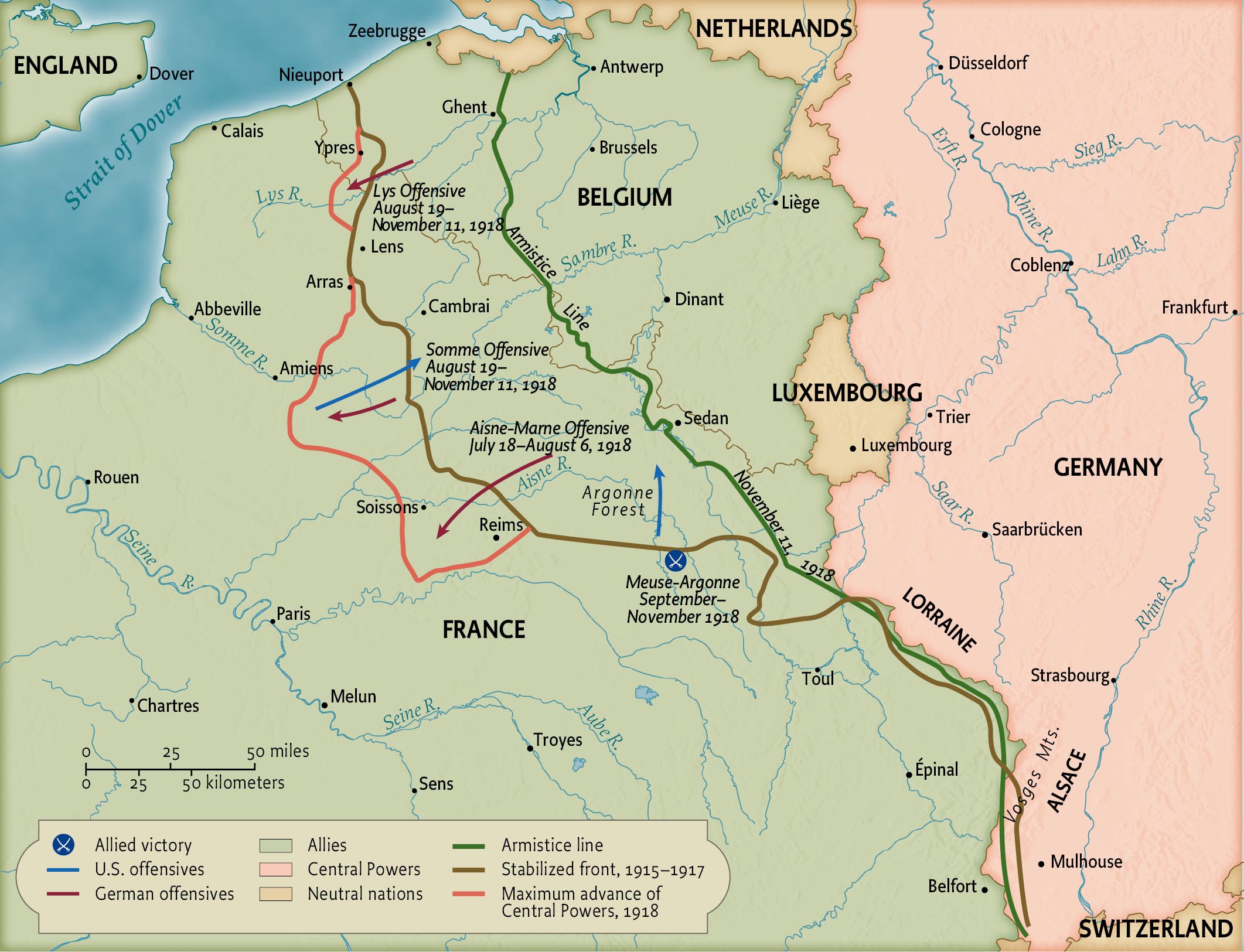
The United States threw its economic resources and manpower into the war. When American troops finally arrived in Europe, they turned the tide of battle. In the spring of 1918, they helped to repulse a German advance near Paris and by July were participating in a major Allied counteroffensive. In September, in the Meuse-Argonne campaign, American soldiers under the command of General John J. Pershing, fresh from his campaigns in Mexico, helped to push back the German army. With 1.2 million American soldiers taking part and well over 100,000 dead and wounded, Meuse-Argonne, which lasted a month and a half, was the main American engagement of the war and one of the most significant and deadliest battles in American history. It formed part of a massive Allied offensive involving British, French, and Belgian soldiers and those from overseas European possessions. With his forces in full retreat, the German kaiser abdicated on November 9. Two days later, Germany sued for peace. More than 100,000 Americans had died, a substantial number, but they were only 1 percent of the 10 million soldiers killed in the Great War.
Glossary
- Zimmermann Telegram
- Telegram from the German foreign secretary to the German minister in Mexico, February 1917, instructing the minister to offer to recover Texas, New Mexico, and Arizona for Mexico if it would fight the United States to divert attention from Germany in the event that the United States joined the war.
- Fourteen Points
- President Woodrow Wilson’s 1918 plan for peace after World War I; at the Versailles peace conference, however, he failed to incorporate all of the points into the treaty.
- Lusitania
- British passenger liner sunk by a German U-boat, May 7, 1915, creating a diplomatic crisis and public outrage at the loss of 128 Americans (roughly 10 percent of the total aboard); Germany agreed to pay reparations, and the United States waited two more years to enter World War I.