 World War I: Effects on Civil Liberty
THE WAR AT HOME
The Forgotten Pandemic
Millions died in combat during World War 1, but even more—between 20 to 40 million—were killed during the 1918–1919 flu pandemic. A mild first wave in the spring of 1918 was followed by a more virulent second wave that spread like wildfire around the globe. The pandemic reached catastrophic proportions in the United States by the fall of 1918. The disease, which hit young adults especially hard, killed 675,000 Americans within a few months.
Wartime mobilization contributed to rapid virus spread with servicemen crossing the ocean on crowded ships and living in packed military camps and trenches. In Philadelphia, a liberty loan parade escalated case numbers, and the city soon became the hardest hit municipality in the country. On the West Coast, San Francisco closed schools, churches, and public amusements and passed a mandatory mask ordinance to stem the rising tide of cases. Such mandates, as with the Covid-19 pandemic a century later, sparked opposition. An Anti-Mask League criticized the efficacy of mask wearing and decried the ordinance as a violation of personal liberty. With numbers falling by the spring of 1919, concerns turned to wartime demobilization, labor upheaval, and the Red Scare. Despite the devastating loss of life, the pandemic was largely forgotten.
The Progressives’ War
Looking at American participation in the European conflict, literary critic Randolph Bourne saw the expansion of government power as a danger. Most Progressives, however, viewed it as a golden opportunity. To them, the war offered the possibility of reforming American society along scientific lines, instilling a sense of national unity and self-sacrifice, and expanding social justice. That American power could now disseminate Progressive values around the globe heightened the war’s appeal.
Almost without exception, Progressive intellectuals and reformers, joined by prominent labor leaders and native-born socialists, rallied to Wilson’s support. The roster included intellectuals like John Dewey, journalists such as Walter Lippmann and Herbert Croly, AFL head Samuel Gompers, socialist writers like Upton Sinclair, and prominent reformers including Florence Kelley and Charlotte Perkins Gilman. In The New Republic, Dewey urged Progressives to recognize the “social possibilities of war.” The crisis, he wrote, offered the prospect of attacking the “immense inequality of power” within the United States, thus laying the foundation for Americans to enjoy “effective freedom.”
The Wartime State
Like the Civil War, World War I created, albeit temporarily, a national state with unprecedented powers and a sharply increased presence in Americans’ everyday lives. Under the Selective Service Act of May 1917, 24 million men were required to register with the draft, and the army soon swelled from 120,000 to 5 million men. The war seemed to bring into being the New Nationalist state Theodore Roosevelt and so many Progressives had desired. New federal agencies moved to regulate industry, transportation, labor relations, and agriculture. Headed by Wall Street financier Bernard Baruch, the War Industries Board presided over all elements of war production from the distribution of raw materials to the prices of manufactured goods. To spur efficiency, it established standardized specifications for everything from automobile tires to shoe colors (three were permitted—Black, brown, and white). The Railroad Administration took control of the nation’s transportation system, and the Fuel Agency rationed coal and oil. The Food Administration instructed farmers on modern methods of cultivation and promoted the more efficient preparation of meals. Its director, Herbert Hoover, mobilized the shipment of American food to the war-devastated Allies, popularizing the slogan “Food will win the war.”
These agencies generally saw themselves as partners of business as much as regulators. They guaranteed government suppliers a high rate of profit and encouraged cooperation among former business rivals by suspending antitrust laws. At the same time, however, the War Labor Board, which included representatives of government, industry, and the American Federation of Labor, pressed for the establishment of a minimum wage, eight-hour workday, and the right to form unions. During the war, wages rose substantially, working conditions in many industries improved, and union membership doubled. To finance the war, corporate and individual income taxes rose enormously. By 1918, the wealthiest Americans were paying 60 percent of their income in taxes. Tens of millions of Americans answered the call to demonstrate their patriotism by purchasing Liberty bonds. Once peace arrived, the wartime state quickly withered away. But for a time, the federal government seemed well on its way to fulfilling the Progressive vision of promoting economic rationalization, industrial justice, and a sense of common national purpose.
The Propaganda War
During the Civil War, it had been left to private agencies—Union Leagues, the Loyal Publication Society, and others—to mobilize prowar public opinion. But the Wilson administration decided that patriotism was too important to leave to the private sector. Many Americans were skeptical about whether democratic America should enter a struggle between rival empires. Some vehemently opposed American participation, notably the Industrial Workers of the World (IWW) and the bulk of the Socialist Party, which in 1917 condemned the declaration of war as “a crime against the people of the United States” and called on “the workers of all countries” to refuse to fight. As the major national organization to oppose Wilson’s policy, the Socialist Party became a rallying point for antiwar sentiment. In mayoral elections across the country in the fall of 1917, the Socialist vote averaged 20 percent, far above the party’s previous total.
In April 1917, the Wilson administration created the Committee on Public Information (CPI) to explain to Americans and the world, as its director, George Creel, put it, “the cause that compelled America to take arms in defense of its liberties and free institutions.” Enlisting academics, journalists, artists, and advertising men, the CPI flooded the country with prowar propaganda, using every available medium from pamphlets (of which it issued 75 million) to posters, newspaper advertisements, and motion pictures. It trained and dispatched across the country 75,000 Four-Minute Men, who delivered brief standardized talks (sometimes in Italian, Yiddish, and other immigrant languages) to audiences in movie theaters, schools, and other public venues.
Never before had an agency of the federal government attempted the “conscious and intelligent manipulation of the organized habits and opinions of the masses,” in the words of young Edward Bernays, a member of Creel’s staff who would later create the modern profession of public relations. The CPI’s activities proved, one adman wrote, that it was possible to “sway the ideas of whole populations, change their habits of life, create belief, practically universal in any policy or idea.” In the 1920s, advertisers would use what they had learned to sell goods. But the CPI also set a precedent for governmental efforts to shape public opinion in later international conflicts, from World War II to the Cold War and Iraq.
“The Great Cause of Freedom”
The CPI couched its appeal in the Progressive language of social cooperation and expanded democracy. Abroad, this meant a peace based on the principle of national self-determination. At home, it meant improving “industrial democracy.” A Progressive journalist, Creel believed the war would accelerate the movement toward solving the “age-old problems of poverty, inequality, oppression, and unhappiness.” He took to heart a warning from historian Carl Becker that a simple contrast between German tyranny and American democracy would not seem plausible to the average worker: “You talk to him of our ideals of liberty and he thinks of the shameless exploitation of labor and of the ridiculous gulf between wealth and poverty.” CPI pamphlets foresaw a postwar society complete with a “universal eight-hour day” and a living wage for all.
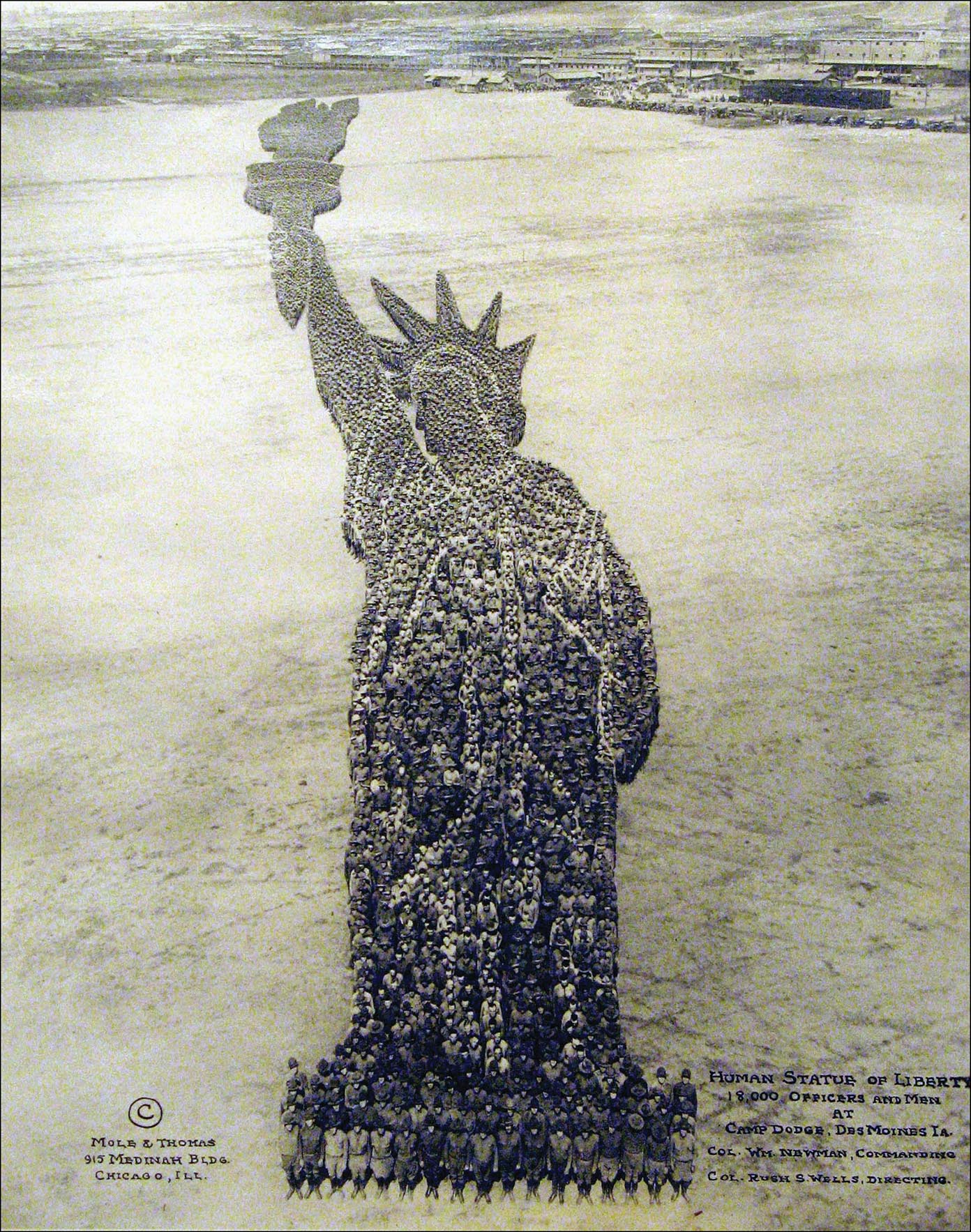
While “democracy” served as the key term of wartime mobilization, “freedom” also took on new significance. The war, a CPI advertisement proclaimed, was being fought in “the great cause of freedom.” Thousands of persons, often draftees, were enlisted to pose in giant human tableaus representing symbols of liberty. One living representation of the Liberty Bell at Fort Dix, New Jersey, included 25,000 people. The most common visual image in wartime propaganda was the Statue of Liberty, employed especially to rally support among immigrants. “You came here seeking Freedom,” stated a caption on one Statue of Liberty poster. “You must now help preserve it.” Buying Liberty bonds became a demonstration of patriotism. Wilson’s speeches cast the United States as a land of liberty fighting alongside a “concert of free people” to secure self-determination for the oppressed peoples of the world. The idea of freedom, it seems, requires an antithesis, and the CPI found one in the German kaiser and, more generally, the German nation and people. Government propaganda whipped up hatred of the wartime foe by portraying it as a nation of barbaric Huns.
The Coming of Woman Suffrage
The enlistment of “democracy” and “freedom” as ideological war weapons inevitably inspired demands for their expansion at home. In 1916, Wilson had cautiously endorsed votes for women. America’s entry into the war threatened to tear the suffrage movement apart, since many advocates had been associated with opposition to American involvement. Indeed, among those who voted against the declaration of war was the first woman member of Congress, the staunch pacifist Jeannette Rankin of Montana. “I want to stand by my country, but I cannot vote for war,” she said. Although defeated in her reelection bid in 1918, Rankin would return to Congress in 1940. She became the only member to oppose the declaration of war against Japan in 1941, which ended her political career. In 1968, at the age of eighty-five, Rankin took part in a giant march on Washington to protest the war in Vietnam.
As during the Civil War, however, most leaders of woman suffrage organizations enthusiastically enlisted in the effort. Women sold war bonds, organized patriotic rallies, and went to work in war production jobs. Some 22,000 served as clerical workers and nurses with American forces in Europe. Many believed wartime service would earn them equal rights at home.
At the same time, a new generation of college-educated activists, organized in the National Woman’s Party, pressed for the right to vote with militant tactics many older suffrage advocates found scandalous. The party’s leader, Alice Paul, had studied in England between 1907 and 1910 when the British suffrage movement adopted a strategy that included arrests, imprisonments, and vigorous denunciations of a male-dominated political system. How could the country fight for democracy abroad, Paul asked, while denying it to women at home? She compared Wilson to the kaiser, and a group of her followers chained themselves to the White House fence, resulting in a seven-month prison sentence. When they began a hunger strike, the prisoners were force-fed.
The combination of women’s patriotic service and widespread outrage over the mistreatment of Paul and her fellow prisoners pushed the administration toward full-fledged support for woman suffrage. “We have made partners of the women in this war,” Wilson proclaimed. “Shall we admit them only to a partnership of suffering and sacrifice and toil and not to a partnership of privilege and right?” In 1920, the long struggle culminated in the ratification of the Nineteenth Amendment barring states from using sex as a qualification for the suffrage. The United States became the twenty-seventh country to allow women to vote.
The Nineteenth Amendment was cause for celebration, but it did not provide all women the vote. It left states free to limit voting by poll taxes and literacy clauses. Voting rights activists, such as Hallie Quinn Brown, president of the National Association of Colored Women, called upon the National Women’s Party to back legislation securing the franchise for all women, but the organization rejected the proposal, declaring its work finished. In North Carolina, the Colored Women’s Rights Association mobilized to ensure “all women the right of the ballot regardless of color.” Concerned about such actions, state lawmakers in the South tightened voting laws further. Mississippi extended poll taxes to women that had been applied to men to prevent Black women from voting.
Prohibition
The war gave a powerful impulse to other campaigns that had engaged the energies of many women in the Progressive era. Ironically, efforts to stamp out prostitution and protect soldiers from venereal disease led the government to distribute birth-control information and devices—the very action for which Margaret Sanger had recently been jailed, as noted in the previous chapter.
Prohibition, a movement inherited from the nineteenth century that had gained new strength and militancy in Progressive America, finally achieved national success during the war. Numerous impulses flowed into the renewed campaign to ban intoxicating liquor. Employers hoped it would create a more disciplined labor force. Urban reformers believed that it would promote a more orderly city environment and undermine urban political machines that used saloons as places to organize. Women reformers hoped Prohibition would protect wives and children from husbands who engaged in domestic violence when drunk or who squandered their wages at saloons. Many native-born Protestants saw Prohibition as a way of imposing “American” values on immigrants.
PROHIBITION, 1915: COUNTIES AND STATES THAT BANNED LIQUOR BEFORE THE EIGHTEENTH AMENDMENT (RATIFIED 1919, REPEALED 1933)
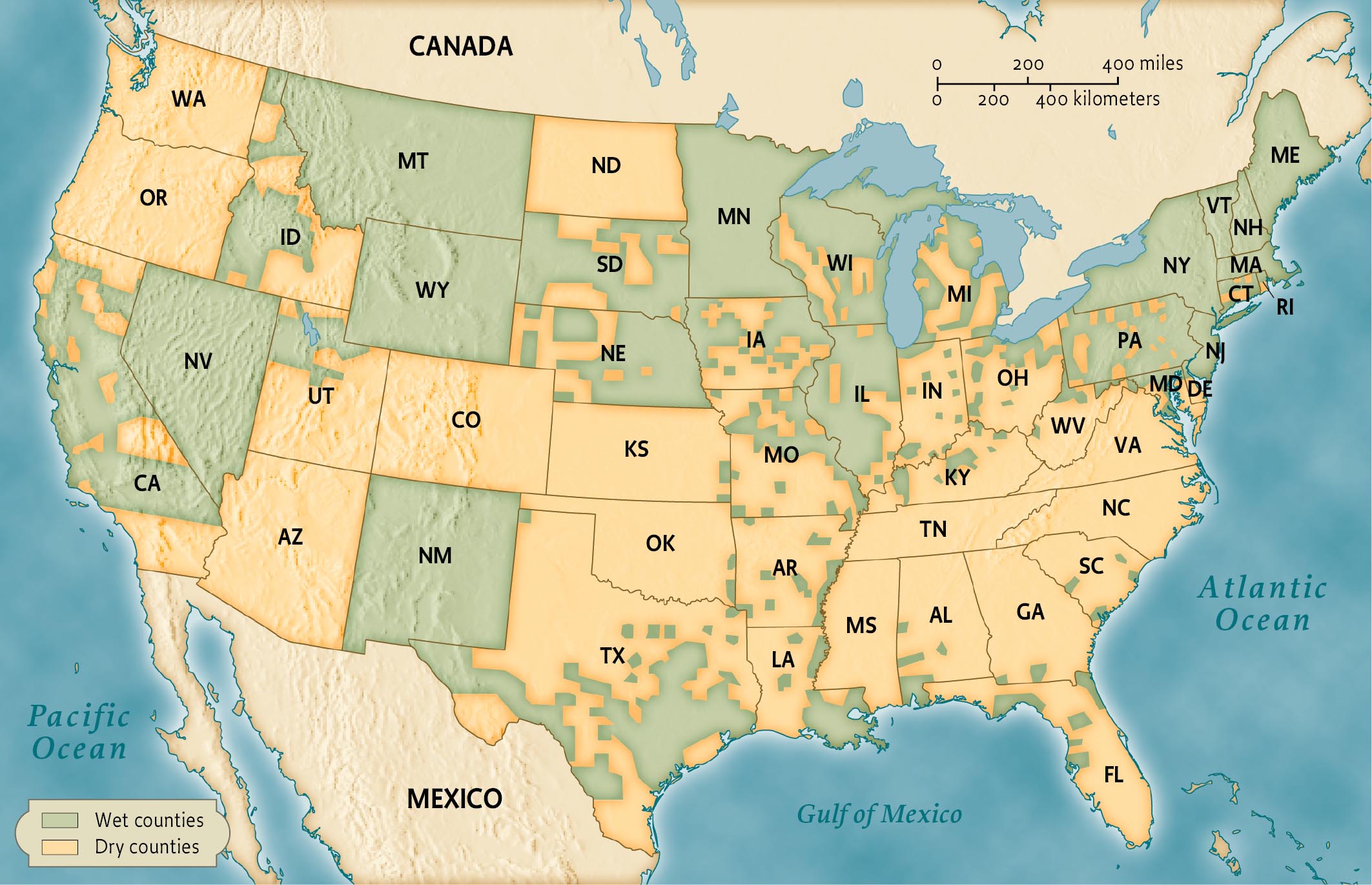
Like the suffrage movement, Prohibitionists first concentrated on state campaigns. By 1915, they had won victories in eighteen southern and midwestern states where the immigrant population was small and Protestant denominations like Baptists and Methodists strongly opposed drinking. But like the suffrage movement, Prohibitionists came to see national legislation as their best strategy. The war gave them added ammunition. Many prominent breweries were owned by German Americans, making beer seem unpatriotic. The Food Administration insisted that grain must be used to produce food, not distilled into beer and liquor. By December 1917, Congress had passed the Eighteenth Amendment, prohibiting the manufacture and sale of intoxicating liquor. It was ratified by the states in 1919 and went into effect at the beginning of 1920.
Liberty in Wartime
World War I raised questions already glimpsed during the Civil War that would trouble the nation again during the McCarthy era and in the aftermath of the terrorist attacks of 2001: What is the balance between security and freedom? Does the Constitution protect citizens’ rights during wartime? Should dissent be equated with lack of patriotism? The conflict demonstrated that during a war, traditional civil liberties are likely to come under severe pressure.
In 1917, Randolph Bourne ridiculed Progressives who believed they could mold the war according to their own “liberal purposes.” The conflict, he predicted, would empower not reformers but the “least democratic forces in American life.” The accuracy of Bourne’s prediction soon became apparent. Despite the administration’s idealistic language of democracy and freedom, the war inaugurated the most intense repression of civil liberties the nation has ever known. Perhaps the very nobility of wartime rhetoric contributed to the massive suppression of dissent. For in the eyes of Wilson and many of his supporters, America’s goals were so virtuous that disagreement could only reflect treason to the country’s values.
The Espionage and Sedition Acts
World War I: Contradictions in American History
For the first time since the Alien and Sedition Acts of 1798, the federal government enacted laws to restrict freedom of speech. The Espionage Act of 1917 prohibited not only spying and interfering with the draft but also “false statements” that might impede military success. The postmaster general barred from the mails numerous newspapers and magazines critical of the administration. The victims ranged from virtually the entire socialist press and many foreign-language publications to The Jeffersonian, a newspaper owned by ex-Populist leader Tom Watson, which criticized the draft as a violation of states’ rights. In 1918, the Sedition Act made it a crime to make spoken or printed statements that intended to cast “contempt, scorn, or disrepute” on the “form of government,” or that advocated interference with the war effort. The government charged more than 2,000 persons with violating these laws. Over half were convicted. A court sentenced Ohio farmer John White to twenty-one months in prison for saying that the murder of innocent women and children by German soldiers was no worse than what the United States had done in the Philippines in the war of 1899–1903.
The most prominent victim was Eugene V. Debs, convicted in 1918 under the Espionage Act for delivering an antiwar speech. Before his sentencing, Debs gave the court a lesson in the history of American freedom, tracing the tradition of dissent from Thomas Paine to the abolitionists and pointing out that the nation had never engaged in a war without internal opposition. Germany sent socialist leader Karl Liebknecht to prison for four years for opposing the war; in the United States, Debs’s sentence was ten years. After the war’s end, Wilson rejected the advice of his attorney general that he commute Debs’s sentence. Debs ran for president while still in prison in 1920 and received 900,000 votes. It was left to Wilson’s successor, Warren G. Harding, to release Debs from prison in 1921.
Coercive Patriotism
Even more extreme repression took place at the hands of state governments and private groups. Americans had long displayed the flag (and used it in advertisements for everything from tobacco products to variety shows). But during World War I, attitudes toward the American flag became a test of patriotism. Persons suspected of disloyalty were forced to kiss the flag in public; those who made statements critical of the flag could be imprisoned. During the war, thirty-three states outlawed the possession or display of red or black flags (symbols, respectively, of communism and anarchism), and twenty-three outlawed a newly created offense, “criminal syndicalism,” the advocacy of unlawful acts to accomplish political change or “a change in industrial ownership.”
“Who is the real patriot?” Emma Goldman asked while on trial for conspiring to violate the Selective Service Act. She answered, those who “love America with open eyes,” who were not blind to “the wrongs committed in the name of patriotism.” But from the federal government to local authorities and private groups, patriotism came to be equated with support for the government, the war, and the American economic system, while antiwar sentiment, labor radicalism, and sympathy for the Russian Revolution became “un-American.” Local authorities formally investigated residents who failed to subscribe to Liberty Loans. Throughout the country, schools revised their course offerings to ensure their patriotism and required teachers to sign loyalty oaths.
VOICES OF FREEDOM
OLIVER WENDELL HOLMES, MAJORITY OPINION, SCHENCK V. UNITED STATES (1919)
Oliver Wendell Holmes delivered the Supreme Court’s majority opinion, which upheld the constitutionality of the Espionage Act and the Sedition Act and the conviction of Charles T. Schenck, a socialist who distributed anti-draft leaflets through the mails. A week later, the Court upheld Eugene Debs’s conviction for a speech condemning the war. The decision in the Schenck case dealt a blow to civil liberties and remained the test for First Amendment cases for half a century.
Listen as you read
We admit that in many places and in ordinary times the defendants in saying all that was said in the circular would have been within their constitutional rights. But the character of every act depends upon the circumstances in which it is done. . . . The most stringent protection of free speech would not protect a man in falsely shouting fire in a theatre and causing a panic. It does not even protect a man from an injunction against uttering words that may have all the effect of force. . . . The question in every case is whether the words used are used in such circumstances and are of such a nature as to create a clear and present danger that they will bring about the substantive evils that Congress has a right to prevent. It is a question of proximity and degree. When a nation is at war many things that might be said in times of peace are such a hindrance to its effort that their utterance will not be endured so long as men fight and that no Court could regard them as protected by any constitutional right.
From EUGENE V. DEBS, SPEECH TO THE JURY BEFORE SENTENCING UNDER THE ESPIONAGE ACT (1918)
Socialist leader Eugene V. Debs was arrested for delivering an antiwar speech and convicted of violating the Espionage Act. In his speech to the jury, he defended the right of dissent in wartime.
Listen as you read
Gentlemen, you have heard the report of my speech at Canton [Ohio] on June 16, and I submit that there is not a word in that speech to warrant the charges set out in the indictment. . . . In what I had to say there my purpose was to have the people understand something about the social system in which we live and to prepare them to change this system by perfectly peaceable and orderly means into what I, as a Socialist, conceive to be a real democracy. . . . I have never advocated violence in any form. I have always believed in education, in intelligence, in enlightenment; and I have always made my appeal to the reason and to the conscience of the people.
In every age there have been a few heroic souls who have been in advance of their time, who have been misunderstood, maligned, persecuted, sometimes put to death. . . . Washington, Jefferson, Franklin, Paine, and their compeers were the rebels of their day. . . . But they had the moral courage to be true to their convictions. . . .
William Lloyd Garrison, Wendell Phillips, Elizabeth Cady Stanton . . . and other leaders of the abolition movement who were regarded as public enemies and treated accordingly, were true to their faith and stood their ground. . . . You are now teaching your children to revere their memories, while all of their detractors are in oblivion. . . .
The war of 1812 was opposed and condemned by some of the most influential citizens; the Mexican War was vehemently opposed and bitterly denounced, even after the war had been declared and was in progress, by Abraham Lincoln, Charles Sumner, Daniel Webster. . . . They were not indicted; they were not charged with treason. . . .
Isn’t it strange that we Socialists stand almost alone today in upholding and defending the Constitution of the United States? The revolutionary fathers . . . understood that free speech, a free press and the right of free assemblage by the people were fundamental principles in democratic government. . . . I believe in the right of free speech, in war as well as in peace.
The 250,000 members of the newly formed American Protective League (APL) helped the Justice Department identify radicals and critics of the war by spying on their neighbors and carrying out “slacker raids” in which thousands of men were stopped on the streets of major cities and required to produce draft registration cards. Many private groups seized upon the atmosphere of repression as a weapon against domestic opponents. Employers cooperated with the government in crushing the Industrial Workers of the World (IWW), a move long demanded by business interests. In July 1917, vigilantes in Bisbee, Arizona, rounded up some 1,200 striking copper miners and their sympathizers, herded them into railroad boxcars, and transported them into the desert, where they were abandoned. Few ever returned to Bisbee. In August, a crowd in Butte, Montana, lynched IWW leader Frank Little. The following month, operating under one of the broadest warrants in American history, federal agents swooped down on IWW offices throughout the country, arresting hundreds of leaders and seizing files and publications.
The war experience, commented Walter Lippmann, demonstrated “that the traditional liberties of speech and opinion rest on no solid foundation.” Yet while some Progressives protested individual excesses, most failed to speak out against the broad suppression of freedom of expression. Civil liberties, by and large, had never been a major concern of Progressives, who had always viewed the national state as the embodiment of democratic purpose and insisted that freedom flowed from participating in the life of society, not standing in opposition. Strong believers in the use of national power to improve social conditions, Progressives found themselves ill prepared to develop a defense of minority rights against majority or governmental tyranny. From the AFL to New Republic intellectuals, moreover, supporters of the war saw the elimination of socialists and alien radicals as a necessary prelude to the integration of labor and immigrants into an ordered society, an outcome they hoped would emerge from the war.
Glossary
- Selective Service Act
- Law passed in 1917 to quickly increase enlistment in the army for the U.S. entry into World War I; required men to register with the draft.
- War Industries Board
- Board run by financier Bernard Baruch that planned production and allocation of war materiel, supervised purchasing, and fixed prices, 1917-1919.
- Eighteenth Amendment
- Prohibition amendment passed in 1919 that made illegal the manufacture, sale, or transportation of alcoholic beverages; repealed in 1933.
- Espionage Act
- 1917 law that prohibited spying and interfering with the draft as well as making “false statements” that hurt the war effort.
- Sedition Act
- 1918 law that made it a crime to make spoken or printed statements that criticized the U.S. government or encouraged interference with the war effort.
- the circular
- A “circular” is another name for a letter or advertisement that is circulated widely. “[A]ll that was said in the circular” is a reference to the anti-draft claims made by Charles T. Schenck in the 15,000 leaflets he distributed in the mail.
- clear and present danger
- The First Amendment restricts the federal government from prohibiting or abridging the freedom of speech. Here Holmes and the justices voting with the majority claim that there are limits to this protection, including the omission of speech that raises the danger of harm to a person or the public welfare.
- the indictment
- Federal officials indicted Debs under the Sedition Act two weeks after his speech in Ohio. The ten-count indictment charged Debs with an attempt to incite mutiny and treason, obstructing military recruitment, among other things.
- compeers
- a peer or colleague; someone of equal rank
- in oblivion
- Debs claims that those who once criticized forward-thinking abolitionists have long been forgotten to history.