In many respects, Progressivism was a precursor to major developments of the twentieth century—the New Deal, the Great Society, the socially active state. But in accepting the idea of “race” as a permanent, defining characteristic of individuals and social groups, Progressives bore more resemblance to nineteenth-century thinkers than to later twentieth-century liberals, with whom they are sometimes compared.
The “Race Problem” and the “Science” of Eugenics
Even before American participation in World War I, what contemporaries called the “race problem”—the tensions that arose from the country’s increasing ethnic diversity—had become a major subject of public concern. “Race” referred to far more than Black-white relations. The Dictionary of Races of Peoples, published in 1911 by the U.S. Immigration Commission, listed no fewer than forty-five immigrant “races,” each supposedly with its own inborn characteristics. They ranged from Anglo-Saxons at the top down to Hebrews, Northern Italians, and, lowest of all, Southern Italians—supposedly violent, undisciplined, and incapable of assimilation. Popular best-sellers like The Passing of the Great Race, published in 1916 by Madison Grant, president of the New York Zoological Society, warned that the influx of new immigrants and the low birthrate of native white women threatened the foundations of American civilization.
The emergence of eugenics, which studied the alleged mental characteristics of different groups of people, gave an air of scientific expertise to anti-immigrant sentiment. Racial “purity” became an obsession of eugenicists. The Race Betterment Foundation and the American Breeder’s Association eugenics committee, both established in 1906, aimed to promote the “purity of the gene pool” and warned about the menace posed by people with “inferior blood.” The Eugenic Records Office, headquartered in New York State, issued certificates to people who could demonstrate their “Nordic purity.”
Eugenics taught that since many social problems, including juvenile delinquency, prostitution, and even poverty, were caused by defective genes, they could be eliminated by controlling reproduction. These ideas led to the passage of laws to “improve” the quality of the human race. Indiana in 1907 passed a law authorizing doctors to sterilize the developmentally disabled housed in state institutions so they would not pass their “defective” genes on to children. During and after World War I, numerous other states followed suit. In Buck v. Bell (1927), the Supreme Court upheld the constitutionality of these laws. Carrie Buck, an eighteen-year-old committed to a Virginia institution for the “feeble-minded,” sued to prevent her sterilization by the state on the grounds that it violated her right to the equal protection of the laws, guaranteed by the Fourteenth Amendment. Justice Oliver Wendell Holmes’s opinion rejecting her plea included the widely publicized statement, “Society can prevent those who are manifestly unfit from continuing their kind. . . . Three generations of imbeciles are enough.” By the time the practice ended in the 1960s, some 63,000 persons had been involuntarily sterilized. American eugenics policies for manipulating the character of the population were carefully studied in Nazi Germany.
Americanization and Pluralism
Somehow, the very nationalization of politics and economic life served to heighten awareness of ethnic and racial difference and spurred demands for “Americanization”—the creation of a more homogeneous national culture. A 1908 play by the Jewish immigrant writer Israel Zangwill, The Melting Pot, gave a popular name to the process by which newcomers were supposed to merge their identity into existing American nationality. Public and private groups of all kinds—including educators, employers, labor leaders, social reformers, and public officials—took up the task of Americanizing new immigrants. The Ford Motor Company’s famed sociological department entered the homes of immigrant workers to evaluate their clothing, furniture, and food preferences and enrolled them in English-language courses. Ford fired those who failed to adapt to American standards after a reasonable period of time. Americanization programs often targeted women as the bearers and transmitters of culture. In Los Angeles, teachers and religious missionaries worked to teach English to Mexican American women so that they could then assimilate American values. Fearful that adult newcomers remained too stuck in their Old World ways, public schools paid great attention to Americanizing immigrants’ children. The challenge facing schools, wrote one educator, was “to implant in their children, so far as can be done, the Anglo-Saxon conception of righteousness, law and order, and popular government.”
With President Wilson declaring that some Americans “born under foreign flags” were guilty of “disloyalty . . . and must be absolutely crushed,” the federal and state governments demanded that immigrants demonstrate their unwavering devotion to the United States. The Committee on Public Information renamed the Fourth of July, 1918, Loyalty Day and asked ethnic groups to participate in patriotic pageants. New York City’s celebration included a procession of 75,000 persons with dozens of floats and presentations linking immigrants with the war effort and highlighting their contributions to American society. Leaders of ethnic groups that had suffered discrimination saw the war as an opportunity to gain greater rights. Prominent Jewish leaders promoted enlistment and expressions of loyalty.
The Anti-German Crusade
German Americans bore the brunt of forced Americanization. The first wave of German immigrants had arrived before the Civil War. By 1914, German Americans numbered nearly 9 million, including immigrants and persons of German parentage. They had created thriving ethnic institutions including clubs, sports associations, schools, and theaters. On the eve of the war, many Americans admired German traditions in literature, music, and philosophy, and one-quarter of all the high school students in the country studied the German language. But after American entry into the war, the use of German and expressions of German culture became a target of prowar organizations. In Iowa, Governor William L. Harding issued a proclamation requiring that all oral communication in schools, public places, and over the telephone be conducted in English. Freedom of speech, he declared, did not include “the right to use a language other than the language of the country.”
WHO IS AN AMERICAN?
From RANDOLPH S. BOURNE, “TRANS-NATIONAL AMERICA” (1916)
Who Is an American?: Randolph S. Bourne
Probably the most penetrating rejection of the Americanization model issued from the pen of the social critic Randolph Bourne. In an article inThe Atlantic, Bourne envisioned a democratic, cosmopolitan society in which immigrants and natives alike retained their group identities while at the same time embracing a new “trans-national” culture.
No reverberatory effect of the great war has caused American public opinion more solicitude than the failure of the “melting-pot.” The discovery of diverse nationalistic feelings among our great alien population has come to most people as an intense shock. . . . We have had to listen to publicists who . . . insist that the alien shall be forcibly assimilated to that Anglo-Saxon tradition which they unquestionably label “American.” . . . We act as if we wanted Americanization to take place only on our own terms, and not by the consent of the governed. . . .
The Anglo-Saxon was merely the first immigrant. . . . Colonials from the other nations have come and settled down beside him. They found no definite native culture . . . and consequently they looked back to their mother-country, as the earlier Anglo-Saxon immigrant was looking back to his. . . .
There is no distinctively American culture. It is apparently our lot rather to be a federation of cultures. This we have been for half a century, and the war has made it ever more evident that this is what we are destined to remain. . . . What we have achieved has been rather a cosmopolitan federation of national colonies, of foreign cultures, from whom the sting of devastating competition has been removed. America is already the world-federation in miniature, the continent where for the first time in history has been achieved that miracle of hope, the peaceful living side by side, with character substantially preserved, of the most heterogeneous peoples under the sun. . . . America is coming to be, not a nationality but a trans-nationality, a weaving back and forth, with the other lands, of many threads of all sizes and colors. Any movement which attempts to thwart this weaving, or to dye the fabric any one color, or disentangle the threads of the strands, is false to this cosmopolitan vision.
QUESTIONS
Why does Bourne believe that the “melting pot” has failed?
What does he mean by describing America as a “trans-nationality”?
By 1919, the vast majority of the states had enacted laws restricting the teaching of foreign languages. Popular words of German origin were changed: “hamburger” became “liberty sandwich,” and “sauerkraut” “liberty cabbage.” Many communities banned the playing of German music. The government jailed Karl Muck, the director of the Boston Symphony and a Swiss citizen, as an enemy alien after he insisted on including the works of German composers like Beethoven in his concerts. The war dealt a crushing blow to German American culture. By 1920, the number of German-language newspapers had been reduced to 276 (one-third the number twenty years earlier), and only 1 percent of high school pupils still studied German. The census of 1920 reported a 25 percent drop in the number of Americans admitting to having been born in Germany.
Even as Americanization programs sought to assimilate immigrants into American society, the war strengthened the conviction that certain kinds of undesirable persons ought to be excluded altogether. The new immigrants, one advocate of restriction declared, appreciated the values of democracy and freedom far less than “the Anglo-Saxon,” as evidenced by their attraction to “extreme political doctrines” like anarchism and socialism. Stanford University psychologist Lewis Terman introduced the term “IQ” (intelligence quotient) in 1916, claiming that this single number could measure an individual’s mental capacity. Intelligence tests administered to recruits by the army seemed to confirm scientifically that Blacks and the new immigrants stood far below native white Protestants on the IQ scale, further spurring demands for immigration restriction.
Fighting for Rights and Freedom
No matter how coercive, Americanization programs assumed that European immigrants and especially their children could eventually adjust to the conditions of American life and become productive citizens enjoying the full blessings of American freedom. This assumption did not apply to non-white immigrants, non-white nationals of U.S. overseas territory, or to Blacks. Although the melting-pot idea envisioned that newcomers from Europe would leave their ethnic enclaves and join the American mainstream, non-whites confronted ever-present boundaries of exclusion.
The war led to further growth of the Southwest’s Mexican population. Wartime demand for labor from the area’s mine owners and large farmers led the government to exempt Mexicans temporarily from the literacy test enacted in 1917. Yet public officials in the Southwest treated them as a group apart. Segregation, by law and custom, was common in schools, hospitals, theaters, and other institutions in states with significant Mexican populations. By 1920, nearly all Mexican children in California and the Southwest were educated in their own schools or classrooms. Phoenix, Arizona, established separate public schools for Indians, Mexicans, Blacks, and whites. Although in far smaller numbers than Blacks, Mexican Americans also suffered lynchings—over 200 between 1880 and 1930. Discrimination led to the formation of La Grán Liga Mexicanista de Beneficencia y Protección, which aimed to improve the conditions of Mexicans in the United States and “to strike back at the hatred of some bad sons of Uncle Sam.”
Asian Americans also experienced continued discrimination and exclusion. In 1906, the San Francisco school board ordered all Asian students confined to a single public school. When the Japanese government protested, President Theodore Roosevelt persuaded the city to rescind the order. He then negotiated the Gentlemen’s Agreement of 1907 whereby Japan agreed to end migration to the United States except for the wives and children of men already in the country. In 1913, California barred all aliens incapable of becoming naturalized citizens (that is, all Asians) from owning or leasing land. And in 1917, Congress passed legislation creating an “Asiatic barred zone” banning immigration from much of Asia.
Despite such discrimination, Asian Americans and Pacific Islanders served in the military. Leaders of these groups saw such service as an opportunity to win greater freedom. The Chinese American press insisted that even those born abroad and barred from citizenship should register for the draft, to “bring honor to the people of our race.” Filipino leaders, such as Manuel L. Quezon, aimed to use military service to gain greater respect under U.S. colonial rule and to strengthen the case for national independence. Despite their ambiguous status as U.S. nationals, neither citizens nor aliens, thousands of Filipinos served in the U.S. army and the navy. Many volunteered but others, such as Filipino contract workers in Hawaii, were drafted.
Puerto Ricans also occupied an ambiguous position within American society. On the eve of American entry into World War I, Congress terminated the status “citizen of Puerto Rico” and conferred American citizenship on residents of the island. The aim was to dampen support for Puerto Rican independence and to strengthen the American hold on a strategic outpost in the Caribbean. The change did not grant islanders the right to vote for president or representation in Congress. Puerto Rican men, nonetheless, were subject to the draft and fought overseas. José de Diego, the Speaker of the House of the island’s legislature, wrote the president in 1917 asking that Puerto Rico be granted the democracy the United States was fighting for in Europe.
Native Americans and World War I
Native Participation in the Great War
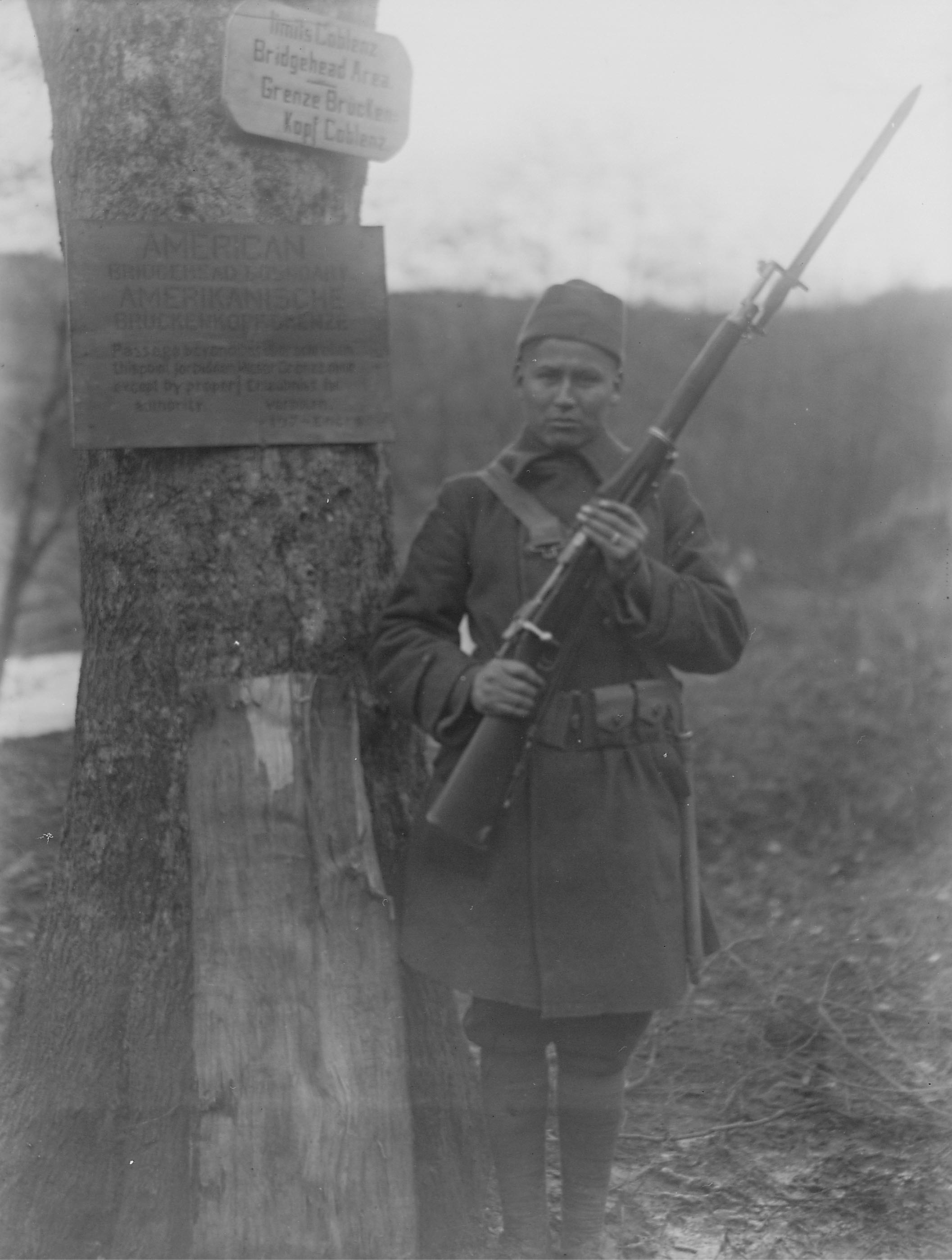
World War I intensified debates among Native Americans about freedom, citizenship, and the place of American Indians in U.S. society. More than 12,000 American Indians served in the military; most volunteered but many were drafted. Off-reservation boarding schools served as important sites of recruitment, with over 200 Native American soldiers recruited from the Carlisle school alone. Native Americans held conflicting views about military service. With widespread poverty and poor health conditions on reservations, the Society of American Indians (discussed in Chapter 18) saw the war as an opportunity to win freedom and citizenship. “Our American Indians are today in France on the battle line, fighting that liberty, fraternity and equality of opportunity may prevail throughout the world,” wrote “Red Progressive” Arthur C. Parker. “Are they to return and find that they alone of all humankind are denied those blood-bought privileges?” Such arguments contributed to legislation in 1919 providing American Indian veterans eligibility for citizenship.
George Miner (Ho-Chunk), an army corporal, stands guard in Niederahren, Germany, shortly after the end of World War I. Many Native Americans volunteered or were drafted.
Many Native Americans, however, viewed the draft as an assault on their sovereignty. The Pueblo, Hopi, Navajo, Haudenosaunee (Iroquois), Lakota, and Ojibwe peoples opposed the draft. The Oneida and Onondaga nations insisted on fighting alongside the United States as an ally rather than for it and declared war on Germany. Native American soldiers’ casualty rate was higher than other groups with white officers using Indians for dangerous tasks such as scouts.
The Color Line
By far the largest non-white group, African Americans were excluded from nearly every Progressive definition of freedom described in Chapter 18. After their disenfranchisement in the South, few could participate in American democracy. Barred from joining most unions and from skilled employment, Black workers had little access to “industrial freedom.” A majority of adult Black women worked outside the home, but for wages that offered no hope of independence. Predominantly domestic and agricultural workers, they remained unaffected by the era’s laws regulating the hours and conditions of female labor. Nor could Blacks, the majority desperately poor, participate fully in the emerging consumer economy, either as employees in the new department stores (except as janitors and cleaning women) or as purchasers of the consumer goods now flooding the marketplace.
Progressive intellectuals, social scientists, labor reformers, and suffrage advocates displayed a remarkable indifference to the Black condition. Israel Zangwill did not include Blacks in the melting-pot idea popularized by his Broadway play. Walter Weyl waited until the last fifteen pages of The New Democracy to introduce the “race problem.” His comment, quoted in the previous chapter, that the chief obstacles to freedom were economic, not political, revealed little appreciation of how the denial of voting rights underpinned the comprehensive system of inequality to which southern Blacks were subjected.
Roosevelt, Wilson, and Race
The Progressive presidents shared prevailing attitudes concerning Blacks. Theodore Roosevelt shocked white opinion by inviting Booker T. Washington to dine with him in the White House and by appointing a number of Blacks to federal offices. But in 1906, when a small group of Black soldiers shot off their guns in Brownsville, Texas, killing one resident, and none of their fellows would name them, Roosevelt ordered the dishonorable discharge of three Black companies—156 men in all, including six winners of the Congressional Medal of Honor. Roosevelt’s ingrained belief in Anglo-Saxon racial destiny (he called Indians “savages” and Blacks “wholly unfit for the suffrage”) did nothing to lessen Progressive intellectuals’ enthusiasm for his New Nationalism. Even Jane Addams, one of the few Progressives to take a strong interest in Black rights and a founder of the National Association for the Advancement of Colored People (NAACP), went along when the Progressive Party convention of 1912 rejected a civil rights plank in its platform and barred Black delegates from the South.
Woodrow Wilson, a native of Virginia, could speak without irony of the South’s “genuine representative government” and its exalted “standards of liberty.” His administration imposed racial segregation in federal departments in Washington, D.C., and dismissed numerous Black federal employees. Wilson allowed D. W. Griffith’s film The Birth of a Nation, which glorified the Ku Klux Klan as the defender of white civilization during Reconstruction, to have its premiere at the White House in 1915. “Have you a ‘new freedom’ for white Americans and a new slavery for your African American fellow citizens?” William Monroe Trotter, the militant Black editor of the Boston Guardian and founder of the all-Black National Equal Rights League, asked the president.
In one of hundreds of lynchings during the Progressive era, a white mob in Springfield, Missouri, in 1906 falsely accused three Black men of rape, hanged them from an electric light pole, and burned their bodies in a public orgy of violence. Atop the pole stood a replica of the Statue of Liberty.
W. E. B. Du Bois and the Revival of Black Protest
Black leaders struggled to find a strategy to rekindle the national commitment to equality that had flickered brightly, if briefly, during Reconstruction. No one thought more deeply, or over so long a period, about the Black condition and the challenge it posed to American democracy than the scholar and activist W. E. B. Du Bois. Born in Great Barrington, Massachusetts, in 1868, and educated at Fisk and Harvard universities, Du Bois lived to his ninety-fifth year. The unifying theme of his career was Du Bois’s effort to reconcile the contradiction between what he called “American freedom for whites and the continuing subjection of Negroes.” His book The Souls of Black Folk (1903) issued a clarion call for Blacks dissatisfied with the accommodationist policies of Booker T. Washington to press for equal rights. Du Bois believed that educated African Americans like himself—the “talented tenth” of the Black community—must use their education and training to challenge inequality.
In some ways, Du Bois was a typical Progressive who believed that investigation, exposure, and education would lead to solutions for social problems. As a professor at Atlanta University, he projected a grandiose plan for decades of scholarly study of Black life in order to make the country aware of racism and point the way toward its elimination. But he also understood the necessity of political action.
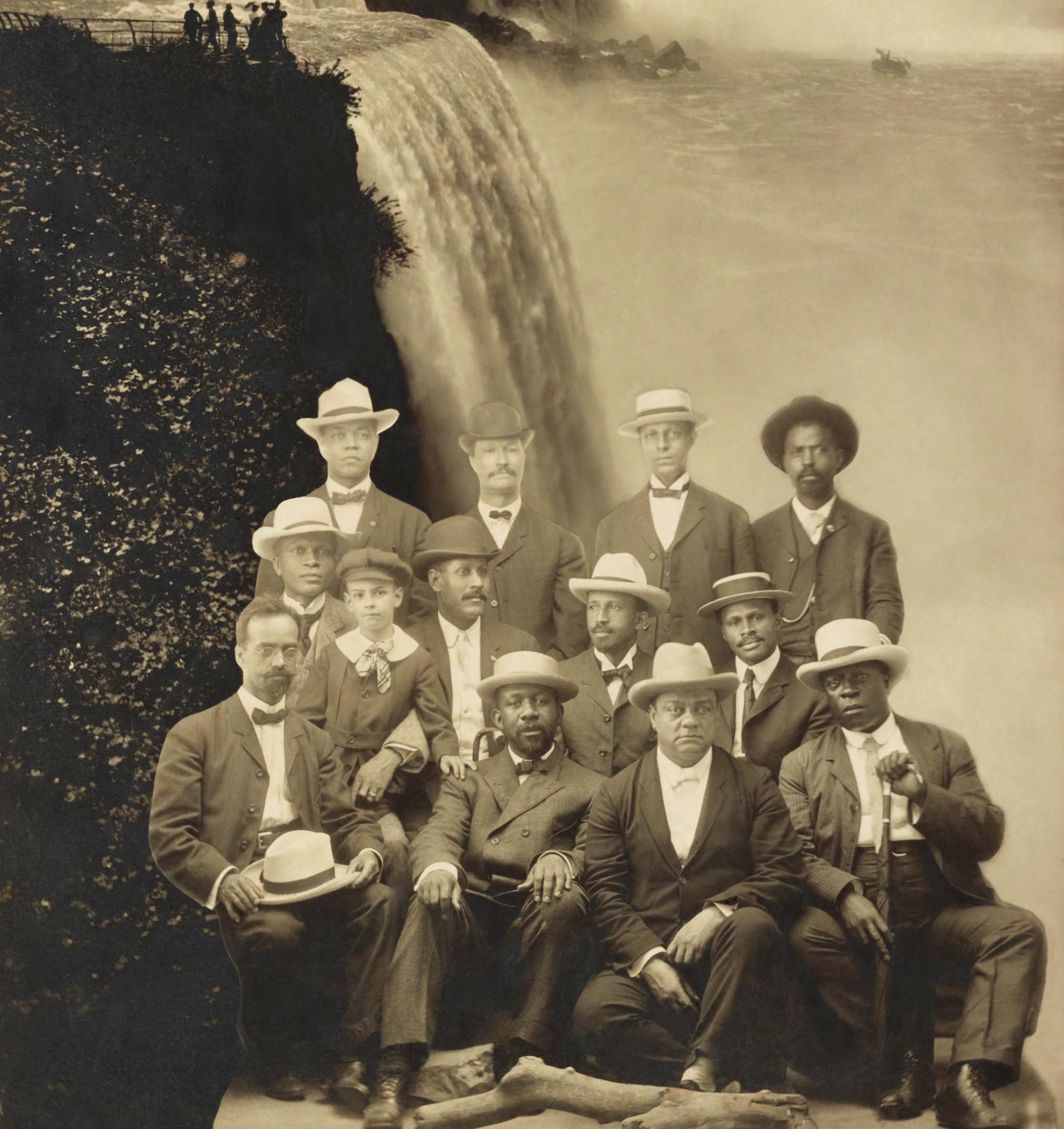
The men who founded the Niagara movement at a 1905 meeting on the Canadian side of Niagara Falls. W. E. B. Du Bois is in the second row, second from the right, in a white hat. They pledged to renew the struggle for “every single right that belongs to a freeborn American.” By the time of the second meeting, a year later, women had become part of the movement.
In 1905, Du Bois gathered a group of Black leaders at Niagara Falls (meeting on the Canadian side since no American hotel would provide accommodations) and organized the Niagara movement, which sought to reinvigorate the abolitionist tradition. “We claim for ourselves,” Du Bois wrote in the group’s manifesto, “every single right that belongs to a freeborn American, political, civil, and social; and until we get these rights we will never cease to protest and assail the ears of America.” The Declaration of Principles adopted at Niagara Falls called for restoring to Blacks the right to vote, an end to racial segregation, and complete equality in economic and educational opportunity. These would remain the cornerstones of the Black struggle for racial justice for decades to come. Four years later, Du Bois joined with a group of mostly white reformers, shocked by a lynching in Springfield, Illinois (Lincoln’s adult home), to create the National Association for the Advancement of Colored People. The NAACP, as it was known, launched a long struggle for the enforcement of the Fourteenth and Fifteenth Amendments.
The NAACP’s legal strategy won a few victories. In Bailey v. Alabama (1911), the Supreme Court overturned southern “peonage” laws that made it a crime for sharecroppers to break their labor contracts. Six years later, it ruled unconstitutional a Louisville zoning regulation excluding Blacks from living in certain parts of the city (primarily because it interfered with whites’ right to sell their property as they saw fit). Overall, however, the Progressive era witnessed virtually no progress toward racial justice.
Military Service and the Promise of Freedom
Among Black Americans, the wartime language of freedom inspired hopes for a radical change in the country’s racial system. With the notable exception of William Monroe Trotter, most Black leaders saw American participation in the war as an opportunity to make real the promise of freedom. To Trotter, much-publicized German atrocities were no worse than American lynchings; rather than making the world safe for democracy, the government should worry about “making the South safe for the Negroes.” Yet the Black press rallied to the war. Du Bois himself, in widely reprinted editorials, called on African Americans to enlist in the army to help “make our own America a real land of the free.”
Black participation in the Civil War had helped to secure the destruction of slavery and the achievement of citizenship. But during World War I, closing ranks did not bring significant gains. The navy barred Blacks entirely, and the segregated army confined most of the 400,000 Blacks who served in the war to supply units rather than combat. Wilson feared, as he noted in his diary, that the overseas experience would “go to their heads.” And the U.S. Army campaigned strenuously to persuade the French not to treat Black soldiers as equals—not to eat or socialize with them, or even shake their hands. Contact with African colonial soldiers fighting alongside the British and French did widen the horizons of Black American soldiers. But while colonial troops marched in the victory parade in Paris, the Wilson administration did not allow Black Americans to participate.
The Great Migration and the “Promised Land”
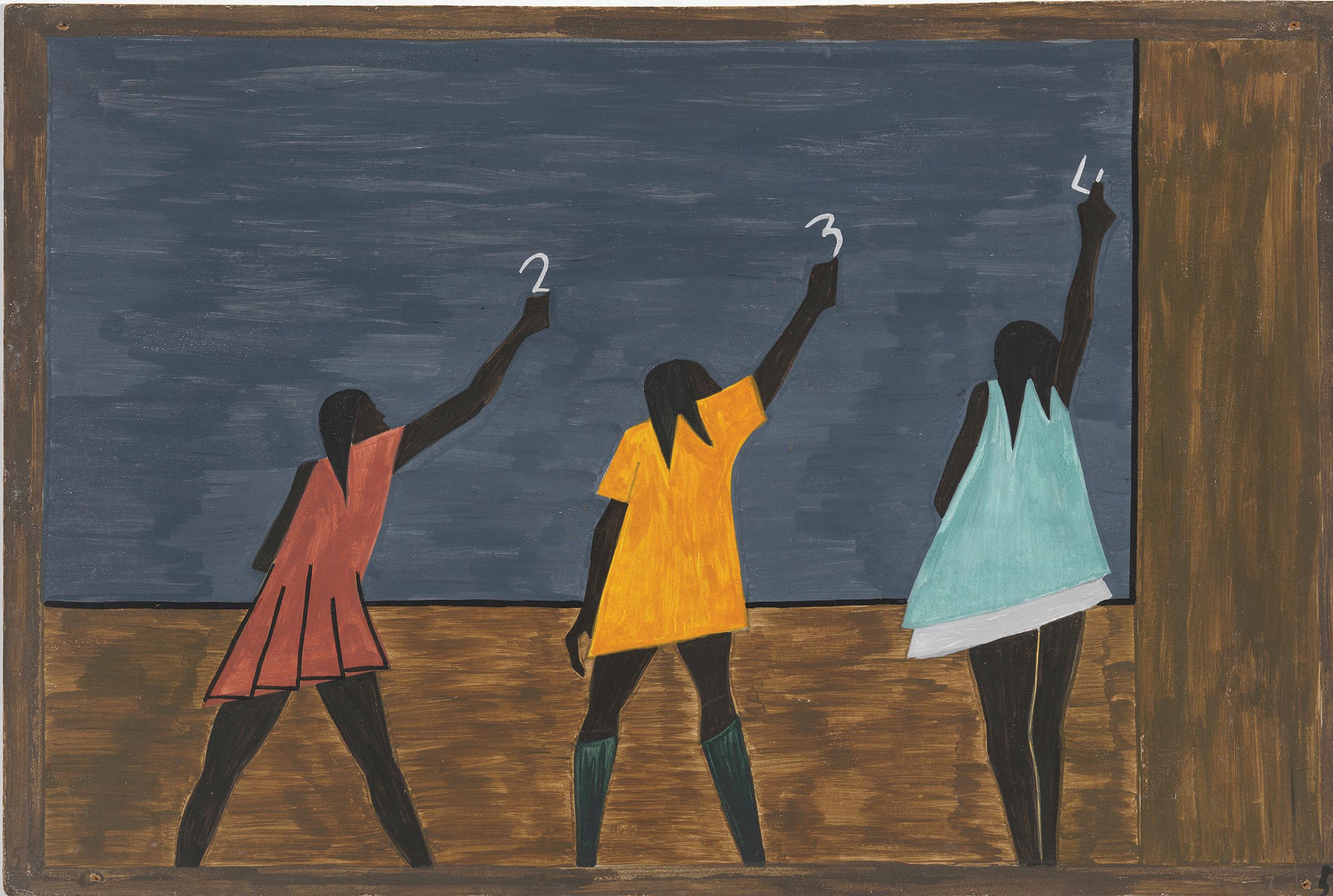
Nonetheless, the war unleashed social changes that altered the contours of American race relations. The combination of increased wartime production and a drastic falloff in immigration from Europe opened thousands of industrial jobs to Black laborers for the first time, inspiring a large-scale migration from South to North. On the eve of World War I, 90 percent of the African American population still lived in the South. Most northern cities had tiny Black populations, and domestic and service work still predominated among both Black men and Black women in the North. But between 1910 and 1920, half a million Blacks left the South. The Black population of Chicago more than doubled, New York City’s rose 66 percent, and smaller industrial cities like Akron, Buffalo, and Trenton showed similar gains.
Table 19.1 The Great Migration
City
Black Population, 1910
Black Population, 1920
Percent Increase
New York
91,709
152,467
66.3%
Philadelphia
84,459
134,229
58.9
Chicago
44,103
109,458
148.2
St. Louis
43,960
69,854
58.9
Detroit
5,741
40,838
611.3
Pittsburgh
25,623
37,725
47.2
Cleveland
8,448
34,451
307.8
Many motives sustained the Great Migration—higher wages in northern factories than were available in the South (even if Blacks remained confined to menial and unskilled positions), opportunities for educating their children, escape from the threat of lynching, and the prospect of exercising the right to vote. Migrants spoke of a Second Emancipation, of “crossing over Jordan,” and of leaving the realm of pharaoh for the Promised Land. One group from Mississippi stopped to sing, “I am bound for the land of Canaan,” after their train crossed the Ohio River into the North.
The Black migrants, mostly young men and women, carried with them “a new vision of opportunity, of social and economic freedom,” as Alain Locke explained in the preface to his influential book The New Negro (1925). Yet the migrants encountered vast disappointments—severely restricted employment opportunities, exclusion from unions, rigid housing segregation, and outbreaks of violence that made it clear that no region of the country was free from racial hostility. More white southerners than Blacks moved north during the war, often with similar economic aspirations. But the new Black presence, coupled with demands for change inspired by the war, created a racial tinderbox that needed only an incident to trigger an explosion.
Racial Violence, North and South
The Tulsa Massacre
Dozens of Blacks were killed during a 1917 riot in East St. Louis, Illinois, where employers had recruited Black workers in an attempt to weaken unions (most of which excluded Blacks from membership). In 1919, more than 250 persons died in riots in the urban North. Most notable was the violence in Chicago, touched off by the drowning by white bathers of a Black teenager who accidentally crossed the unofficial dividing line between Black and white beaches on Lake Michigan. The riot that followed raged for five days and involved pitched battles between the races throughout the city. By the time the National Guard restored order, 38 persons had been killed and more than 500 injured.
One of a series of paintings by the Black artist Jacob Lawrence called The Migration Series, inspired by the massive movement of African Americans to the North during and after World War I. For each, Lawrence composed a brief title, in this case, “In the North the Negro had better educational facilities.”
Violence was not confined to the North. In the year after the war ended, seventy-six persons were lynched in the South, including several returning Black veterans wearing their uniforms. In Phillips County, Arkansas, attacks on striking Black sharecroppers by armed white vigilantes left as many as 200 persons dead and required the intervention of the army to restore order. The worst single incidence of racial terror in American history occurred in Tulsa, Oklahoma, in 1921, when more than 300 Blacks were killed and over 10,000 left homeless after a white mob, including police and National Guardsmen, burned an all-Black section of the city, the Greenwood District, to the ground. Its main thoroughfare was nicknamed “Negro Wall Street” by Booker T. Washington for its prosperous Black-owned businesses. The Tulsa massacre erupted after a group of Black veterans tried to prevent the lynching of a youth who had accidentally tripped and fallen on a white female elevator operator, causing rumors of rape to sweep the city.
The Rise of Garveyism
World War I kindled a new spirit of militancy. The East St. Louis riot of 1917 inspired a widely publicized Silent Protest Parade on New York’s Fifth Avenue in which 10,000 Blacks silently carried placards reading, “Mr. President, Why Not Make America Safe for Democracy?” In the new densely populated Black ghettos of the North, widespread support emerged for the Universal Negro Improvement Association, a movement for African independence and Black self-reliance launched by Marcus Garvey, a recent immigrant from Jamaica. Freedom for Garveyites meant national self-determination. Blacks, they insisted, should enjoy the same internationally recognized identity enjoyed by other peoples in the aftermath of the war. “Everywhere we hear the cry of freedom,” Garvey proclaimed in 1921. “We desire a freedom that will lift us to the common standard of all men, . . . freedom that will give us a chance and opportunity to rise to the fullest of our ambition and that we cannot get in countries where other men rule and dominate.” Du Bois and other established Black leaders viewed Garvey as little more than a demagogue, but the massive movement he built testified to the popular appeal of Black nationalist ideas and the sense of betrayal that had been kindled in Black communities during and after the war. Garvey’s influence spread to the Caribbean, Canada, and Africa. The government launched an investigation into Garvey in 1919 hoping to deport him as an “undesirable alien.” Charged and convicted of mail fraud in 1922, Garvey was deported in 1927.
The study of the alleged mental and physical characteristics of different groups of people aiming to “improve” the quality of the human race through selective breeding.
Founded in 1910, the civil rights organization that brought lawsuits against discriminatory practices and published The Crisis, a journal edited by African American scholar W. E. B. Du Bois.
Large-scale migration of southern Blacks during and after World War I to the North, where jobs had become available during the labor shortage of the war years.
A race riot in 1921—the worst in American history—that occurred in Tulsa, Oklahoma, after a group of Black veterans tried to prevent a lynching. Over 300 African Americans were killed, and 10,000 lost their homes in fires set by white mobs.
The leading spokesman for Negro Nationalism, which exalted Blackness, Black cultural expression, and Black exclusiveness. He called upon African Americans to liberate themselves from the surrounding white culture and create their own businesses, cultural centers, and newspapers. He was also the founder of the Universal Negro Improvement Association.
 Who Is an American?: Randolph S. Bourne