CHAPTER 15
“WHAT IS FREEDOM?”: RECONSTRUCTION ★ 1865–1877
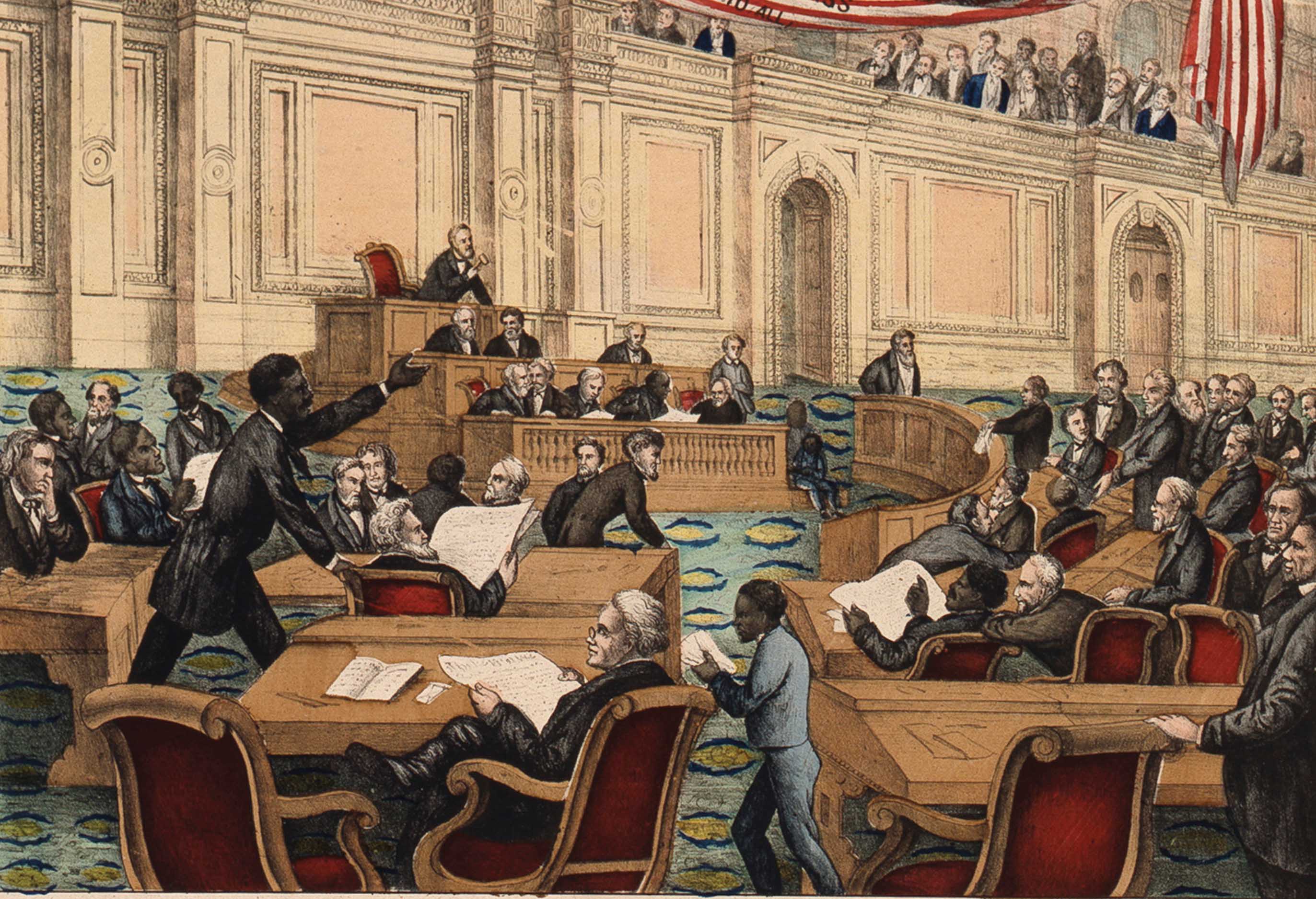
On the evening of January 12, 1865, less than a month after Union forces captured Savannah, Georgia, twenty leaders of the city’s Black community gathered for a discussion with General William T. Sherman and Secretary of War Edwin M. Stanton. Mostly Baptist and Methodist ministers, the group included several men who within a few years would assume prominent positions during the era of Reconstruction that followed the Civil War. Ulysses S. Houston, pastor of the city’s Third African Baptist Church, and James Porter, an Episcopal religious leader who had operated a secret school for Black children before the war, in a few years would win election to the Georgia legislature. James D. Lynch, who had been born free in Baltimore and educated in New Hampshire, went on to serve as secretary of state of Mississippi.
The conversation revealed that the Black leaders brought out of slavery a clear definition of freedom. Asked what he understood by slavery, Garrison Frazier, a Baptist minister chosen as the group’s spokesman, responded that it meant one person’s “receiving by irresistible power the work of another man, and not by his consent.” Freedom he defined as “placing us where we could reap the fruit of our own labor, and take care of ourselves.” The way to accomplish this was “to have land, and turn it and till it by our own labor.” Frazier insisted that Blacks possessed “sufficient intelligence” to maintain themselves in freedom and enjoy the equal protection of the laws.
Sherman’s meeting with the Black leaders foreshadowed some of the radical changes that would take place during the era known as Reconstruction (meaning, literally, the rebuilding of the shattered nation). In the years following the Civil War, former slaves and their white allies, North and South, would seek to redefine the meaning and boundaries of American freedom and citizenship. Previously an entitlement of whites, these would be expanded to include Black Americans. The laws and Constitution would be rewritten to guarantee African Americans, for the first time in the nation’s history, recognition as citizens and equality before the law. Black men would be granted the right to vote, ushering in a period of interracial democracy throughout the South. Black schools, churches, and other institutions would flourish, laying the foundation for the modern African American community. Many of the advances of Reconstruction would prove temporary, swept away during a campaign of violence in the South and the North’s retreat from the ideal of equality. But Reconstruction laid the foundation for future struggles to extend freedom to all Americans.
All this, however, lay in the future in January 1865. Four days after the meeting, Sherman responded to the Black delegation by issuing Special Field Order 15. This set aside the Sea Islands and a large area along the South Carolina and Georgia coasts for the settlement of Black families on forty-acre plots of land. He also offered them broken-down mules that the army could no longer use. In Sherman’s order lay the origins of the phrase “forty acres and a mule,” which would reverberate across the South in the next few years. By June, some 40,000 freed slaves had been settled on “Sherman land.” Among the emancipated slaves, Sherman’s order raised hopes that the end of slavery would be accompanied by the economic independence that they, like other Americans, believed essential to genuine freedom.
1865 Special Field Order 15
Freedmen’s Bureau established
Lincoln assassinated; Andrew Johnson becomes president
1865–1867 Presidential Reconstruction
Black Codes
1866 Civil Rights Bill
Ku Klux Klan established
1867 Reconstruction Act of 1867
Tenure of Office Act
1867–1877 Radical Reconstructionof 1867
1868 Impeachment and trial of President Johnson
Fourteenth Amendment ratified
1869 Inauguration of Ulysses S. Grant
Women’s rights organization splits into two groups
1870 Hiram Revels, first Black U.S. senator
Fifteenth Amendment ratified
1870– Enforcement Acts
1871
1872 Liberal Republicans established
1873 Colfax Massacre
Slaughterhouse Cases
National economic depression begins
1876 United States v. Cruikshank
1877 Bargain of 1877