What were the directions of social and economic change in the eighteenth-century colonies?
THE GROWTH OF COLONIAL AMERICA
In North America, three new and very different empires were competing for wealth and power. The urban-based Spanish empire, with a settler elite, a growing mestizo population, and a large Native labor force, still relied for wealth primarily on the gold and silver mines of Mexico and South America. The French empire centered on the plantation islands of Saint Domingue, Martinique, and Guadeloupe. On the mainland, it consisted of a string of farms and trading posts in the St. Lawrence Valley. In North America north of the Rio Grande, the English claimed less land than their rivals but outpaced them in population and trade.
As stability returned after the crises of the late seventeenth century, English North America experienced an era of remarkable growth. Starvation and disease diminished, agricultural settlement pressed westward, and hundreds of thousands of newcomers arrived from Europe. Thanks to a high birthrate and immigration, the population of England’s mainland colonies, 265,000 in 1700, grew to over 2.3 million by 1770. At the same time, in places where Europeans brought war, enslavement, and destruction of natural resources, Native populations declined. When disease accompanied intensive colonization, the effects were catastrophic. In 1700, Native Americans still outnumbered Europeans in North America, but over the course of the next century, the population of the English colonies would outstrip everyone else.
A Diverse Population
Probably the most striking characteristic of eighteenth-century British colonial society was its diversity. In 1700, the colonies were essentially English outposts. In the eighteenth century, African and non-English European arrivals skyrocketed, while the number emigrating from England declined.
About 40 percent of European immigrants to the colonies during the eighteenth century continued to arrive as bound laborers who had temporarily sacrificed their freedom to make the voyage to the New World. But as the colonial economy prospered, poor indentured migrants were increasingly joined by professionals and skilled craftsmen—teachers, ministers, weavers, carpenters—whom England could ill afford to lose. This brought to an end official efforts to promote English emigration.
Nevertheless, the government in London remained convinced that colonial development enhanced the nation’s power and wealth. To bolster the Chesapeake labor force, nearly 50,000 convicts were sent to work in the tobacco fields. Officials also encouraged Protestant immigration from the non-English parts of the British Isles and from the European continent, promising newcomers access to land and the right to worship freely.
Among eighteenth-century migrants from the British Isles, the 70,000 English newcomers were considerably outnumbered by 145,000 from Scotland and Ulster, the northern part of Ireland, where many Scots had settled as part of England’s effort to subdue the island. Mostly Presbyterians, they added significantly to religious diversity in North America.
The German Migration
Germans, 110,000 in all, formed the largest group of newcomers from the European continent. In the eighteenth century, Germany was divided into numerous small states, each with a ruling prince who determined the official religion. Those who found themselves worshiping the “wrong” religion—Lutherans in Catholic areas, Catholics in Lutheran areas, and everywhere, followers of small Protestant sects such as Mennonites, Moravians, and Dunkers—faced persecution. Many decided to emigrate. Other migrants were motivated by agricultural crises and the difficulty of acquiring land.
|
TABLE 3.1 Origins of Free and Unfree Newcomers to British North American Colonies, 1700–1775 |
|||||
|
TOTAL |
SLAVES |
INDENTURED SERVANTS |
CONVICTS |
FREE |
|
|
Africa |
278,400 |
278,400 |
— |
— |
— |
|
Ireland |
108,600 |
— |
39,000 |
17,500 |
52,100 |
|
Germany |
84,500 |
— |
30,000 |
— |
54,500 |
|
England/Wales |
73,100 |
— |
27,200 |
32,500 |
13,400 |
|
Scotland |
35,300 |
— |
7,400 |
2,200 |
25,700 |
|
Other |
5,900 |
— |
— |
— |
5,900 |
|
Total |
585,800 |
278,400 |
103,600 |
52,200 |
151,600 |
English and Dutch merchants created a well-organized system whereby redemptioners (as indentured families were called) received passage in exchange for a promise to work off their debt in America. Most settled in frontier areas—rural New York, western Pennsylvania, and the southern backcountry—where they formed tightly knit farming communities in which German remained the dominant language.
Religious Diversity
 What religious freedoms did eighteenth-century colonists have?
Eighteenth-century British America was not a “melting pot” of cultures. Ethnic groups tended to live and worship in relatively homogeneous communities. But outside of New England, which received few immigrants and retained its overwhelmingly English ethnic character, American society had a far more diverse population than Britain. Nowhere was this more evident than in the practice of religion.
Apart from New Jersey, Rhode Island, and Pennsylvania, the colonies did not adhere to a modern separation of church and state. Nearly every colony levied taxes to pay the salaries of ministers of an established church, and most barred Catholics and Jews from voting and holding public office. But increasingly, de facto toleration among Protestant denominations flourished. By the mid-eighteenth century, dissenting Protestants in most colonies had gained the right to worship as they pleased and own their churches, although many places still barred them from holding public office and taxed them to support the official church. A visitor to Pennsylvania in 1750 described the colony’s religious diversity: “We find there Lutherans, Reformed, Catholics, Quakers, Menonists or Anabaptists, Herrnhuters or Moravian Brethren, Pietists, Seventh Day Baptists, Dunkers, Presbyterians, . . . Jews, Mohammedans, Pagans.”
Native-Colonial Relations
How did Native-Colonial relations shift in the eighteenth century?
The newcomers, who equated liberty with possession of land, threatened Native nations on the Atlantic coast. By the eighteenth century, Native people were well integrated into global trade networks. Men sold the products of the hunt to trade for European cloth and other goods, while women continued to farm and to collect local resources, including berries and medicinal plants. Some made products for the European market, including baskets, brooms, snowshoes, wooden utensils, and pottery.
DIVERSITY IN THE EUROPEAN SETTLEMENTS, ATLANTIC COAST OF NORTH AMERICA, 1760
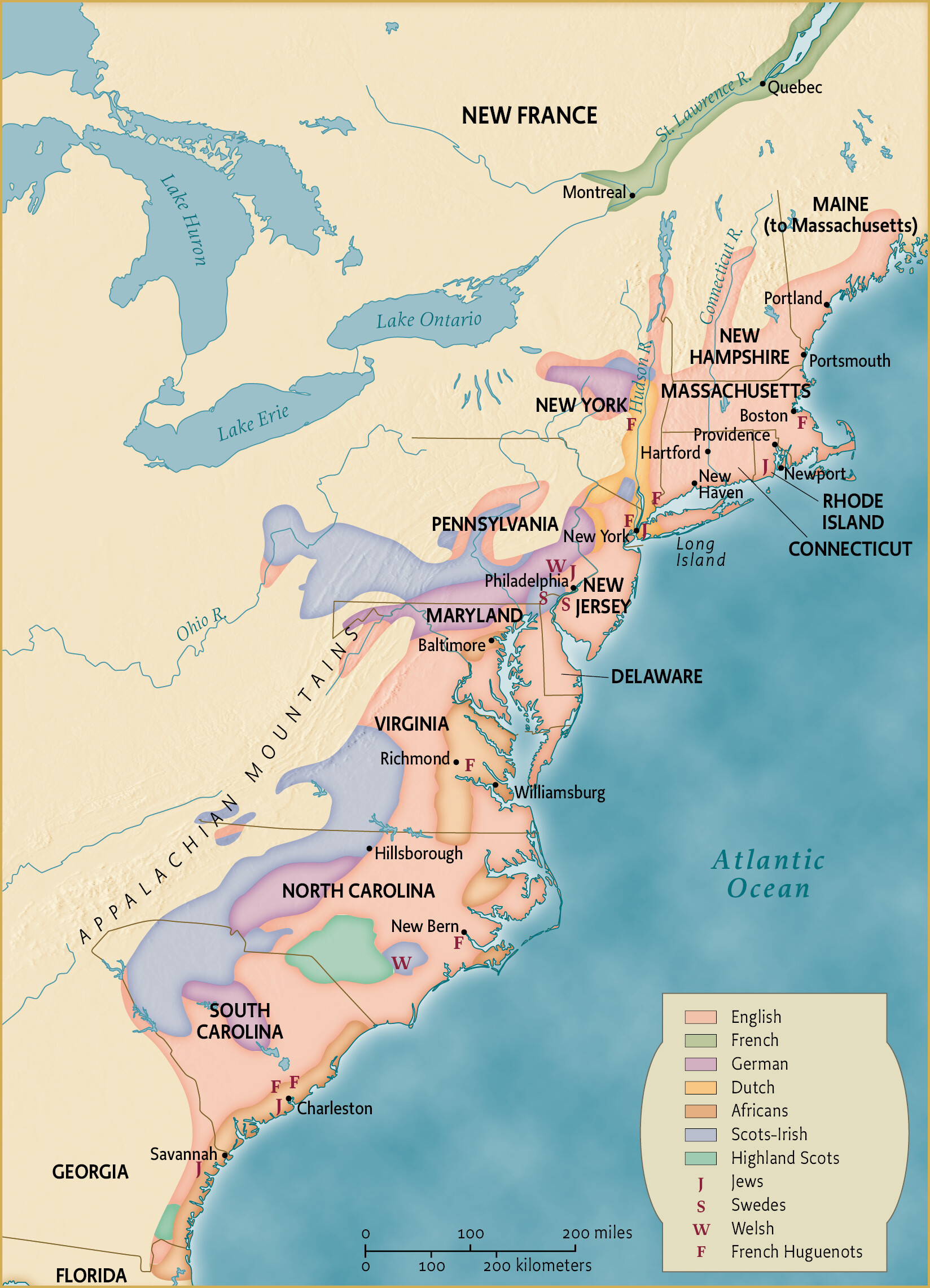
Among the most striking features of eighteenth-century British colonial society was the racial and ethnic diversity of the population (except in New England). This resulted from increased immigration from the non-English parts of the British Isles and from mainland Europe, as well as the rapid expansion of the slave trade from Africa. Also note how little of the continent Europeans possessed in 1760, after nearly two centuries of colonial attempts.
New confederacies, including the Catawbas of South Carolina and the Muscogee (Creek) Confederacy to the west of South Carolina and Georgia, united formerly independent towns and also absorbed Indigenous refugees from colonial wars. To preserve their independence from colonists, many moved farther away and became more interdependent with other Native peoples.
WHO IS AN AMERICAN?
From Benjamin Franklin, Observations Concerning the Increase of Mankind (1751)
Who Is an American?: Benjamin Franklin
Only a minority of immigrants from Europe to British North America in the eighteenth century came from the British Isles. Some prominent colonists found the growing diversity of the population quite disturbing. Benjamin Franklin was particularly troubled by the large influx of newcomers from Germany into Pennsylvania in the mid-eighteenth century.
Listen as you read
Why should the Palatine [German] boors be suffered to swarm into our settlements, and by herding together establish their language and manners to the exclusion of ours? Why should Pennsylvania, founded by the English, become a Colony of Aliens, who will shortly be so numerous as to Germanize us instead of our Anglifying them, and will never adopt our language or customs, any more than they can acquire our complexion?
Which leads me to add one remark: That the number of purely white people in the world is proportionably very small. All Africa is black or tawny. Asia chiefly tawny. America (exclusive of the newcomers) wholly so. And in Europe, the Spaniards, Italians, French, Russians and Swedes, are generally of what we call a swarthy complexion; as are the Germans also, the Saxons only excepted, who with the English, make the principal body of white people on the face of the earth. I could wish their numbers were increased. And while we are, as I may call it, scouring our planet, by clearing America of woods, and so making this side of our globe reflect a brighter light to the eyes of inhabitants in Mars or Venus, why should we . . . darken its people? Why increase the sons of Africa, by planting them in America, where we have so fair an opportunity, by excluding all Blacks and Tawneys, of increasing the lovely White and Red? But perhaps I am partial to the complexion of my country, for such kind of partiality is natural to mankind.
QUESTIONS
- What is Franklin’s objection to the growing German presence?
- What does Franklin’s characterization of the complexions of various groups suggest about the reliability of his perceptions of non-English peoples?
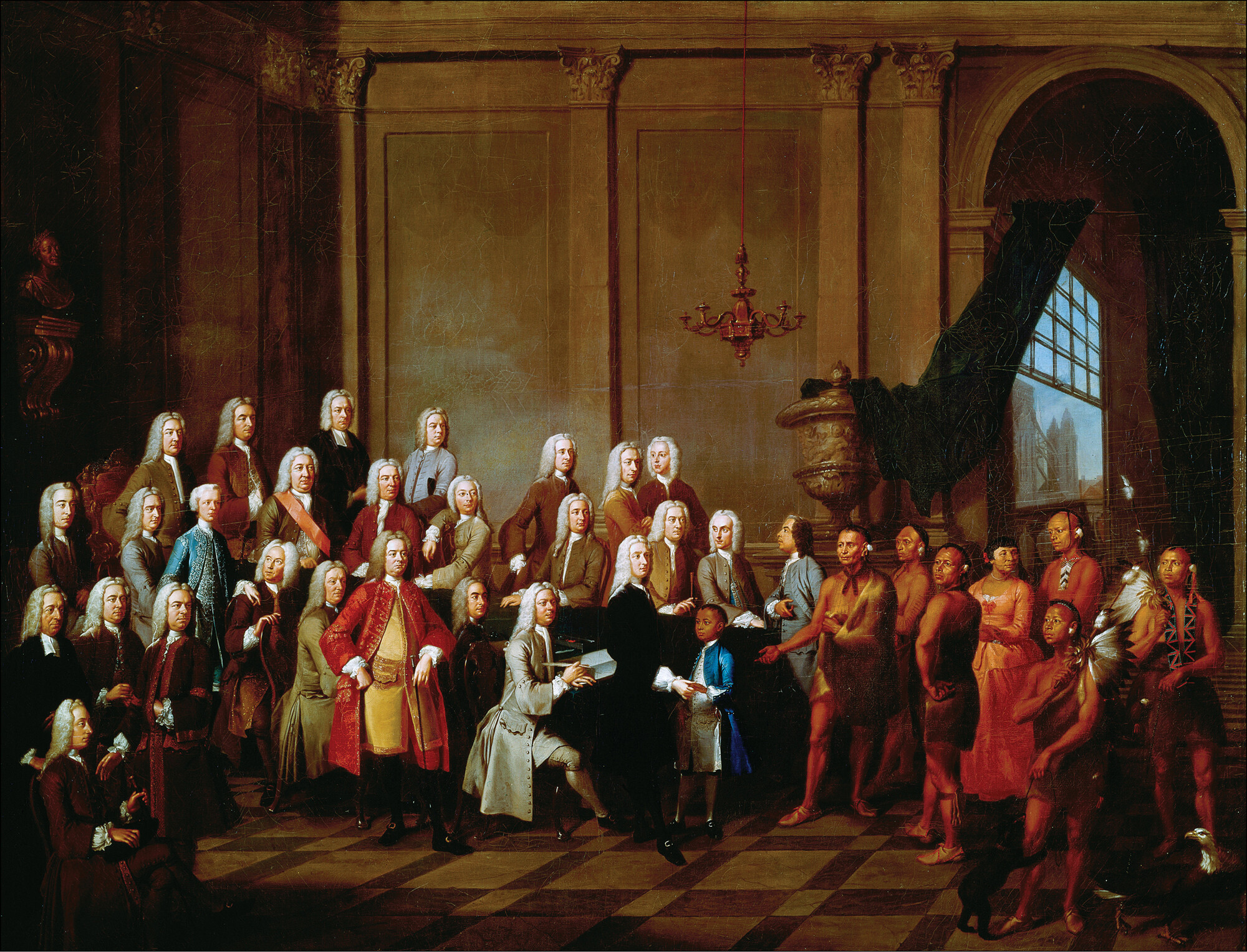
In 1734, representatives of the Muscogee (Creek) Confederacy traveled to London to conduct diplomacy with British king George II and other officials, including the trustees of the colony of Georgia, pictured in this painting. Included in the Muscogee delegation are Chief Tomochichi, his wife Senawchi, and a Muscogee boy in the center. The eagle in the bottom right corner was a gift from the Muscogees to the king.
Like many other Native peoples, the Delawares had built strong economic and diplomatic relationships with colonies, only to be undermined by the large numbers of immigrants pushing west. While European traders saw potential profits in Native towns, nations, and confederacies, and British officials saw allies against France and Spain, farmers and planters viewed Indians as little more than an obstacle to their desire for land. The infamous Walking Purchase of 1737 brought the fraudulent dealing so common in other colonies to Pennsylvania. Colonists pressured Delawares into agreeing to an arrangement to cede a tract of land bounded by the distance a man could walk in thirty-six hours. To the Delawares’ amazement, Governor James Logan hired a team of swift runners, who marked out an area far in excess of what they had anticipated.
By 1760, Pennsylvania’s population, a mere 20,000 in 1700, had grown to 220,000. Native-colonist relations, initially the most harmonious in British North America, had become poisoned by suspicion and hostility. One group of Susquehannocks declared “that the white people had abused them and taken their lands from them, and therefore they had no reason to think that they were now concerned for their happiness.” They pointedly reminded Pennsylvanians that “old William Penn” had treated them with fairness and respect.
Regional Diversity
By the mid-eighteenth century, the different regions of the British colonies had developed distinct economic and social orders. Small farms tilled by family labor and geared primarily to production for local consumption predominated in New England and the new settlements of the backcountry (the area stretching along the east side of the Appalachian Mountains from central Pennsylvania southward through the Shenandoah Valley of Virginia and into upland North and South Carolina). This region had all belonged to Native Americans at the start of the 1700s, but by the eve of the American Revolution, it contained one-quarter of Virginia’s population and half of South Carolina’s. Most of these people were farm families raising grain and livestock.
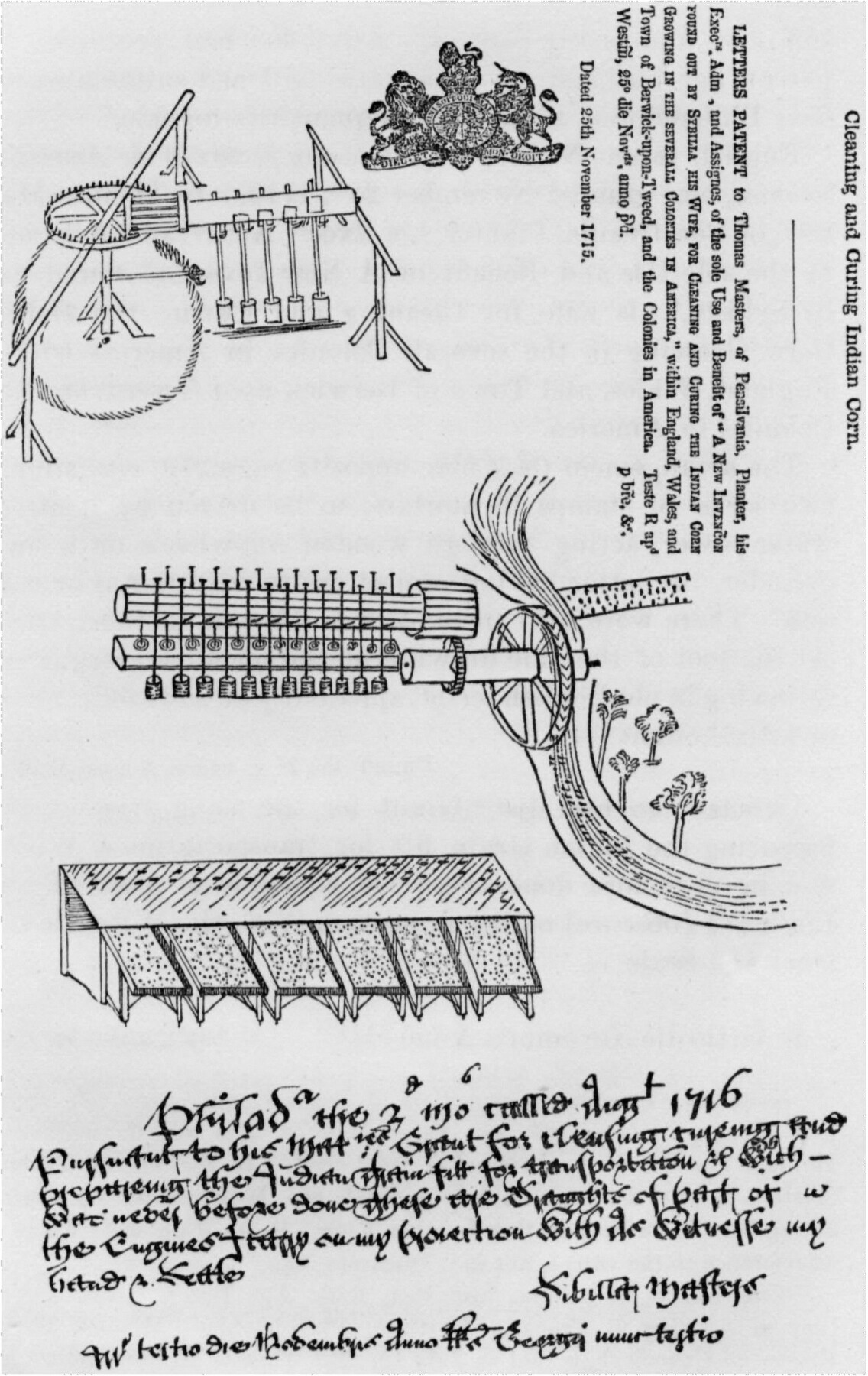
Drawings that Sybillia Righton Masters and her husband submitted along with her request for a patent for the machine she invented to process corn into cornmeal. The top two pictures show machines that would pound the corn into cornmeal, the top one powered by an animal and the second one by a stream. The drawing at the bottom shows how the cornmeal would be roasted.
In the older portions of the Middle Colonies of New York, New Jersey, and Pennsylvania, farmers were more oriented to commerce than on the frontier. They grew grain both for their own use and for sale abroad and supplemented the work of family members with that of wage laborers, tenants, and in some instances slaves. In 1715, Philadelphian Sybilla Righton Masters invented a machine to process corn into cornmeal. She filed a patent for it in London, which was given to her in her husband’s name because of her legal status under coverture. With its fertile soil, favorable climate, initially peaceful Indian relations, generous governmental land distribution policy, and rivers that facilitated long-distance trading, Pennsylvania came to be known as “the best poor man’s country.” Ordinary colonists there enjoyed a standard of living unimaginable in Europe.
The Consumer Revolution
During the eighteenth century, Great Britain eclipsed the Dutch as the leading producer and trader of inexpensive consumer goods, including colonial products like coffee and tea and such manufactured goods as linen, metalware, pins, ribbons, glassware, ceramics, and clothing. Trade integrated the British empire. The British colonies shared in the era’s consumer revolution. In port cities and small inland towns, shops proliferated and colonial newspapers were filled with advertisements for British goods. Women were colonial households’ primary purchasers, so merchants had to appeal to their needs and wishes. Eighteenth-century estate inventories revealed the wide dispersal in American homes of European and even Asian products. Even modest families owned books, ceramic plates, metal cutlery, and items made of imported silk and cotton. Tea, once a luxury enjoyed only by the wealthy, became virtually a necessity of life. Upper- and middle-class women’s tea tables displayed their connections to the wider world, and a careful etiquette of preparing and serving tea showed their refinement.
Colonial Cities
Colonial cities like Boston, New York, Philadelphia, and Charleston were quite small by the standards of Europe or Spanish America. In 1700, when the population of Mexico City stood at 100,000, Boston had 6,000 residents and New York 4,500.
English American cities were mainly gathering places for agricultural goods and for imported items to be distributed to the countryside. Nonetheless, the expansion of trade encouraged the rise of port cities, home to a growing population of colonial merchants and artisans (skilled craftsmen) as well as an increasing number of poor. In 1770, with some 30,000 inhabitants, Philadelphia was, after London and Liverpool, the empire’s third busiest port. The financial, commercial, and cultural center of British America, Philadelphia was economically integrated with the rich agricultural region nearby. Philadelphia merchants organized the collection of farm goods, supplied rural storekeepers, and extended credit to consumers. They exported flour, bread, and meat to the West Indies and Europe.
Cities were also home to a large population of furniture makers, jewelers, and silversmiths serving wealthier citizens, and hundreds of smaller-scale artisans like weavers, blacksmiths, coopers, basket-makers, potters, and construction workers. Artisans generally owned their own tools and labored in a small workshop, often in the home, assisted by family members and young journeymen and apprentices learning the trade. The most prominent and profitable craft professions were limited to white men, but others made products for the market less formally.
Despite the influx of British goods, colonial craftsmen benefited from the expanding consumer market and allowed most journeymen to enjoy a reasonable chance of rising to the status of master and establishing workshops of their own. Those who did gained a far greater degree of economic freedom than those dependent on others for a livelihood. “He that hath a trade, hath an estate,” wrote Benjamin Franklin, who had worked as a printer before achieving renown as a scientist and statesman.
An Atlantic World
People, ideas, and goods flowed back and forth across the Atlantic, knitting together the empire and its diverse populations and creating webs of interdependence among the European empires. As trade expanded, the North American and West Indian colonies became a major market. The British manufactured goods in return for furs and deerskins. North Americans shipped farm products to Britain, the West Indies, and, with the exception of goods like tobacco “enumerated” under the Navigation Acts, outside the empire. Virtually the entire Chesapeake tobacco crop was marketed in Britain, with most of it then re-exported to Europe by British merchants. Most of the bread and flour exported from the colonies was destined for the West Indies. Africans enslaved there grew sugar that could be distilled into rum, a product increasingly popular in North America. The mainland colonies carried on a flourishing trade in fish and grains with southern Europe. Ships built in New England made up one-third of the British empire’s trading fleet.
Membership in the empire had many advantages for the colonists. Most Americans did not complain about British regulation of their trade because commerce enriched the colonies as well as England and lax enforcement of the Navigation Acts allowed smuggling to flourish. In a dangerous world, moreover, the Royal Navy protected American shipping. Eighteenth-century English America drew closer to, and in some ways became more similar to, England itself.
Glossary
- redemptioners
- Indentured families or persons who received passage to the New World in exchange for a promise to work off their debt in America.
- Walking Purchase
- An infamous 1737 purchase of Native land in which Delaware Indians agreed to cede land equivalent to the distance a man could walk in thirty-six hours, but the colonists marked out an area using a team of runners.
- backcountry
- In colonial America, the area stretching from central Pennsylvania southward through the Shenandoah Valley of Virginia and into upland North and South Carolina.