What was the significance of the Anglo–Powhatan Wars?
THE CHESAPEAKE
The Jamestown Colony
On April 26, 1607, three small ships carrying colonists from England sailed out of the morning mist at what is now called Cape Henry into the mouth of Chesapeake Bay. After exploring the area for a little over two weeks, they chose a site sixty miles inland on the James River for their settlement, hoping to protect themselves from marauding Spanish warships. Here they established Jamestown (named for the king of England) as the capital of the colony of Virginia (named for his predecessor, Elizabeth I, the “virgin queen”). The voyage was sponsored by the Virginia Company, a private business organization whose shareholders included merchants, aristocrats, and members of Parliament, and to which the queen had given her blessing before her death in 1603. When the three ships returned home, 104 settlers remained in Virginia. All were men, for the Virginia Company had more interest in searching for gold and in other ways of exploiting the area’s natural resources than in establishing a functioning society. Nevertheless, Jamestown became the first permanent English settlement in the area that is now the United States.
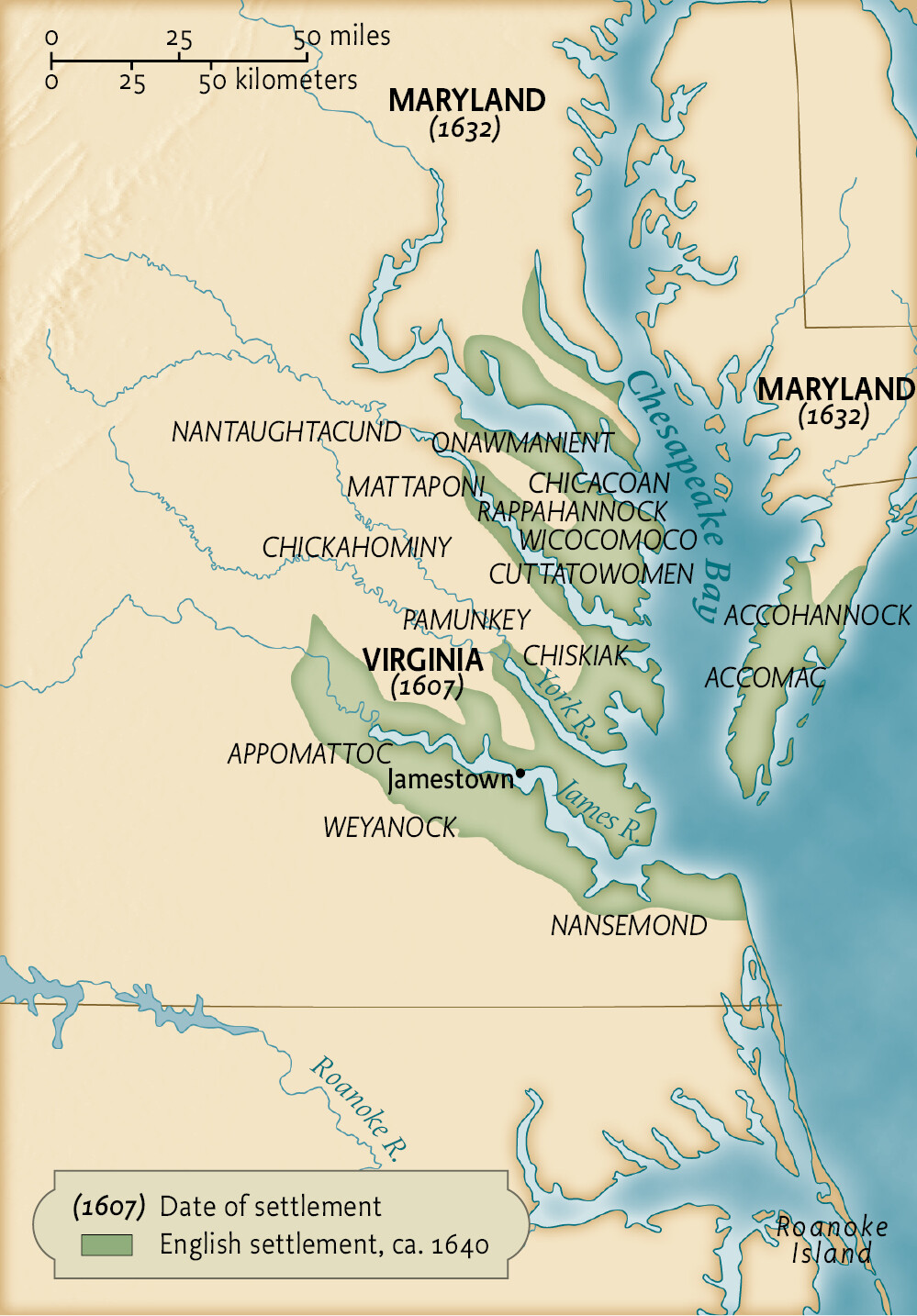
THE CHESAPEAKE, ca. 1640
More information
A map entitled, “The Chesapeake, circa 1640.” A map of the Chesapeake Bay. The date of settlement in Virginia was 1607, and the date of settlement in Maryland was 1632. English settlements are shaded on the map and are restricted to areas near the coast up most of the west side of the bay, while only occupying the tip of the peninsula on the east side. The Native communities along coastal Virginia, from north to south, were Nantaughtacund, Onawmanient, Mattaponi, Chicacoan, Rappahannock, Wicocomoco, Chickahominy, Cuttatowomen, Pamunkey, Chiskiak, Appomattoc, Weyanock, and Nansemond. The Native communities in southern Maryland were Accohannock and Accomac.
The early history of Jamestown was, to say the least, not promising. The colony’s leadership changed repeatedly, its inhabitants suffered an extraordinarily high death rate, and, with the company seeking a quick profit, supplies from England proved inadequate. The hopes of locating riches such as the Spanish had found in Mexico were quickly dashed. “Silver and gold they have none,” one Spanish observer commented, their local resources were “not much to be regarded,” and they had “no commerce with any nation.” The first settlers were “a quarrelsome band of gentlemen and servants.” They included few farmers and laborers and numerous sons of English gentry and high-status craftsmen (jewelers, stonecutters, and the like), who preferred to prospect for gold rather than farm. They “would rather starve than work,” declared John Smith, one of the colony’s first leaders.
Jamestown lay beside a swamp containing malaria-carrying mosquitoes, and the garbage settlers dumped into the local river bred germs that caused dysentery and typhoid fever. Disease and lack of food took a heavy toll. By the end of the first year, the original population of 104 had fallen by half. New arrivals (including the first two women, who landed in 1608) brought the numbers up to 400 in 1609, but by 1610, after a winter long remembered as the “starving time,” only 65 settlers remained alive. At one point, the survivors abandoned Jamestown and sailed for England, only to be intercepted and persuaded to return to Virginia by ships carrying a new governor, 250 colonists, and supplies. By 1616, about 80 percent of the immigrants who had arrived in the first decade were dead.
Only rigorous military discipline held the colony together. John Smith was a forceful man whose career before coming to America included a period fighting the Ottoman Turks in Hungary, where he was captured and for a time enslaved. He imposed a regime of forced labor on company lands. “He that will not work, shall not eat,” Smith declared. Smith’s autocratic mode of governing alienated many of the colonists. After being injured in an accidental gunpowder explosion in 1609, he was forced to return to England. But his immediate successors continued his iron rule.
From Company to Society
The Virginia Company slowly realized that for the colony to survive it would have to abandon the search for gold, grow its own food, and find a marketable commodity. It would also have to attract more settlers. With this end in view, it announced new policies in 1618 that powerfully shaped Virginia’s development as a functioning society rather than an outpost of London-based investors. Instead of retaining all the land for itself, the company introduced the headright system, awarding fifty acres of land to any male colonist who paid for his own or another’s passage. Thus, anyone who brought in a large family or a sizable number of servants would immediately acquire a large estate. In place of the governor’s militaristic regime, a “charter of grants and liberties” was issued, including the establishment of a House of Burgesses. When it convened in 1619, this became the first elected assembly in colonial America.
The House of Burgesses was hardly a model of democracy—only freemen could vote, and the company and its appointed governor retained the right to nullify any measure the body adopted. But its creation established a political precedent that all English colonies would eventually follow. Also in 1619, the first enslaved Africans arrived in Virginia. The full significance of these two events would not be apparent until years later. But they laid the foundation for a society that would one day be dominated economically and politically by slaveowning planters.
Powhatan and Pocahontas
When the English arrived at Jamestown, they landed in an area inhabited by some 15,000 to 25,000 Algonquian-speaking people living in numerous agricultural towns. Most acknowledged the rule of Wahunsonacock, a shrewd and forceful Pamunkey leader from a town near present-day Richmond. Usually referred to by his title Powhatan, he had recently consolidated his authority over the region and collected tribute from over 100 subordinate towns collectively known as the Powhatans, although their regional leaders, such as the woman the English called the Queen of Appomattoc, continued to have subordinate power. Like Native leaders throughout the Americas, Powhatan quickly realized the advantages of trade with the newcomers. For its part, mindful of Las Casas’s condemnation of Spanish behavior and the failures at Roanoke, the Virginia Company instructed its colonists to treat the Powhatans fairly and to try to convert them to Christianity. Realizing that the colonists depended on the Native women’s farming for food, John Smith tried to stop settlers from seizing produce from nearby villages, lest Powhatan cut off all trade.
More information
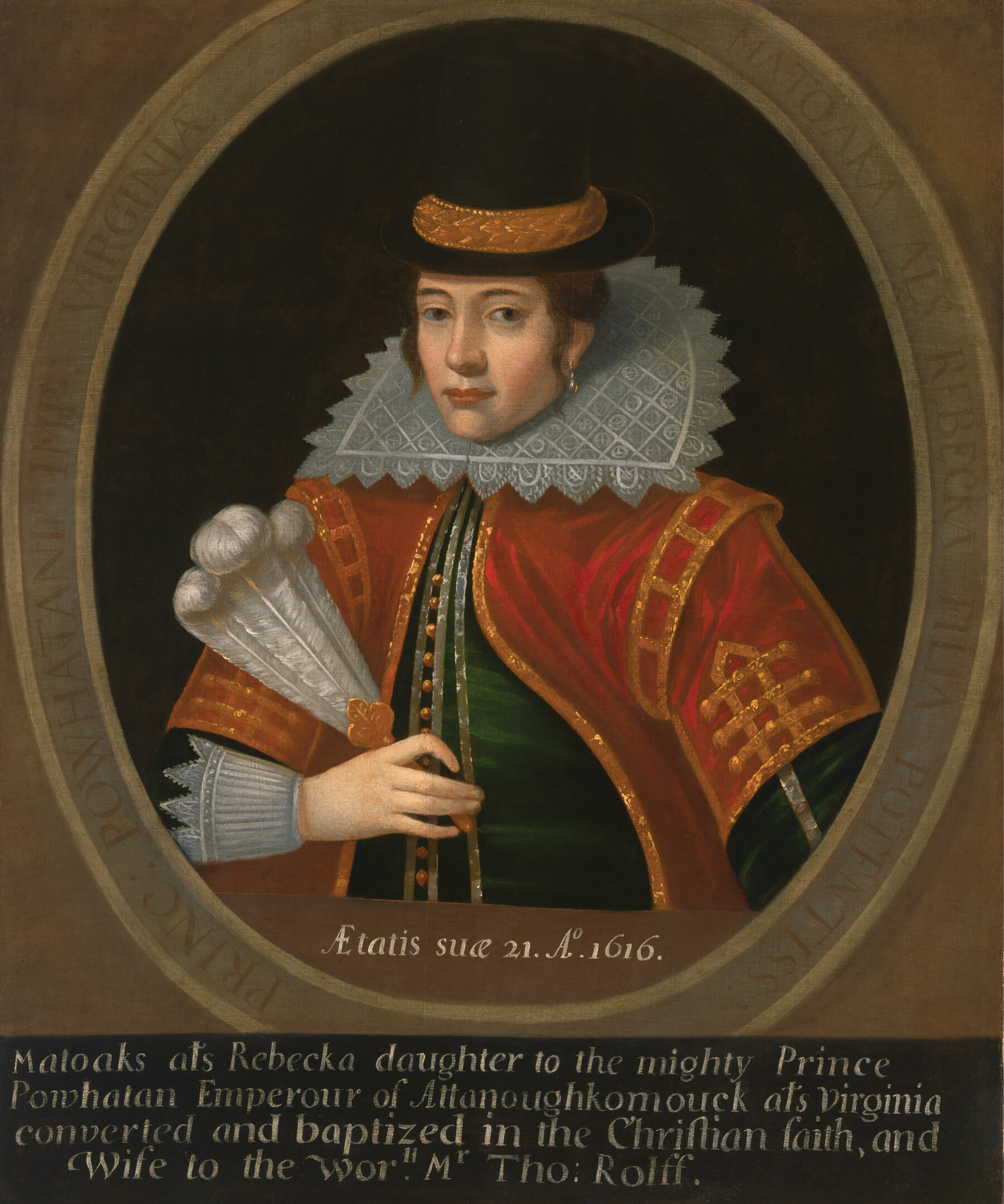
A portrait of Pocahontas, then named Rebecca, a Native American woman in European dress. She has very fair skin, light brown eyes and hair, pink cheeks, and lipstick. She wears silver earings, a black hat with a gold band, a red and gold coat over an emerald green shirt with white cuffs and gold buttons, and an over-sized, half-circle shaped white lace collar. She is seated in a 3/4 pose, with her body angled towards the left of the image, but her eyes turn towards the viewer; her gaze rests on the viewer. She holds a large white feather in her right hand. She appears inside an oval frame engraved with her names. The background inside the oval is plain black, and outside the oval is light brown. At the bottom of the image is a black strip with a description of the portrait that reads, “Matoaks ats Rebecka daughter to the mighty Prince Powhatan Emperour of Attanoughkomouck ats Virginia converted and baptized in the Christian faith, and Wife to the wor.Mr. Tho:Rolff.”
In the first two years of Jamestown’s existence, relations were mostly peaceful. At one point, Smith was captured and threatened with execution by Powhatan, only to be rescued by Pocahontas, reputedly the favorite among his many children by dozens of wives. The incident has come down in legend and film as an example of a rebellious, love-struck teenager defying her father. In fact, it was probably part of an elaborate ceremony designed by Powhatan to demonstrate his power over the colonists and incorporate them into his realm. To Powhatan, Jamestown was one of the many towns under his rule. Pocahontas subsequently became an intermediary between the two peoples.
But after Pocahontas married a fellow Powhatan and stopped coming to Jamestown and John Smith returned to England, tension grew between the two groups. The First Anglo-Powhatan War broke out in 1610, with Powhatans killing settlers who stole corn and the English indiscriminately killing Powhatans and destroying towns to try to scare them into feeding the colony. Pocahontas herself was captured and held as a hostage by the settlers in 1613. As part of the restoration of peace, she converted to Christianity and in 1614 married the English colonist John Rolfe. Two years later, she accompanied him to England, where she caused a sensation in the court of James I as a symbol of Anglo-Indian harmony and missionary success. In England, she became sick and died in 1617. Her father died the following year.
The Second and Third Anglo-Powhatan Wars
Once it became clear that the English were interested in establishing a constantly expanding colony, not a trading post, conflict with the Powhatans was inevitable. The peace that began in 1614 ended abruptly in 1622 when Powhatan’s brother and successor, Opechancanough, led a brilliantly planned surprise attack that in a single day wiped out a quarter of Virginia’s settler population of 1,200. Opechancanough hoped the English would abandon Virginia or submit to his rule, but instead the surviving 900 colonists organized themselves into military bands, which then massacred scores of Powhatans and devastated their towns. By going to war, declared Governor Francis Wyatt, the Powhatans had forfeited any claim to the land. Virginia’s policy, he continued, must now be nothing less than the “expulsion of the savages to gain the free range of the country.”
Native Americans remained a significant presence in Virginia and on its western border, but the English victory in the Second Anglo-Powhatan War began to shift the balance of power. Although most of the settlers whom the Virginia Company had sent had died from war, starvation, or disease, more kept coming. The Third Anglo-Powhatan War, which began in 1644, caused the deaths of some 500 colonists. But by then, colonists outnumbered Powhatans, whose population was reduced due to war, disease, and flight. After the war ended in 1646 with Opechancanough’s death, Virginia forced a treaty on the peoples who had been part of Powhatan’s realm. The treaty acknowledged their subordination to the government at Jamestown and required them to move to reservations and not enter areas of European settlement without permission. This policy of separation followed the precedent already established in Ireland. Settlers spreading inland continued to seize Native lands.
The destruction caused by the First and Second Anglo-Powhatan Wars had already doomed the Virginia Company. Investors had never turned a profit. In 1624, the company surrendered its charter and Virginia became the first royal colony, its governor now appointed by the crown. The government in London for years was preoccupied with affairs at home and paid little attention to Virginia. Henceforth, the local elite controlled the colony’s development. And that elite was growing rapidly in wealth and power thanks to the cultivation of a crop introduced from the West Indies by John Rolfe—tobacco.
A Tobacco Colony
King James I considered tobacco “harmful to the brain and dangerous to the lungs” and issued a spirited warning against its use. But increasing numbers of Europeans enjoyed smoking and believed the tobacco plant had medicinal benefits. As a commodity with an ever-expanding mass market in Europe, tobacco became Virginia’s substitute for gold. It enriched an emerging class of tobacco planters, as well as members of the colonial government who assigned good land to themselves. The crown profited from customs duties (taxes on tobacco that entered or left the kingdom). By 1624, more than 200,000 pounds were being grown, producing startling profits for landowners. Forty years later, the crop totaled 15 million pounds, and it doubled again by the 1680s. The spread of tobacco farming produced a dispersed society with few towns and little social unity. It inspired a get-rich-quick attitude and a frenzied scramble for land and labor. By the middle of the seventeenth century, a new influx of immigrants with ample financial resources—sons of merchants and English gentlemen—had taken advantage of the headright system and governmental connections to acquire large estates along navigable rivers. They established themselves as the colony’s social and political elite.
The expansion of tobacco cultivation also led to an increased demand for field labor, met for most of the seventeenth century by young male indentured servants. Despite harsh conditions of work in the tobacco fields, a persistently high death rate, and laws mandating punishments from whipping to an extension of service for those who ran away or were unruly, the abundance of land continued to attract migrants. Of the 120,000 English immigrants who entered the Chesapeake region during the seventeenth century, three-quarters came as servants.
Glossary
- headright system
- A land-grant policy that promised fifty acres to any colonist who could afford passage to Virginia, as well as fifty more for any accompanying servants. The headright policy was eventually expanded to include any colonists and was also adopted in other colonies.
- House of Burgesses
- The first elected assembly in colonial America established in 1619 in Virginia. Only wealthy landowners could vote in its elections.
- Anglo-Powhatan Wars
- Three wars fought between the Powhatans and the Jamestown colonists in 1610–1614, 1622–1626, and 1644–1646.