THE NEW ENGLAND WAY
The Rise of Puritanism
As Virginia and Maryland evolved toward societies dominated by a small aristocracy ruling over numerous bound laborers, a very different social order emerged in seventeenth-century New England. The early history of that region is intimately connected to the religious movement known as “Puritanism,” which arose in England late in the sixteenth century. The term was initially coined by opponents to ridicule those not satisfied with the progress of the Protestant Reformation in England, who called themselves not Puritans but “godly” or “true Protestants.” Puritanism came to define a set of religious principles and a view of how society should be organized. Puritans differed among themselves on many issues. But all shared the conviction that the Church of England retained too many elements of Catholicism in its religious rituals and doctrines. Puritans saw elaborate church ceremonies, the rule that priests could not marry, and ornate church decorations as vestiges of “popery.” Many rejected the Catholic structure of religious authority descending from a pope or king to archbishops, bishops, and priests. Only independent local congregations, they believed, should choose clergymen and determine modes of worship. These Puritans were called “Congregationalists.” All Puritans shared many of the beliefs of the Church of England and the society as a whole, including a hatred of Catholicism and a pride in England’s greatness as a champion of liberty. But they believed that neither the church nor the nation was living up to its ideals.
More information
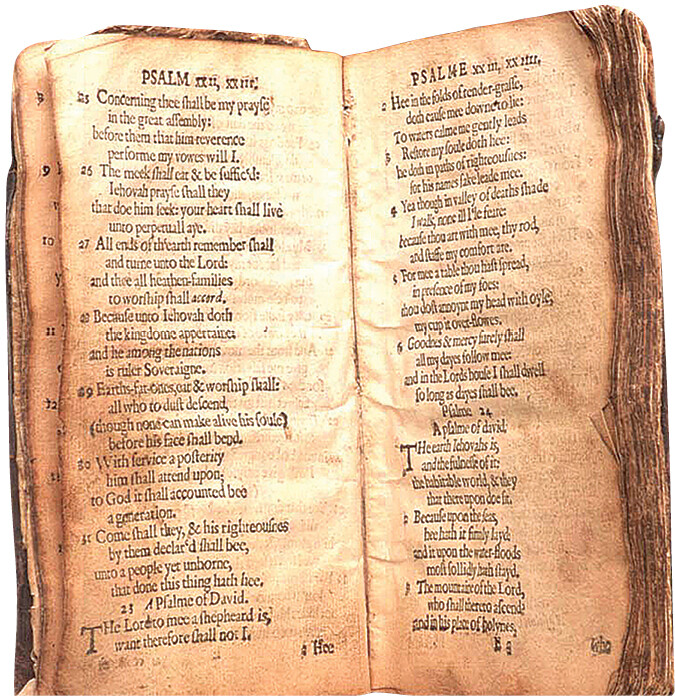
An old book with yellowed, wrinkled pages with worn edges. It is open, displaying text in an antique typeface. “Psalm” can be read at the top of one page of text.
The first book printed in the English mainland colonies, The Whole Book of Psalmes Faithfully Translated into English Metre was published in Cambridge, Massachusetts, in 1640. Worshipers used it to sing psalms (religious songs from the Bible, sung in Massachusetts unaccompanied by music, which Puritan churches banned).
Puritans considered religious belief a complex and demanding matter and urged believers to seek the truth by reading the Bible and listening to sermons by educated ministers, rather than devoting themselves to sacraments administered by priests and to what Puritans considered formulaic prayers. The sermon was the central rite of Puritan practice. In the course of a lifetime, according to one estimate, the average Puritan listened to some 7,000 sermons. In their religious beliefs, Puritans followed the ideas of the French-born Swiss theologian John Calvin. The world, Calvin taught, was divided between the elect and the damned. All persons sought salvation, but whether one was among the elect destined to be saved had already been determined by God. His will, ultimately, was unknowable, and nothing one did on earth—including prayers, good works, and offerings—would make any difference. But while there were no guarantees of salvation, worldly success—leading a good life, prospering economically—might well be indications of God’s grace. Idleness and immoral behavior were sure signs of damnation.
Moral Liberty
Puritanism, however, was not simply a set of ideas but a state of mind, a zealousness in pursuing the true faith that alienated many who held differing religious views. A minority of Puritans (such as those who settled in Plymouth Colony) became separatists, abandoning the Church of England entirely to form their own independent churches. Most, however, hoped to purify the church from within. But in the 1620s and 1630s, as Charles I seemed to be moving toward a restoration of Catholic ceremonies and the Church of England dismissed Puritan ministers and censored their writings, many Puritans decided to emigrate. They departed England not so much because of persecution, but because they feared that “Popish” practices had grown to such “an intolerable height,” as one minister complained, that “the consciences of God’s saints . . . could no longer bear them.” When Puritans emigrated to New England, they hoped to escape what they believed to be the religious and worldly corruptions of English society. They would establish a “city set upon a hill,” a Bible Commonwealth whose influence would flow back across the Atlantic and rescue England from godlessness and social decay.
Like so many other immigrants to America, Puritans came in search of liberty, especially the right to worship and govern themselves in what they deemed a truly Christian manner. Freedom for Puritans was primarily a spiritual affair. It implied the opportunity and the responsibility to obey God’s will through self-government and self-denial. It certainly did not mean unrestrained action, improper religious practices, or sinful behavior, of which, Puritans thought, there were far too many examples in England. In a 1645 speech to the Massachusetts legislature explaining the Puritan conception of freedom, John Winthrop, the colony’s governor, distinguished sharply between two kinds of liberty. “Natural” liberty, or acting without restraint, suggested “a liberty to do evil.” This was the false idea of freedom supposedly adopted by the Irish, Indians, and bad Christians generally. Genuine “moral” liberty—the Christian liberty described in Chapter 1—meant “a liberty to that only which is good.” It was quite compatible with severe restraints on speech, religion, and personal behavior. True freedom, Winthrop insisted, depended on “subjection to authority,” both religious and secular; otherwise, anarchy was sure to follow. To Puritans, liberty meant that the elect had a right to establish churches and govern society, not that others could challenge their beliefs or authority.
The Pilgrims at Plymouth
The first Puritans to arrive in America were a group of separatists known as the Pilgrims. They had already fled to the Netherlands in 1608, believing that Satan had begun “to sow errors, heresies and discords” in England. A decade later, fearing that their children were being corrupted by being drawn into the surrounding culture, they decided to emigrate to Virginia. The expedition was financed by a group of English investors who hoped to establish a base for profitable trade. In September 1620, the Mayflower, carrying 150 settlers and crew (among them many non-Puritans), embarked from England. Blown off course, they landed not in Virginia but hundreds of miles to the north, on Cape Cod. Here the 102 who survived the journey established the colony of Plymouth. Before landing, the Pilgrim leaders drew up the Mayflower Compact, in which the forty-one adult men going ashore agreed to obey “just and equal laws” enacted by representatives of their own choosing. This was the first written frame of government in what is now the United States. Men not normally signatories to such documents—printers, carpenters, even indentured servants—were among those who affixed their names. (This was over 200 years before most working-class men were allowed to vote in Great Britain.) More than a quarter of the Mayflower’s passengers were female, but they were not invited to join the compact because the men saw them as fully dependent on their husbands and fathers.
More information
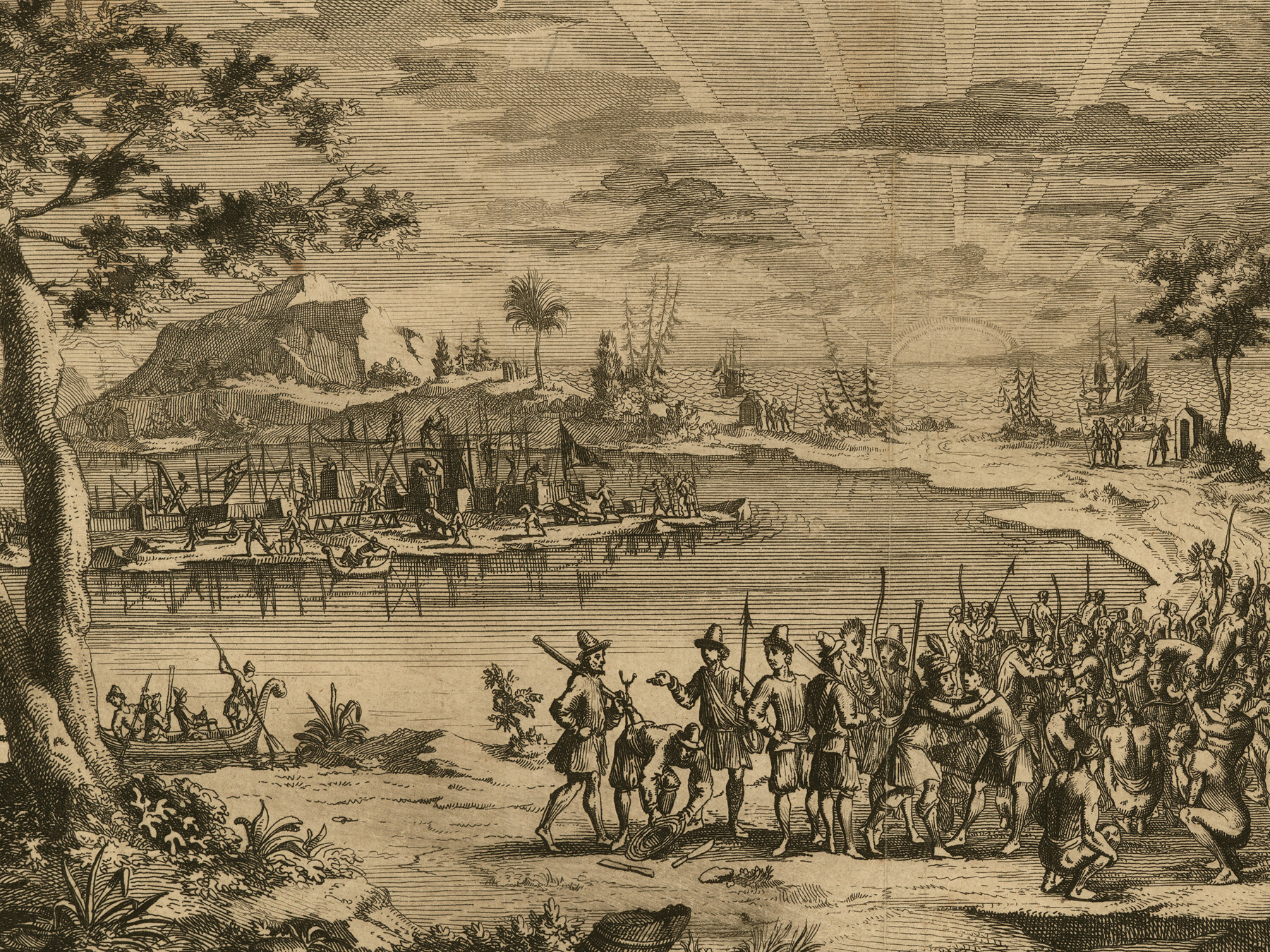
An engraving shows the English explorer Bartholomew Gosnold encountering Native Americans. In the foreground, Gosnold and a group of English explorers stand on the beach holding spears and sticks. They wear tall hats, long shirts, and boots. One crouches down, picking up two knives and what appears to be a hat that he dropped off of the ground. The Native Americans are grouped in the bottom right corner of the image; they are mostly naked and crouch on the ground. Some hold bows and arrows, but many are weaponless. A large tree grows from the bottom left of the engraving and stretches up the left side of the frame. Behind it, more settlers are paddling a rowboat up to the shore. The beach they stand on is U-shaped, encircling a body of water in the center of the image. In the middle of the water is an island, crowded with builders and half-finished structures. The water is calm and still. Farther down the beach there are more soldiers and some small structures. On the farthest point of the U-shaped beach there is a large mountain. Beyond that, the ocean is visible. The ocean has many waves and two large ships are anchored off the shore. On the horizon, the sun is rising; it is half-visible over the water and its rays stretch across the cloudy sky.
An early-seventeenth-century engraving shows Algonquian-speaking Native Americans greeting the English explorer Bartholomew Gosnold. Gosnold landed at Cape Cod in 1602 and then established a small outpost on nearby Cuttyhunk Island. The region’s Native peoples had much experience with Europeans before Pilgrims settled there.
A century earlier, when Giovanni da Verrazano explored the Atlantic coast of North America, he encountered thickly settled towns. By the time the Pilgrims landed, hundreds of European fishing vessels had operated off New England, landing to trade with Indians and bringing, as elsewhere, epidemics. The Pilgrims arrived in an area whose Native population had recently been devastated by smallpox. They established Plymouth on the site of an abandoned Patuxet Indian town whose fields had been cleared before the epidemic and were ready for cultivation. Nonetheless, the settlers arrived six weeks before winter without food or farm animals. Half died during the first winter. The colonists only survived through the help of local Indians, notably Squanto, a Patuxet man who had grown up in the town where the Pilgrims settled. With twenty other Indians, Squanto had been kidnapped and brought to Spain in 1614 by English sailors, who sold them as slaves. Squanto somehow made his way to London, where he learned English. He returned home in 1619 only to find his town abandoned. He taught the Pilgrims where to fish and how to plant corn and served as an interpreter between them and Massasoit, chief of the powerful Wampanoags. They agreed to an alliance, in which the Wampanoags would help to feed and defend Plymouth and the Pilgrims would help to fight the Wampanoags’ enemies, including the Narragansetts. The celebration and renewal of this treaty one year later, in the autumn of 1621, later became known as the first Thanksgiving.
The Pilgrims hoped to establish a society based on the lives of the early Christian saints. Their government rested on the principle of consent, and voting was not restricted to church members. All land was held in common until 1627, when it was divided among the settlers. Plymouth survived as an independent colony until 1691, but it was soon overshadowed by Massachusetts Bay to its north.
The Great Migration
Chartered in 1629, the Massachusetts Bay Company was founded by a group of London merchants who hoped to further the Puritan cause and turn a profit through trade with the Indians. The first ships sailed from England in 1630, and by 1642 some 21,000 Puritans had immigrated to Massachusetts. Long remembered as the Great Migration, this flow of population represented less than one-third of English emigration in the 1630s. Far more English settlers arrived in Ireland, the Chesapeake, and the Caribbean. After 1640, migration to New England virtually ceased, and in some years more colonists left the region than arrived. Nonetheless, the Great Migration established the basis for a stable and thriving society.
In many ways, the settling of New England was unique. Although servants represented about one-quarter of the Great Migration, most settlers arrived in Massachusetts in families. They came for many reasons, including the desire to escape religious persecution, anxiety about the future of England, and the prospect of economic betterment. Compared with colonists in Virginia and Maryland, they were older and more prosperous, and the number of men and women more equally balanced. Because of the even sex ratio and New England’s healthier climate, the population grew rapidly, doubling every twenty-seven years. Although the region received only a small fraction of the century’s migration, by 1700 New England’s white population of 91,000 outnumbered that of both the Chesapeake and the West Indies. Nearly all were descendants of those who crossed the Atlantic during the Great Migration.
The Puritan Family
While the imbalance between male and female migrants made it difficult for patriarchal family patterns fully to take root in the Chesapeake until the end of the seventeenth century, they emerged very quickly in New England. Whatever their differences with other Englishmen on religious matters, Puritans shared with the larger society a belief in male authority within the household as well as an adherence to coverture, the common-law tradition that severely limited married women’s legal and economic rights. Puritans in America carefully emulated the family structure of England, insisting that the obedience of women, children, and servants to men’s will was the foundation of social stability. They believed that the father’s authority was vital in a farming society without large numbers of slaves or servants because control over the labor of one’s family was essential to a man’s economic success.
To be sure, Puritans deemed women to be the spiritual equals of men, and women were allowed to become full church members. Although all ministers were men, the Puritan belief in the ability of believers to interpret the Bible opened the door for some women to claim positions of religious leadership. The ideal Puritan marriage was based on reciprocal affection and companionship, and divorce was legal. Prospective marriage partners were even allowed to “bundle,” to spend the night together in one of the family’s beds—with a board between their bodies. Yet within the household, the husband’s authority was virtually absolute. Indeed, a man’s position as head of his family was thought to replicate God’s authority in spiritual matters and the authority of the government in the secular realm. Magistrates sometimes intervened to protect wives from physical abuse, but they also enforced the power of fathers over their children and husbands over their wives. Moderate physical “correction” was considered appropriate for women who violated their husbands’ sense of proper behavior.
More information
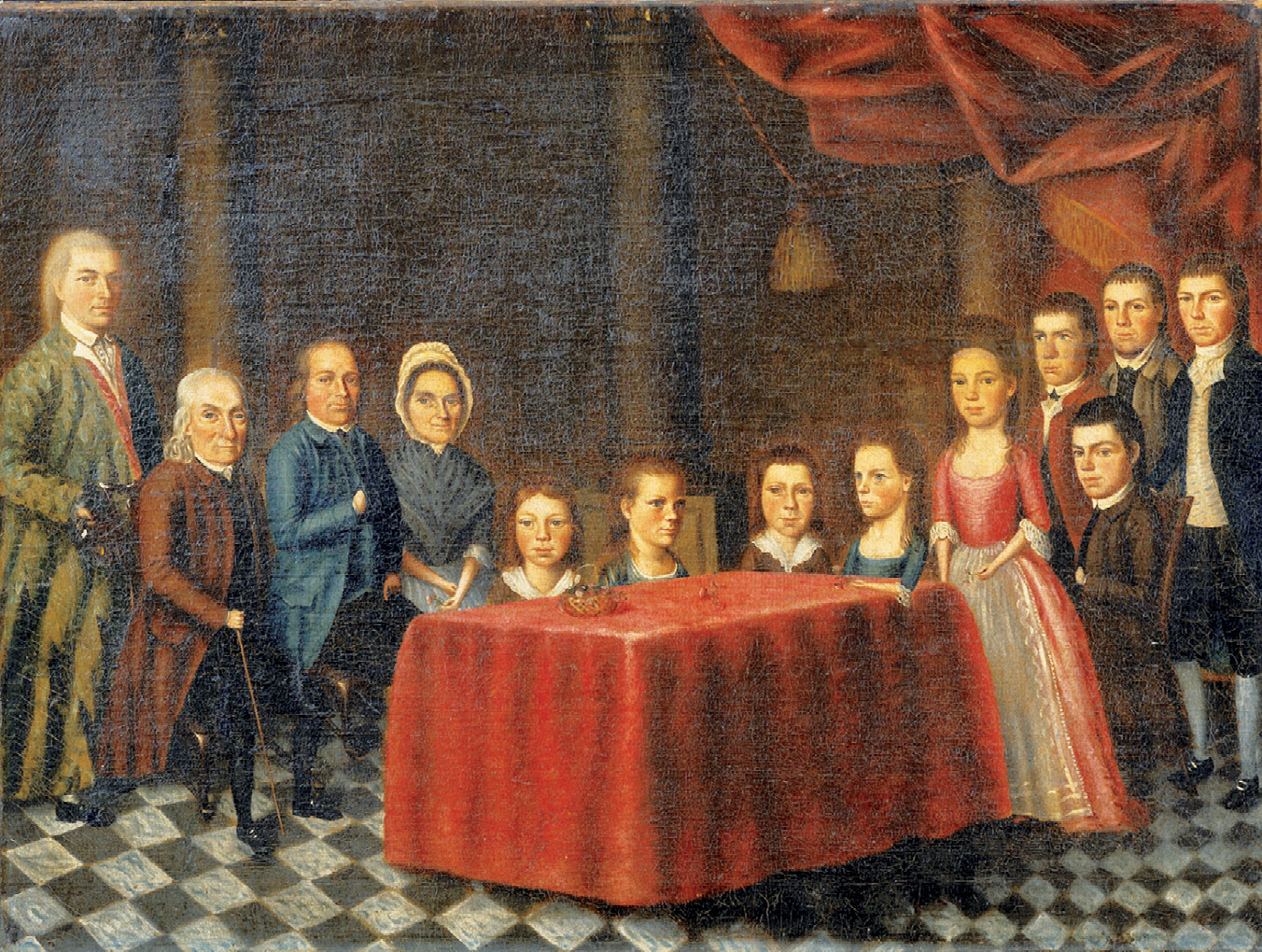
A painting depicting 13 members of a large family of European colonists. In the center of the frame is a large table covered with a red cloth. Four children sit at the table, a young woman stands to the right with a seated young man. Three other men stand behind them. On the left side, three older people are seated, one woman in a bonnet and two men, with balding heads and one with gray hair. Behind them stands a younger man with light colored hair. The painting is distinctive in that the people are portrayed with oversized heads relative to their body dimensions.
The Savage Family, a 1779 painting by the New England artist Edward Savage, depicts several generations of a typically numerous Puritan family.
Their responsibilities as wives and mothers defined women’s lives. A “goodwife” was supposed to be industrious in her household work, pious in her religion, and obedient to her husband. To do anything else required elaborate justifications and even apologies. New England Puritan Anne Bradstreet became a published poet but claimed she had not intended her work to be published. In one of her poems, she acknowledged that “I am obnoxious to each carping tongue, Who says my hand a needle better fits, A Poet’s Pen, all scorn, I should thus wrong; For such despite [spite] they cast on female wits.” The family was the foundation of strong communities, and unmarried adults seemed a danger to the social fabric. An early law of Plymouth declared that “no single person be suffered to live of himself.” The typical New England woman married at twenty-two, a younger age than her English counterparts, and gave birth seven times. Because New England was a far healthier environment than the Chesapeake, more children survived infancy. Thus, much of a woman’s adult life was devoted to bearing and rearing children.
Government and Society in Massachusetts
In a sermon aboard the Arabella, on which he sailed for Massachusetts in 1630, John Winthrop spoke of the settlers binding themselves together “in the bond of brotherly affection” in order to promote the glory of God and their own “common good.” Puritans feared excessive individualism and lack of social unity. Unlike the dispersed plantation-centered society of the Chesapeake, the leaders of Massachusetts organized the colony in self-governing towns. Groups of settlers received a land grant from the colony’s government and then subdivided it, with residents awarded house lots in a central area and land on the outskirts for farming. Much land remained in commons, either for collective use or to be divided among later settlers or the sons of the town’s founders. Each town had its own Congregational Church. Each, according to a law of 1647, was required to establish a school, since the ability to read the Bible was central to Puritan belief. To train an educated ministry, Harvard College was established in 1636 (nearly a century after the Royal University of Mexico, founded in 1551), and two years later the first printing press in English America was established in Cambridge.
The government of Massachusetts reflected the Puritans’ religious and social vision. Wishing to rule the colony without outside interference and to prevent non-Puritans from influencing decision making, the shareholders of the Massachusetts Bay Company emigrated to America, taking the charter with them and transforming a commercial document into a form of government. At first, the eight shareholders chose the men who ruled the colony. In 1634, a group of deputies elected by freemen (landowning church members) was added to form a single ruling body, the General Court. Ten years later, company officers and elected deputies were divided into two legislative houses. Unlike in Virginia, whose governors were appointed first by a faraway company and after 1624 by the crown, or Maryland, where authority rested with a single proprietor, the freemen of Massachusetts elected their governor.
More information
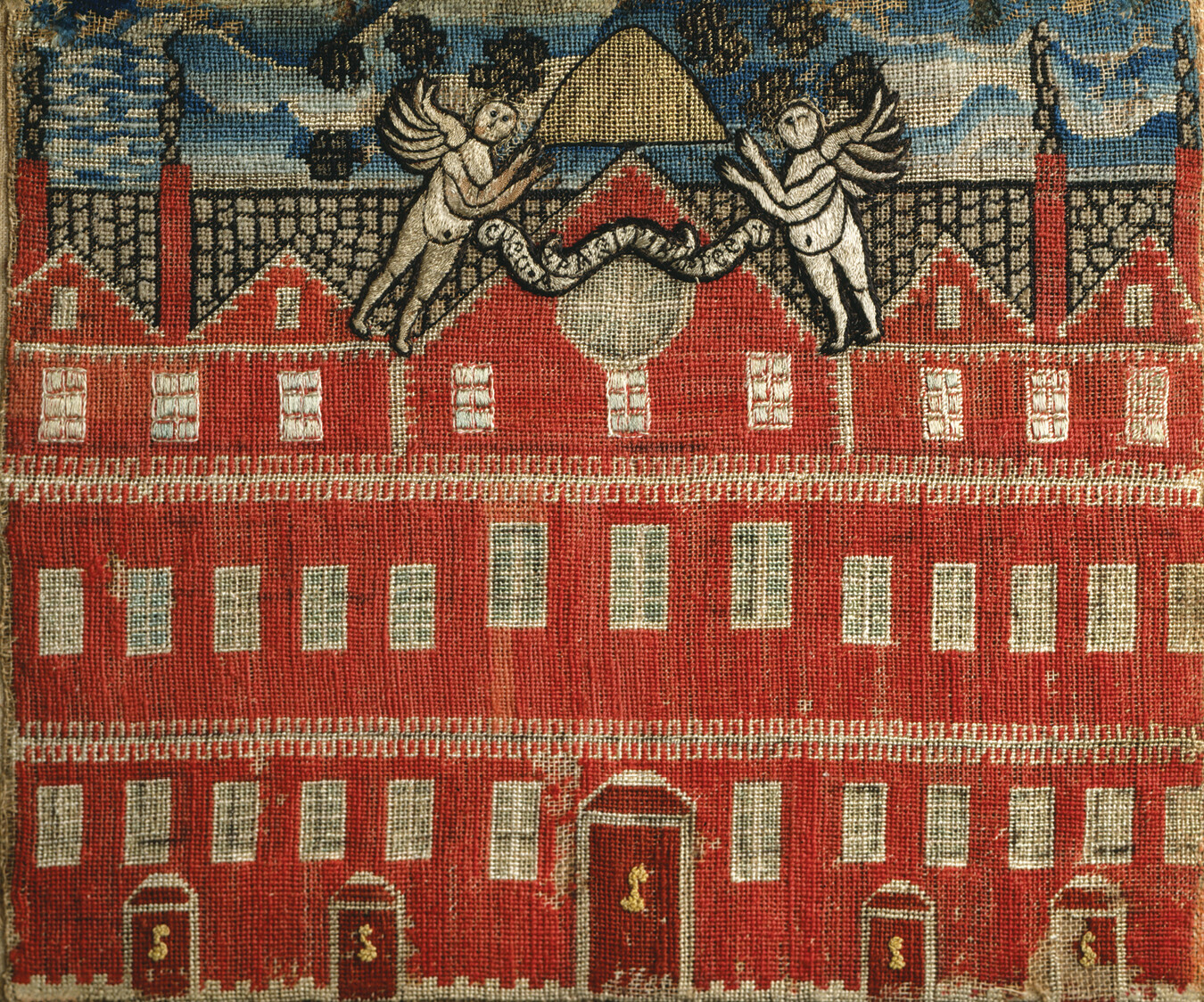
An embroidered banner depicting a red building with three doors and three stories with windows and several smoking chimneys. Two cherubs fly over the center of the scene, with a banner with text. There is also a golden triangle over them.
An embroidered banner depicting the main building at Harvard, the first college established in the English colonies. It was probably made by a Massachusetts woman for a husband or son who attended Harvard, which admitted only male students.
The principle of consent was central to Puritanism. Church government was decentralized—each congregation, as one minister put it, had “complete liberty to stand alone.” Churches were formed by voluntary agreement among members, who elected the minister. No important church decision was made without the agreement of the male members. Towns governed themselves, and local officials, delegates to the General Court, and the colonial governor were all elected. Puritans, however, were hardly believers in equality. Church membership, a status that carried great prestige and power, was a restrictive category. Anyone could worship at a church, or, as the Puritans preferred to call it, meeting house, but to be a full member required demonstrating that one had experienced divine grace and could be considered a “visible saint,” usually by testifying about a conversion experience. Although male property holders generally chose local officials, voting in colony-wide elections was limited to men who had been accepted as full church members. As time went on, this meant that a smaller and smaller percentage of the population controlled the government. Puritan democracy was for those within the circle of church membership; those outside the boundary occupied a secondary place in the Bible Commonwealth.
Church and State in Puritan Massachusetts
Seventeenth-century New England was a hierarchical society in which socially prominent families were assigned the best land and the most desirable seats in church. “Some must be rich and some poor, some high and eminent in power and dignity; others mean and in subjection,” declared John Winthrop. This was part of God’s plan, reinforced by man-made law and custom. The General Court forbade ordinary men and women from wearing “the garb of gentlemen.” Ordinary settlers were addressed as “goodman” and “goodwife,” while the better sort were called “gentleman” and “lady” or “master” and “mistress.” When the General Court in 1641 issued a Body of Liberties outlining the rights and responsibilities of Massachusetts colonists, it adopted the traditional understanding of liberties as privileges that derived from one’s place in the social order. While some liberties applied to all inhabitants, there were separate lists of rights for freemen, women, children, and servants. The Body of Liberties also allowed for slavery. The first African slave appears in the records of Massachusetts Bay in 1640.
Massachusetts forbade ministers from holding office so as not to interfere with their spiritual responsibilities. But church and state were closely interconnected. The law required each town to establish a church and to levy a tax to support the minister. The Body of Liberties affirmed the rights of free speech and assembly and equal protection of the law for all within the colony, but the laws of Massachusetts prescribed the death penalty for, among other things, worshiping “any god, but the lord god,” practicing witchcraft, or committing blasphemy.
Like many others in the seventeenth century, Puritans believed that religious uniformity was essential to social order. They did not believe in religious toleration—theirs was the one truth. Religious liberty meant the liberty to practice this truth. The purpose of the Puritan experiment was to complete the Reformation and, they hoped, spread it back to England. But they set their experiment up in the land of the Wampanoags, who had their own ideas about order, religion, and liberty.
Native Nations and New England
Massasoit and the Wampanoags sought alliance with the Pilgrims in order to change the balance of power in the region. The epidemic that destroyed Squanto’s town had also hit the Wampanoags, but it had not reached the Narragansetts, who used the devastation to force the Wampanoags to pay them tribute. After forging an alliance and trading partnership with the English, Massasoit was able to persuade the Narragansetts to back down. The Wampanoags became intermediaries between the English and other Native groups, profiting from the trade and increasing their regional power. Massasoit consolidated diverse Native communities that had been torn apart by disease, including Squanto’s Patuxets, into a strong and prosperous Wampanoag nation.
Like the Pilgrims, the English colonists who came to Massachusetts Bay established Boston and other settlements on formerly Native towns and fields and were recruited as allies and trading partners by local Indians. These included the Massachusetts Indians, on whose land they settled, and the Narragansetts, who had been shut out of Plymouth trade by the Wampanoags.
Although Puritans announced that they intended to bring Christian faith to the Indians, they made no sustained conversion efforts in the early decades of settlement. Instead, New England’s leaders feared that Native Americans were converting colonists. To Puritans, Native people enjoyed freedom, but the wrong kind—what Winthrop condemned as undisciplined “natural liberty.” Yet many men and especially women who spent time in Native communities found the relatively egalitarian and communal life more appealing than the harsh dictates and patriarchal hierarchy of Puritan towns. In 1642, the Connecticut General Court set a penalty of three years at hard labor for any colonist who abandoned “godly society” to live with Indians. To counteract the attraction of Native life, the leaders of New England also encouraged the publication of captivity narratives by those captured by Indians. The most popular was The Sovereignty and Goodness of God by Mary Rowlandson, who had immigrated with her parents as a child in 1639 and was seized along with a group of other settlers and held for three months until ransomed in the 1670s. Rowlandson acknowledged that she had been well treated and suffered “not the least abuse or unchastity,” but her book’s overriding theme was her determination to return to Christian society.
The Pequot War
Like the Wampanoags, the Pequots on the north shore of Long Island Sound and the lower Connecticut River valley became a regional power through European trade and alliance, in their case with the Dutch of New Netherland. The Pequots forced their neighbors the Mohegans and the Narragansetts to pay them tribute and conduct Dutch trade through them. But in the 1630s, the Narragansetts and their Mohegan allies used their alliance with the Massachusetts Bay Colony to fight the Pequots.
More information
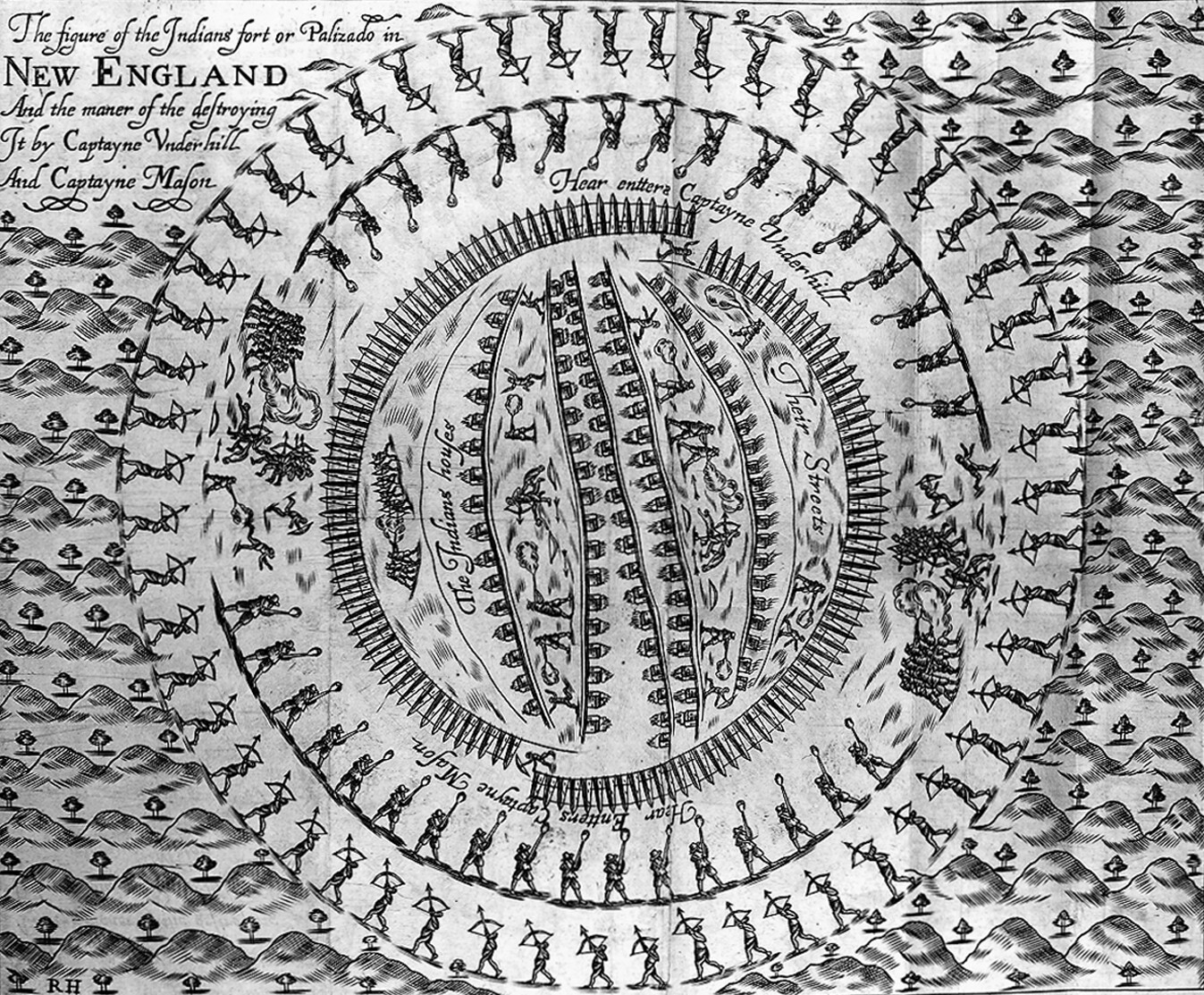
A stylized engraving depicting an attack on and destruction of a Pequot village by Europeans and Native American allies. The village is depicted as a perfect circular enclosure surrounded by a palisade of sharpened stakes. Within are rows of houses. Among the houses are images of men with firearms shooting people fighting with boys and arrows or fleeing. Around the palisade is a ring of nearly identical gunmen firing on the village. The ring is broken in two places by nearly identical small battle scenes with gunmen firing on fighters with bows and arrows. The ring of men with firearms is surrounded by an unbroken ring of Native Americans with bows and arrows, also aiming inward. Fanciful small round hills surround the scene. In the upper left, there is script reading, “The figure of the Indians’ fort or Palizado in New England and the manner of the destroying it by Captain Underhill and Captain Mason.”
An engraving from John Underhill’s News from America, published in London in 1638, shows the destruction of the Pequot town on the Mystic River in 1637. The colonial forces are firing guns, while the Narragansetts and Mohegans shoot bows and arrows.
In May 1637, a force of 500 Narragansetts, 70 Mohegans, and 90 English colonists from Massachusetts and newer settlements in the Connecticut River valley marched on the Pequots. The fighting was fiercest at a Pequot town on the Mystic River. The English commanders set the village ablaze, killing over 500 Pequot men, women, and children.
By the end of the Pequot War a few months later, around one-quarter of the Pequot population of 3,000 had been killed. Survivors were enslaved in the homes of New England colonists, sold into slavery in the West Indies or Bermuda, or absorbed into other Native communities. The treaty that restored peace decreed that their name be wiped from the historical record and that surviving Pequots no longer call themselves by that name (neither decree succeeded). Although the Narragansetts and Mohegans had won the war, they also learned that the English were more dangerous enemies than they had realized.
Glossary
- Puritans
- English religious group that sought to purify the Church of England; founded the Massachusetts Bay Colony under John Winthrop in 1630.
- Pilgrims
- Puritan separatists who broke completely with the Church of England and sailed to the Americas aboard the Mayflower, founding Plymouth Colony on Cape Cod in 1620.
- Mayflower Compact
- Document signed in 1620 aboard the Mayflower before the Pilgrims landed at Plymouth; the document committed the group to majority-rule government by its male colonists.
- Great Migration
- Large-scale migration of southern Black people during and after World War I to the North, where jobs had become available during the labor shortage of the war years.
- captivity narratives
- Accounts written by colonists after their time in Indigenous captivity, often stressing the captive’s religious convictions.
- Pequot War
- An armed conflict in 1637 fought between the Pequot Indians and an alliance of Narragansett, Mohegan, and English. The Pequot loss led to most of them being killed, enslaved, or incorporated into other Native nations.
- Winthrop, John
- Puritan leader and governor of the Massachusetts Bay Colony who resolved to use the colony as a refuge for persecuted Puritans and as an instrument of building a “wilderness Zion” in America.