Economic Change in Texas
★ Trace the evolution of Texas’s economy
Over the last 150 years, three great waves of technological change defined and redefined the state’s economy. The first centered on the production of cotton and cattle and their distribution by an extensive railroad system. The second grew out of the oil industry. The third and most recent is tied to the development of the high-tech digital economy.
Cotton
Cotton is one of the oldest crops grown in Texas.10 Missions in San Antonio in the eighteenth century are reported to have produced several thousand pounds of cotton annually, which were spun and woven by local artisans. Large-scale cultivation began in 1821 with the arrival of White Americans. Political independence, statehood, and the ongoing removal of what was then considered the Native American threat in the years before the Civil War promoted the development of the cotton industry. By the mid-nineteenth century, production soared under the expanding institution of slavery, placing Texas eighth among the cotton-producing states in the Union. By 1880, Texas led all states in the production of cotton in most years.
Throughout the 1870s, immigrants from the Deep South and Europe flooded the prairies of Texas to farm cotton. Most of these newly arrived Texans became tenant farmers or sharecroppers. Tenants lived on farms owned by others, providing their own animals, tools, and seed. They generally received two-thirds of the final value of the cotton grown on the farm, while their landlord received the other third. Sharecroppers, a subset of tenant farmers, furnished only their labor and received only half the value of the final product. By the turn of the century, almost half of the state’s farmers were tenants.11
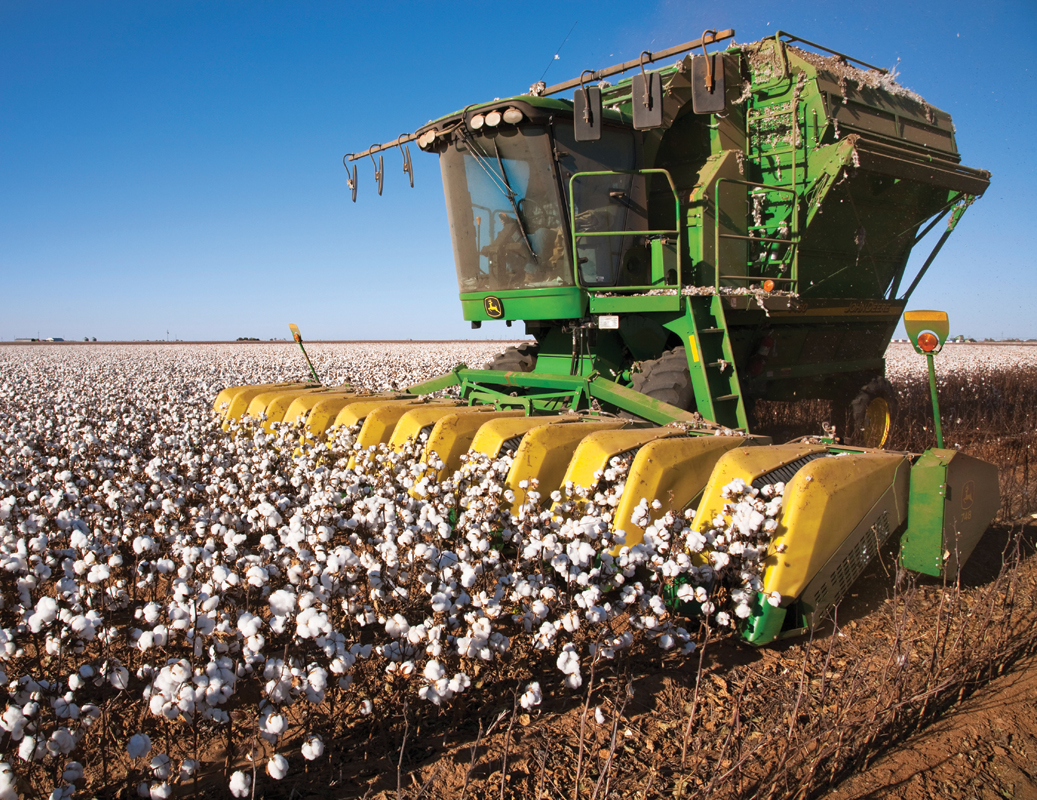
During the late nineteenth century, in most years Texas produced more cotton than any other state. Although over one-third of the cotton produced in the United States still comes from Texas, the importance of the cotton industry to the state’s economy has declined since the 1920s. This photo shows land and machinery used to farm cotton.
Two important consequences resulted from the tenant and sharecropping system. First, it condemned many rural Texans to lives of social and economic dependency. Under the notorious crop lien system, developed by landlords and merchants to extend credit to farmers who did not own their land, farmers profited from their work only after their debts had been paid or new loans had been made to pay off old debts. The result often was to trap farmers in a debt cycle from which they could not escape. Second, the tenant and sharecropping system helped fuel radical political discontent in rural areas, sparking both the Grange and Populist movements. These movements played a major role in defining the style of Texas politics throughout much of the late nineteenth and early twentieth centuries.
Cotton production cycled up and down during this period as farmers experienced a series of crises and opportunities, ranging from destructive boll weevils to an increased demand brought on by World War I to a collapse in prices following the war. Overall, however, the cotton culture began a decline that continued after World War II. The 1930 Census reported that 61 percent of all farmers in Texas were tenant farmers and that one-third of these were sharecroppers. These numbers fell throughout the Great Depression and beyond. By 1987 only 12 percent of all farmers were tenants.12 In 2019, 98.6 percent of Texas farms and ranches were family farms, partnerships, or family-held corporations.13
Cattle
The history of ranching and the cattle industry parallels that of cotton.14 Their origins extend back to the late seventeenth century, when the Spanish colonial authorities brought livestock to the region to feed their missionaries, soldiers, and civilians. During the periods of Mexican rule and independence, ranching offered immigrants an attractive alternative to farming. In the 1830s, traffic in cattle was limited to local areas, but over the next two decades cattle drives and railroads began opening new markets in the east. Following the Civil War, the cattle industry took off, expanding throughout the state.
Ranching and cotton production remain important industries in the state, although they are increasingly dominated by big agribusiness companies. Today, Texas normally leads the nation in both livestock and cotton production. About 37.5 percent of the cotton produced in the United States comes from Texas. In 2020 the cotton crop was over 4.7 million bales, valued at $1.4 billion, most of which was exported to China, Turkey, and Mexico. Production has fluctuated over the last decade because of the severe drought that plagued parts of the state.15
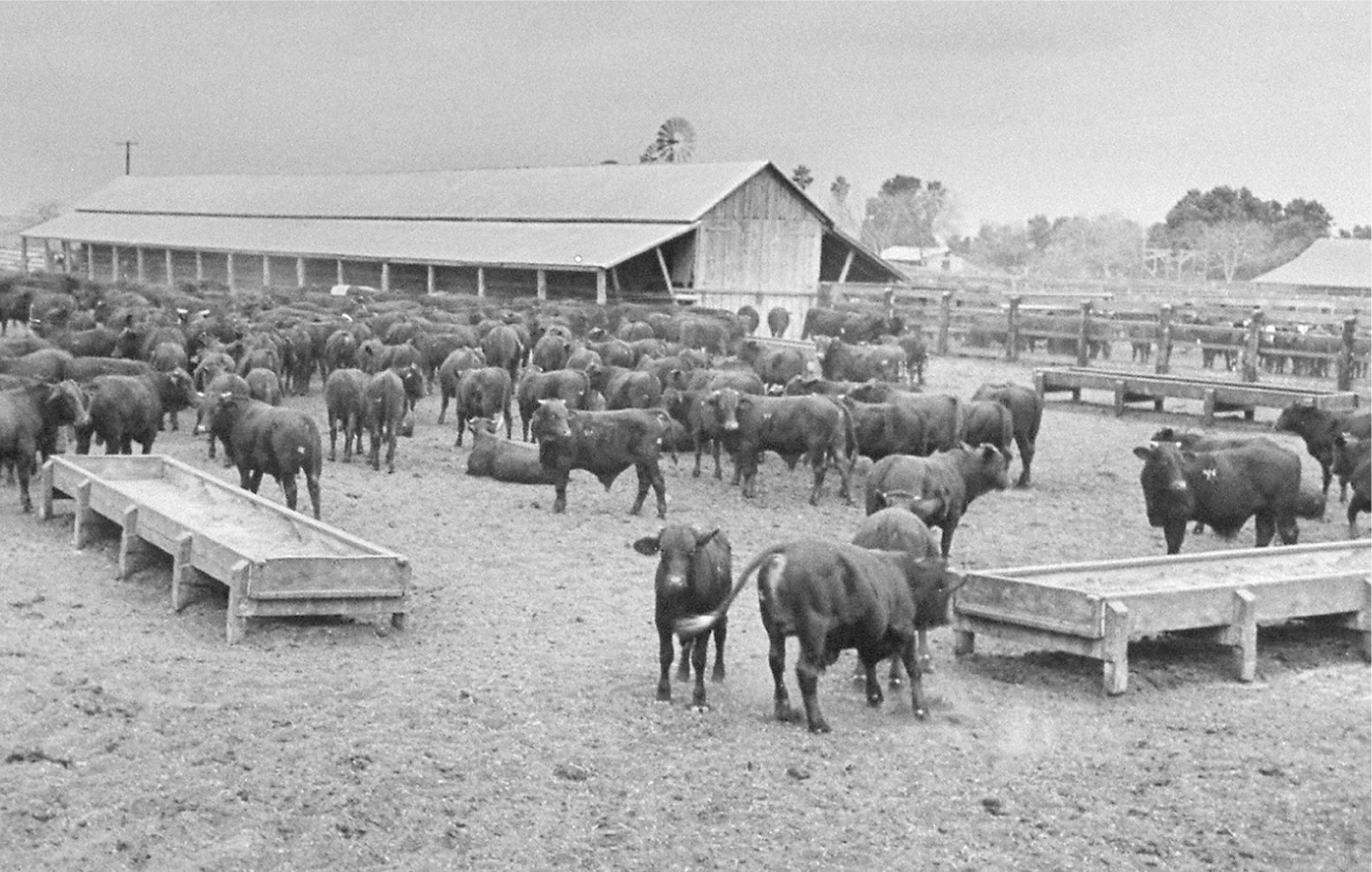
Cattle ranching is another of Texas’s important industries. The most famous ranch in Texas is the King Ranch, shown here in 1950. Currently covering almost 1,300 square miles, it is larger than the state of Rhode Island.
Today, however, neither cotton production nor ranching drives the Texas economy. The number of people making a living from agriculture has dropped significantly over the last 50 years as agribusiness has pushed out the family farm and ranch. In 1940, 23 percent of the population lived on farms and ranches. Another 17 percent were suppliers to farms and ranches or helped assemble, process, or distribute agricultural products. Currently, less than 2 percent of the population lives on farms and ranches, with an additional 15 percent providing support, processing, or distribution services to agriculture.16
In the early twentieth century, a new set of technological breakthroughs challenged the nineteenth-century dominance of cotton and cattle. These breakthroughs focused not on what grew on the land, but on what lay beneath it.
Oil
Spanish explorers first sighted oil oozing out of the ground in the mid-seventeenth century.17 Because there was then no market or demand for it, however, nothing was done to develop this natural resource. Over a century later, encouraged by a growing demand for petroleum products following the Civil War, a scattering of entrepreneurs dug wells, but they proved not commercially viable. The first economically significant oil discovery in Texas was in 1894 in Navarro County near Corsicana. By 1898 the state’s first oil refinery was operating at the site.
What catapulted Texas into the era of oil and gas was the discovery at Spindletop on January 10, 1901. Located three miles south of Beaumont along the Gulf Coast, the Spindletop discovery produced the state’s first oil boom and encouraged large numbers of speculators and entrepreneurs to try their luck in the new business. Within three years, three major oilfields had been discovered within 150 miles of Spindletop. As a result, oil fever spread throughout Texas in the early twentieth century with major oilfields developed all across the state.
The oil and gas industry transformed Texas. A cheap new source of energy helped farms and factories operate more efficiently, reducing the need for farm workers and stimulating manufacturing. This encouraged people to escape rural unemployment by moving to cities with growing numbers of industrial jobs. In addition, cheap oil encouraged automobile production and the building of roads. The Interstate Highway System built during the 1950s and 1960s changed fundamentally the transportation patterns that previously had shaped the movements of people and goods in Texas. The triangle formed by I-35 from San Antonio to Dallas–Fort Worth, I-45 from Dallas–Fort Worth to Houston, and I-10 from Houston to San Antonio became the heartland of the Texas economy and the location of an increasing percentage of the state’s population.
The oil and gas boom brought a new rhythm to economic life in the state. When the economy was tied to cotton and cattle, prices of products could rise and fall, bringing prosperity or gloom to local economies. There were natural seasonal and annual cycles in these agricultural activities, and a bond existed between the land and the people and the communities that formed around them. Oil and gas, on the other hand, introduced a boom-and-bust mentality that carried over into the communities that sprang up around oil and gas discoveries. Rural areas often were unprepared for the population explosion that followed such discoveries: housing often was inadequate or nonexistent, schools quickly became overcrowded, and living conditions were poor as new people arrived hoping to make a fortune. A major discovery that brought large amounts of new oil and gas to market could lead to a sudden collapse in prices. Local prosperity could then quickly turn into depression. When particular fields were tapped out, boomtowns could quickly become ghost towns.
The oil and gas industry also transformed Texas government and its role in the state’s economy. In 1890, after considerable controversy fueled by hostility to railroad companies, a constitutional amendment was passed to create a regulatory agency, the Texas Railroad Commission. In 1917 the commission’s powers were extended to regulation of energy, to ensure that petroleum pipelines were common carriers (that they transported all producers’ oil and gas on equal terms) and to promote well-spacing rules (which controlled production by limiting how closely packed together oil wells could be in a particular field). In the 1930s, in an attempt to limit price fluctuations brought on by the glut of oil on world markets and to avoid wasteful production, the commission won the authority to determine how much every well in Texas was allowed to produce. Through the late 1960s, the Texas Railroad Commission was one of the most important, as well as one of the few democratically elected, regulatory bodies in the nation.
Expanding the power of state government in the economy through the Railroad Commission was only one political effect of the oil and gas industry in Texas. The industry also had an important fiscal effect. Beginning in 1905 the state collected oil production taxes, which rose from $101,403 in 1906 to almost $6 million in 1929. For the 2020–21 biennium, it was estimated that such taxes, known as severance taxes, would contribute $7.8 billion to the state budget, up 7 percent from $7.3 billion in 2018–19. Natural gas production taxes in 2020–21 added another $3 billion to the state budget, similar to the $3.1 billion in 2018–19.18 These revenue numbers have fluctuated wildly in recent years, particularly during the months of the coronavirus pandemic. As we will see in Chapter 11 on public finance in Texas, oil and natural gas production plays an important role in the state’s finances through the severance tax.
Higher education in Texas has also benefited from the oil and gas industry. What many thought was worthless land at the time had been set aside by the state constitution of 1876 and the state legislature in 1883 as the Permanent University Fund to support higher education. As luck would have it, oil was discovered in the West Texas Permian Basin in 1923 on university land. Soon, 17 wells were producing oil there, sparking a building boom at the University of Texas. In 1931 the income of the Permanent University Fund was split between the University of Texas at Austin and Texas A&M University, with the former receiving two-thirds and the latter one-third. In 1984 the income was opened up to all University of Texas and Texas A&M schools. Along with the royalties from other natural resources on university land, oil and gas royalties created one of the largest university endowments in the world. In August 2021 the Permanent University Fund held title to 2.1 million acres in 24 counties, primarily in west Texas, and the market value of the fund was calculated to be almost $32 billion.19
At the end of the twentieth century, the oil and natural gas industry was no longer as important to the state’s economy as it once had been. Production of oil had fallen to below 400,000 barrels in 2010, despite high world prices for oil (see Figure 1.2). Beginning in 2008 new technologies such as horizontal drilling and fracking led to a new boom era of oil and gas production in Texas. Through 2017 a large share of the new production came from the Permian Basin region in west Texas, which may be the second-largest oilfield in the world. The result of this most recent boom is that oil and gas have emerged again as mainstays of the Texas economy, although it is an economy that is far more diversified than in any earlier era. With the boom came greater resources for the state’s budget, but the boom also brought new demands for vast water supplies—an essential component of the new drilling and fracking technologies—and new concerns about the effects of this technology on the environment.20
FIGURE 1.2
Oil Production in Texas
NOTE: These data refer to onshore production in Texas.
SOURCE: Texas Railroad Commission and Macrotrends.
In the spring of 2020, two events posed new challenges to the oil and natural gas industry in Texas. First, in the late spring there was glut of oil on world markets. The price of oil collapsed, driving many oil producers out of business. Second, in response to the Covid-19 pandemic, shelter-in-place policies were put into effect throughout the state and nation, driving the economy into a serious, albeit short, recession. The demand for oil products fell significantly in Texas and around the world. The economic collapse was short-lived and by the fall the economy was in recovery, as was the oil industry. By early 2022 oil prices and production had spiked up again as oil resumed its important role as a lubricant for Texas's economy.
High-Tech Industry

More information
A man wearing a lab coat holding a model of a human heart. The heart is translucent.
Houston has become an important center of medical research. Here Dr. C. Huie Lin of Houston Methodist Research Institute displays a 3-D printed medical model of a patient’s heart, which is used to test surgical techniques.
By the last decade of the twentieth century, new industries and technologies were assuming significant roles in the state’s economy. The 1990s were a period of rapid growth in the Texas economy. At the heart of this boom was a fast-growing manufacturing sector tied to high tech. In the 1990s, Texas went from seventh in the nation in total manufacturing employment to second. In 2021 more than 13 percent of the total output in the state came from manufacturing, and more than 7 percent of the workforce was employed in manufacturing.21
The Austin–San Marcos area is the home of the computer giant Dell and has become a production center for computer chips, personal computers, and related computer hardware and software with such companies as Google, Facebook, Flex, Apple, Oracle, and IBM. Seven of the area’s largest employers are part of the computer or semiconductor industry. The Dallas metropolitan area, particularly north of the city, is the home of a number of important electronic and electronic-equipment companies, including Texas Instruments. Houston also has become known worldwide for its medical center and expanding research facilities in the medical field.
NAFTA, USMCA, and the International Economy
Texas’s place in national and international markets has been shaped by its central location within the United States, its border with Mexico, and its sophisticated transportation infrastructure. Since the signing of the North American Free Trade Agreement (NAFTA) by the United States, Mexico, and Canada, international trade has grown in importance to the Texas economy. The following statistics from 2019 put the importance of Texas’s international trade, particularly with Mexico and Canada, into perspective:22
- Texas exports totaled $328.9 billion, up from $207 billion in 2019.
- Texas exports were 20.5 percent of all U.S. exports in 2021.
- The North American market (Mexico and Canada) was the destination for 41.5 percent of these exports.
- Mexico was the top importer of Texas exports, at almost $108.2 billion in 2021, up from almost $73 billion in 2012.
- Canada’s imports from Texas totaled $28.3 billion in 2021, up from $19 billion in 2010.
The Trump administration’s concerns over undocumented workers in the United States and terrorism added a new dimension to the debate over NAFTA and global trade in Texas. Most Texas political and business leaders continue to believe that expanding trade with Mexico and other countries is a good thing. A free flow of people across the border, however, is another issue. An increasing number of people, particularly conservative Republicans, now question the benefits to Texas of a porous border. During recent election campaigns, Donald Trump, as well as leading Texas Republicans, portrayed the large numbers of undocumented workers in Texas as a burden upon the state’s social services. President Trump claimed that undocumented immigrants have brought crime and drugs across the border with them. Moreover, fears of Islamic terrorists accompanying Mexicans and other Latin Americans seeking work in the United States have led to calls for building walls and fences that will make illegal immigration a thing of the past. Conceding that immigration is a national issue, numerous Texas politicians have called for a stricter policing of the border by state authorities. It is hard to imagine a new stricter border policy not having negative effects on the trade that has followed from NAFTA and expanding global trade.
NAFTA was replaced by the United States-Mexico-Canada Agreement (USMCA) in 2018. Among the changes demanded by the Trump administration were provisions to protect American workers in the car industry from low wages, provisions that increased intellectual property protections, and provisions that opened up the Canadian milk market. Initial fears that free trade among the three nations might be a thing of the past were set aside as they agreed that increased trade under the proper conditions benefited all parties and that tariffs served no one.
More information
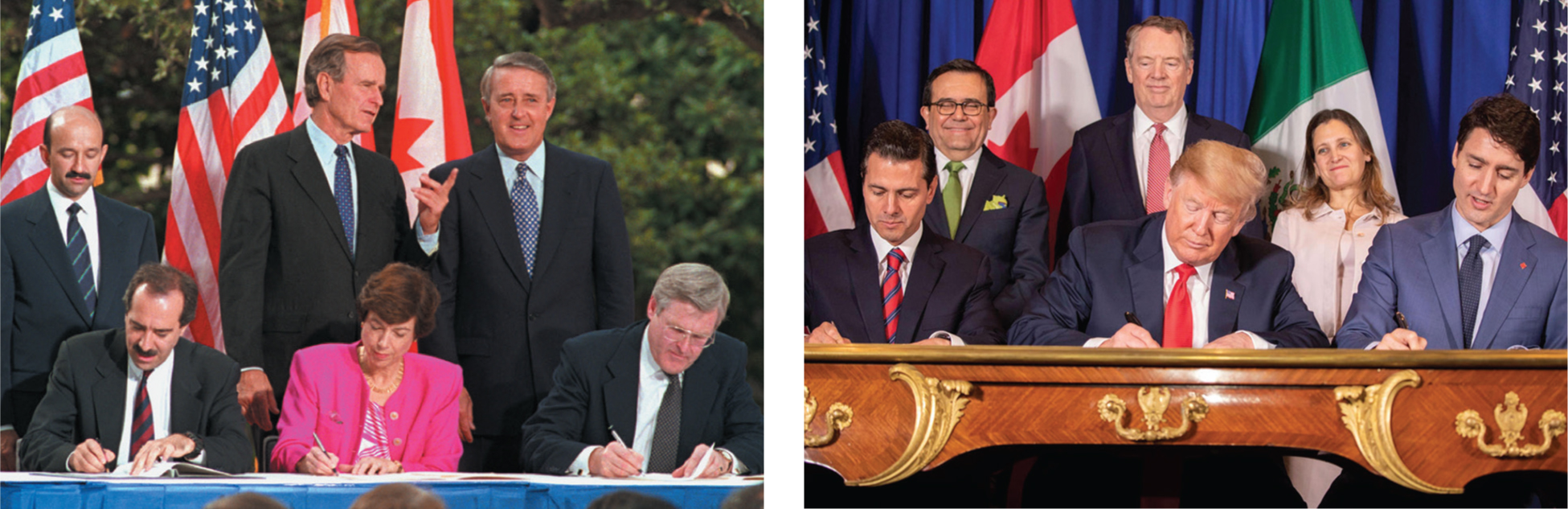
Three people sitting at a table outside with three more people behind them. One of the standing people is President George H.W. Bush.
The signing of NAFTA in 1992 (left) created a free-trade zone in North America. Although many Texas workers were adversely affected by the availability of cheaper labor in Mexico, NAFTA appears to have had a beneficial effect on the state’s economy as a whole. In 2018, President Trump negotiated a new trade deal between the United States, Mexico, and Canada that addressed the concerns of many conservatives over NAFTA (right).
The Military in Texas
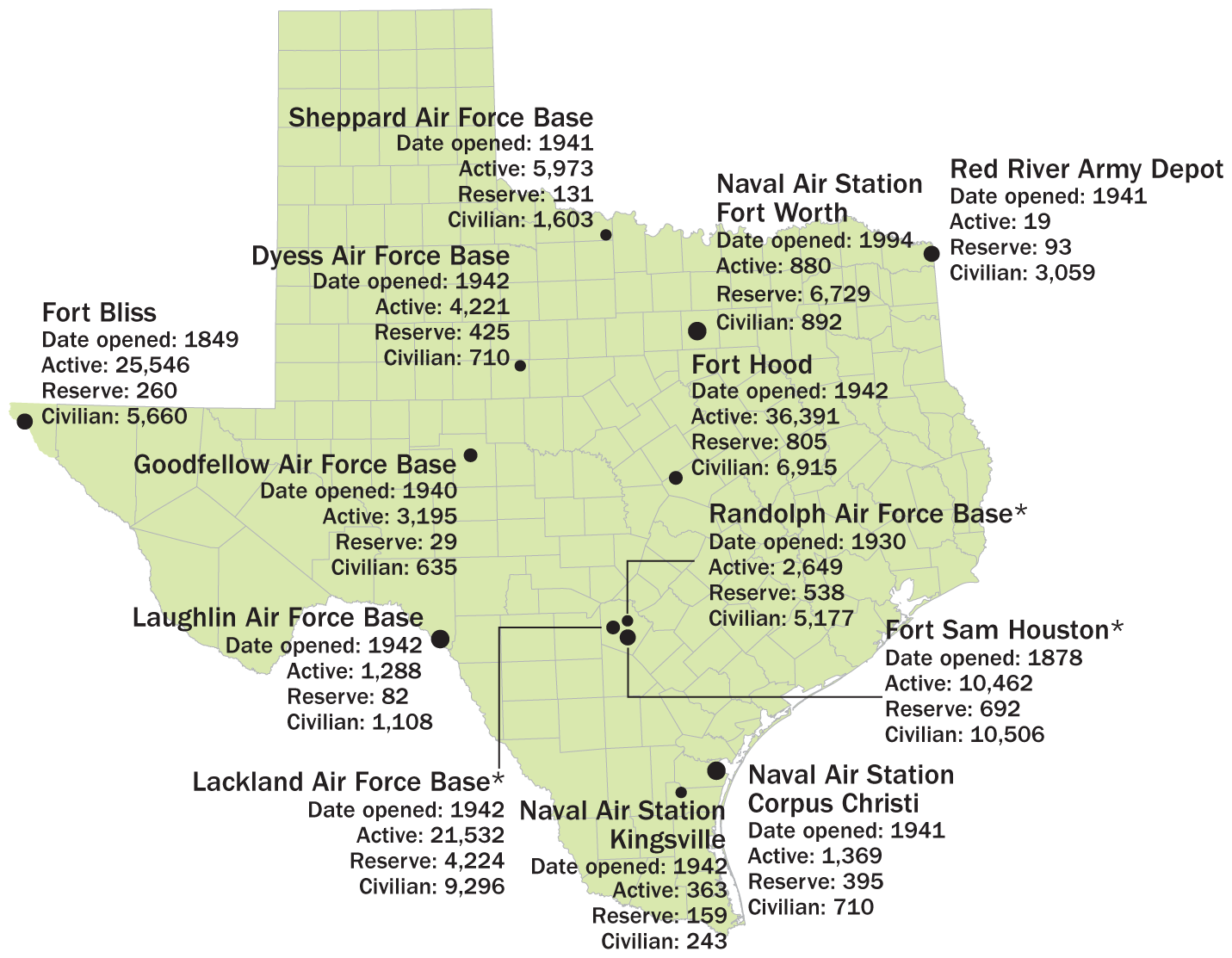
Texas’s economic development has been closely tied to the establishment of military bases since its annexation by the United States. As population pressures pushed westward, a series of federal forts were built to protect Texans from Native Americans, who were perceived to be threats to the expanding Anglo American culture. Seizing federal forts for the Confederacy was one of the first and most important acts of the Texas government following secession. Texas provided a major military training center during both world wars. Strong leadership in Congress from Texas politicians such as Sam Rayburn and Lyndon Johnson during the New Deal and the post–WWII years brought much-needed jobs and money into the state through the building of one military installation after another (see Figure 1.3).
It is hard to overestimate the importance of these military bases to local communities. For example, Fort Bliss is the U.S. Army’s second-largest base in size, covering over 1.1 million acres in Texas and New Mexico. In partnership with the city of El Paso, Fort Bliss created the world’s largest inland desalination plant, providing fresh water to the base and city. Fort Hood is today the army’s largest active-duty armored post. Taking up more than 217,000 acres, Fort Hood has been responsible for deploying and redeploying over 852,000 soldiers since 2003. Fort Hood is the home to over 56,000 military and civilian personnel, making it the largest single-site employer in the state. The base generates almost $30 billion per year to the state’s economy.23
Today, military installations continue to be important to the economic well-being of the state. Today, about 150,000 active-duty, reserve, and civilian personnel employed by the U.S. military live in Texas. The military, along with the many businesses that provide consumer services to its members, is big business in Texas. Expanding the military stimulates economic growth and employment in Texas.
FIGURE 1.3
Major U.S. Military Bases in Texas
More information
A map shows the size and location of the military bases in Texas. A paragraph reads: In October 2010, Fort Sam Houston, Lackland Air Force Base, and Randolph Air Force Base were merged into Joint Base San Antonio under the jurisdiction of the U.S. Air Force 502nd Air Base Wing, Air Education and Training Command, in accordance with the recommendations of the federal Base Realignment and Closure Commission.
The map shows that the largest bases are Fort Hood (in the Northeast), Laughlin Air Force Base (in the Southwest), and Naval Air Station Corpus Christie (in the Southeast). Most bases opened in the early 1940s; however, Fort Bliss (west) opened in 1849.
Most bases opened in the 19 forties. From West to East, North to South, the bases are: Fort Bliss, date opened: 1849, active: 25,546, reserve: 260, civilian: 5,660. Laughlin Airforce Base, date opened: 1942, active: 1,288, reserve: 82, civilian: 1,108. Goodfellow Air Force Base: date opened: 1940, active: 3,195, reserve: 29, civilian: 635. Dyess Air Force Base: date opened: 1942, active: 4,221, reserve: 425, civilian: 710. Sheppard Air Force Base: date opened: 1941, active: 5,973, reserve: 131, civilian: 1,603. Lackland Air Force Base: date opened: 1942, active: 21,532, reserve: 4,224, civilian: 9,296. Fort Sam Houston: date opened: 1878, active: 10,462, reserve: 692, civilian: 10,506. Randolph Air Force Base: date opened: 1930, active: 2,649, reserve: 538, civilian: 5,177. Naval Air Station Kingsville: date opened: 1942, active: 363, reserve: 159, civilian: 243. Fort Hood: date opened: 1942, active: 36,391, reserve: 805, civilian: 6,915. Naval Air station Fort Worth: date opened: 1994, active: 880, reserve: 6,729, civilian: 892. Naval Air Station, Corpus Christi: date opened: 1941, active: 1,369, reserve: 395, civilian: 710. Red River Army Depot: date opened: 1941, active: 19, reserve: 93, civilian: 3,059.
SOURCE: Texas Almanac 2022–2023 (Denton: Texas State Historical Association, 2020), 517–18.
*In October 2010, Fort Sam Houston, Lackland Air Force Base, and Randolph Air Force Base were merged into Joint Base San Antonio under the jurisdiction of the U.S. Air Force 502nd Air Base Wing, Air Education and Training Command, in accordance with the recommendations of the federal Base Realignment and Closure Commission.
SOURCE: Texas Almanac 2022–2023 (Denton: Texas State Historical Association, 2020), 517–18.
Endnotes
- The following is drawn from Karen Gerhardt Britton, Fred C. Elliott, and E. A. Miller, “Cotton Culture,” Handbook of Texas Online, 1976/updated October 7, 2020, www.tshaonline.org.Return to reference 10
- See Cecil Harper, Jr., and E. Dale Odom, “Farm Tenancy,” Handbook of Texas Online, September 1, 1995/updated October 22, 2020, www.tshaonline.org.Return to reference 11
- Texas Almanac 2014–2015, 687; see Harper and Odom, “Farm Tenancy,” Handbook of Texas Online.Return to reference 12
- Texas Department of Agriculture, “Texas Ag Stats,” www.texasagriculture.gov/About/TexasAgStats.aspx.Return to reference 13
- T. C. Richardson and Harwood P. Hinton, “Ranching,” Handbook of Texas Online, 1952/updated April 30, 2019, www.tshaonline.org.Return to reference 14
- Texas Almanac online, “Principal Crops of Texas” (Texas State Historical Association); Texas Almanac 2022–2023 (Denton: Texas State Historical Association, 2022), 676; Southern Plains Regional Office, U.S. Department of Agriculture, National Agriculture Statistics Service, “Texas Cotton Production,” Issue No. PR-123-14 (Austin: May 2014).Return to reference 15
- Texas Almanac 2022–2023 (Denton: Texas State Historical Association, 2022), 672.Return to reference 16
- The following is drawn from Mary G. Ramos, “Oil and Texas: A Cultural History,” Texas Almanac 2000–2001, (Dallas: Dallas Morning News, 1999), 29–35; Roger M. Olien, “Oil and Gas Industry,” Handbook of Texas Online, December 1, 1995/updated January 29, 2022, www.tshaonline.org.Return to reference 17
- See Texas Legislative Budget Board, “Fiscal Size-Up: 2018–19 Biennium” (September 2018), 31; Texas Legislative Budget Board, Fiscal Size-Up: 2020–21 Biennium (May 2020), 33.Return to reference 18
- See Texas Legislative Budget Board, “Fiscal Size-Up: 2022–23 Biennium” (March 2022), 277–79; see also UTIMCO, “Permanent University Fund (PUF),” www.utimco.org/funds-managed/endowment-funds/permanent-university-fund-puf/.Return to reference 19
-
Simone Sebastian, “New Data Show ‘Meteoric’ Rise of Texas Oil,” Houston Chronicle, December 3, 2013, www.houstonchronicle.com/business/energy/article/New-data-show-meteoric-rise-of-Texas-oil-5032539.php. See James Osborne, “Texas Oil Production Hits 2 Million Barrels a Day, the Most Since 1986,” Dallas Morning News, April 25, 2014. See Texas Railroad Commission, “Texas Permian Basin Oil Production 2008 through March 2016.” For a more detailed discussion of the new technology of fracking and its impact on the oil boom in Texas and the United States, see Russell Gold, The Boom: How Fracking Ignited the American Energy Revolution and Changed the World (New York: Simon & Schuster, 2014).Return to reference 20
- See National Association of Manufacturers, “2021 Texas Manufacturing Facts,” www.nam.org/state-manufacturing-data/2021-texas-manufacturing-facts/.Return to reference 21
- David Green and Shannon Halbrook, “Texas’ International Trade,” Fiscal Notes, July 2020, Office of the Texas Comptroller, www.comptroller.texas.gov/economy/fiscal-notes/2020/july/trade.php.Return to reference 22
- See Comptroller Glenn Hagar, “Economy: Fort Hood: Economic Impact on the Texas Economy, 2019,” www.comptroller.texas.gov/economy/economic-data/military/fort-hood.php.Return to reference 23
Glossary
- Texas Railroad Commission
- an elected state regulatory commission originally created to regulate railroads in Texas, it now plays an important role in regulating the oil and gas industry in Texas
- North American Free Trade Agreement (NAFTA)
- a trade agreement among the United States, Canada, and Mexico that gradually eliminated most tariffs and trade barriers
- United States-Mexico-Canada Agreement (USMCA)
- a trade agreement in 2018 superseding NAFTA, providing for more balanced reciprocal trade among the United States, Mexico, and Canada