★Describe the seven Texas constitutions and their role in Texas political life
Texas has operated under seven constitutions: one when it was part of a state under the Mexican political regime prior to independence, one as an independent republic, one as a member of the Confederacy, and four as a state within the United States. Each was shaped by historical developments of its time and, following the first constitution, attempted to address the shortcomings of each previous constitution. To understand constitutional government in Texas today demands a clear understanding of the founding of Texas out of its war of independence with Mexico and the specific historical circumstances that gave rise to each constitution.
The Texas Founding
Political scientists refer to “the Founding” as that period in American history when the foundational principles of American political life were established, roughly the period of time from the Declaration of Independence in 1776 through the ratification of the Constitution (1790) and the Bill of Rights (1791). Texas too has a founding period and Texas’s road to independence appears to mirror that of the United States. Like the United States, Texas had a period of discontent with the governing regime that culminated in a Declaration of Independence. However, Texas’s march toward independence was much longer and more convoluted than the United States’.
THE CONSTITUTION OF COAHUILA Y TEJAS, 1827 Texas was part of New Spain until the Mexican War of Independence,3 which grew out of a series of revolts against Spanish rule during the Napoleonic Wars. Burdened by debts brought on by a crippling war with France, Spain sought to extract more wealth from its colonies. The forced abdication of King Ferdinand VII in favor of Napoleon’s brother Joseph in 1808 and an intensifying economic crisis in New Spain in 1809 and 1810 undermined the legitimacy of Spanish rule. Revolts broke out in Guanajuato and spread throughout Mexico, including its Texas province. Although these rebellions were initially put down by royalist forces loyal to Spain, by 1820 additional local revolts and guerrilla actions had helped to further weaken Spanish rule. On August 24, 1821, Mexico was formally granted independence by Spain.
The first federal constitution that Texas operated under was thus the Mexican Constitution of 1824. At the national level, it provided for two houses of Congress, a president and vice president elected for four-year terms by the legislative bodies of the states, and a supreme court. Although the Mexican Constitution mandated separate legislative, executive, and judicial branches, no attempt was made to define the scope of states’ rights within the Mexican confederation, and local affairs remained independent of the central government. This constitution embodied many of the ideas found in the U.S. Constitution, but there was one important difference: Catholicism was established as the state religion and was supported financially by the state.4
Under the Mexican Constitution, the state of Coahuila and the sparsely populated province of Texas were combined into the state of Coahuila y Tejas, with Saltillo, in Coahuila, as the capital. More than two years were spent drafting a constitution for the new state. It was finally published on March 11, 1827.
The state of Coahuila y Tejas was formally divided into three districts, with Texas composing the District of Bexar. Legislative power for the state was placed in a unicameral legislature composed of 12 deputies elected by the people, including 2 representing Bexar. Along with wide-ranging legislative powers, the legislature was also empowered to elect state officials when no majority emerged from the popular vote, to serve as a grand jury in political and military matters, and to regulate the state’s army and militia. Executive power was vested in a governor and a vice governor, each elected by the people for a four-year term. Judicial power was placed in state courts. The Constitution of 1827 formally guaranteed citizens the right to liberty, security, property, and equality. Its language also supported efforts to curtail the spread of slavery, an institution of vital importance to planters who were immigrating from the American South. The legislature was ordered to promote education and freedom of the press. As in the Mexican federal constitution, Catholicism was the established state religion.5
Political instability in Mexico in the late 1820s and early 1830s largely undercut the provisions and protections of both the federal and the state constitutions under which Texans lived. These constitutions were important to political debate at the time as discontent against the central government built up. At least in the early stages of the Texas rebellion against Mexico, many Texans could, and did, see themselves as defending these constitutions and most of the political principles that they represented. The turn away from defending the Mexican Constitution of 1824 and the state constitution of 1827 to articulating a new constitutional regime relying more on American political and cultural values was a fundamental step on the road to independence for Texas.
The Constitution of the Republic of Texas, 1836
Texas’s break with Mexico was in large part a constitutional crisis that culminated in separation. Americans had come to Texas for a variety of reasons. Some, like Stephen F. Austin, had come in the service of the Mexican state as empresarios, whose goal was to encourage American immigration into Texas by distributing land made available by the Mexican government. They saw themselves as Mexican citizens working with the constitutional regime of 1827. Americans who had come to Texas in the early 1830s still wanted the land and economic opportunities offered by Texas, but they, as part of America’s move westward, were far less committed to integrating themselves into the Mexican political community. For these people, separation from Mexico, either as an independent republic or as part of the United States, was the ultimate political objective.
Recognizing the dangers to Mexican authority from Americans coming into Texas, Mexican officials made various attempts to limit the influx. These restrictions, along with other grievances, led to growing discontent among Texans over their place in the Mexican federal system. Ultimately, Texans called for political conventions in 1832 and 1833 to discuss new constitutional forms of government. Along with demands for a more liberal immigration policy for people from the United States and for the establishment of English- and Spanish-speaking primary schools, calls for separate statehood for Texas emerged from the conventions. The 1833 convention actually drafted a constitution and sent Stephen F. Austin to Mexico City to petition the central government for reform. Austin’s mission failed and led to his imprisonment, which in turn pushed Texas closer to open rebellion.
On November 7, 1835, a meeting of Texas political leaders at San Felipe adopted a declaration stating the reasons Texans were beginning to take up arms against the Mexican government. The declaration proclaimed that Texas was rising up in defense of its rights and liberties as well as the republican principles articulated in the Mexican Constitution of 1824. Though it was one thing to call for a defense of republican principles under the Mexican Constitution of 1824, it was something else to call for separation from Mexico. In the end, the declaration was but a prelude to the formal Texas Declaration of Independence that emerged out of the Convention of 1836 held at Washington-on-the-Brazos.
Of the 59 delegates attending the Convention of 1836, only 10 had lived in Texas prior to 1830, and 2 had arrived as late as 1836. Two-thirds of the delegates—39—were from southern states that had slavery, 6 were from the border state of Kentucky, 7 were from northern states, 3 were from Mexico (including 2 born in Texas), and 4 were from other English-speaking lands.6 The final products of the convention—the Texas Declaration of Independence and the Constitution of 1836—reflected the interests and values of these participants.
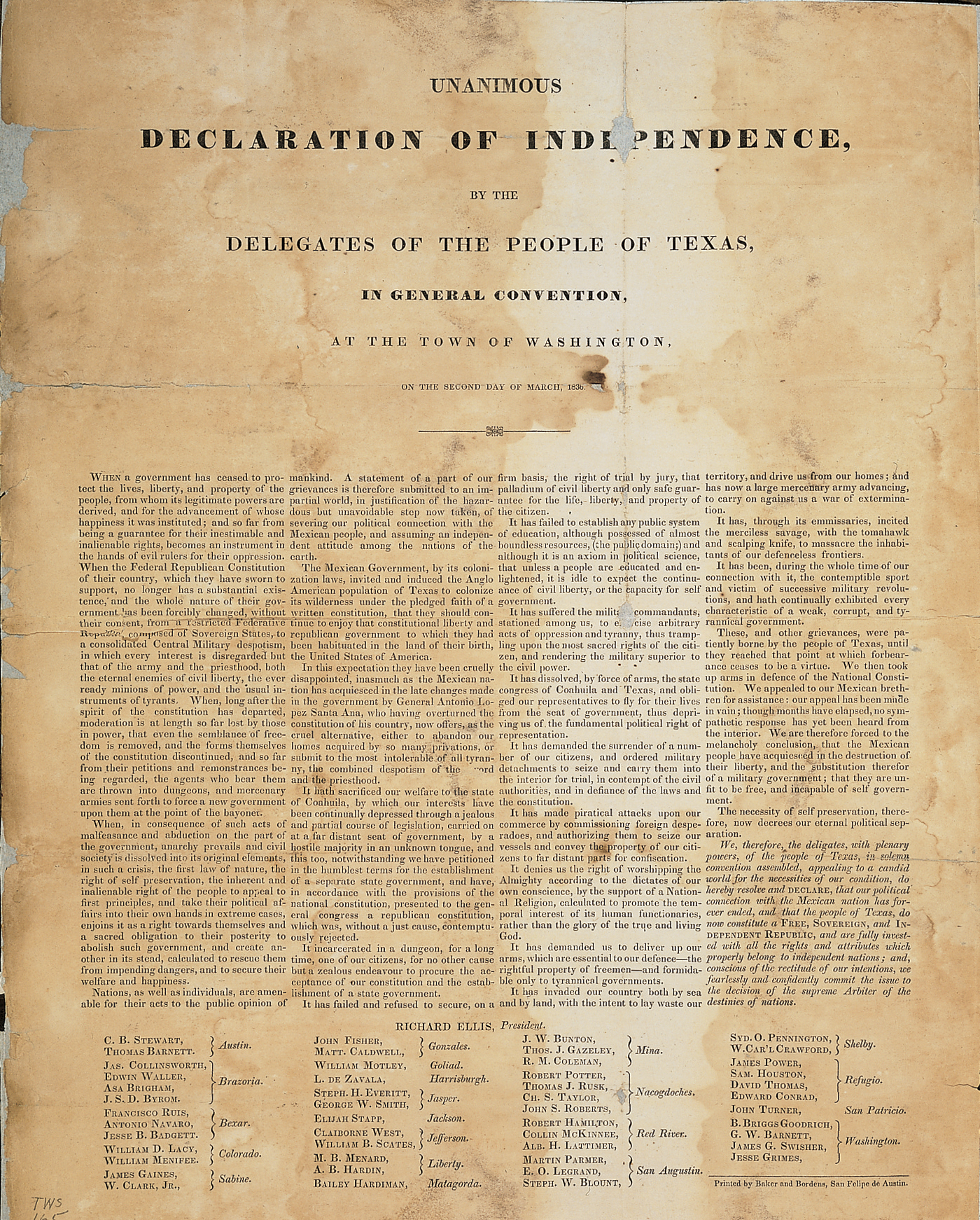
THE TEXAS DECLARATION OF INDEPENDENCE Like the Founders during the American Revolution, leaders of the Texas Revolution felt they needed to justify their actions in print. Written by George C. Childress and adopted by the general convention at Washington-on-the-Brazos on March 2, 1836, the Texas Declaration of Independence stated why the signers believed it was necessary to separate from Mexico and create an independent republic (see appendix, pp. A1–A3). Not surprisingly, the document draws heavily on the ideas of John Locke and Thomas Jefferson for inspiration. The description of the role of the government, “to protect the lives, liberty, and property of the people,” repeated verbatim Locke’s litany of the primary reasons for establishing government. Like Jefferson’s Declaration for the United States, Texas’s declaration catalogs a list of grievances against the Mexican regime that they said failed to provide freedom of religion, a system of public education, and trial by jury. It proclaimed that the federal constitutional regime they had been invited to live under by the rulers of Mexico had been replaced by a military tyranny that combined a “despotism of the sword and the priesthood.”
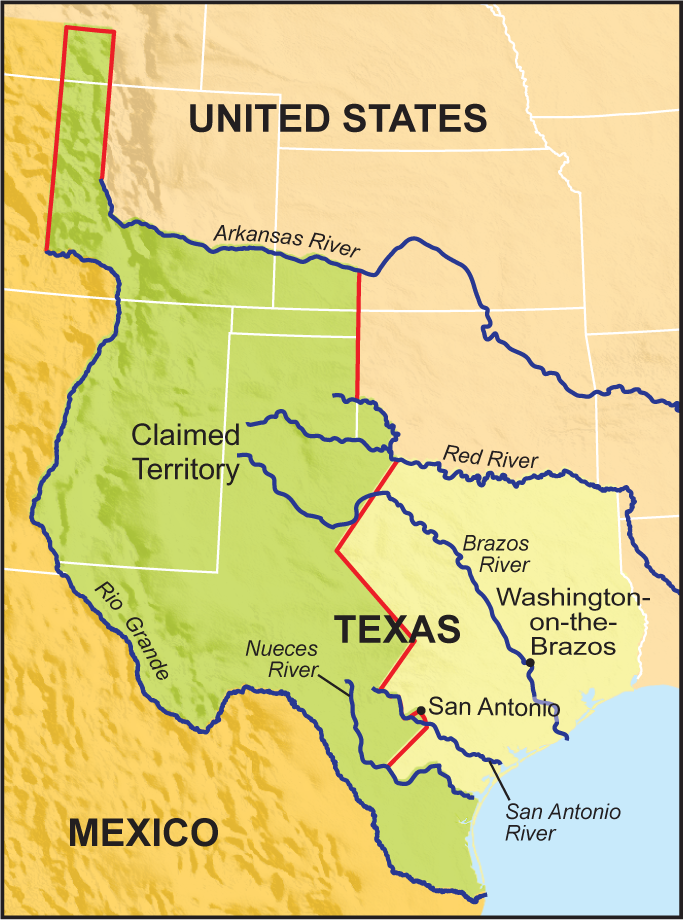
The “melancholy conclusion” of Texas’s declaration echoed ideas that Locke and Jefferson would have understood well: any government that stripped a people of their liberty was unacceptable to those raised on principles of self-government. Self-preservation demanded “eternal political separation” from the very state (Mexico) that had invited them to settle in Texas (see Figure 2.1).
THE PROVISIONS AND VALUES IN THE 1836 CONSTITUTION After declaring Texas a separate republic independent from Mexico, the convention proceeded to draft and pass a new constitution reflecting these republican sentiments. Resembling the U.S. Constitution in being flexible and brief (fewer than 6,500 words), the 1836 Constitution established an elected chief executive with considerable powers, a bicameral legislature, and a four-tiered judicial system composed of justice, county, district, and supreme courts.7 Power was divided among these three branches, with a system of checks and balances between them. The constitution also included complicated procedures for amendments, along with a bill of rights.
FIGURE 2.1
The Republic of Texas, 1836–45
This map shows the Republic of Texas with its large claimed territory. Texas’s current boundaries were not established until 1850. Even then, minor controversies persisted along the Red River.
More information
Figure 2.1 titled The Republic of Texas 1836-45 is a map that shows the claimed territory of the Republic of Texas in 1836–1845 along with the current boundaries of Texas.
A paragraph reads: This map shows the Republic of Texas with its large claimed territory. Texas’s current boundaries were not established until 1850. Even then, minor controversies persisted along the Red River.
In the map, the southern, western, and northern parts of current-day Texas were part of the claimed territory as well as the eastern half of New Mexico, the panhandle of Oklahoma, the southwestern corner of Kansas, large areas in the south and west of Colorado, and a small part of the south of Wyoming. The eastern half of current-day Texas was unclaimed territory. The Rio Grande served as the western and southern border, and the Arkansas River as a northern boundary. San Antonio sits right on the San Antonio River, and Washington-on-the-Brazos on the Brazos River in the middle of the territory, which runs roughly parallel to the Arkansas and Red rivers, which make up the territory’s northen boundaries.
The values of American democracy percolated through the document in other ways as well, such as a guarantee that all White males could vote. A number of important provisions from Spanish-Mexican law were adapted for the Texas Republic in the constitution, including the idea of community property, in which property acquired by either spouse during a marriage would be jointly owned; homestead protections in which one’s home would be protected during bankruptcy proceedings; and debtor relief.
While giving these Spanish-American legal provisions constitutional status, Texas moved closer to the Anglo-American model of jurisprudence in other ways. In 1840 the Republic of Texas formally adopted the rules of English Common Law to replace Spanish Law in most civil and criminal matters. There was one notable exception. Following Spanish-Mexican law, Texas initially retained ownership of all minerals under the ground even as land grants provided for individual ownership of the land itself. Until the Constitution of 1866, a consensus existed that the best model for developing Texas and its mineral resources was through direct government ownership of all mineral rights. Under the constitutions of 1866, 1869, and 1876, a new model was adopted granting ownership of mineral rights to the individuals who owned the land under which minerals were found. The state retained some claims to mineral rights, largely in western parts of the state, to fund public schools and higher education. The new idea was that private entrepreneurs would do a better job developing the state’s natural resources than would state officials. The complicated history of mineral rights and oil and gas law (as well as the entire oil and natural gas industry) in the nineteenth and twentieth centuries follows directly from the decisions made in later constitutions to replace the original mineral rights provisions of the constitutions of 1836, 1845, and 1861.
TEXAS AND THE NATION
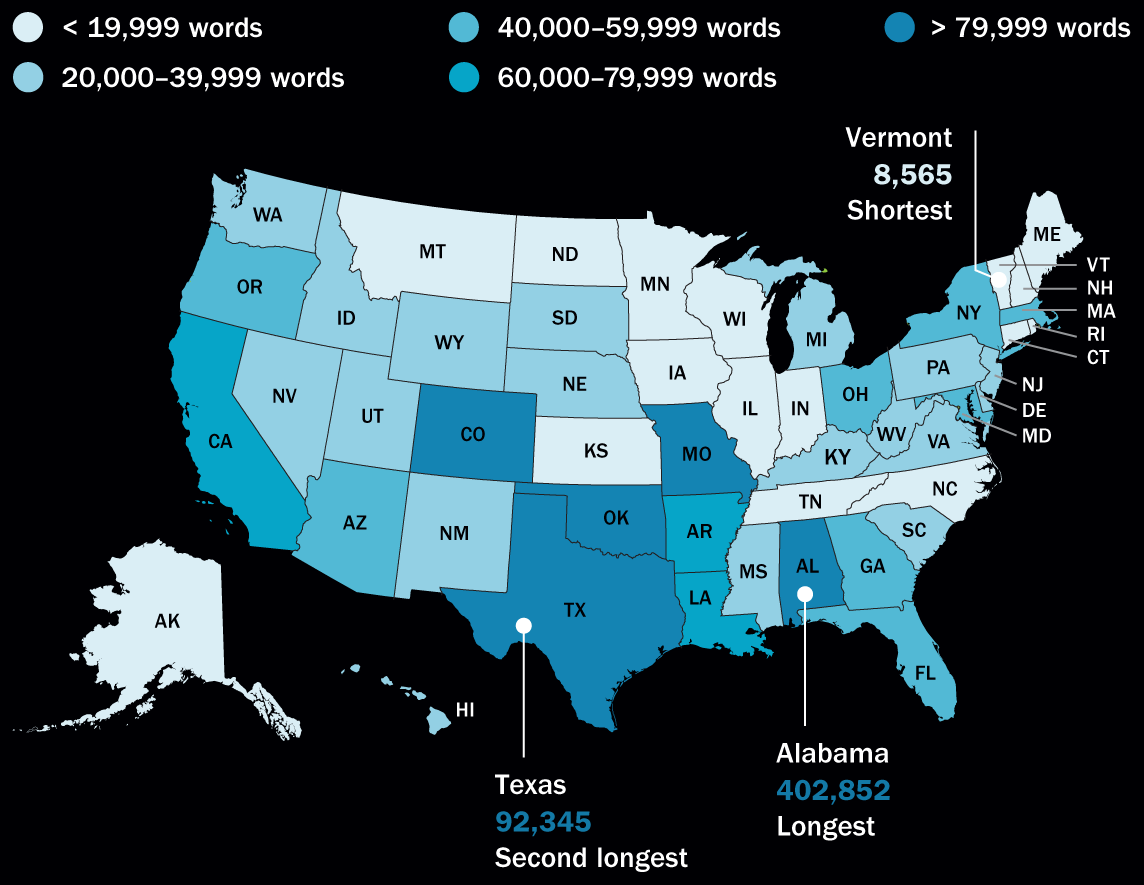
Which State Has the Longest Constitution?
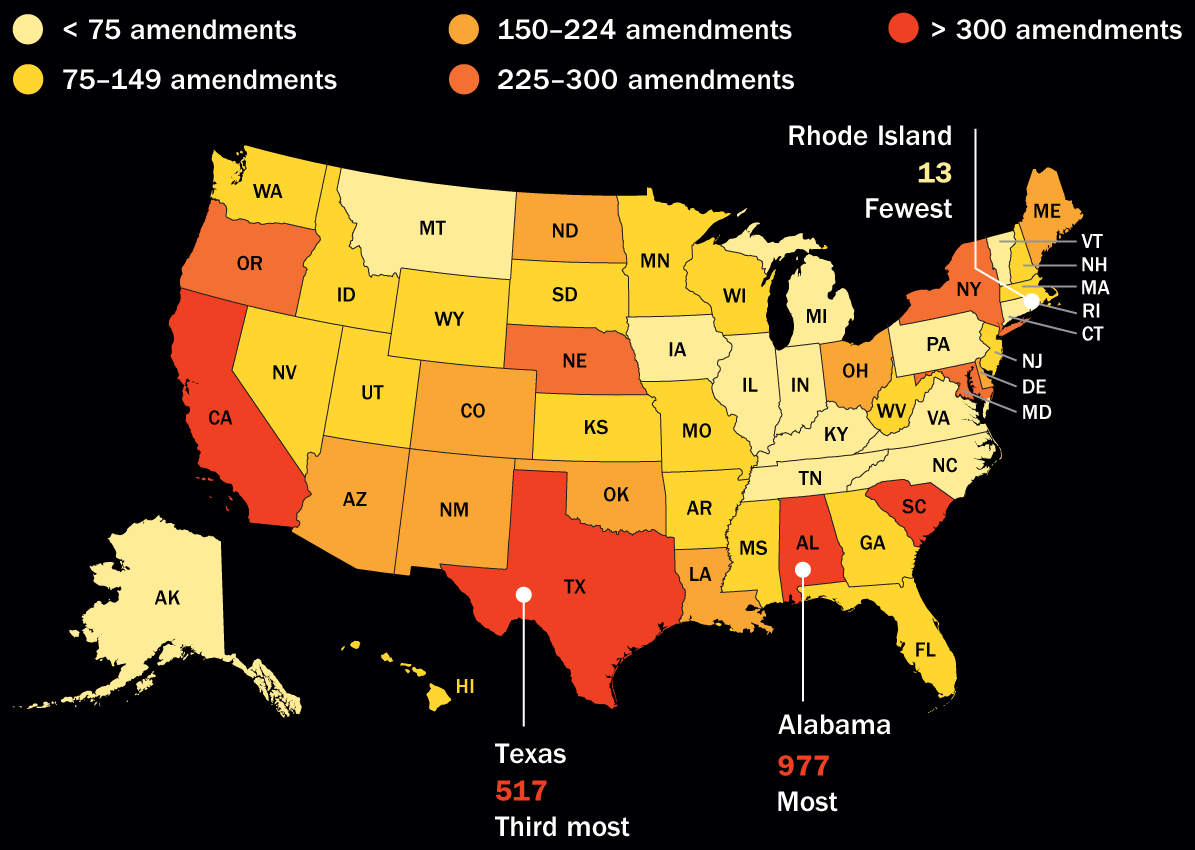
The Texas Constitution is the second-longest state constitution in the United States. The framers of the Texas Constitution gave the state government very specific powers so that the government could not use ambiguity to expand its powers. As a result, the Texas Constitution requires frequent amendments to address situations not covered specifically in the original constitution. The Texas Constitution has been amended 517 times as of 2022, third most of any state.
State Constitution Length
More information
A map shows the length of each state’s constitution. Most state constitutions are less than 59,999 words. Vermont’s, at 8,565 words, is the shortest. California, Colorado, Missouri, Texas, Oklahoma, Louisiana, and Alabama all have Constitutions over 60,000 words. Texas’s is the second longest, at 92,345 words, and Alabama’s is the longest, at 402,852 words.
SOURCE: The Book of the States (Lexington, KY: Council of State Governments, 2021).
Amendments Added to Constitution
More information
A map shows the number of amendments added to each state’s constitution. The states that have the longer constitutions tend to have more amendments. Rhode Island has the fewest amendments with just 13, and other states such as Montana, Tennessee, Kentucky, Michigan, and Vermont all have fewer than 75 amendments. Texas has the third most with 517 amendments, and Alabama has the most with 977 amendments.
SOURCE: The Book of the States (Lexington, KY: Council of State Governments, 2021).
SOURCE: The Book of the States (Lexington, KY: Council of State Governments, 2021).
Video: Which State Has the Longest Constitution?
CRITICAL THINKING
After examining the two maps, do you see any relationship between the length of a state constitution and the number of amendments to the constitution? Why do you think that there might be such a relationship in some states?
Do different regions in the country seem to favor short rather than long state constitutions? What factors might account for such similarities?
One of the most important aspects of the Constitution of 1836, at least from the perspective of newly immigrated Americans from the South, was its defense of slavery as an economic and political institution with constitutional protections. The Constitution of Coahuila y Tejas of 1827 had challenged, albeit unsuccessfully, the existence of slavery. Although the 1836 Constitution outlawed the importation of enslaved people from Africa, it guaranteed that slaveowners could keep enslaved people as property and that new slaveowning immigrants could bring enslaved people into Texas with them. The results of this constitutional protection were monumental. In 1836, Texas had a population of 38,470, including 5,000 enslaved people. By 1860 there were more than 182,566 enslaved people, accounting for more than 30 percent of the Texas population of 608,553.8 The Constitution of 1836 not only saved slavery as an institution in Texas but also provided the protections needed for slavery to flourish.
More information
A copy of the Texas Declaration of Independence. The heading of the declaration reads: Unanimous. Declaration of Independence by the delegates of the people of Texas, In General Convention, At the Town of Washington.
The Texas Declaration of Independence was written by George C. Childress and adopted at the Convention of 1836. Childress modeled the document on the American Declaration of Independence (see appendix, pp. A1–A3).
Writing a constitution is one thing; putting it into effect is another. Texas really became an independent state with a working constitution only after the Battle of San Jacinto, where on April 21, 1836, Sam Houston’s force of 900 men overran the 1,300-man force of Antonio López de Santa Anna and captured Mexican dictator Santa Anna himself. Still many questioned whether the Lone Star Republic would survive, given the dismal state of its finances, an army that couldn’t protect the Republic’s sweeping land claims to the west and the south, a hostile Mexico that only reluctantly accepted Texas’s secession, and a United States that appeared to be unwilling to bring Texas into the Union.9 Annexation to the United States in 1845 ended such questions and brought into being a new constitution, this time a state constitution that would operate within the framework of the U.S. Constitution.
The Texas State Constitution of 1845
The next phase of Texas’s Founding took place from 1845 to 1861. Although the 1836 Constitution called for annexation by the United States, Texas remained an independent republic for nine years. The reasons included American concerns that if Texas were admitted to the Union as a slave state, the move could alter the delicate balance between slave and free states and further divide the nation over the sensitive subject of slavery. Additionally, it was feared that annexation by the United States would lead to war with Mexico. Santa Anna had repudiated the Treaty of Velasco, which had ended the war between Texas and Mexico, and Mexico thus still claimed Texas as part of its territory.
Though both of these fears proved justified, hesitation over annexation was overcome by the mid-1840s. On March 1, 1845, the U.S. Congress approved a resolution that brought Texas into the Union as a state (see appendix, pp. A4–A5). The annexation resolution had a number of interesting provisions. First, the Republic of Texas ceded to the United States all military armaments, bases, and facilities pertaining to public defense. Second, Texas retained a right to all “its vacant and unappropriated lands” as well as responsibility for its public debts. This was no small matter, because Texas claimed an enormous amount of land that extended far beyond its present state boundaries. The boundary issues were not resolved until Congress passed the Compromise of 1850, which among other provisions established Texas’s present boundaries in exchange for a payment from the federal government, some of which was used to pay the state’s debts. Finally, Texas was given permission to break up into four additional states when its population proved adequate. Considerable controversy surrounds this provision, and no serious attempt has been made to put it into effect.
On July 4, 1845, Anson Jones, fourth and final president of the Republic of Texas, called a convention in Austin to draft a state constitution. Drafters of the constitution relied heavily on the Constitution of 1836, although the final document ended up being almost twice as long. The familiar doctrines of separation of powers, checks and balances, and individual rights defined the basic design of government.
Under the Constitution of 1845, the legislature would be composed of two houses. The House of Representatives would have between 45 and 90 members, elected for two-year terms, and the Senate between 19 and 33 members, elected for four-year terms. (Half of the Senate would be elected every two years.) As in the U.S. Constitution, revenue bills would have to originate in the House. In a separate article on education, the legislature was ordered to establish a public school system and to set aside lands to support a Permanent School Fund. Another power granted to the legislature was the authority to select the state treasurer and comptroller in a joint session.
This constitution provided for an elected governor and a lieutenant governor. The governor’s term was set at two years, and a governor could serve only four years in any six-year period. Among the executive powers granted to the governor were powers to convene and adjourn the legislature, to veto legislation (vetoes could be overturned by a two-thirds vote of each house of the legislature), to grant pardons and reprieves, and to command the state militia. The governor also had the power to appoint the attorney general, secretary of state, and district and supreme court judges, subject to the approval of the Senate.
More information
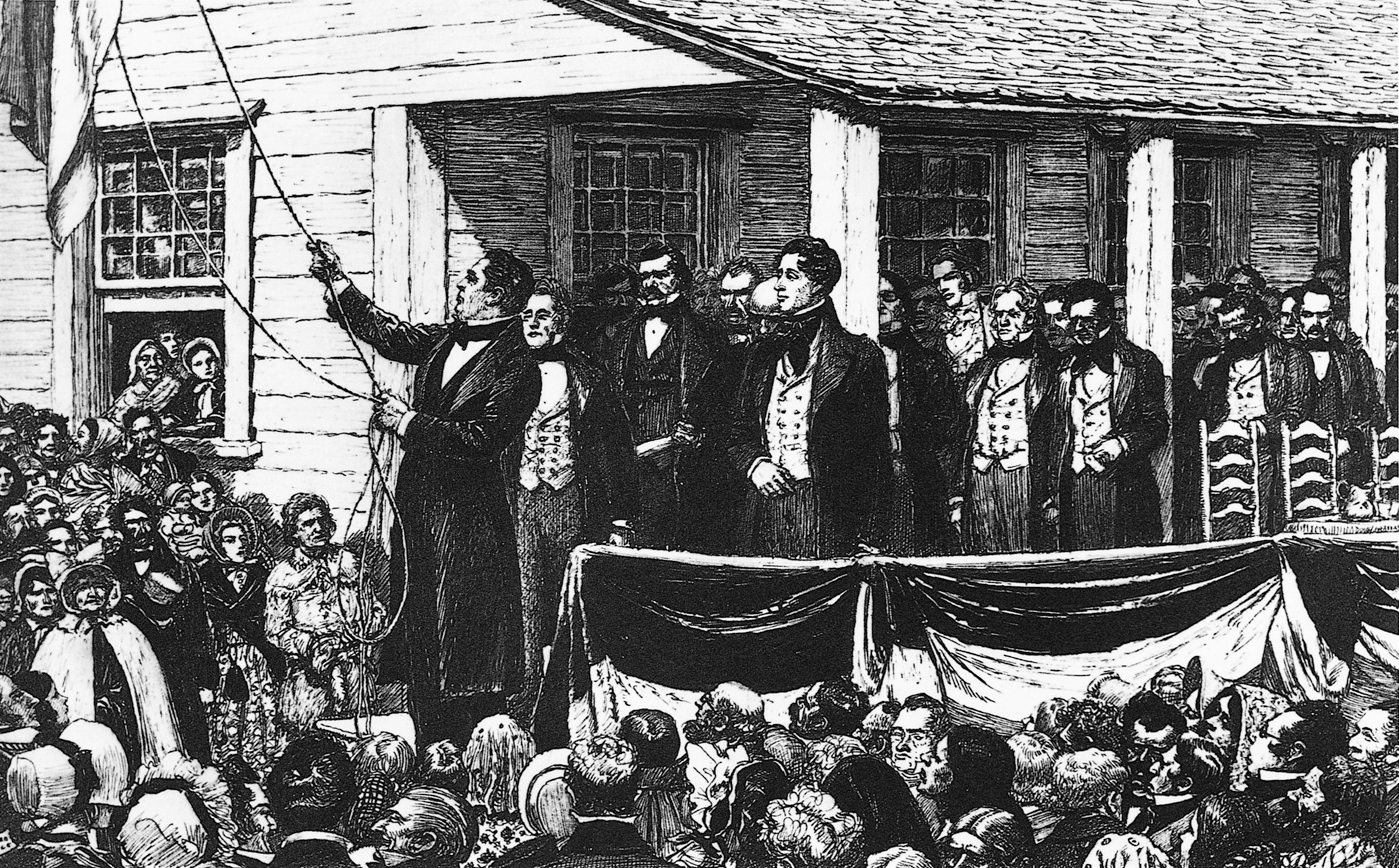
A drawing shows the lowering of the Republic flag of Texas on March 1, 1845. The people lowering the flag are standing outside in front of a large audience.
The lowering of the Republic flag marked Texas’s annexation to the Union on March 1, 1845. A state constitution was drafted shortly thereafter to reflect Texas’s new role.
The Constitution of 1845 established a judicial branch consisting of a supreme court composed of three judges, district courts, and lower courts deemed necessary by the legislature. Judges on the higher courts were to be appointed to six-year terms and could be removed from office subject to a two-thirds vote of each house of the legislature.
Amending the Constitution of 1845 was difficult. After being proposed by a two-thirds vote of each house, amendments had to be approved by a majority of the voters and then by another two-thirds vote of each house in the next legislature in order to be ratified. Only one amendment was ever made, an 1850 provision for the election of state officials who were originally appointed by the governor or by the legislature.10
The Constitution of 1861: Texas Joins the Confederacy
While slavery had made it difficult for Texas to get into the Union in the early 1840s, slavery drove Texas from the Union twenty years later. By 1860 slavery, concentrated in east Texas and along the Gulf Coast, had become a vital institution to the Texas economy. However, in large sections of the state, particularly in the north and west, the economy was based on ranching or corn and wheat production rather than cotton. There, slavery was virtually nonexistent. The question of whether Texas should secede from the Union along with other southern slave states was a controversial one that divided the state along regional as well as party lines.
Pressure to secede mounted following the November 1860 election of President Abraham Lincoln, who was committed to resisting the further expansion of slavery. A staunch Unionist, Governor Sam Houston refused calls to convene a special session of the legislature to discuss secession (see appendix, pp. A6–A9). Seeking to bypass Houston, a number of influential political leaders in the state, including the chief justice of the Texas Supreme Court, called for a special convention in January 1861 to consider secession. Giving in to the pressure, Houston called a special session of the legislature in the hopes of undercutting the upcoming secession convention. The legislature, however, had other ideas, validating the call for the convention and turning its chambers over to the convention delegates.
Lawyers and slaveowners dominated the secession convention, with lawyers composing 40 percent of the delegates and slaveowners 70 percent. The Texas Ordinance of Secession, produced by the convention on February 2, 1861, reflected this proslavery membership (see appendix, pp. A10–A11). In striking language, it proclaimed that the northern states had broken faith with Texas, particularly regarding the institution of slavery, and that Northerners had violated the laws and constitution of the federal Union by appealing to a so-called “higher law” that trampled on the rights of Texans. The Ordinance of Secession proclaimed,
We hold as undeniable truths that the governments of the various States, and of the confederacy itself, were established exclusively by the white race, for themselves and their posterity; that the African race had no agency in their establishment; that they were rightfully held and regarded as an inferior and dependent race, and in that condition only could their existence in this country be rendered beneficial and tolerable.11
Texas voters approved secession from the Union on February 23, 1861. The secession convention then reconvened to enact a new constitution to guide the state as it entered the Confederacy. This constitution was surprisingly similar to the Constitution of 1845, except that references to the United States of America were replaced with references to the Confederate States of America. Public officials had to declare allegiance to the Confederacy, and slavery and states’ rights were defended. A clause in the 1845 Constitution that provided for the possible emancipation of enslaved people was eliminated, and freeing enslaved people was declared illegal. More controversial proposals, such as resuming the African slave trade, were rejected. The move out of the Union into the Confederacy may have been a radical one, but the new constitution was conservative insofar as it reaffirmed the existing constitutional order in the state.12
The Constitution of 1866: Texas Rejoins the Union
Defeat in the Civil War led to the writing of another state constitution in 1866. The provisional governor, pro-Union Andrew Jackson Hamilton, called a constitutional convention on November 15, 1865, a little over six months after the surrender of Robert E. Lee’s army in Virginia essentially ended the Confederacy’s existence. Delegates were elected on January 8, 1866, and the convention was held February 7. Under the provisions of President Andrew Johnson’s Presidential Reconstruction, few former secessionists were excluded from voting. As a result, the convention was dominated by former secessionists, many of whom had held commissions in the Confederate army.
The delegates took a number of actions to bring the state into compliance with Presidential Reconstruction, including the rejection of the right to secession (see appendix, p. A10), a repudiation of the war debt incurred by the state, and an acceptance of the abolition of slavery. Formerly enslaved males were granted fundamental rights to their persons and property as well as the right to sue and be sued and to contract with others. However, they were not allowed to vote and were banned from holding public office. The various amendments to the Constitution of 1861 passed by the convention came to be known as the Constitution of 1866.
As in the two previous constitutions, the size of the House was set between 45 and 90 members, and that of the Senate between 19 and 33. Terms of office remained the same as under the 1845 and 1861 constitutions, although salaries were increased. Reapportionment was to be based on the number of White male citizens, who would be counted in a census every 10 years.
The salary was also increased for the governor, whose term was extended to 4 years, with a limit of 8 years in any 12-year period. The governor was also granted, for the first time, a line-item veto on appropriations. The comptroller and the treasurer were to be elected by the voters for 4-year terms.
Under the new constitution, the state supreme court was expanded from three to five judges, whose terms were increased to 10 years, and whose salaries were also increased. The chief justice was to be selected from among the five judges on the supreme court. District court judges were to be elected for 8-year terms, and the attorney general for a 4-year term.
Voters ratified the Constitution of 1866 in June in a relatively close referendum, 28,119 to 23,400. The close vote was attributed to a widespread unhappiness with the salary increases for the various state officers,13 but there were other sources of opposition as well. Many unionists who had been driven from the state during the war rejected the constitution, arguing it was the product of a convention dominated by former secessionists. They appealed to the increasingly Radical Republican Congress in Washington, D.C., for redress, arguing that former secessionists should be disenfranchised and forbidden from holding office. Their arguments gained force when the first legislature elected under the provisions of the Constitution of 1866 passed laws including the Black Codes, which limited the social, political, and economic status of African Americans in Texas. In response, Radical Republicans in Washington passed the Congressional Reconstruction Acts of 1867.
The Reconstruction Constitution of 1869
Republicans in Congress had come to see the initial efforts of reintegrating Texas and other southern states back into the Union as a failure. Under the direction of Congress, General Winfield Scott, the commander of the Union military force that was still occupying Texas and Louisiana, summarily dismissed most state officials elected to office under the 1866 Constitution and called for a new convention to write a new constitution in Texas in 1868. This time, however, former secessionists would be banned from voting or holding office. Against limited Democratic opposition, Radical Republicans easily won the vote to hold a convention by 44,689 to 11,440. Of the 90 delegates to the convention, only 6 had served in the previous constitutional convention. Ten were African American. The vast majority represented the interests of various wings in the Republican Party. The convention was a rancorous affair as delegates argued over a wide range of issues, including railroad charters, lawlessness in the state, and whether laws passed during the war years were legal. In the final days of the convention, delegates finally got down to the constitutional matters and the challenges of accepting the Thirteenth and Fourteenth Amendments to the United States Constitution, which abolished slavery, provided full citizenship to African Americans, and restricted former secessionists from holding office. Although delegates never completed their task of reworking the Constitution of 1866, the results of their efforts were published under orders by military officials, without being submitted to the voters, and became the Constitution of 1869.
A number of features of the Constitution of 1869 stand out.14 The U.S. Constitution was declared to be the supreme law of the land. As in the 1866 Constitution, slavery was forbidden, but now Black men were given the right to vote. Fourteenth Amendment guarantees of the privileges and immunities of citizens, due process under law, and equal protection under the law were recognized. Additionally, the constitution altered the relationship among the three branches of government.
The House of Representatives was set at 90 and the Senate at 30 members. Senatorial terms were extended to six years, with one-third of the seats to be elected every biennium. Legislative sessions were to be held annually. Critical changes were made in the executive branch and the courts. The powers of the governor were vastly expanded. Among other things, the governor was given wide-ranging appointment powers that included the power to appoint judges. The state supreme court was reduced from five to three judges, and their term was reduced to nine years, with one new judge to be appointed every three years. Salaries for state officials were increased.
Underlying and fueling the debate over the Constitution of 1869 was another, deeper constitutional debate about the meaning of the Secession Ordinance of 1861, the Constitution of 1861, and the Texas government that had functioned under the Confederacy. From the perspective of the U.S. Constitution, had Texas ever left the union? Was the Constitution of 1861 illegal? What about the laws that had been passed by the legislature under the powers granted by the 1861 Constitution? Were they the law of the land, or did they have no legal force? Were all laws that had been written and all contracts that had been made during the period of rebellion null and void? This debate came to an end with the U.S. Supreme Court decision Texas v. White et al. (1869). Here, the court ruled that Texas had never left the Union, which was “perpetual, and as indissoluble as the union between the original states.” The Ordinance of Secession of 1861 and all acts of the legislature that gave effect to that ordinance were considered to be “null” (see appendix, pp. A10–A11).
The first governor elected under the Constitution of 1869 was Edmund Davis, a Republican affiliated with the Radical faction of the party and a former Union general. Davis had vast authority, since the constitution had centralized power in the executive while reducing local governmental control. The popular perception at the time was that he presided over a corrupt, extravagant administration that eventually turned to the state police and the militia to attempt to maintain its control. Closer to the truth may be the fact that Davis sought to maintain his rule by relying on formerly enslaved people who had become a bulwark of the Republican Party in the state, and by limiting the reintegration of former Confederates into state politics.
In 1872 the Democrats regained control of the legislature, and in 1873 the Democrat Richard Coke was elected governor. Davis attempted to maintain control over the governor’s office by having his handpicked supreme court invalidate Coke’s election. He refused to give up his office and surrounded himself with state police in the capitol. However, when Democrats slipped past the guards and gathered upstairs in the capitol to organize a government, Davis was unable to obtain federal troops to maintain him in office and finally had to leave.
The Constitution of 1876
The final phase of Texas’s Founding began with the passage of the Constitution of 1876. To prevent another government such as Davis’s, efforts were made to write a new constitution, but in 1874 a proposed constitution was rejected by the legislature.15 Finally, in 1875, a new constitutional convention was called, with 3 delegates selected by popular vote from each of the 30 senatorial districts. The final composition of the convention included 75 White Democrats and 15 Republicans, 6 of whom were African American. Not one of the elected delegates had participated in the constitutional convention of 1868–69. Forty of them were farmers, and 40 were members of the Grange, a militant organization that had emerged to improve the financial plight of farmers.
The document that emerged from this convention, the Constitution of 1876, is still the basis for Texas government today. In an era of agriculture when prices and incomes were low and when little was demanded or expected from government, much in the 1876 Constitution made sense. However, one might question whether a constitution designed primarily by White males for White people in a rural agrarian society—and for the purpose of keeping the likes of Edmund Davis from ever controlling the state again—is the best foundation for government in the modern era.
More information
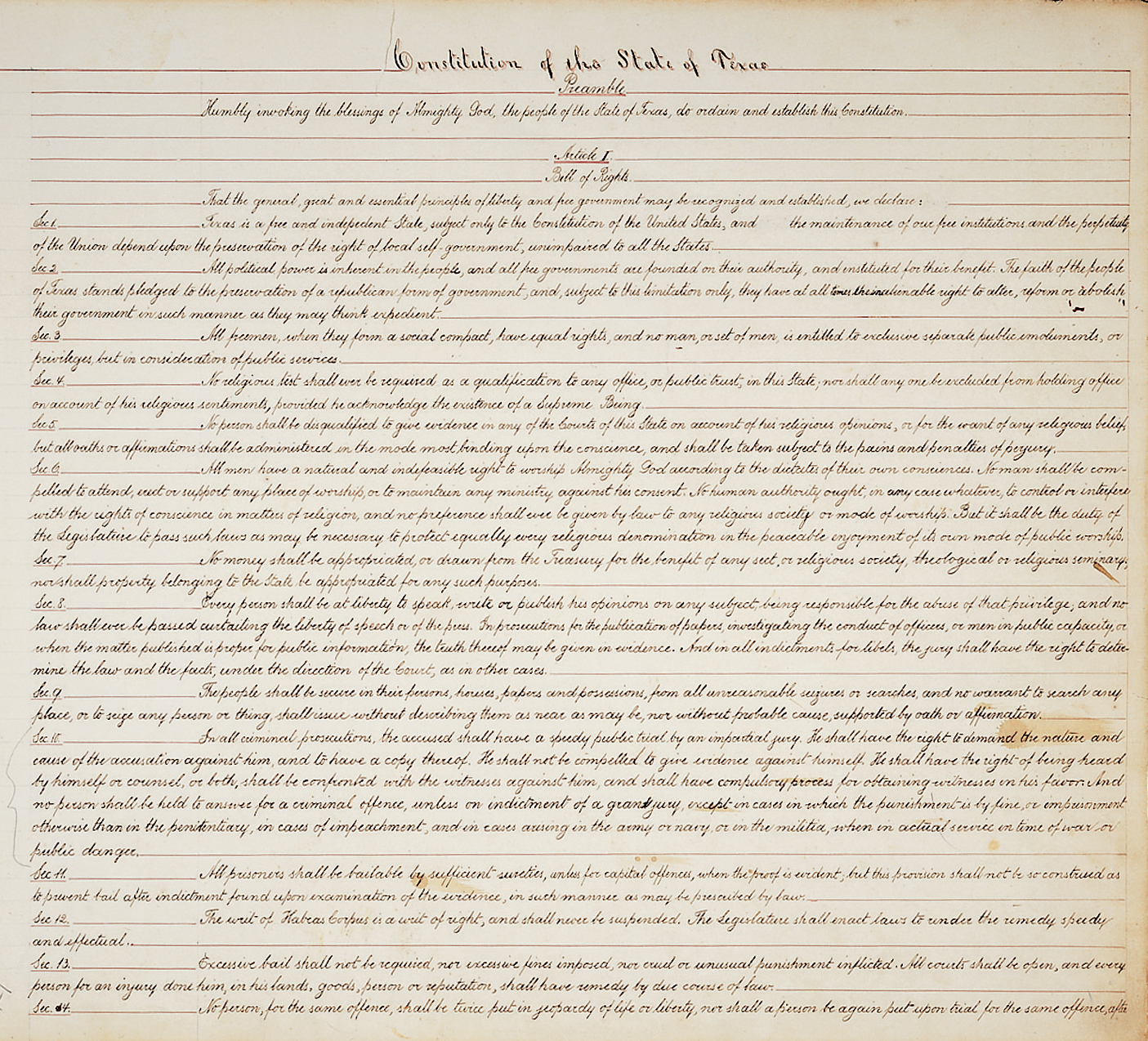
A copy of the Constitution of the State of Texas from 1876. It is handwritten.
The example of Edmund Davis’s reign motivated the revision of executive branch power in the Constitution of 1876. The framers of that constitution sought popular control of state government in order to limit the appointment powers of the governor as provided by the Constitution of 1869.
The framers were committed to a constitution with four major themes. First, they wanted strong popular control of state government. Second, they believed that a constitution should seriously limit the power of state government. Third, they sought economy in government, by which they meant government would spend as little as possible and as efficiently as possible. Fourth, they sought to promote agrarian interests, particularly those of small farmers, who formed the basis of support for the Grange movement.
Popular control of state government meant that the governor’s previously vast appointment powers were limited by making judges and other public officials subject to election. It did not mean broadening the electorate. When the framers of the 1876 Constitution thought of popular control of government, they thought of control by White males.
In the effort to limit the powers of state government, the constitution placed great restrictions on governmental actions, restrictions that could be modified only through a complex constitutional amendment process. Executive authority was diffused among numerous officeholders, rather than concentrated in the hands of the governor. Although subsequently changed by constitutional amendment, an initial provision further limited gubernatorial power by setting a two-year term limit for the office. The legislature was part-time, ordinarily sitting for a prescribed period every other year, in contrast to the annual sessions provided for in the 1869 Constitution.
TABLE 2.1
The Changing Texas Constitutions, 1836–76
1836
1845
1861
1866
1869
1876
Legislature
Session frequency
annual
biennial
biennial
annual
annual
biennial
House term length
1 year
2 years
2 years
2 years
2 years
2 years
Senate term length
3 years
4 years
4 years
4 years
6 years
4 years
Supreme Court
Size
*
3
3
5
3**
3†
Term length
4 years
6 years
6 years
10 years
9 years
6 years
Method of selection
elected††
appointed‡
elected
elected
appointed
elected
Governor
Term length
2 years
2 years
2 years
4 years
4 years
2 years‡‡
*Chief justice and district judges acting as associate judges. The constitution provides for 3–8 district judges.
**Increased to 5 in 1874 by constitutional amendment.
†Amended. Currently 9 members.
††Elected by joint ballot by the Texas congress.
‡Election made selection method in 1850 by constitutional amendment.
‡‡Amended. Currently 4 years.
Limiting the power of state government was accomplished in several other ways. The constitution restricted the extent of government debt and of government’s power to tax. In addition, there were limits on the salaries of state officials, especially legislators. A major economic depression had begun in 1873, and many Texans were experiencing economic hardship. One way money was saved was by decentralizing public education. The constitution provided for racially segregated schools and eliminated compulsory education laws. By gaining local control over education, White landowners could avoid paying taxes for the education of African American students.
Texas at that time was an agricultural state. Wishing to protect agrarian interests, the framers wrote provisions protecting homesteads from bankruptcy proceedings and restricting institutions that were perceived to be harmful to farmers, such as banks and railroads. There were also detailed regulations on railroad competition, freight and passenger rates, and railroad construction incentives.
TABLE 2.2
A Constitutional Timeline, 1836–76
1836: The Constitution of the Republic of Texas following the revolution.
Adopted U.S. Constitution as a working model, including separation of powers, checks and balances, bill of rights.
Rejected Catholicism as state religion.
Defended slavery.
1845: The first Constitution of the State of Texas after annexation by the United States.
Affirmed many of the institutional features of the U.S. Constitution and the 1836 Constitution of Texas.
Made amendment process difficult.
Texas retained ownership of all public lands and minerals under these lands.
1861: The constitution following secession from the Union.
Affirmed broad features of the 1845 Constitution.
Strongly defended slavery as an institution and the existing White-dominated political and economic system.
1866: Embodied values of Presidential Reconstruction. Suspended by military rule under Radical Reconstruction.
Affirmed broad institutional features of the 1845 and 1861 constitutions.
Reflected values of former secessionists.
Accepted results of Civil War and an end to slavery.
Rejected equality before the law or the franchise for formerly enslaved people.
1869: The product of Radical Reconstruction. Never completed and went into effect without approval by the people.
Affirmed U.S. Constitution as the “Supreme Law of the Land.”
Affirmed the Thirteenth Amendment (ending slavery) and the Fourteenth Amendment (granting equality under the law and due process to all formerly enslaved people).
Greatly expanded powers of governor.
Increased salaries of state officials.
1876: Texas’s current constitution. Amended 517 times.
Backed away from radical features of Reconstruction including the acceptance of the dominance of the national government over the state.
Reflected a break with activist constitution of 1869.
Promoted traditional agrarian interests like the Grange in Texas.
Promoted values of “economy” and “efficiency.”
Curtailed powers of governor and legislature.
Provided for election of judges.
Provided for future regulation of railroads.
The Constitution of 1876 was a conservative document with a distinctly populist flavor. On the one hand, it broke with the more activist government model laid out by the two Reconstruction constitutions of 1866 and 1869. On the other hand, it sought to protect those being harmed by the social and economic changes that transformed Texas after Reconstruction. The debates of the Constitutional Convention of 1875 drew attention to the fact that Texas was undergoing rapid change. New social and economic conditions, particularly the aggregation of capital in immense railroad systems, gave rise to new social and political problems. These, in turn, demanded the institution of new restrictions on the powers of state government to prevent corruption. A new constitution with new provisions that restricted the activities of government became the bulwark of a conservative White social and political order in the state throughout the late nineteenth and early twentieth centuries (see Governor Richard Coke’s inaugural address in 1876, appendix, p. A12).
Even in its earliest stages, the Texas Constitution of 1876 was a lengthy, rigid, and detailed document, and purposely so. Regulations curtailing government power were placed not in statutes where they could easily be reversed, but in the body of the constitution. The goal of this design was to ensure that the Radical Republicans and Edmund Davis would never again be able to control the state. They never did, although over the years the constitution became an increasingly unwieldy document (see Tables 2.1 and 2.2).
SOCIAL RESPONSIBILITY
Get Involved
What are the advantages of having a constitution written over 140 years ago? What are the disadvantages?
What changes could be made to the current constitution to make it more effective? How might you go about lobbying for such changes?
Endnotes
Harriett Denise Joseph and Donald E. Chipman, “Spanish Texas,” Handbook of Texas Online, modified January 23, 2017, www.tshaonline.org/handbook/online/articles/nps01; Donald E. Chipman, Spanish Texas, 1519–1821 (Austin: University of Texas Press, 1992).Return to reference 3
S. S. McKay, “Constitution of 1824,” Handbook of Texas Online, modified February 29, 2016, www.tshaonline.org/handbook/online/articles/ngc02.Return to reference 4
S. S. McKay, “Constitution of Coahuila and Texas,” Handbook of Texas Online, June 12, 2010, www.tshaonline.org/handbook/online/articles/ngc01.Return to reference 5
See Ralph W. Steen, “Convention of 1836,” Handbook of Texas Online, modified August 3, 2020, https://www.tshaonline.org/handbook/entries/convention-of-1836.Return to reference 6
Joe E. Ericson, “Constitution of the Republic of Texas,” Handbook of Texas Online, modified February 25, 2016, www.tshaonline.org/handbook/online/articles/mhc01.Return to reference 7
Randolph B. Campbell, “Slavery,” Handbook of Texas Online, modified October 30, 2017, www.tshaonline.org/handbook/online/articles/yps01.Return to reference 8
For a brief summary of the war, see Eugene C. Barker and James W. Pohl, “Texas Revolution,” Handbook of Texas Online, modified March 30, 2017, www.tshaonline.org/handbook/online/articles/qdt01.Return to reference 9
S. S. McKay, “Constitution of 1845,” Handbook of Texas Online, December 1, 1994, www.tshaonline.org/handbook/online/articles/mhc03.Return to reference 10
See Walter L. Buenger, “Secession Convention,” Handbook of Texas Online, modified July 1, 1995; Walter L. Buenger, Secession and the Union in Texas (Austin: University of Texas Press, 1984).Return to reference 12
See Claude Elliott, “Constitutional Convention of 1866,” Handbook of Texas Online, modified October 6, 2020; S. S. McKay, “Constitution of 1866,” Handbook of Texas Online, modified October 7, 2020; Charles W. Ramsdell, Reconstruction in Texas (New York: Columbia University Press, 1970).Return to reference 13
See S. S. McKay. Revised by Carl H. Moneyhon. “Constitution of 1869,” Handbook of Texas Online. Published: 1952. Updated January 12, 2021. Ramsdell, Reconstruction in Texas.Return to reference 14
See John Walker Mauer, “Constitution Proposed in 1874,” Handbook of Texas Online, modified Octover 7, 2020; John Walker Mauer, “State Constitutions in a Time of Crisis: The Case of the Texas Constitution of 1876,” Texas Law Review 68 (June 1990): 1615–46.Return to reference 15
the Confederate States of America, those southern states that seceded from the United States in late 1860 and 1861 and argued that the power of the states was more important than the power of the central government
a reconstruction plan for reintegrating former Confederate states back into the Union and freeing the enslaved people that placed mild demands upon the existing White power structure
the reconstruction program put forward by Radical Republicans in Congress in 1867 that disenfranchised former Confederates and granted formerly enslaved people American citizenship and the right to vote
a bloc of Republicans in the U.S. Congress who pushed through the adoption of African American suffrage as well as an extended period of military occupation of the South following the Civil War
SOCIAL RESPONSIBILITY
Get Involved