★Explain how the population of Texas has changed over time
The population of Texas has grown rapidly since 1850, when it stood at a little more than 210,000 people, more than one-quarter of whom were enslaved African Americans. According to the 1900 U.S. Census, there were only 470 Native Americans still residing in Texas, the others having been driven out during the Indian Wars. Today Texas is home to over 65,000 Native Americans. Although there are three recognized reservations, most live in urban areas, including over 20,000 in Dallas–Fort Worth.26
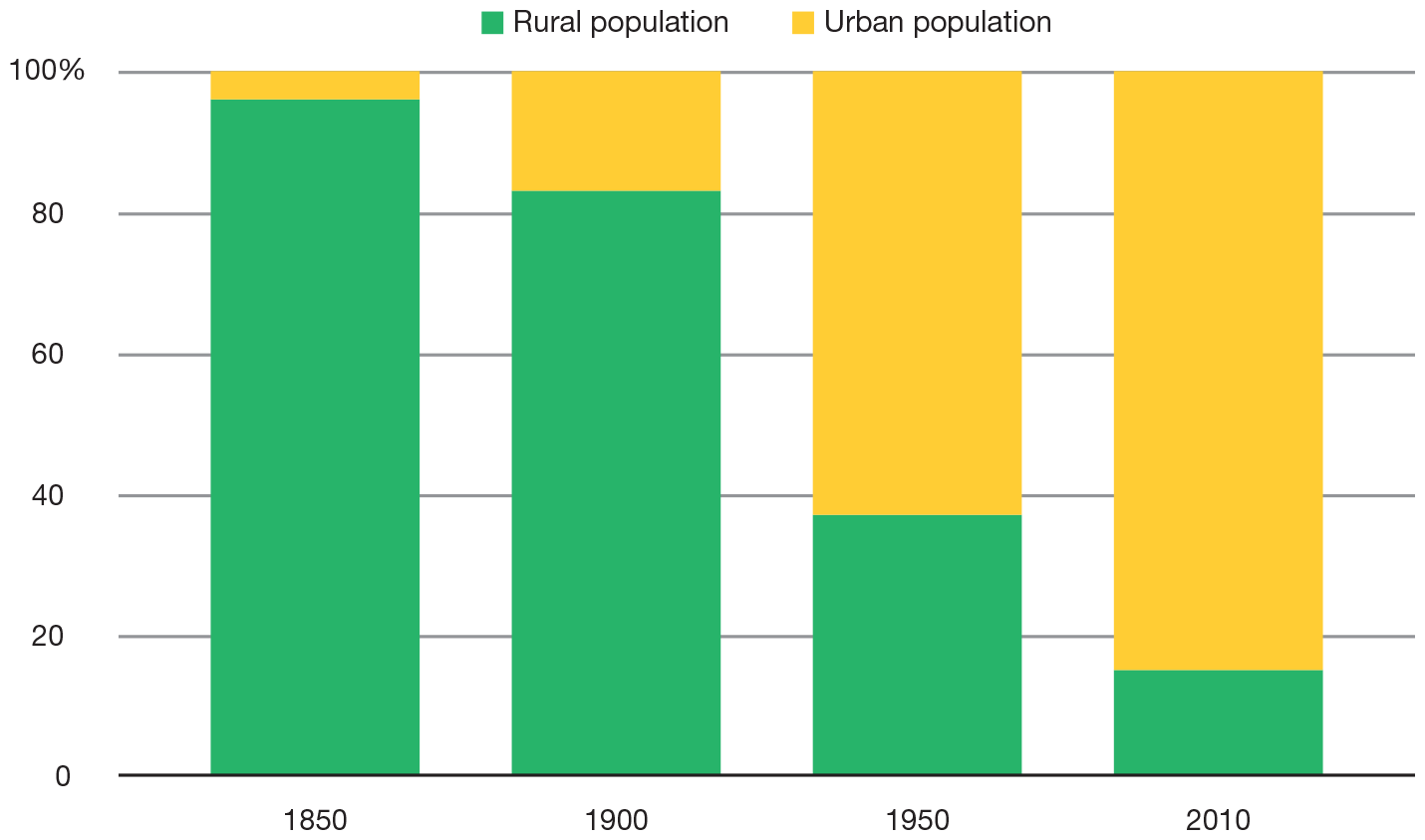
Texas in 1850 was an overwhelmingly rural state. Only 4 percent of the population lived in urban areas. By 1900 the population had increased to more than 3 million, with 83 percent living in rural areas. The 1980s began as boom years for population growth, with increases running between 2.9 percent and 1.6 percent per year from 1980 through 1986. After a brief slowdown, a recovering economy spurred population growth, which surged in the 1990s and has continued to do so into the twenty-first century.
Three factors account for the population growth in Texas: natural increase due to the difference between births and deaths in the state; international immigration into Texas, particularly from Mexico; and domestic immigration from other states. The makeup of the growth in population shifted in significant ways in the first two decades of the twenty-first century. From 2000 to 2010, 55 percent of population growth was accounted for by natural increase. International immigration accounted for 23 percent. Domestic migration accounted for 22 percent. Between 2010 and 2020, natural increase accounted for only 48 percent, while international immigration accounted for about 21 percent and domestic immigration for about 31 percent. In the early decades of the 2000s, Texas was being redefined not by native-born Texans but by outsiders coming to benefit from and contribute to the state’s diversified economy.27
This trend reversed itself in a startling fashion with the onset of the pandemic. From 2020 to 2021, international migration only contributed 7.5 percent to net population growth, while domestic migration from other states contributed 55.3 percent and natural increase contributed 37.2 percent. It is unlikely that this trend will continue throughout the remainder of the decade. International migration has been slowed by more stringent border controls by both the federal and state governments. But long lines have been forming along the Mexican border, and the demand to enter the United States from other countries both legally and illegally has been intensifying. In addition, pressures to move to Texas from other states have been alleviated somewhat by economic recovery and the retreating pandemic.28
White People
For most of the nineteenth and twentieth centuries, the largest ethnic group was non-Hispanic Whites, also referred to as White people or Anglos. White people comprise a wide range of European ethnic groups, including English, Germans, Scots, Irish, Czechs, and European Jews. The first wave of White people came to Texas before the break with Mexico. Encouraged by empresarios such as Moses Austin and his son Stephen F. Austin, who were authorized by the Spanish and later the Mexican leaders to bring people to Texas, these newcomers sought inexpensive land. They brought along a new set of individualistic attitudes and values about democratic government that paved the way for the Texas Revolution. Following the revolution, a new surge of White immigrants came from the Deep South. Like their predecessors, they too sought cheap land, but they brought with them new cultural baggage: slavery. By the time of the American Civil War, this group had come to dominate the political culture of the state. Although most Texas farmers were not slaveowners themselves, the vast majority supported the institution as well as secession from the Union.
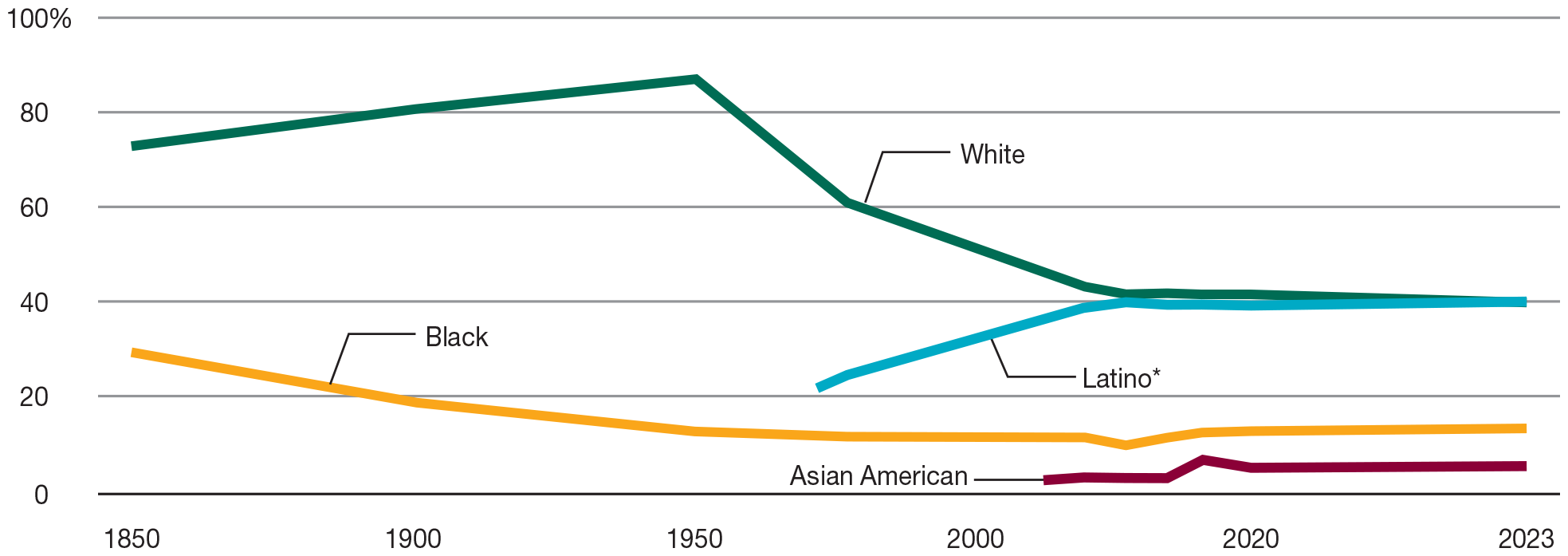
Defeat in the Civil War shattered temporarily the dominance of the traditional White power structure in the state. By the end of Reconstruction, however, the dominance of the White power structure had reasserted itself, establishing the three patterns that defined Texas politics for the next hundred years: the one-party Democratic state, provincialism, and business dominance. White people continued to define Texas’s political culture throughout most of the twentieth century, but by the end of that century much had changed. As a percentage of the total, White population peaked at 74 percent in 1950. This percentage began to fall, reaching 39.8 percent in 2023, and will likely continue to fall (see Figure 1.4).29
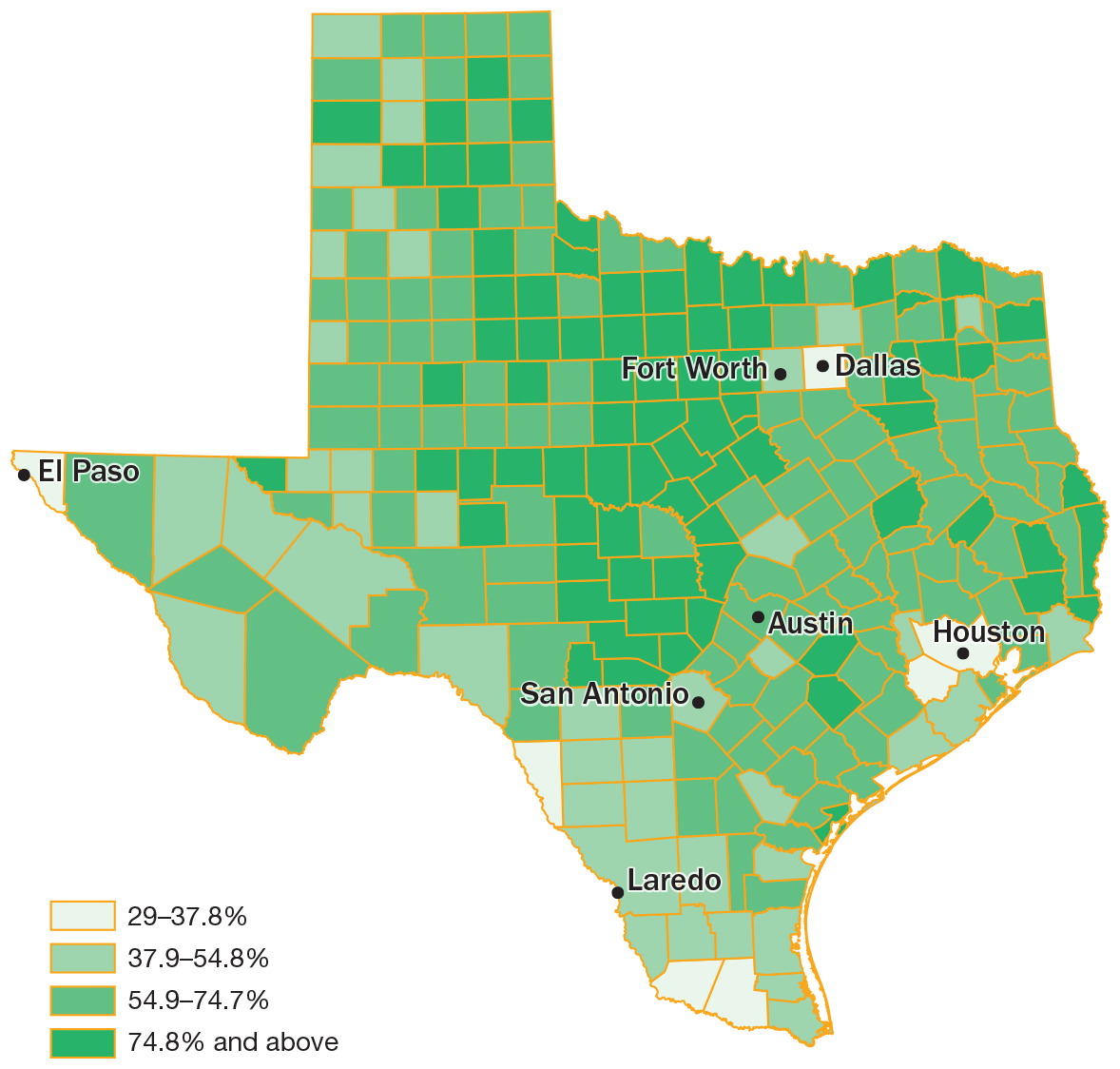
Numbers alone do not tell the whole story. A new wave of White immigration into Texas over the past 40 years has redefined the political culture of White Texans. No longer can one assume that a White Texan lives on a farm, holds culturally conservative values, and is firmly tied to the Democratic Party. On the contrary, they may not have been born in Texas and furthermore may be urbanites with progressive values or suburbanites who vote Republican (see Figure 1.5).
FIGURE 1.4
The Changing Face of Texas, 1850–2023
More information
A line graph that shows the change in population of Whites, Blacks, Latinos, and Asians in Texas from 1850 to 2018. Note reads: Latinos were not counted as a separate group until 1990 and were included in the White census count.
The graph shows that in 1850, Whites made up 72 percent of the population in Texas, while Blacks comprised 28 percent. The percentage of Whites rose to 80 percent in 1900 and even further to 87 percent in 1950. However, when Latinos began to be counted as a separate racial group in 1990, they comprised 25 percent of the population of Texas. Whites comprised 61 percent, and Blacks comprised 12 percent. In 2015, Whites comprised 43.5 percent of the population, Blacks comprised 11.8 percent, Latinos comprised 38.6 percent, and Asians comprised 4.2 percent, the first year this group appears on the graph. In 2020, Whites comprised 42 percent of the population, Latinos comprised 40 percent of the population, Blacks comprised 12 percent of the population, and Asian Americans comprised 6 percent of the population.
Sources: Statistical Abstract of the United States of: 1994 (Washington, D.C.: Department of Commerce, Bureau of the Census, 1994); see also Texas Almanac 2014–15 (Denton: Texas State Historical Association, 2014), 155; 2010 U.S. Census. Texas Almanac 2018–19 also consulted. These are available online.
*Latinos were not counted as a separate group until 1990 and were included in the White census count.
SOURCES: Statistical Abstract of the United States: 1994 (Washington, DC: U.S. Department of Commerce, Bureau of the Census, 1994); see also Texas Almanac 2014–15 (Denton: Texas State Historical Association, 2014), 15; Texas Almanac 2018–19; 2020 U.S. Census. These are available online.
Latinos
The use of Hispanic and Latino can be confusing. The terms are often used interchangeably to refer to people of Spanish descent or people from Latin America. In asking about ethnic identity and reporting the results, the U.S. Census generally uses the term Hispanic in its databases, but we will generally use the term Latino.
Most Latinos in Texas are of Mexican descent.30 Prior to independence from Spain, this group included people born of Iberian (Spanish) parents as well as mestizos (people of mixed Spanish and Native American ancestry). In the early nineteenth century, approximately 5,000 people of Mexican descent were living in Texas. Although their number fluctuated considerably over the years, by 1850 it was estimated that 14,000 Texans were of Mexican origin. Over the next 75 years, Texas became for many a refuge from the political and economic instability that troubled Mexico from the late 1850s to the 1920s. Subsequently, despite periodic attempts to curtail the growth of the Mexican American population in Texas, it grew from an estimated 700,000 in 1930 to 1.4 million in 1960 and to 5.1 million in 2000. Immigration from other Latin American countries intensified as well. In 2021 there were approximately 11.7 million Latinos in Texas, almost 19 percent of all Latinos in the United States.31
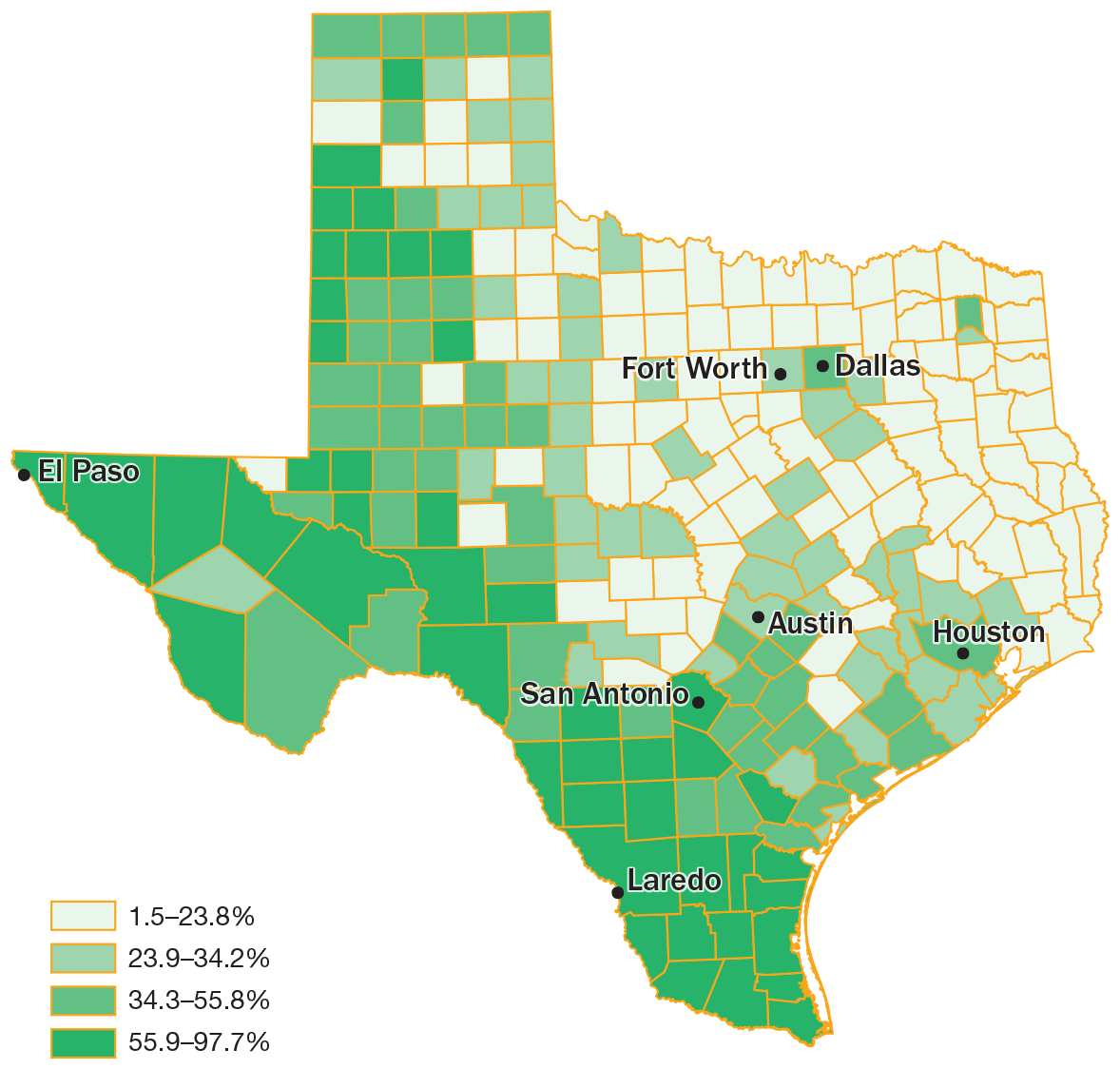
Until 1900, Latinos were concentrated in south Texas, constituting a majority along the border with Mexico and in certain border counties of west Texas. During the first few decades of the twentieth century, many migrated to northwest Texas and the Panhandle to work as laborers in the newly emergent cotton economy. Labor segregation limited the opportunities available to them before World War II. After the war, however, many Latinos left agricultural work and took jobs in the rapidly growing urban areas of Texas. By the end of the century, Latinos and Latinas constituted majorities in the cities of San Antonio and El Paso and sizable minorities in Houston, Dallas, Austin, and Fort Worth (see Figure 1.6).
FIGURE 1.5
White Population in Texas Counties
More information
Figure 1.5 titled White Population in Texas Counties, 2018 is a map that shows the White population in Texas counties in 2021. The map shows that counties with the highest percentage of white residents are concentrated in the northern and eastern most parts of the state. The Southern and western most parts of the state are the least white and range from 0 to 56.1 percent white.
Source: U.S. Census Bureau, “Quick Facts,” www.census.gov.
SOURCE: The County Information Program, Texas Association of Counties.
The political status of Latinos in Texas has changed considerably over the past hundred years. Well into the twentieth century, their ability to vote, particularly among the lower economic classes, was tightly controlled or actively discouraged by the White primary and the poll tax. Only after World War II were Latino politicians able to escape some of the strictures that had been imposed on them by the dominant White political culture. A more tolerant atmosphere in urban areas enabled some to assume positions of importance in local political communities. In 1956, Henry B. González became the first Mexican American elected to the Texas Senate since the nineteenth century. In the mid-1960s a political movement emerged in the La Raza Unida Party, which confronted many of the discriminatory practices that isolated Texas Latinos from the political and economic mainstream. By the 1980s, Latino political leaders were playing a growing role in state politics, and Latino voters were courted heavily by both political parties. The number of Latinos and Latinas elected to public office rose from 1,466 in 1986 to 2,521 in 2011. In 2021 the National Association of Latino Elected and Appointed Officials (NALEO) reported that 1 Latino served in the U.S. Senate from Texas, 7 Latinos represented Texas in the U.S. House of Representatives, 1 state official was Latino, 7 Latinos were in the Texas Senate, and 38 Latinos were elected to the state legislature. In addition, the association reported that 2,808 Latinos and Latinas served as local officials in Texas.32
FIGURE 1.6
Latino Population in Texas Counties
More information
Figure 1.6 titled Latino Population in Texas Counties, 2021 is a map that shows the Latino population in Texas counties. Most counties are more than 15.2 percent Latino. A few counties in the Northern and Eastern parts of the state are between 2.4 and 15.2 percent Latino.
Source: U.S. Census Bureau, “QuickFacts,” www.census.gov.
SOURCE: The County Information Program, Texas Association of Counties.
Black People
People of African descent were among the earliest explorers of Texas. An African slave named Estevanico accompanied his master as part of the Pánfilo de Narváez expedition, landing on Galveston Island in 1529.33 Most Black people, however, entered Texas as enslaved people brought by White people from the upper and lower South in the nineteenth century. At first, antislavery attitudes among Spanish and Mexican authorities kept the population of enslaved people down. However, independence from Mexico lifted the restrictions on slavery, creating an incentive for southerners to expand the system westward. The number of enslaved people in Texas rose from 5,000 in 1845 to 58,000 in 1850. By the Civil War, over 182,000 enslaved people lived in Texas, approximately one-third of the state’s entire population.
More information
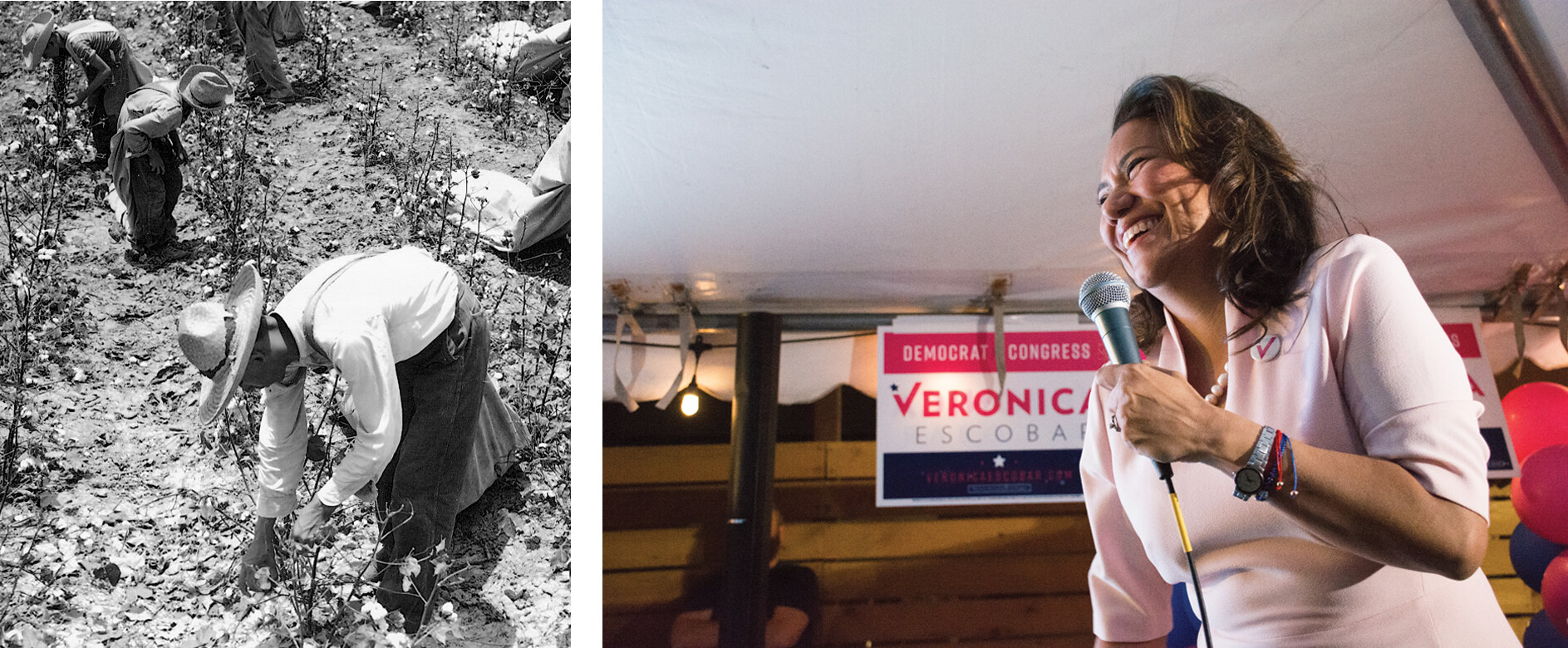
A black and white photograph shows men picking cotton.
Representative Veronica Escobar at a campaign event during the 2018 election season.
Most Latinos and Latinas in Texas are Mexican American. During the first half of the twentieth century, Mexicans immigrated to Texas to work in the emerging cotton industry. Today, Latinos play a central role in Texas politics. In 2019 former El Paso County judge Veronica Escobar became one of the first Latinas to represent Texas in the U.S. Congress.
Emancipation for enslaved Black people living in Texas came on June 19, 1865, when federal troops landed in Galveston to take formal control of the state. On that day, the federal commander, General Granger, released General Order No. 3, which proclaimed “The people of Texas are informed that, in accordance with a proclamation from the Executive of the United States, all slaves are free. This involves an absolute equality of personal rights and rights of property between former masters and slaves, and the connection heretofore existing between them becomes that between employer and hired labor.” With this order, over 250,000 enslaved people in Texas were granted their freedom, two and a half years after Lincoln’s Emancipation Proclamation and six months before the Thirteenth Amendment to the U.S. Constitution was ratified by the states on December 18, 1865. June 19 is now celebrated across the country as “Juneteenth” and commemorates the official end of slavery in the United States.
Emancipation did not bring anything approaching equality, however. Between 1865 and 1868 both the state legislature and various cities passed a series of so-called Black Codes that restricted the rights of formerly enslaved people. Even so, federal military occupation of the state and congressional reconstruction of its government opened new opportunities for formerly enslaved people, who supported the radical wing of the Republican Party. Ten Black delegates helped write the Texas Constitution of 1869, and 43 served in the state legislature between 1868 and 1900.
The end of Reconstruction and the return to power of the Democratic Party in the mid-1870s reversed much of the postwar progress made by Black Texans. In 1900 over 100,000 African Americans voted in Texas elections. By 1903 the number had fallen to under 5,000, largely because of the imposition of the poll tax in 1902 and the passage of an early version of the White primary law in 1903. In 1923 the legislature explicitly banned Black people from voting in the Democratic primary. Segregation of the races became a guiding principle of public policy, backed by the police power of the state and reinforced by lynching and race riots against Black people. Between 1885 and 1942, 339 Black people were lynched in Texas.34 For all intents and purposes, Black people had become second-class citizens, disenfranchised by the political system and marginalized by the political culture.
More information
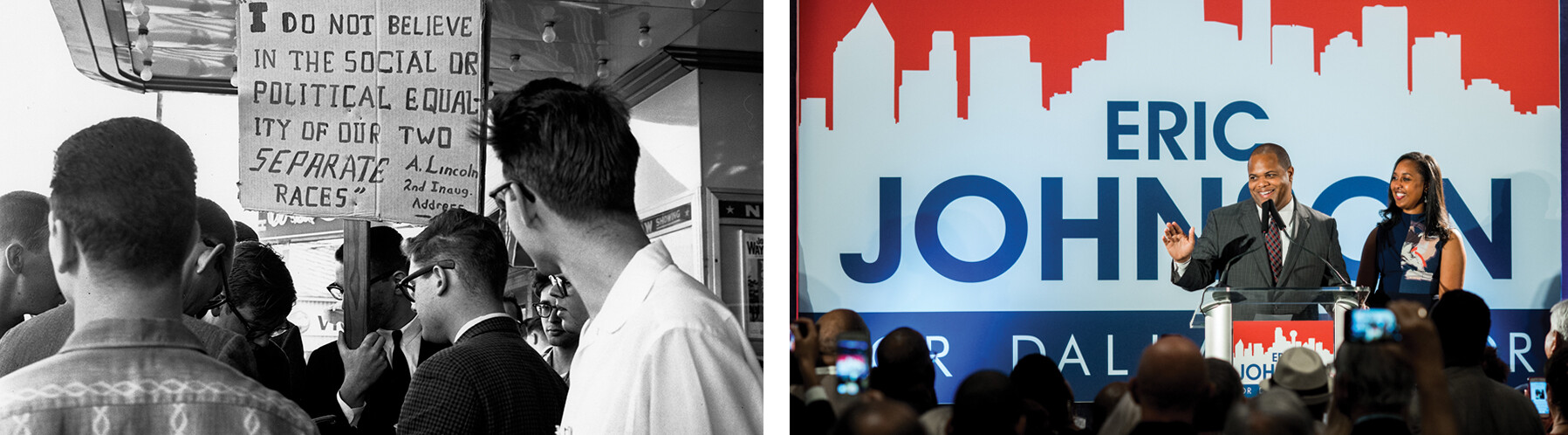
A black and white photograph shows men at a demonstration with a sign reading “I do not believe in the social or political equality of our two separate races”
Eric Johnson and his wife stand on stage at a campaign rally. A sign behind them reads, Eric Johnson for Dallas Mayor.
As in most former slave states, there was initial resistance to the civil rights movement in Texas (left). In 1956, a crowd blocked Steve Poston as he tried to enter Texarkana Junior College in 1956. He was one of the first Black people who tried to gain admission after the courts opened the school to Black students for the first time. Today, Eric Johnson (right) serves as the mayor of Dallas.
In the 1940s and 1950s federal court decisions offered some hope of relief to African Americans living in Texas. The U.S. Supreme Court decision in Smith v. Allwright (1944) outlawed the White primary. Sweatt v. Painter (1950) guaranteed Black people admission to graduate and professional schools at state colleges and universities. Finally, Brown v. Board of Education (1954) outlawed the segregation of public schools.
Political progress was much slower. The Civil Rights Act of 1964 and the Voting Rights Act of 1965 helped to open the political system in Texas to Black people, and in 1966 a small number of Black candidates began to win political office in the state. In 1972, Barbara Jordan became the first Black woman from Texas to be elected to the U.S. House of Representatives.
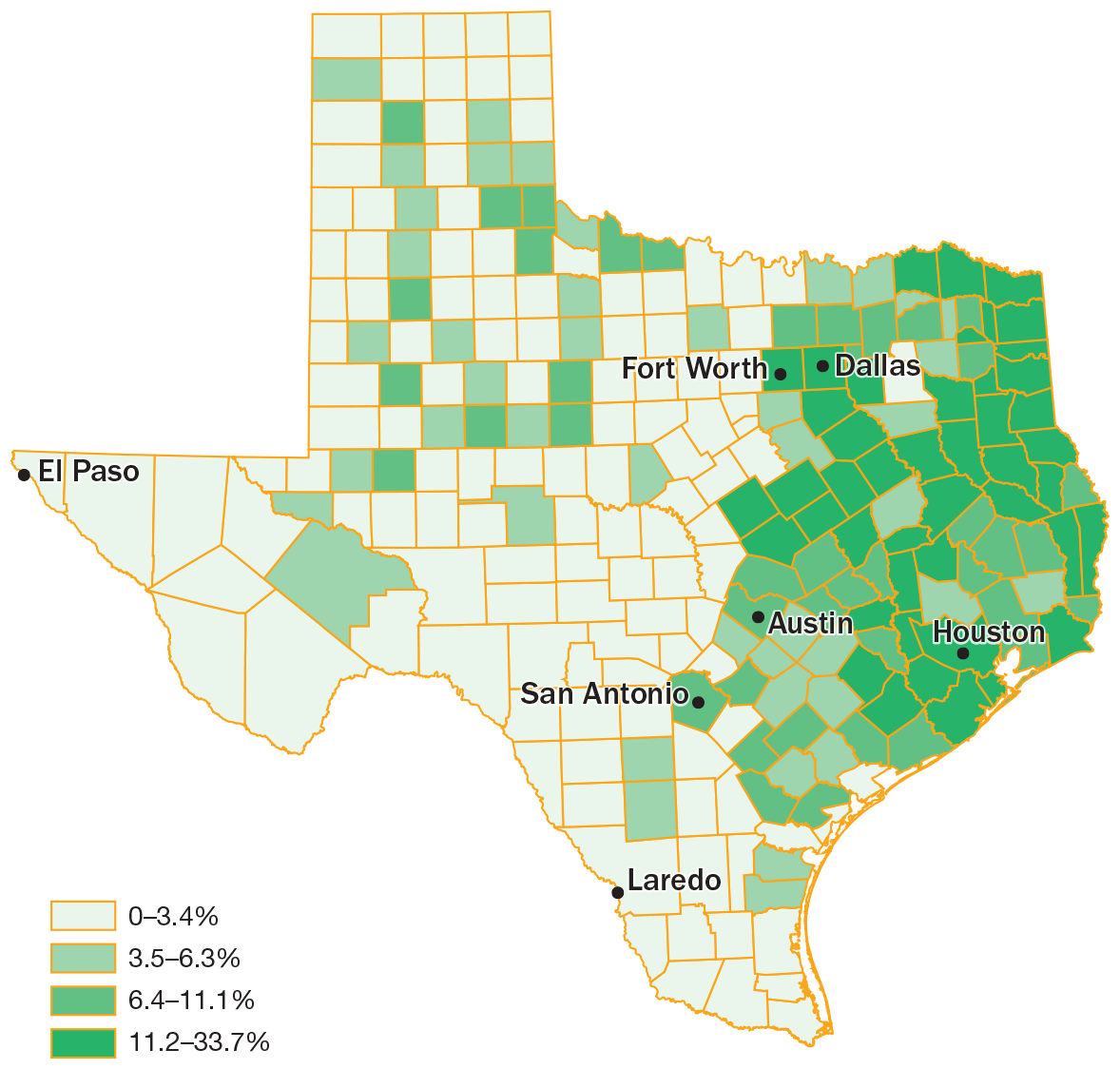
The state’s Black population remains concentrated in east Texas, where the plantation and sharecropping systems were dominant during the nineteenth century. Large numbers of Black people have also migrated to Houston and Dallas, where they form sizable minorities in both central-city and suburban areas (see Figure 1.7). Beginning in the late 1990s, Black political leaders came to play major roles in these areas as members of Congress, the state legislature, and city councils, as well as mayors of Houston and Dallas.
Asian Americans
Although considerably smaller than the groups already discussed, the Asian population has grown in Texas in recent years. It includes individuals from many countries, but particularly India, Vietnam, China, Pakistan, Korea, and Japan. In 2020 the U.S. Census Bureau estimated that over 1.5 million Asian Americans resided in Texas, or about 5.2 percent of the state’s population.35 Asian Americans tend to be concentrated in certain cities and their suburbs, particularly in west Houston and Fort Bend County, the western and northern suburbs of Dallas, Arlington, and Austin and its suburbs. Sizable pockets of Asian Americans also live along the Gulf Coast.36
FIGURE 1.7
Black Population in Texas Counties
More information
A map that shows the Black population in Texas counties in 2018. The map shows that counties with the highest percentage of Black residents are concentrated in the eastern part of the state and along the northern gulf coast and range from 15.3 to 86.4 percent. Counties in the rest of the state range from 0.8 percent to 15.3 percent. Only 3 counties are less than 1.8 percent Black.
Source: U.S. Census Bureau, “QuickFacts,” www.census.gov.
SOURCE: The County Information Program, Texas Association of Counties.
Age
When compared with the rest of the nation, the population of Texas is younger. In 2020, 32.4 percent of the population was estimated to be under 18 years old, compared with 28.3 percent nationally. In addition, only 12.9 percent of Texans were 65 or older, compared with 16.5 percent nationally.37 Its relatively young population presents Texas with a variety of both problems and opportunities, as we shall see in later chapters. One of the most challenging of these issues is poverty. Younger populations tend to be poorer, as income and poverty statistics bear out.
SOCIAL RESPONSIBILITY
Get Involved
Based on the population growth, urbanization, and economic change of the last two decades, what do the next two decades hold for Texas? Which areas will grow in population, and will government be ready for that growth?
If you wrote a letter to the governor or your state legislators, what advice would you give them to strengthen the Texas economy? Would you want them to focus on supporting rural or urban communities? Why?
Poverty and Wealth
Economic growth has played an important role in reshaping Texas over the past 30 years. Even considering the Great Recession (2008–09), the late twentieth and early twenty-first centuries were a period of rapid economic growth in Texas. Although the state continued to lag slightly behind the nation as a whole, its per capita income rose from $17,455 in 1990 to $62,586 in 2022 (see Table 1.1). The percentage of the population in Texas with incomes below the poverty level—as defined by the federal government—was 13.4 percent in 2019.38
WHO ARE TEXANS?
How Is the Texas Population Changing?
SHOW OVERVIEWHIDE OVERVIEW
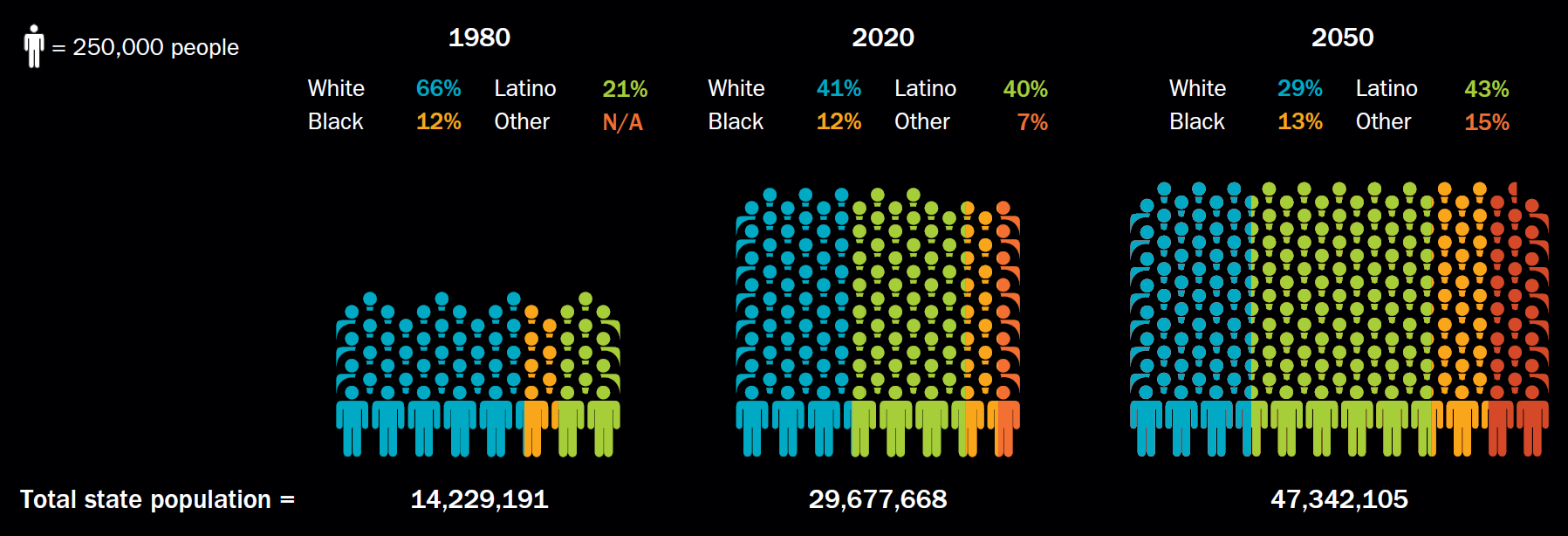
The face of Texas is changing and will continue to change well into the future. The figures below show projections of how the Texas population will change over the next 30–40 years. The state’s population will continue to grow quickly, especially as the number of Latino Texans increases. Further, most of the population growth in the state will happen in metropolitan areas—Dallas–Fort Worth, Houston, San Antonio, and Austin.
Race and Total Population
More information
A graphic shows how the populations of different racial groups in Texas have changed since 1980 and are projected to change in 2050. In 1980, 66 percent of Texans were white, 21 percent Latino, 12 percent Black, and other N/A. In 2020, the white population had decreased to 41 percent and the Latino population had increased to 40 percent. The Black population increased to 13 percent, and other racial groups moved to Texas, comprising 5 percent of the population. In 2050 the Latino population is expected to increase even more to 43 percent, the white population is expected to decrease to 29 percent, and the Black population is expected to remain at 13 percent, with other racial groups growing to 16 percent.
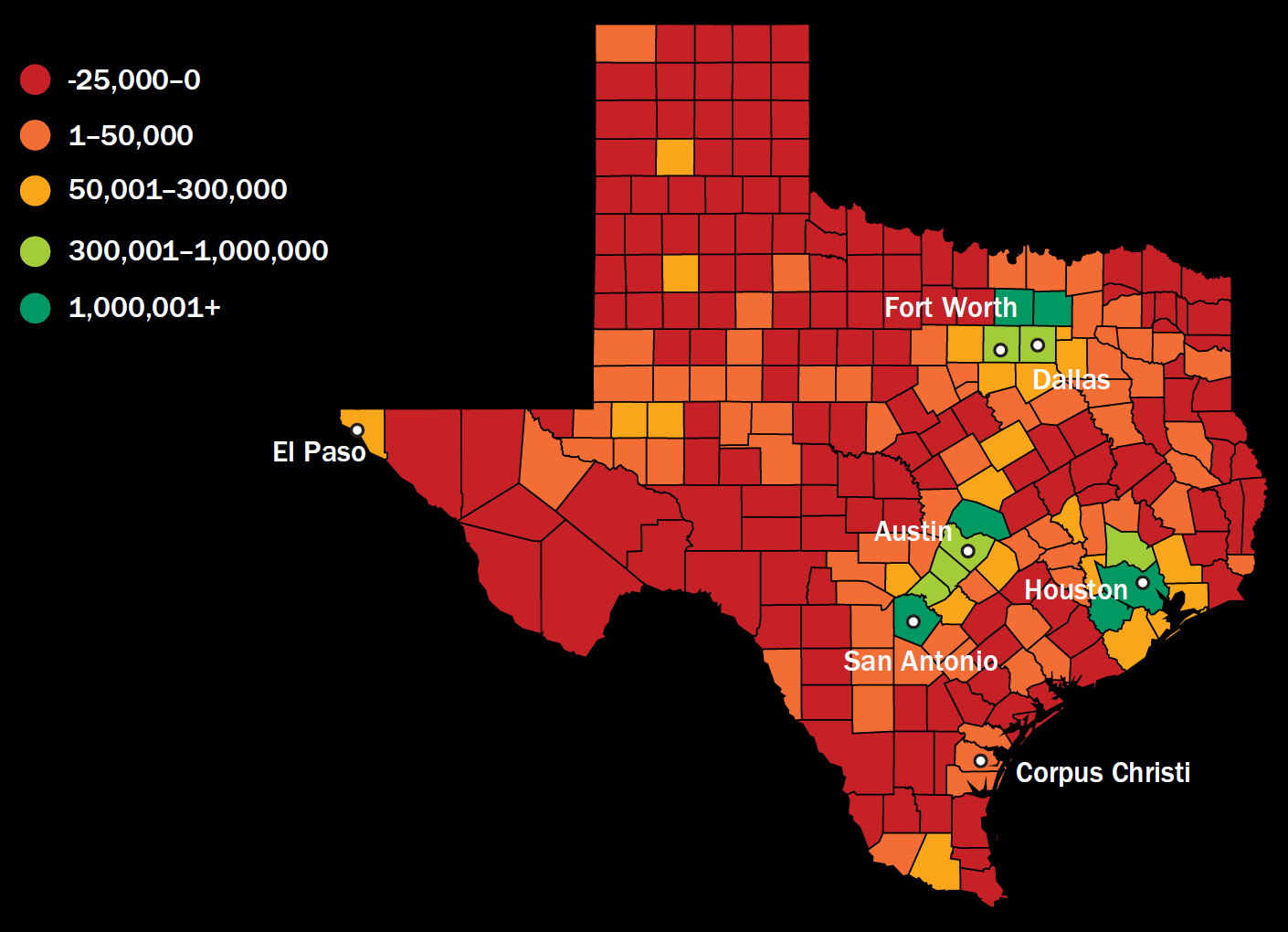
Projected Population Change in Texas Counties, 2020–2060
More information
The second part of the graphic shows projected growth in urban areas of Texas from 2010, to 2030, to 2050. The data are as follows: San Antonio, 2010, 2,481,508; 2030, 3,196,038, 49 percent increase; 2050, 4,467,980, 109 percent increase. El Paso: 2010: 804,123; 2030: 939,968 17 percent increase; 2050: 1,049,246 30 percent increase. Dallas-Fort Worth-Arlington: 2010: 6,426,214; 2030: 9,263,558 46 percent increase; 2050: 13,186,434 107 percent increase. Houston: 2010: 5,920,416; 2030: 9,077,879 53 percent increase; 2050: 13,209,128 123 percent increase. Austin: 2010: 1,716,289; 2030: 2,868,341 67 percent increase; 2050: 4,560,117 166 percent increase. McAllen slash Edinburg slash Mission: 2010: 774,769; 2030: 956,044 23 percent increase; 2050: 1,032,926 33 percent increase.
SOURCE: Texas Demographic Center, demographics.texas.gov.
QUANTITATIVE REASONING
Based on your reading of this data, how many Latinos were added to the state population between 1980 and 2020? How many White people? How is the projected 2050 population different from the population in 2020?
Given the county–level population projections for 2020–2060, in what areas is the population likely to grow? Where is it likely to decline? How might this shift the balance of political power?
TABLE 1.1
Per Capita Personal Income in Texas and the United States
1990
2022
United States
$19,641
$65,471
Texas
17,455
62,586
SOURCE: Federal Reserve Economic data, https://fred.stlouisfed.org/ .
Urbanization
Urbanization is the process by which people move from rural to urban areas. Suburbanization is the process by which people move out of central-city areas to surrounding suburban areas. Much of Texas’s history is linked to ongoing urbanization. By the twenty-first century, this process was largely complete, as 85 percent of the population now resides in urban areas (see Figure 1.8). Suburbanization, however, continues as city populations spill over into surrounding suburban areas.39
Urbanization has transformed Texas political life. Understanding the complexity of the government and politics in Texas today demands having some sense of how Texas’s major metropolitan areas compare with each other (see Table 1.2). We will look briefly at four of the most important.
HOUSTON
Houston, located in Harris County, is the largest city in Texas and—with a population of 2.3 million—the fourth-largest in the United States, behind New York, Los Angeles, and Chicago. Its metropolitan area encompasses eight counties, with an estimated population of 7.1 million in 2021.
FIGURE 1.8
Urbanization in Texas, 1850–2010
More information
A bar graph shows the distribution of the Texas population in rural and urban areas from 1850 to 2020. The x-axis represents the year from 1850 to 2020. The y-axis represents the percentage ranging from 0% to 100%. The graph shows that in 1850, the population of Texas was nearly 100% in rural areas, with only a small percentage in urban areas. By 1900 a little under 20% of the Texas population was located in urban areas, and in 1950 the percentage of urban Texans had increased to about 60%. In 2020, about 85% of Texans lived in urban areas, with 15% in rural areas.
Source: Statistical Abstract of the United States: 1994 (Washington, D.C.: U.S. Department of Commerce, Bureau of the Census, 1994); Texas Almanac 2001–2002 (Dallas: Dallas Morning News, 2001); U.S. Department of Agriculture, Economic Research Service, U.S. Census Bureau, “Texas: 2010, Population and Housing Unit Courts, 2010 Census of Population and Housing” (September 2012), p. 16.
SOURCE: Statistical Abstract of the United States: 1994 (Washington, D.C.: U.S. Department of Commerce, Bureau of the Census, 1994); Texas Almanac 2001–2002 (Dallas: Dallas Morning News, 2001); U.S. Department of Agriculture, Economic Research Service, U.S. Census Bureau, “Texas: 2010, Population and Housing Unit Courts, 2010 Census of Population and Housing” (September 2012), p. 16.
TABLE 1.2
Race and Ethnic Breakdown of Texas and Its Largest Counties, 2023 (major cities indicated in parentheses)
In the late nineteenth century, Houston’s economic well-being depended on cotton and commerce. Railroads played an integral role in placing the city at the hub of the Texas economy, and the opening of the Houston Ship Channel further enhanced its position by helping to turn the Port of Houston into the busiest port in the United States based upon total waterborne tonnage. It was oil that fundamentally transformed the Houston area in the twentieth century. Oil refineries opened along the ship channel and a petrochemical industry emerged, making Houston one of the leading energy centers in the world. Today, Houston continues to rank first in the nation in the manufacture of petroleum equipment.
By 1930, Houston had become the largest city in Texas, with a population of around 292,000 people. The population continued to expand in the next half century, assisted by a liberal state annexation policy that enabled the city to incorporate into itself many of the outlying suburban areas. Although the oil bust in the mid-1980s slowed the city’s growth, that growth continued in the early twenty-first century.
DALLAS–FORT WORTH METROPLEX
The Metroplex is an economic region encompassing the cities of Dallas and Fort Worth as well as a number of their suburban cities, including Arlington (population in 2020 of 394,266), Mesquite (150,108), Garland (246,018), Richardson (119,469), Irving (256,684), Plano (285,494), McKinney (195,308), Carrollton (133,434), Grand Prairie (196,100), Frisco (200,509), and Denton (139,869).40 The major counties in the area are Dallas, Tarrant, and Collin. The Metroplex is joined together by a number of interlocking highways running north-south and east-west and by a major international airport strategically located in the national air system. There is also a rapidly expanding regional transportation light rail system that many cities participate in called DART (Dallas Area Rapid Transit).
Dallas was founded as a trading post in 1841, near where two roads were to be built by the Republic.41 By the 1850s it had become a retail center servicing surrounding rural areas, with a population that reached 3,000 by 1870. The coming of the Houston and Texas Central Railway in 1871 and the Texas and Pacific Railway in 1873 made Dallas the first rail crossroads in Texas and transformed forever its place in the state’s economy. Markets now beckoned east and north, encouraging entrepreneurs and merchants to set up shop.
As cotton became a major cash crop, the city’s population more than tripled by 1880 to more than 10,000 people. By the turn of the twentieth century, Dallas had grown to more than 42,000 people.
As with Houston, the oil economy changed the direction and scope of the city’s economic life. With the discovery of oil in east Texas in 1930, Dallas became a major center for petroleum financing. By the end of World War II, the economy had diversified, making Dallas a minor manufacturing hub in the nation. In the 1950s and 1960s, technology companies such as Ling-Temco-Vought (LTV) and Texas Instruments were added to the industrial mix, transforming Dallas into the third-largest technology hub in the nation. The high-tech boom of the 1990s was built from the corporate infrastructure laid down in the 1950s and 1960s. Dallas grew from 844,401 people in 1970 to 1,304,379.
Although locked together in important ways economically, Dallas and Fort Worth are as different as night and day. Whereas Dallas looks to the east and embodies a corporate, white-collar business culture, Fort Worth looks to the west. Fort Worth originated as an army post in 1849,42 but by 1853 the military had abandoned it as new forts were built to the west. Although settlers replaced the soldiers, population growth was slow through the early 1870s. The spark that set off the town’s prosperity was the rise of the cattle industry. Because Fort Worth was a convenient place for cowboys to rest on their cattle drives from southern Texas to Kansas, cattle buyers established headquarters in the city. By 1900, Fort Worth was served by eight railroad companies, most of them transporting cattle and related products to national markets.
More information
A shopping center with 5 businesses shown. Four of the five businesses have their company name written in English as well as another language.
Houston is a large metropolitan area with a growing minority population. In fact, Harris and Fort Bend Counties are some of most diverse counties in the United States.
TEXAS AND THE NATION
How Does Texas’s Population Compare to Other Major States’?
SHOW OVERVIEWHIDE OVERVIEW
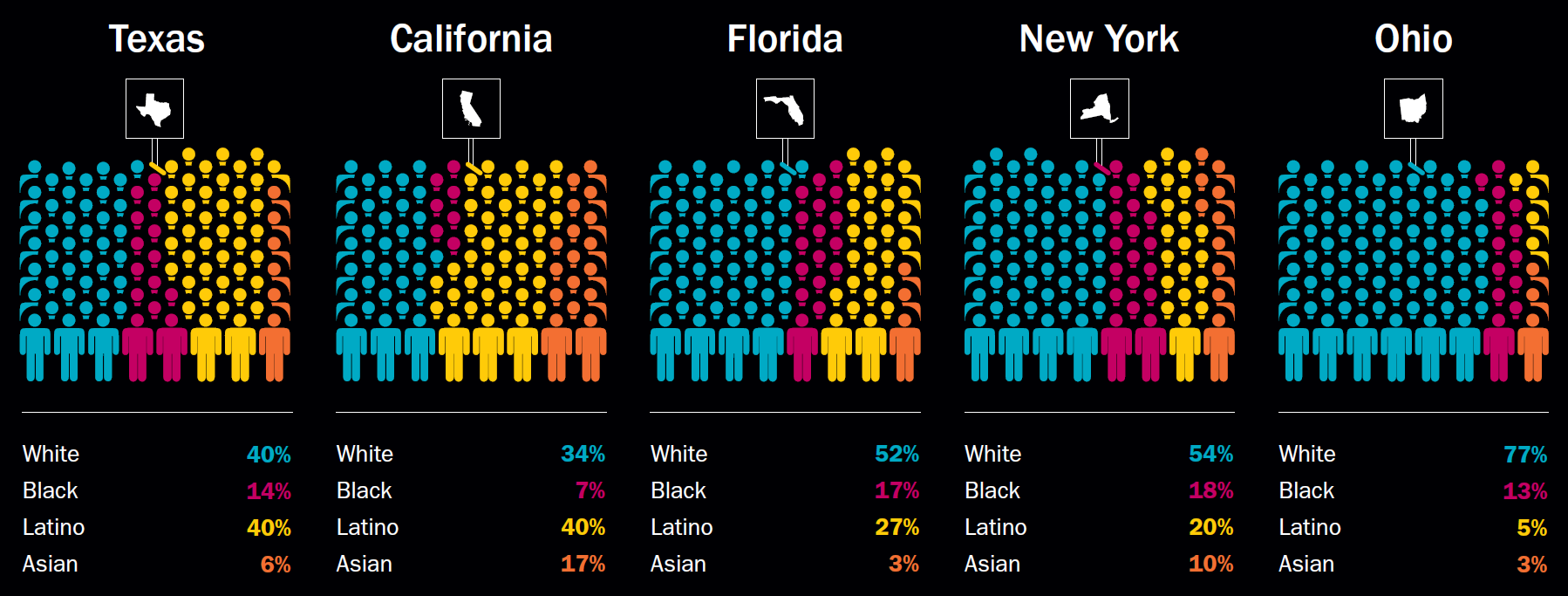
Texas is more diverse than many states, which has important implications for the future of the state’s politics. Also, the Texas population has increased dramatically, while some states are not growing as fast. In fact many states in the Midwest such as Ohio and Pennsylvania have seen population declines in recent years.
A graphic shows that Texas’s current population is comparable to California’s, though California has a larger Asian population. Florida and New York have larger white and black populations, and Ohio has a significantly larger white population and smaller minority populations.
The population data are as follows: Texas is 41 percent white, 13 percent Black, 40 percent Latino, and 5 percent Asian population. California’s population is 37 percent white, 7 percent black, 39 percent Latino, and 16 percent Asian. Florida’s population in 53 percent white, 17 percent Black, 26 percent Latino, and 3 percent Asian. New York’s population is 55 percent white, 18 percent Black, 19 percent Latino, and 9 percent Asian. Ohio is the least diverse, with whites making up 78 percent of their population; 13 percent is Black, 4 percent Latino, and 3 percent Asian. Note: Numbers do not always add up to 100 percent. Black Latinos may be counted in both categories.
Percent Change in Population by County, 2010–20
More information
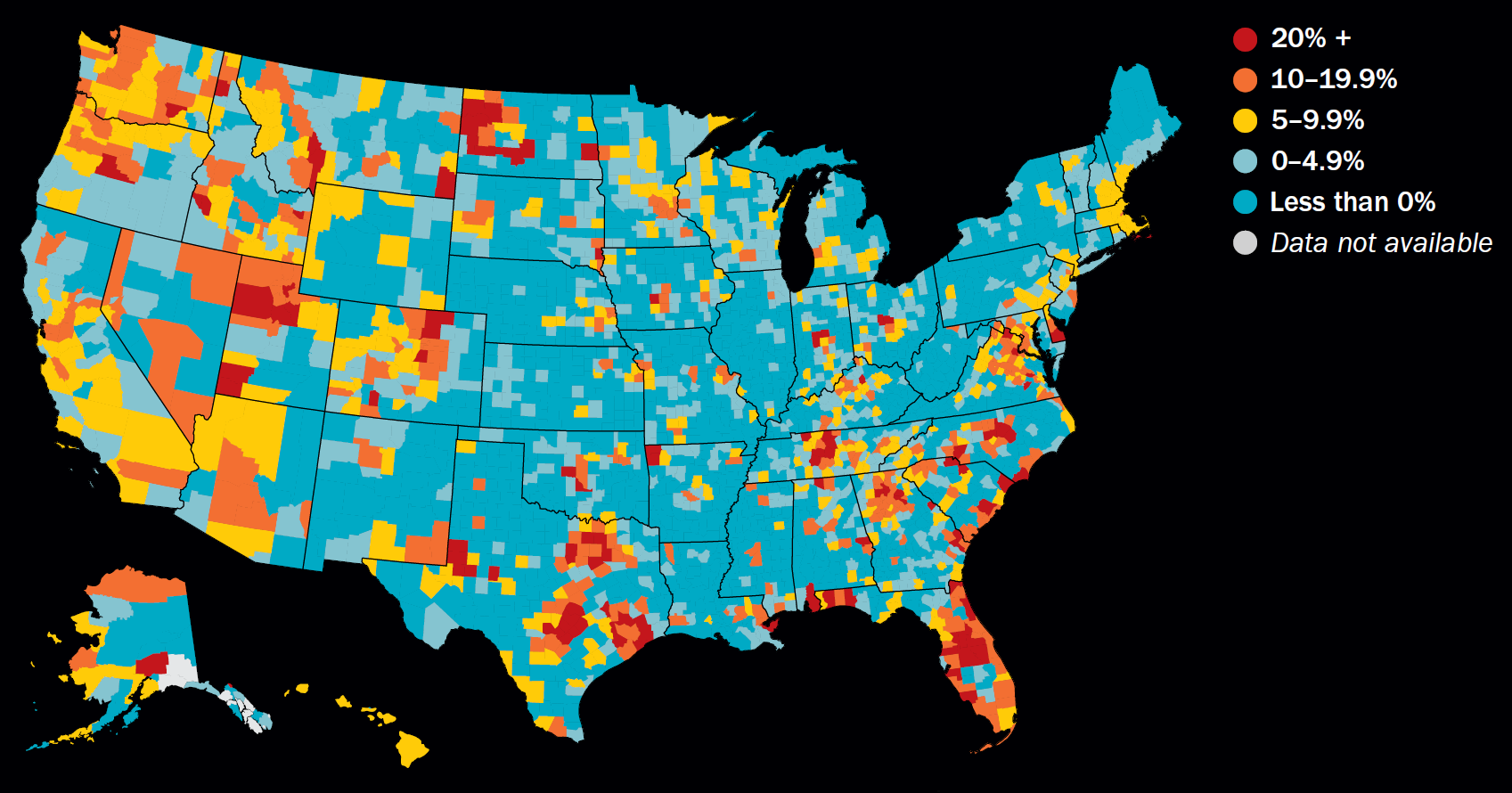
A graphic shows a county-level map of the United States, color coded according to the type of population growth that occurred in each county from 2010 to 2020. Much of the population growth throughout the country over that period of time was concentrated in the south and west of the country, and the population of the midwest and northeast decreased. However, there were at least some counties in each state that experienced growth. The counties with the highest rate of growth saw their population increase by over 20 percent (such as in Washington, Oregon, Idaho, Montana, Utah, Colorado, North Dakota, Texas, and Florida).
NOTE: Note that data may not add up to 100 percent.
SOURCE: U.S. Census Bureau. QuickFacts.
CRITICAL THINKING
In what ways are California and Texas similar in terms of demographic makeup? How are they different?
Which regions are growing rapidly, and which are growing more slowly or declining? Do you think urban or rural areas are growing the fastest? What do you think accounts for these trends?
The two world wars encouraged further economic development in Fort Worth. Over 100,000 troops were trained at Camp Bowie during World War I. World War II brought an important air force base and, along with it, the aviation industry. The Consolidated Vultee Aircraft Corporation, which was later bought by General Dynamics, became the largest manufacturer in the city. Between 1900 and 1950, Fort Worth’s population grew from 26,668 to 277,047. By 2017 the population was 918,915. The overall metropolitan area of Dallas–Fort Worth included 7,637,337 people in 2020.
SAN ANTONIO
San Antonio, in Bexar County, grew out of the Spanish presidio San Antonio de Béxar, which was founded in 1718.43 In 1773 it became the capital of Spanish Texas, and by the Civil War, it was the largest city in Texas.
Following the war, San Antonio continued to grow rapidly, stimulated by the building of the San Antonio Railroad in 1877. By 1880 the population was more than 20,000, mostly White Americans from southern states. By 1920 it had reached 161,000. Mexican immigration increased significantly following the Mexican Revolution of 1910 and the building of a city infrastructure that provided paved roads, utilities, water, telephones, and hospitals. By midcentury, San Antonio had become a unique blend of Latino, German, and southern Anglo American cultures.
Today, San Antonio is Texas’s second-largest city (third if you consider Dallas and Fort Worth together). The population of the city was estimated to be 1,434,625 in 2020. San Antonio’s population has become increasingly Latino. In San Antonio, approximately 64.2 percent of the people were Latino, 24.7 percent were White, and 7.0 percent were African American in 2020.44
Unlike Houston or Dallas, San Antonio lacks high-paying manufacturing jobs, and average metropolitan income is lower than in Houston and Dallas. The economy rests on four legs: national military bases, educational institutions, tourism, and a large medical research complex.
AUSTIN
Located in central Texas in Travis County on the eastern edge of the Hill Country, Austin had an estimated population of 961,855 in 2020. Per capita income was $40,391—33 percent higher than the state average. Median household income in 2019 dollars was $71,576—15.6 percent higher than the state median. Almost half of adults living in Austin had a bachelor’s degree or higher.45 Along with Round Rock and San Marcos, Austin is part of the 35th-largest metropolitan area in the country, with a combined population of over 2 million. Austin is the 4th-largest city in the state (behind Houston, Dallas–Fort Worth, and San Antonio).
Austin’s economy rests on three solid foundations. First, as the state capital, Austin is the hub of governmental business in the state. Although the legislature only meets for 140 days every two years, state agencies are a year-round activity, as are the lobbying activities of special interests. Second, Austin is the location of the University of Texas at Austin, the flagship institution of the University of Texas system and home to more than 50,000 students and faculty. In 2021 it was estimated that the school generated $8.2 billion in Texas business activity.46 Third, Austin has a thriving high-tech industry. Grown from seeds planted by governmental and university activity, Austin’s computer and electronics businesses are the core of one of the most vibrant regional economies in the country. Through them, the city continues to attract people and businesses at a remarkable pace.
Having settled its status as the government hub in the state in 1846, Austin began to gradually grow, reaching a population of 3,546 in 1860. The emergence of the Houston and Texas Central Railroad in 1871 linked Austin to the eastern part of the state and turned it into a trading center in central Texas. By 1880 the city’s population had grown to 11,013.
More information
A group of demonstrators hold signs reading Keep Families Together and Families Belong Together outside the Texas capitol building.
Urban areas like Austin, Houston, and Dallas have become bastions of liberal politics. Here, demonstrators rally outside in Austin to protest the U.S. Supreme Court’s Dobbs v. Jackson Women’s Health Organization decision that overturned Roe v. Wade and allowed states to set abortion policies.
Compared with that of Dallas–Fort Worth or Houston, Austin’s economic base was narrow for the early decades of the twentieth century. Except for the benefits gleaned from the university’s endowment, Austin missed out on much of the economic development flowing from the rise of oil and gas production. The population of the city was 22,258 in 1900 and 132,459 in 1950.47 Austin’s population began to surge in the second half of the twentieth century, growing to 656,962 in 2000. Driving this increase was a rapidly diversifying economy led by the high-tech sector. IBM located to Austin in 1969 and was soon followed by Texas Instruments and Motorola. Other high-tech firms followed in the 1980s, including Dell Computers and Sematech. By the 1990s there were estimated to be 400 high-technology businesses located in Austin, including Amazon and Facebook.48 In 2021 over 8,300 employers in Austin were in high tech, employing 176,406 people.49
a state tax imposed as a requirement for voting; poll taxes were rendered unconstitutional in national elections by the Twenty-Fourth Amendment in 1964 and in state elections by the U.S. Supreme Court in 1966
the process by which people move from rural to urban areas
Endnotes
Columns may not add to 100 percent as a result of multiple counting. These are estimates projected from the 2019 Census.Return to reference *
Census tables include other categories for two or more races, Native Hawaiian and other Pacific Islanders alone, and American Indian and Alaska Native alone.Return to reference *
See Robert Plocheck, “Native American in Texas,” www.texasalmanac.com. The revival of the American Indian population in Texas was fostered by a federal government program between 1950 and 1980 that encouraged Indians to leave reservations (some in other states) and integrate themselves in post–WWII urban communities.Return to reference 26
See Texas Demographic Center, “Updates on Texas’ Demographic Trends and the On-Going Research at TDC,” March 7, 2021, www.demographics.texas.gov.Return to reference 27
See Texas Demographic Center, “Updates on Texas’ Demographic Trends.”Return to reference 28
How the U.S. Census counts individuals in certain demographic groups is a complicated affair and is getting more complicated. The U.S. Census did not provide data for non-Hispanic White people, Hispanics, or Latinos as separate groups prior to 1970. Beginning in the 2000 census the term Hispanic was included. See U.S. Census Bureau, “QuickFacts Texas 2019.”Return to reference 29
See Arnoldo De León, “Mexican Americans,” Handbook of Texas Online, 1976/updated December 3, 2020, www.tshaonline.org.Return to reference 30
See U.S. Census Bureau, “QuickFacts Texas 2021” and “State & County QuickFacts”; U.S. Census Bureau, 2010 Census; Sharon R. Ennis, Merarys Ríos-Vargas, and Nora G. Albert, “The Hispanic Population: 2010” (2010 Census Briefs, May 2011);Texas Almanac 2014–2015, 15.Return to reference 31
See National Association of Latino Elected and Appointed Officials (NALEO) Educational Fund, 2021 National Directory of Latino Elected Officials (Los Angeles, 2021).Return to reference 32
See W. Marvin Dulaney, “African Americans,” Handbook of Texas Online, 1976/updated September 29, 2020, www.tshaonline.org; Chandler Davidson, “African Americans and Politics,” Handbook of Texas Online, June 1, 1995/updated September 29, 2020, www.tshaonline.org.Return to reference 33
See John R. Ross, “Lynching,” Handbook of Texas Online, 1976/updated March 24, 2021, www.tshaonline.org.Return to reference 34
See U.S. Census Bureau, “QuickFacts: The Asian Population in Texas,” 2020.Return to reference 35
See Texas Almanac 2014–2015 for county-by-county data. The Asian population of Texas counties can be found at www.indexmundi.com.Return to reference 36
The definition used to measure the urban/rural dichotomy has shifted over time. For a more detailed discussion, see U.S. Census Bureau, “2012 Census Urban Area FAQs.”Return to reference 39
Estimates are drawn from the U.S. Census Bureau, “State & County QuickFacts,” 2020 Census.Return to reference 40
Information in this section is drawn from Jackie McElhaney and Michael V. Hazel, “Dallas, Texas,” Handbook of Texas Online, 1952/updated June 28, 2021, www.tshaonline.org.Return to reference 41
Information in this section is drawn from Janet Schmelzer, “Fort Worth, Texas,” Handbook of Texas Online, 1952/updated June 28, 2021, www.tshaonline.org.Return to reference 42
Information in this section is drawn from T. R. Fehrenbach, “San Antonio, Texas,” Handbook of Texas Online, 1952/updated January 27, 2021, www.tshaonline.org.Return to reference 43
Estimates are drawn from the U.S. Census Bureau, “State & County QuickFacts,” 2020 Census.Return to reference 44
See the University of Texas at Austin impact on Austin, www.utsystem.edu.Return to reference 46
See “City of Austin Population History, 1840–2016” at www.austintexas.gov.Return to reference 47
See David C. Humphrey, “Austin, TX (Travis County),” Handbook of Texas Online, 1976/updated September 8, 2020; and Anthony M. Orum,Power, Money and the People: The Making of Modern Austin (Austin: Texas Monthly Press, 1987), 235–36, 312–16.Return to reference 48
See Dom Nicastro, “Is Austin Emerging as the New American Technology Hub?” CMSwire.com, August 20, 2021, www.cmswire.com; see also Beverly Kerr, “High Tech Industry,” Austin Chamber, June 8, 2021, www.austinchamber.com.Return to reference 49