The Role of the Media in Texas Politics
★ Describe the key roles the media play in the Texas political system
The First Amendment of the U.S. Constitution establishes freedom of the press along with other important freedoms like freedom of speech and religion. The Texas Constitution affirms these freedoms in Article I, Section 8, stating that “Every person shall be at liberty to speak, write, or publish his opinions on any subject, being responsible for the abuse of that privilege; and no law shall ever be passed curtailing the liberty of speech or of the press.”
What Are the Media, and What Roles Do They Serve in Democracy?
The media play three crucial roles in democracy. They inform the public of current events in their city, state, nation, and around the world; provide a forum for public debate; and act as a watchdog over government leaders.
An informed public that makes choices based on objective information is vital for a thriving democracy. But most Texans cannot attend all sessions of their city council, track every legislative proposal filed in Austin, or read every ruling issued by the Texas Supreme Court. So, the press bridges the gap between government and the people, reporting on matters like policy debates in the state legislature, government corruption, and candidates’ campaigns. This relationship can result in a more informed, engaged public and government officials who heed the will of their constituents.
The media serve as a forum for the public to be heard on issues and potentially influence others’ views. Also, government officials and candidates promote their views and policies through the media to shape public opinion or gather support to win elections. Thus, the media are important spaces for exposing people to alternative political perspectives.
We say the media serve as a watchdog because they safeguard transparency in government. How well Texas government reflects the people’s will depends on citizens’ ability to hold their leaders accountable. The media do this by informing the public about policies that affect them, fact-checking statements made by candidates and government officials, identifying who influences these decisions, and challenging officials about concerns relevant to the public.
There are limitations on how well the media perform these functions, though. Critics claim the media in Texas exhibit a partisan bias, don’t do enough to help Texans avoid misinformation and disinformation, and are too focused on gaining viewership through sensationalism rather than producing a more engaged and informed public.
Do the media in Texas effectively fulfill their core functions, or are the critics right? To answer these questions, we need to understand how Texans get their news, what sources they rely on, and the quality of political media in the state. But first we need to explain two foundational principles of news media in the United States—journalism (who gathers the news) and media ownership (who owns the media).
Journalism
News journalism involves the reporting of events ranging from crime to politics, on a local or national scale. News journalists strive to be accurate and objective, relying on original sources of information whenever possible, being transparent, and providing multiple perspectives.
Investigative journalism involves in-depth research and analysis to understand an issue of public interest. Reflecting the media’s role as a watchdog, investigative journalism often exposes wrongdoing by individuals, groups, or organizations. The Texas government has at times produced policy changes in response. For instance, Houston Chronicle reporter Lisa Falkenberg twice won the Pulitzer Prize for uncovering problems in the legal and immigration systems and grand jury abuses that led to a wrongful conviction of Alfred Dewayne Brown, a Houston man sentenced to death and whose conviction was subsequently overturned. Austin journalist Tony Plohetski was awarded the 2021 Hillman Prize for his work covering the death of Javier Ambler II and the practices of the Williamson County Sheriff’s office. Plohetski was the first reporter to reveal that Ambler died after being chased by police for failing to dim his headlights and being tased multiple times as he shouted that he could not breathe (all while being filmed for the reality TV show Live PD). Plohetski’s reporting helped trigger investigations that led to the indictment of former Sheriff Robert Chody and an assistant county attorney on evidence tampering charges. It also led to the passage of the Javier Ambler Law in 2021, which bans Texas state and local law enforcement agencies from signing deals with reality TV shows.17

More information
A photo of Alfred Dewayne Brown reaching out to hug journalist Lisa Falkenberg outside of the Harris County jail. Alfred has a happy expression on his face with a slight smile and arms outstretched. He is wearing a mint green polo shirt buttoned to the top. A woman, Lisa Falkenberg, is standing to his right with a big smile on her face. She is wearing a light blue v neck and silver hoop earrings. Lisa is facing Alfred with her right arm outstretched about to hug Alfred. She is white with red hair and is wearing a white collared shirt. The brick exterior and entryway of the Harris County jail is visible in the background behind the smiling, hugging people.While news journalism strives for objectivity, opinion journalism is more subjective. Aiming to provoke thought in audiences, these pieces evaluate and contextualize local and world events, and they provide a forum for public engagement surrounding important issues in communities. Local newspaper opinion sections often feature vibrant public debate.
Many newspapers offer endorsements of candidates during elections, conducting interviews with the candidates and doing original research and reporting on them. During the 2022 election, the Houston Chronicle faced backlash among Democrats when it endorsed Republican challenger Alexandra del Moral Mealer for Harris County Judge over Democratic incumbent Lina Hidalgo (who won re-election). Letters to the editor streamed in criticizing the newspaper for its endorsement.18 Yet evidence is mixed on whether newspaper endorsements actually influence election outcomes. Endorsements matter most among those who are less engaged in politics.19 They also have greater influence in primary elections (where voters choose between candidates of the same party) and in nonpartisan local elections (e.g., a school board election), where voters lack a partisan cue at the ballot box and may have less information about candidates.20
Citizen journalism involves reporting and commentary by ordinary people—not trained journalists—who usually publish their work on the internet. Thanks to cell phones and social media, every Texan can photograph, record, and share events. This allows the public to act as watchdogs exposing wrongdoing, but it makes the objectivity and accuracy of such reports unclear. Citizen journalism also raises questions about how far First Amendment protections extend—an issue that Texas courts have been considering.

More information
A photo shows a close up of a citizen journalist, Priscilla Villarreal, documenting real time events on her phone. The perspective of the photo is as if you are looking over her shoulder and at her phone screen while she documents the events. The phone screen is visible in the center of the photo and displays a police car near a large overpass bridge and some text below from her livestream. The livestream text is not visible from the photo.Priscilla Villarreal, a Latina firebrand known as La Gordiloca (“the big crazy lady”) on Facebook, has made her mark in Laredo by livestreaming crime scene videos to her 200,000 followers.21 Her career as a citizen journalist began in 2015 when she recorded a hostage situation unfolding with shots fired and two dead girls being carried out of a house. She uploaded clips to Facebook, where they were viewed almost one million times.
Villarreal’s zealous pursuit of exposing malfeasance and corruption in Laredo government and law enforcement stirred controversy. She was arrested after releasing the name of a local U.S. Border Security agent who died by suicide in 2017 and again after identifying a family involved in a deadly car crash. Prosecutors claimed Villarreal had run afoul an obscure state law involving soliciting or receiving information from a public servant that “has not been made public” with an intent to obtain a benefit, but a judge dismissed these charges both times. In 2019, Villarreal brought a lawsuit against the Laredo Police Department, the City of Laredo, and Webb County, among others, for violating her First Amendment rights by arresting her for doing journalism. While the Fifth Circuit Court of Appeals ruled against Villarreal, upholding the district court’s decision on qualified immunity, the Supreme Court subsequently tossed out the decision, ordering the appeals court to review the case again. In the original full-panel decision rendered by the Fifth Circuit, the dissenting judges warned of the serious threat this decision could pose to free speech and news gathering. According to U.S. Circuit Judge James Graves,
“. . . the majority would limit journalists who work the government beat to publicly disclosed documents and official press conferences, meaning they will only be able to report information the government chooses to share.” U.S. Circuit Judge James Ho noted in his dissent, “The Constitution doesn’t mean much if you can only ask questions approved by the state. Freedom of speech is worthless if you can only express opinions favored by the authorities.”22
Who Owns the Media in Texas?
Independence of the press is crucial for ensuring that the press can perform its watchdog function. While we may take this as a given in the United States, media freedom and safety of journalists worldwide has declined. In 2023 Reporters Without Borders revealed a dire state of media freedom. They characterize the environment for journalism today as “bad” in 70 percent of countries (a record high), and satisfactory in only 30 percent. The United Nations reports that 85 percent of people live in countries where media freedom has declined in the past five years.23
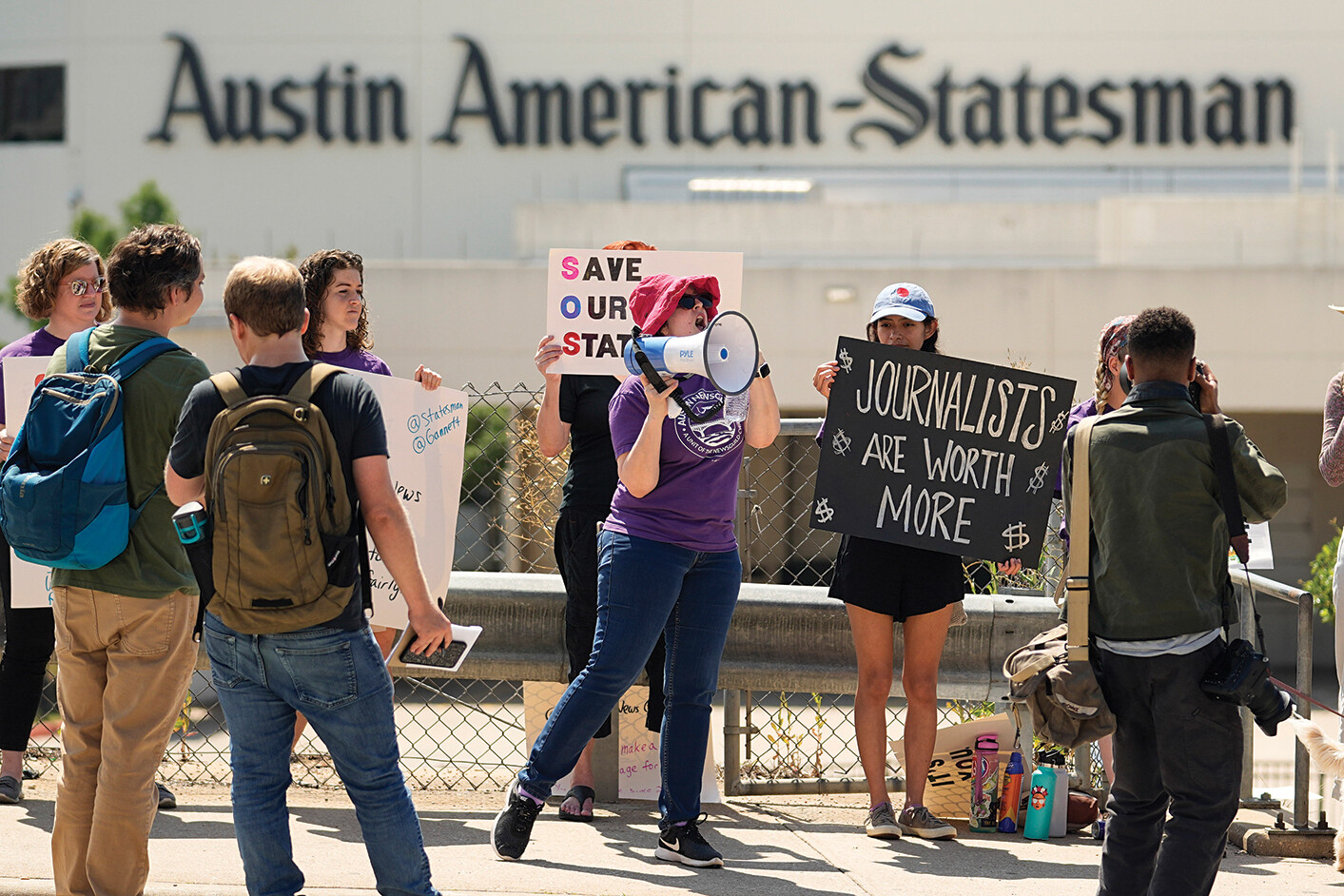
The content produced by media outlets is influenced by the structure and nature of media ownership. The major media outlets in Texas include a mix of for-profit and non-profit organizations, with most resting in private hands operating as for-profit businesses. Recent years have seen a rise in acquisitions of local media by hedge funds and private equity firms; this is concerning because these kinds of owners generally acquire distressed news outlets and slash their staff to cut costs, which can endanger the quality of the news produced. The largest newspaper giant, Gannett, which owns USA Today and more than 200 other daily U.S. newspapers including the Austin American-Statesman, has come under fire recently. In June 2023, hundreds of Gannett journalists employed at nearly two dozen newspapers nationwide walked out to demand an end to cost-cutting measures and a change of leadership at Gannett. According to the NewsGuild (the union representing the company’s newsroom employees), Gannett’s workforce has shrunk 47 percent in the last three years. Others have shrunk by as much as 90 percent. The Austin American-Statesman’s newsroom shrank from 110 employees in 2018 to 41 in 2023.24
More information
A photo shows a group of journalists on strike outside of the Austin American-Statesman. A woman in the center of the photograph has a megaphone in her hand and is actively shouting something and swaying. Behind her, a protester holds a white sign with large lettering that reads, "Save Our State." To the right of her, another protestor holds a large black sign that reads, "Journalists are worth more" in large white lettering. To the right of the sign holder, more protesters are obscured by a photographer facing the crowd of protesters and documenting the whole scene. More protesters holding signs are visible on the left side of the photo, but their signs are obscured by two onlookers wearing backpacks. Behind the protesters, the words "Austin American-Statesman" are prominently displayed on the side of a white building. The protesters all stand in front of a fence surrounding the building.THE PROFIT MOTIVE
Most media in Texas (and nationwide) are owned by private individuals or corporations. Media corporations that are publicly traded and controlled by shareholders tend to be especially driven by earning a profit. And because advertising is a major source of revenue, the media have incentives to give the public what it wants since better ratings lead to increased advertising revenue. Given the need to appeal to wide audiences, for-profit media generally focus on “soft news” (such as stories on celebrities or sports) and dramatic or conflictual stories (such as crime, political scandals, or candidates’ attacks against each other) rather than on highly technical stories detailing policies being debated by legislators or complex court rulings on constitutional matters. Decisions over what stories to cover and how they are covered can have important consequences for public knowledge and engagement in politics and government.
MEDIA CONSOLIDATION
Prior to the 1980s, the federal government alongside the Federal Communications Commission (FCC) worked to prevent media monopolies. Since then, there has been a trend toward media deregulation—that is, the relaxing of rules concerning media ownership. When the Telecommunications Act of 1996 permitted corporations to amass large numbers of local newspapers and news stations, it led to media consolidation, the process in which fewer individuals or groups control a growing share of mass media. The largest ten chains own more than half of all dailies nationwide.25
This trend has also affected Texas media. Hearst Communication, for example, owns many newspapers, including the Houston Chronicle, Laredo Morning Times, Midland Reporter-Telegram, and the San Antonio Express-News. Sinclair Broadcast Group owns television stations in Amarillo, Beaumont, El Paso, Houston, San Antonio, and Corpus Christi, among other locations. iHeartMedia (formerly Clear Channel) owns radio stations across Texas in locations like Austin, Waco, Houston, Dallas−Fort Worth, and El Paso.
There are economic benefits of consolidation. Large corporations can provide resources necessary for struggling newspapers and television and radio stations to survive, particularly in the face of declining viewership and circulations. However, mergers and acquisitions by media corporations and hedge funds can also result in large-scale cuts. In 2019, for example, when Gannett merged with GateHouse Media the two companies had roughly 25,000 employees combined. Less than four years later, the workforce is around 11,000. Since the merger, Gannett has steadily reduced the number of papers in circulation. In 2019, Gannett owned 261 daily and 302 weekly newspapers. By the end of 2022 they were down to 217 dailies and 175 weeklies—a reduction of 171 in total.26
Media consolidation can affect the product being delivered to the public. Political scientists Gregory Martin and Joshua McCrain examined local news coverage of 743 stations nationwide over a nine-month period in 2017. They found that rising corporate media ownership and consolidation led to superficial coverage, fewer locally focused stories, and less diverse viewpoints. For example, stations acquired by Sinclair increased the time allocated to national politics by about 25 percent (largely at the expense of local news coverage) and started using more conservative-leaning phrases in reporting.27
Media consolidation also contributes to a lack of diversity in ownership of media outlets. According to the most recent FCC report, men had a majority interest in 61 percent of commercial TV stations, and women in only 9 percent (23 percent had no single majority interest). White people held majority ownership interest in 73 percent of commercial broadcast stations. Latinos accounted for 6 percent of majority interests, while Black people accounted for only 2 percent, and Asian Americans accounted for 1 percent.28
PUBLIC AND NONPROFIT MEDIA
Texas has 38 public broadcasting stations, including National Public Radio (NPR), Public Broadcasting Station (PBS), and Pacifica Radio. In 2019, The Texas Newsroom was announced, which is a collaboration led by the state’s largest public radio stations—KERA in Dallas, KUT in Austin, Texas Public Radio in San Antonio, and Houston Public Media. The goal of the collaboration is to increase coverage of statewide issues and revitalize reporting in underserved regions, including along the border with Mexico. The next push will be extending coverage to areas with no local news whatsoever.
Founded in 2009 with an initial $1 million in funding from venture capitalist John Thornton, Texas Tribune is a nonprofit, nonpartisan, digital-first organization. Its news coverage spans a wide range of issues in the state including education, health care, immigration, civil rights, and infrastructure. One of its largest partnerships is the Texas Tribune–ProPublica investigative unit, which has produced award-winning reporting exposing how Texas regulators and lawmakers furthered the interests of large electricity providers instead of protecting its power grid against extreme weather events like the 2021 winter storm Uri.29
In 2023, the Texas Observer, a liberal publication owned by the nonprofit Texas Democracy Foundation, announced that it would shut down after 68 years. Upon the announcement, journalists for the publication appealed to the public and raised over $300,000 through GoFundMe, leading the publication’s governing board to reverse its decision.30
How Do the Media Shape the Political News That Texans Encounter?
The content and nature of news programming can have important consequences in setting the political agenda. The media can shape public perception of events, issues, institutions, and individuals; and the media are influenced by the institutions and individuals who are subjects of the news. Knowing this, politicians craft their images by maintaining a good relationship with reporters and leaking and staging news events.
DETERMINING WHAT THE NEWS IS: AGENDA-SETTING
One crucial way the media can exercise power is through agenda-setting. The designation of certain stories as newsworthy can thrust such issues into the public’s awareness and the government’s agenda. Media attention can be key in whether officials act on a policy issue and can increase the salience, or importance, that the public places on those issues. For example, if Texas journalists emphasize issues concerning immigration and border security, then Texans are more likely to cite immigration as an important problem that government should address.
SHAPING HOW PEOPLE UNDERSTAND THE NEWS: FRAMING
The process of presenting information in a way that shapes the audience’s understanding of the information is called framing. Each issue can be presented in a variety of ways, with a different slant or spin to describe the heart of the issue and possible solutions. For example, in 2013, the Associated Press banned the use of the term “illegal immigrant” in its immigration reporting. Economist Milena Djourelova found that changing how the press framed this issue affected the public’s attitudes about immigration. She found a decline in support for restrictive immigration policies among consumers of local media once they stopped using the term “illegal immigrant.”31
The Media in the Texas Political System
The media have an important role in the Texas political system in covering campaigns and elections, reporting on state and local government, and highlighting major policy debates. Having accurate and current information on state and local governments enables the public to hold government accountable over the decisions that affect their lives.
Government officials and candidates crave good media coverage. To gain name recognition they promote themselves through newspapers, television advertisements, and on social media, and they appear on local news shows and seek endorsements from newspaper editorial boards. Positive press coverage can help politicians achieve their policies, while bad publicity can subvert their goals. Although many efforts by state and local officials in the past were directed at print media, they now seek coverage on television and social media platforms like Facebook and X (formerly Twitter), which allow supporters to widely share these messages.
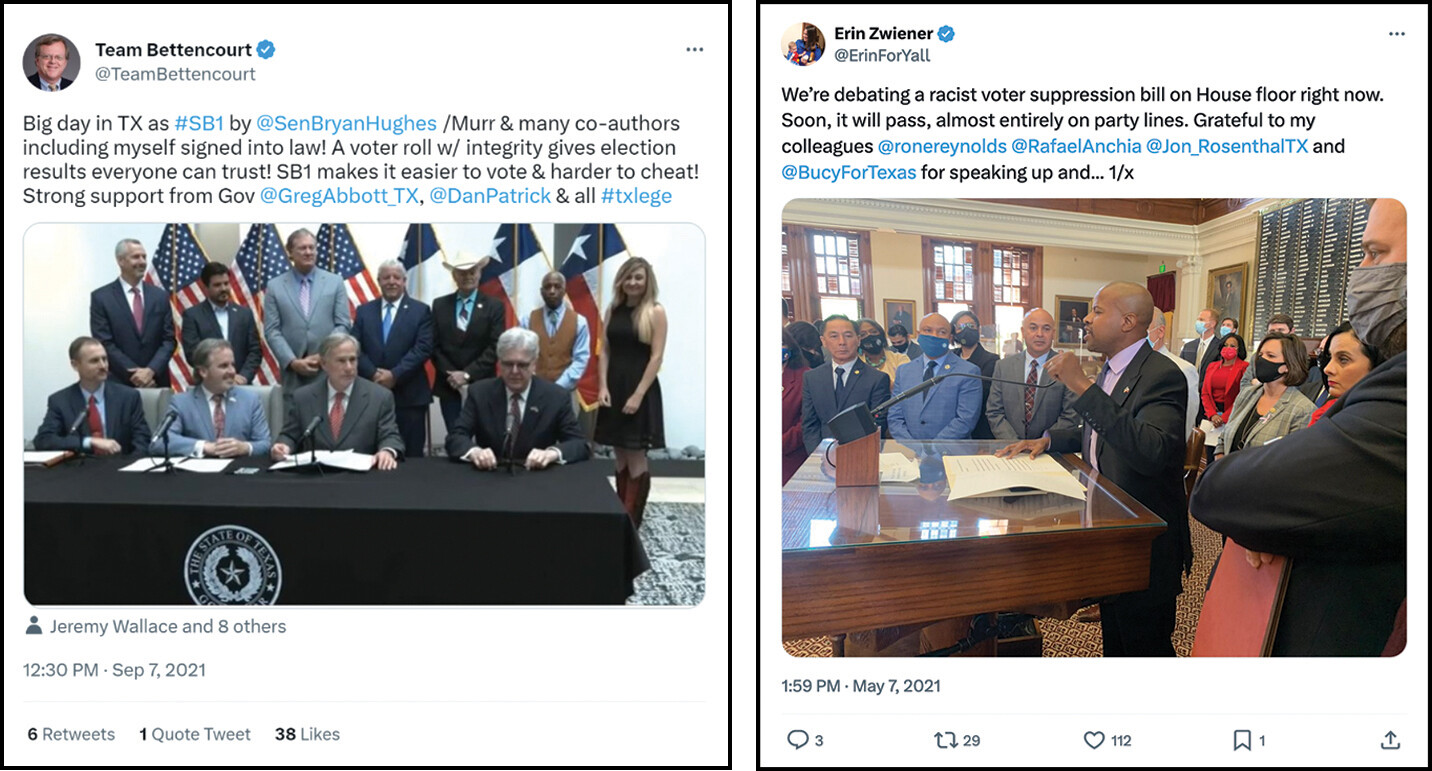
Politicians use agenda-setting and framing to gain support for their positions and/or make their opponents look bad. For example, as major issues are debated during the legislative session, each political party tends to unite around different ways to frame the bills being considered. One of the major pieces of legislation passed during the 87th Texas Legislature (2021) was the Republicans’ overhaul of the Texas election code. The parties throughout the debate adopted different framing. Texas Republicans framed their election reform legislation as a matter addressing “election integrity,” while Texas Democrats framed the legislation as a plan by Republicans to engage in “voter suppression.”
More information
A photo shows a screenshot of a tweet from Team Bettencourt that celebrates the passing of S B one. The tweet shows a photo of policy-makers signing the bill, with the tweet reading, "Big day in Texas as hashtag S B one by at Sen Bryant Hughes slash Murr and many co authors including myself signed into law! A voter roll with integrity gives election results everyone can trust! S B one makes it easier to vote and harder to cheat! Strong support from Gov at Greg Abbot underscore T X at Dan Patrick and all at hashtag T X lege." The photo underneath the tweet shows ten legislators standing behind a desk with a black table cover and a state of Texas seal. There are two microphones at the table with open paperwork present. Three American flags and three Texas flags are in a row behind the ten legislators. A couple of the legislators are smiling but many look serious. They are all wearing suits and ties of various colors, and one legislator is wearing a cowboy hat. A photo shows a screenshot of a tweet from Erin Zwiener that expresses disappointment at the passing of S B one. The tweet reads, "We’re debating a racist voter suppression bill on House floor right now. Soon, it will pass, almost entirely on party lines. Grateful to my colleagues at Ron E Reynolds at Rafael Anchia, at Jon underscore Rosenthal T X and at Bucy for Texas for speaking up. The tweet shows a photo of a policy maker Ron E Reynolds giving an impassioned speech at a podium with many legislator onlookers. He is wearing a black suit and a light lavender buttoned up shirt with a gray tie. His hand is up as he is clearly gesturing while giving an impassioned speech. Many onlookers in suits are paying close attention to him. Many of the onlookers are wearing masks. The room is white with white crown molding on the walls and portraits decorating the space.Glossary
- media
- print and digital forms of communication—including television, newspapers, radio, the internet, and social media sites—that deliver news and information
- news journalism
- reporting about individuals, issues, or current events with the aim of objectivity and transparency
- investigative journalism
- news reporting involving in-depth research and analysis into a matter of public interest, such as crime, government corruption, or corporate malfeasance
- opinion journalism
- news reporting that includes personal commentary and subjective judgments about an individual, event, or issue
- endorsements
- support or approval that newspapers or other organizations give to political parties or candidates
- citizen journalism
- news reporting and political commentary by ordinary citizens, not professional journalists, often distributed on social media
- media consolidation
- the concentration of ownership of news sources into the hands of fewer individuals or companies
- agenda-setting
- the media’s designation of some issues, events, or people as important and others not
- framing
- the process of presenting information from a certain perspective in order to shape the audience’s understanding of that information
Endnotes
- American-Statesman Staff, “Tony Plohetski Wins Prestigious National Prize for Javier Ambler II Reporting,” Austin American-Statesman, April 20, 2021.Return to reference 17
- Letters to the Editor, “Opinion: Unlike Mealer, Hidalgo Understands Latinos’ Concerns,” October 14, 2022.Return to reference 18
- Michael G. Hagen and Kathleen Hall Jamieson, “Do Newspaper Endorsements Matter? Do Politicians Speak for Themselves in Newspapers and on Television?” InEverything You Think You Know about Politics—and Why You’re Wrong, ed. Kathleen Hall Jamieson (New York: Basic Books, 2000).Return to reference 19
- Mirya R. Holman and J. Celeste Lay, “Are You Picking Up What I Am Laying Down? Ideology in Low-Information Elections,” Urban Affairs Review 57 (2021): 315−341.Return to reference 20
- Roxanna Asgarian, “Appeals Court to Decide if First Amendment Should Have Protected Laredo’s “Big Crazy Lady” from Arrest,” Texas Tribune, January 6, 2023.Return to reference 21
- Villarreal v. City of Laredo, Texas, 2024 WL 244539 (5th Cir. 2024).Return to reference 22
- “2023 Press Freedom Index,” Reporters Without Borders, https://rsf.org.Return to reference 23
- The Associated Press, “Hundreds of Journalists Strike to Demand Leadership Change at Biggest U.S. Newspaper Chain,” NPR News, June 6, 2023.Return to reference 24
- Penelope Abernathy, “The State of Local News: The 2022 Report,” Northwestern/Medill Local News Initiative, June 29, 2022, https://localnewsinitiative.northwestern.edu.Return to reference 25
- Manuela Lopez Restrepo, “How America’s Largest Newspaper Company Is Leaving Behind News Deserts,” National Public Radio, April 10, 2023.Return to reference 26
- Gregory J. Martin and Joshua McCrain, “Local News and National Politics,” American Political Science Review 113, no. 2 (2019): 372−384.Return to reference 27
- Media Bureau and Office of Economic and Analytics, “Sixth Report on Ownership of Broadcast Stations,” January 2023, fcc.gov.Return to reference 28
- ProPublica, “ProPublica and Partners Win Three IRE Awards,” April 6, 2022.Return to reference 29
- Sewell Chan, “ Texas Observer Will Continue Publishing after Staff Crowdfunds More Than $300,000,” Texas Tribune, March 30, 2023.Return to reference 30
- Milena Djourelova, “Persuasion through Slanted Language: Evidence from the Media Coverage of Immigration,” American Economic Review 113, no. 3 (2023): 800−35.Return to reference 31