ocher
What Is an Image? Thinking about Cave Paintings
Recent research has shown that the paintings applied to the walls of dark, deep caves may have been the work of specialized individuals, using a variety of mineral and vegetal pigments, and experimenting with different tools and techniques—especially the use of the body. Techniques included printing with the palm, tracing with fingers, drawing with sticks or blocks of ocher, scraping the rock surface, shading with charcoal, and using a paintbrush made of hair or moss. Sometimes, ancient artists and their descendants created this art over several thousand years, repainting over existing images at the same sites.
More information
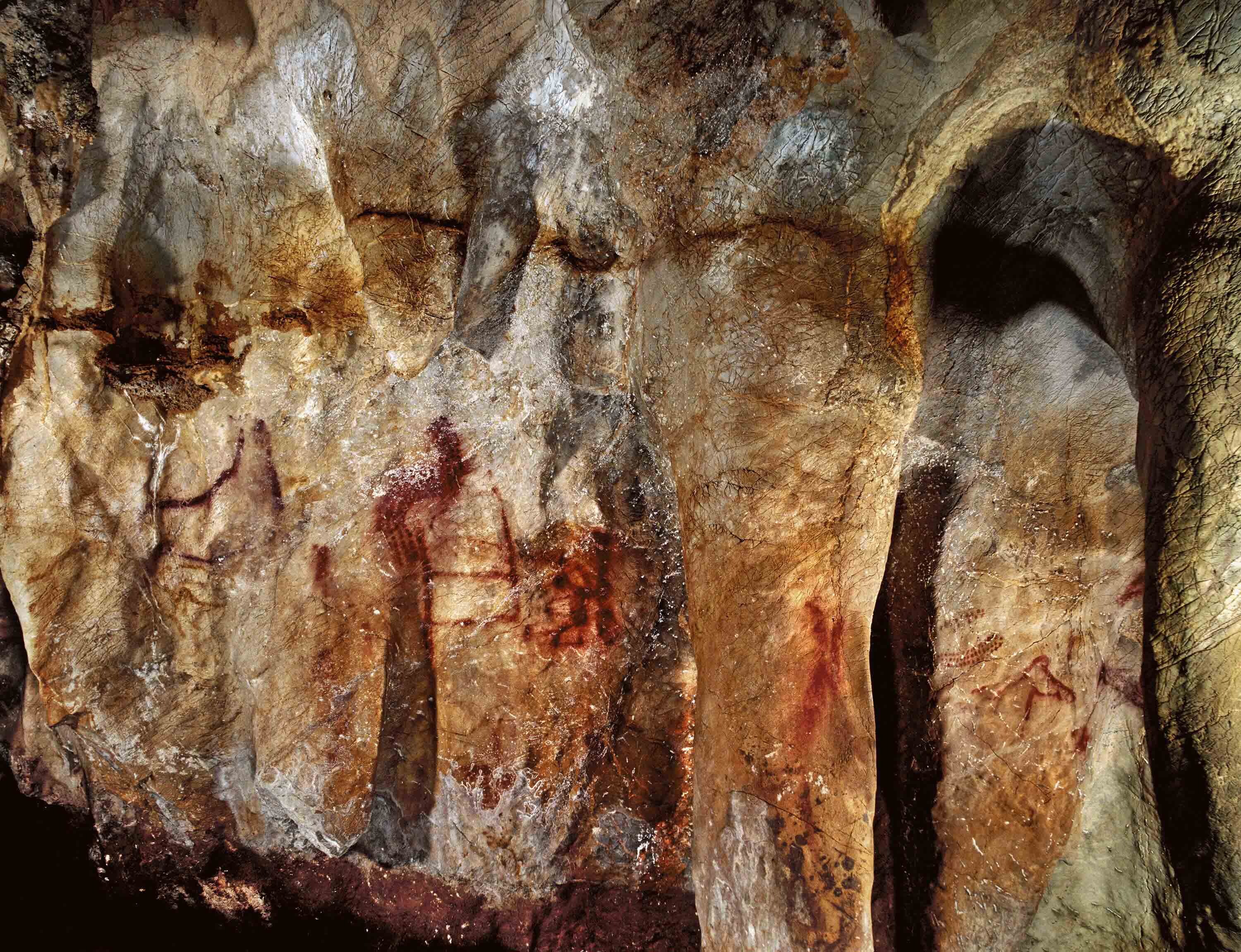
The drawings are done in rich dark red pigment. One drawing to the far right appears to be of an animal’s head.
La Pasiega Cave
The durability of the stone surfaces and the protection provided by caves and rock shelters have preserved significant sites of early art around the world. One of the earliest examples of cave art was discovered by scientists in the La Pasiega Cave in Monte Castillo in northern Spain (Fig. 1.1). Here, walls of this cave are richly painted in red and black with dots and lines, club-shaped forms, groups of animals, and possibly even human-formed figures. A dating technique based on the age of calcium deposits that formed over some of these paintings tells us that at least one ladder-like form was likely created by Neanderthal artists, long before the arrival of Homo sapiens in Europe. It was once thought that Neanderthals lacked the cognitive capacity to create art, but La Pasiega, along with cave paintings at other sites, challenges that thinking.
More information
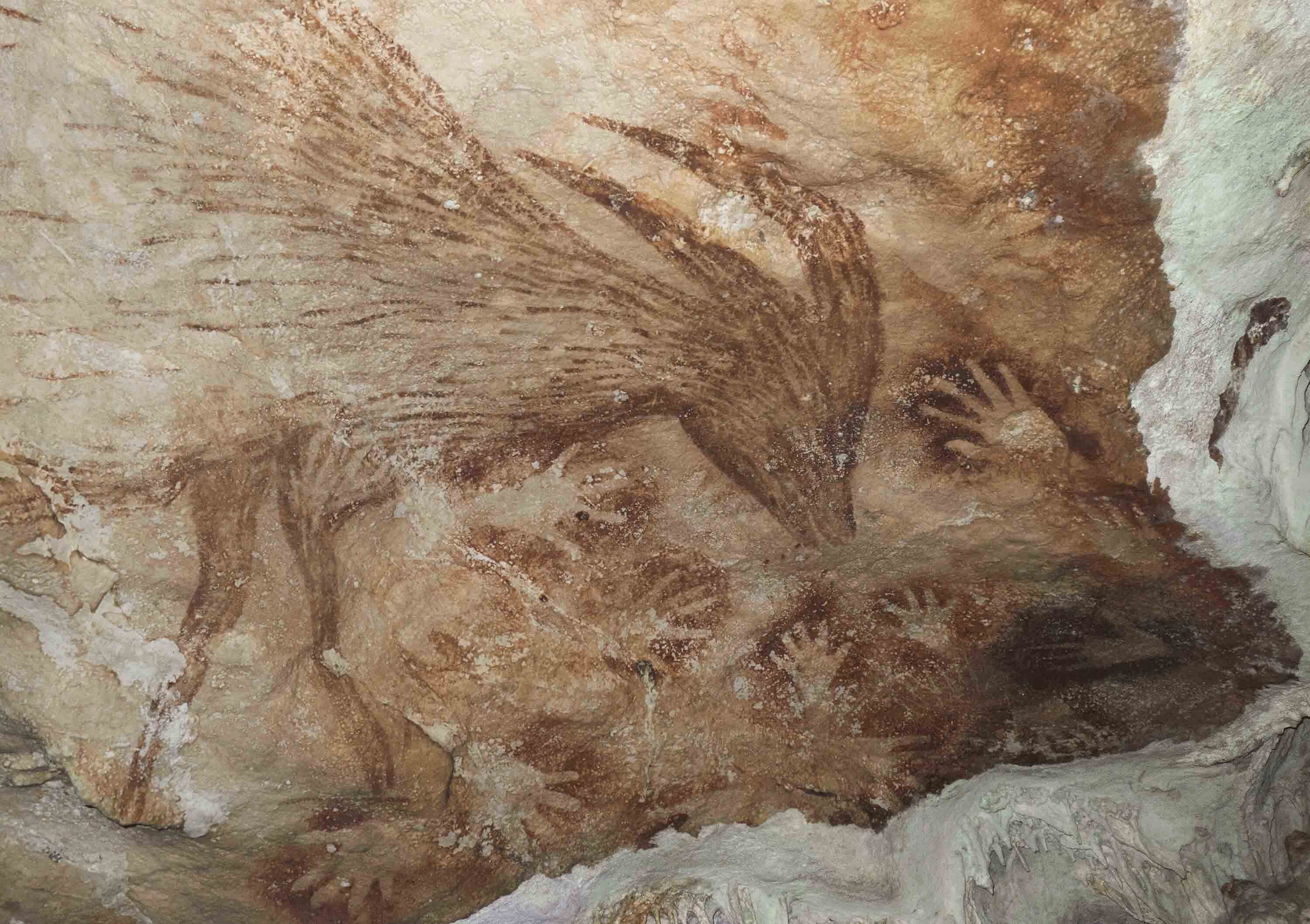
A cave painting of a horned quadruped. The animal’s head and forelegs are surrounded by multiple silhouetted hand-stencil images.
Maros-Pangkep Caves
Sulawesi
Cueva de las Manos
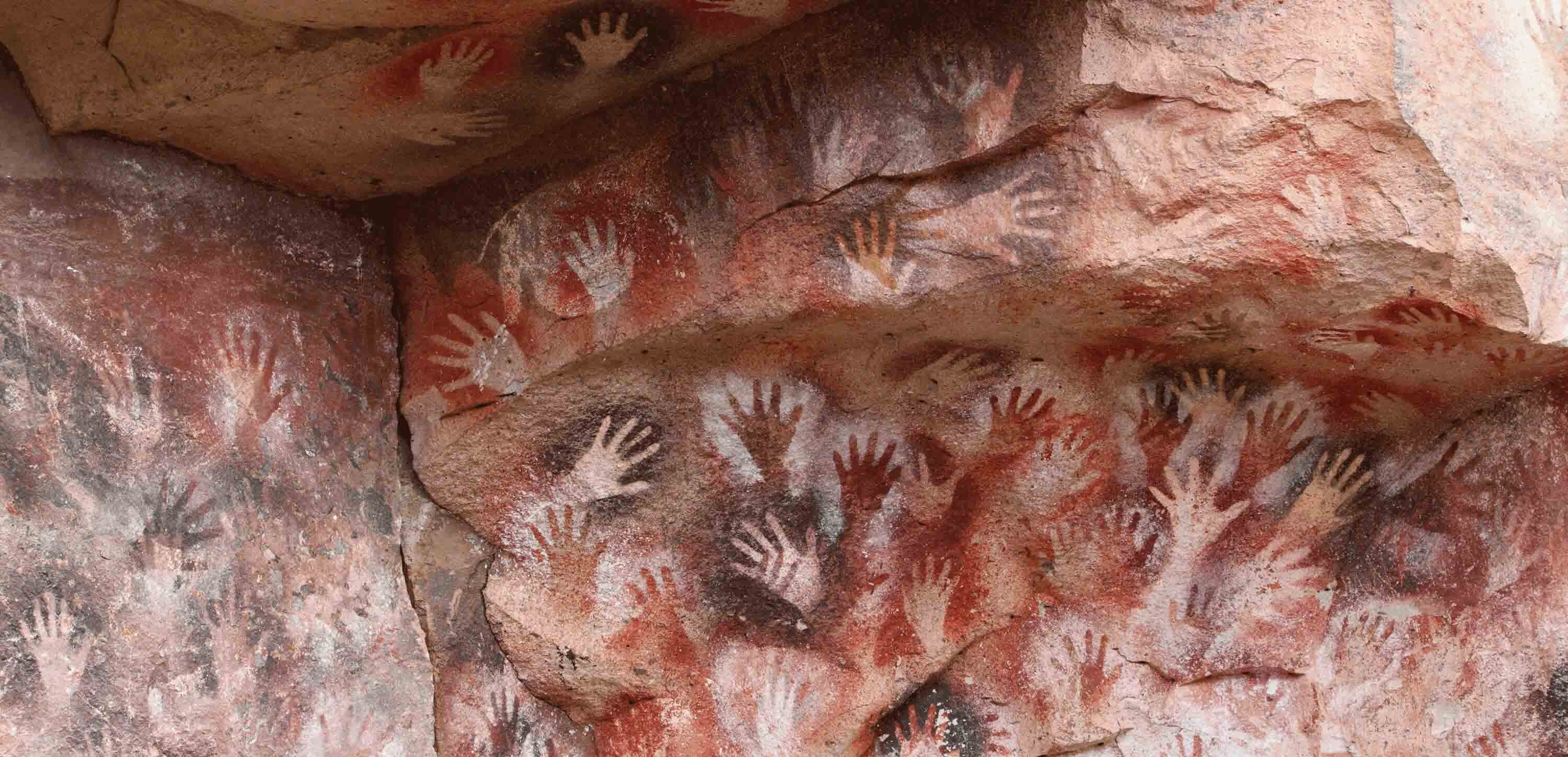
MAROS-PANGKEP CAVE PAINTINGS In the Maros-Pangkep Caves on the Indonesian island of Sulawesi, artists created hand stencils by placing their hands on the wall and then blowing pigment over them to create negative images, or imprints (Fig 1.2). This method is seen in many caves across the world and over time. In Argentina’s Cueva de las Manos (Cave of the Hands) (Fig. 1.3) similar hand-stencil images were applied to the walls of a rock shelter between 11,000 and 7000 BCE. The paintings in the Maros-Pangkep Caves, which also include images of animals moving across the surfaces of the cave walls, may date to between 37,000 and 34,000 BCE.
More information
Many hand images, sometimes overlapping. Some hands appear light against a black or red background, while others appear dark against a white background.
When humans began to create figurative forms like those at Maros-Pangkep, they typically depicted the animals they saw around them—for example, aurochs (an extinct species of wild cattle) and bison in Europe, and kangaroos and flightless birds in Australia. Human figures were much less commonly and often less naturalistically depicted than animals. In some locations, artists combined animal and human features to depict hybrid figures. They also drew imaginary figures that feature some human and animal parts, perhaps to represent supernatural spirits or forces. Plant life and landscape features are almost never shown.
Chauvet Cave
Lascaux
Paintings from a series of deep caves that cluster in the mountainous region of southern France and northern Spain tell extraordinary stories about ancient peoples. Similar to the Maros-Pangkep Caves, the cave sites of Chauvet and Lascaux (in France) and Altamira (in Spain) served for thousands of years as sacred sites of ritual and image-making for the hunting-gathering communities of Europe during the Upper Paleolithic. They each demonstrate the Paleolithic artists’ interest in creating scenes of wild, powerful animals moving across the uneven surfaces, nooks and crevices of limestone cave walls.
CHAUVET CAVE Some of the best-preserved and most complex figurative paintings from Europe are contained in Chauvet Cave. These may date to 30,000 to 28,000 BCE, although these dates are debated by specialists. Located on the Ardèche River in south-central France, this buried and sealed limestone cave was discovered in 1994 and is now closed to the general public to preserve its interior and paintings. The 1,300-foot-long (nearly 400 m) cave features about 950 images, including both engravings and paintings, most with scenes of animals (at least thirteen different species) depicted in groups and individually, along with hand imprints and stencils, geometric shapes and patterns, and a few partial human figures. There are also other images at Chauvet that are engraved, formed by lines carved with flakes of flint (a hard, gray rock) into the surface of the cave wall.
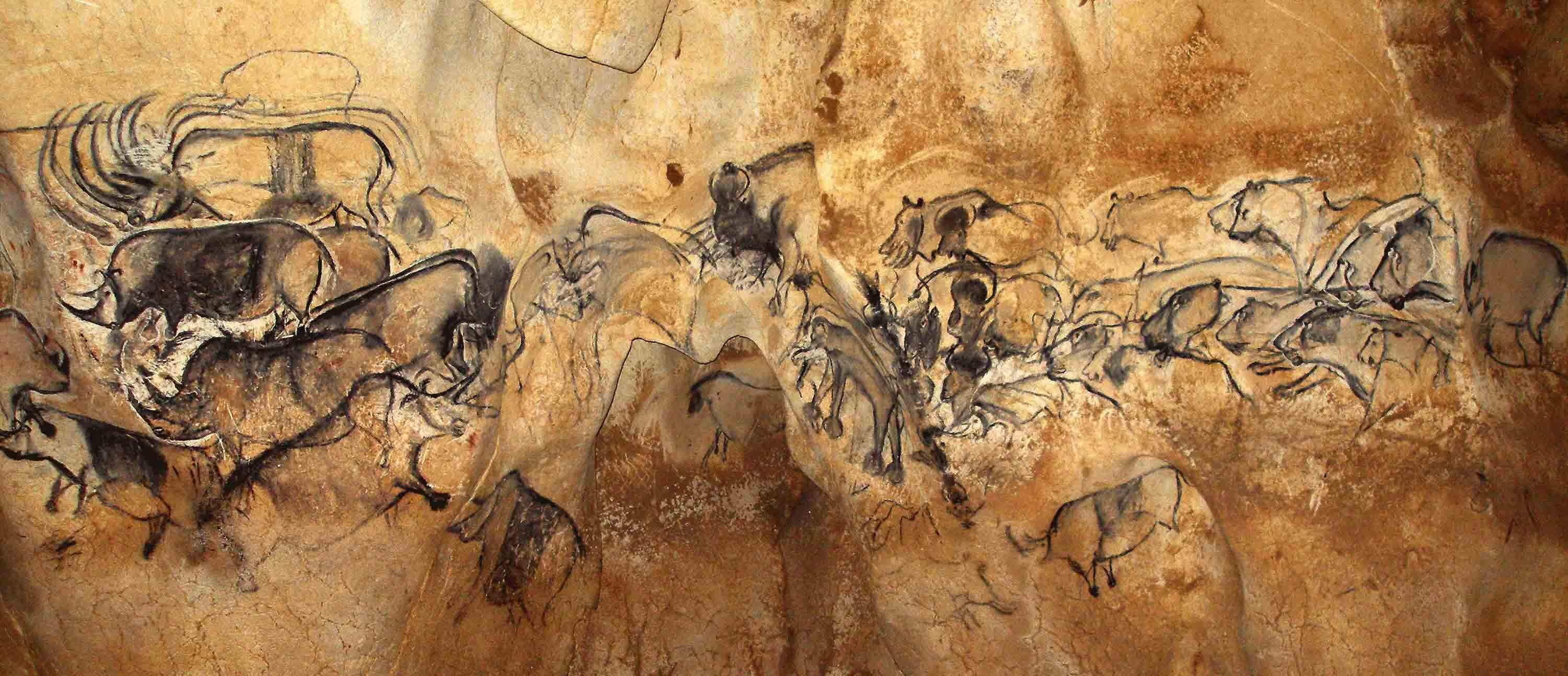
One scene in the End Chamber of the Chauvet Cave’s Megaloceros Gallery (named for an extinct species of large deer) features an extraordinary continuum of moving animals, sometimes overlapping and in some cases seeming to emerge from cracks in the wall (Fig. 1.4). Drawings of horses, rhinoceroses, aurochs, a panther, cave lions, and bears stretch across a large wall. The figures were created with charcoal and are shown in profile. They are mostly outlined, though some are partially created by areas of solid color, and shading appears to give dimension to portions of the animals. While the ground they stand on is not depicted or implied, the animals do appear to have a spatial relationship with one another. Within some of the various animal groups, the activities seem to tell a story, showing creatures fighting, mating, and moving as a herd. New images were added to the existing images over time. In fact, radiocarbon dating suggests that some of the overlapping images were created up to 5,000 years apart.
Until radiocarbon dating was invented, scholars attempted to date cave paintings by analyzing their style and technique, hypothesizing that the oldest paintings in Europe were those created using simpler techniques and less skilled workmanship, while the more recent paintings were those that featured more naturalistic representation of animals and the most complex painting technologies. The majority of radiocarbon dates have upheld this hypothesis, although some results from Chauvet Cave (which many scholars dispute) suggest much earlier dates for some of the more naturalistic figures.
More information
The animals are shown moving generally right to left. The animals on the right are mostly cave lions, while the animals on the left are mostly rhinoceroses. The animals in the middle are less distinct.
auroch
The interest of early human communities in depicting wild animals may be linked to the idea of these animals as potentially dangerous and therefore powerful. Making images would have thus transformed caves into efficacious, potent, and divine places. Art historians have offered various interpretations by analyzing the paintings, studying their context, and borrowing insights from other scientific fields. For example, one early interpretation of European cave art argued that early humans were depicting the animals they hunted and ate. By drawing animals in a particular situation, the artists were compelling them to be there during the hunt—a form of magic that may have been believed to give humans control of the outcome. However, while lions, leopards, aurochs, bulls, snakes, foxes, scorpions, and birds are frequently found in Paleolithic and Neolithic art, very few of these animals were hunted and consumed by ancient peoples. Analysis of bone residue found in caves has revealed that the animals depicted were often not the principal ones eaten. The visual evidence of the paintings and the evidence of bone residues both challenge the earlier assumption that early artists portrayed only the animals that they hunted, as well as the popular idea that cave paintings served as a hunting magic to capture the spirit of the animal.
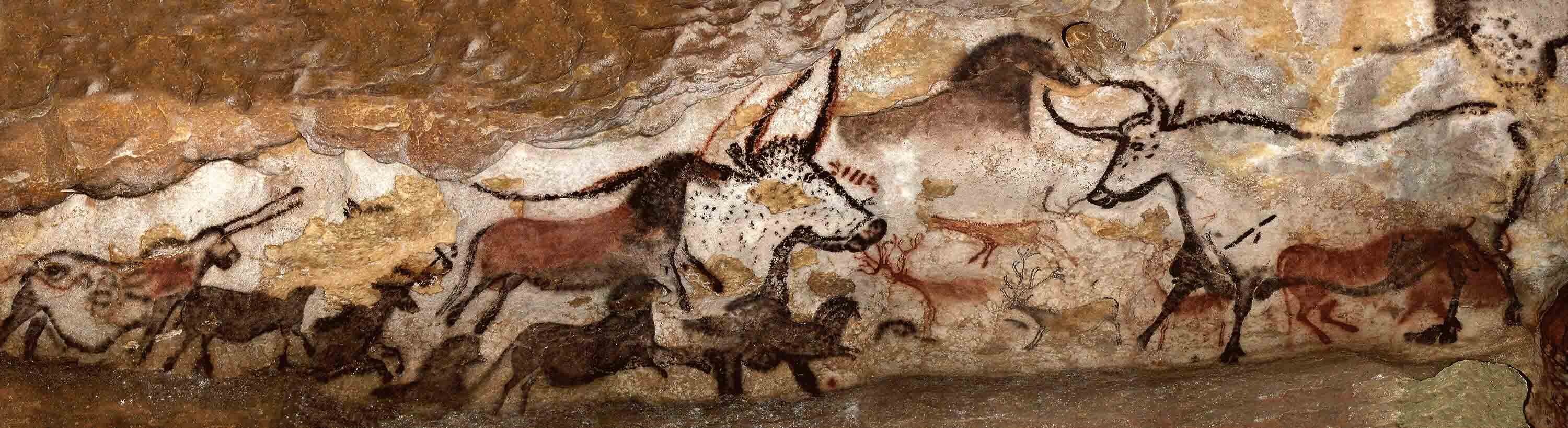
More information
Three large bulls are outlined in black. Several galloping horses and some stags appear as smaller solid figures.
LASCAUX CAVE Discovered in 1940, the paintings in Lascaux Cave may date to the height of the Ice Age, around 15,000 BCE. Lascaux features approximately 2,000 individual engraved and painted figures. One of the most spectacular spaces in the Lascaux Cave is the gallery known as the Hall of Bulls, named for the extensive depiction of aurochs (wild cattle) and other wild animals on the walls and ceiling (Fig. 1.5). Based on the organization of space and on the accumulation of these paintings over thousands of years, scholars suggest that this gallery was the site of rituals in which multiple individuals participated. As in the Chauvet Cave, the scenes are dominated by superimposed images of wild animals including aurochs, horses (equines), and stags. Some of the auroch figures are 15 feet long (4.57 m), making the representations in the gallery feel monumental.
The uneven surfaces of the rock are used by the artists deploying painterly techniques in such a way that the paintings do not flatten or ignore the existing geological texture but enhance and empower it. In this scene, for example, the artists appear to have used horizontal bands on the wall as the ground on which several of the animals move. Most of the figures are drawn in profile, but with certain elements, such as the eyes and the horns, as if viewed from the front. The artists used lines (outline), solid blocks of color (silhouette), or a combination of these techniques, and they mixed manganese with yellow and red ocher pigments in some of the figures. The flickering light of the torches in the darkness of the cave would have animated the figures. With the effect of light and shadow, the aurochs and other creatures would have appeared to be swiftly moving. While the Lascaux painters may have used techniques similar to modern artists, however, they probably made the images for reasons far distant from ours; rather than simply representing animals, people may have believed that the images enabled encounters with animals on a spiritual plane.
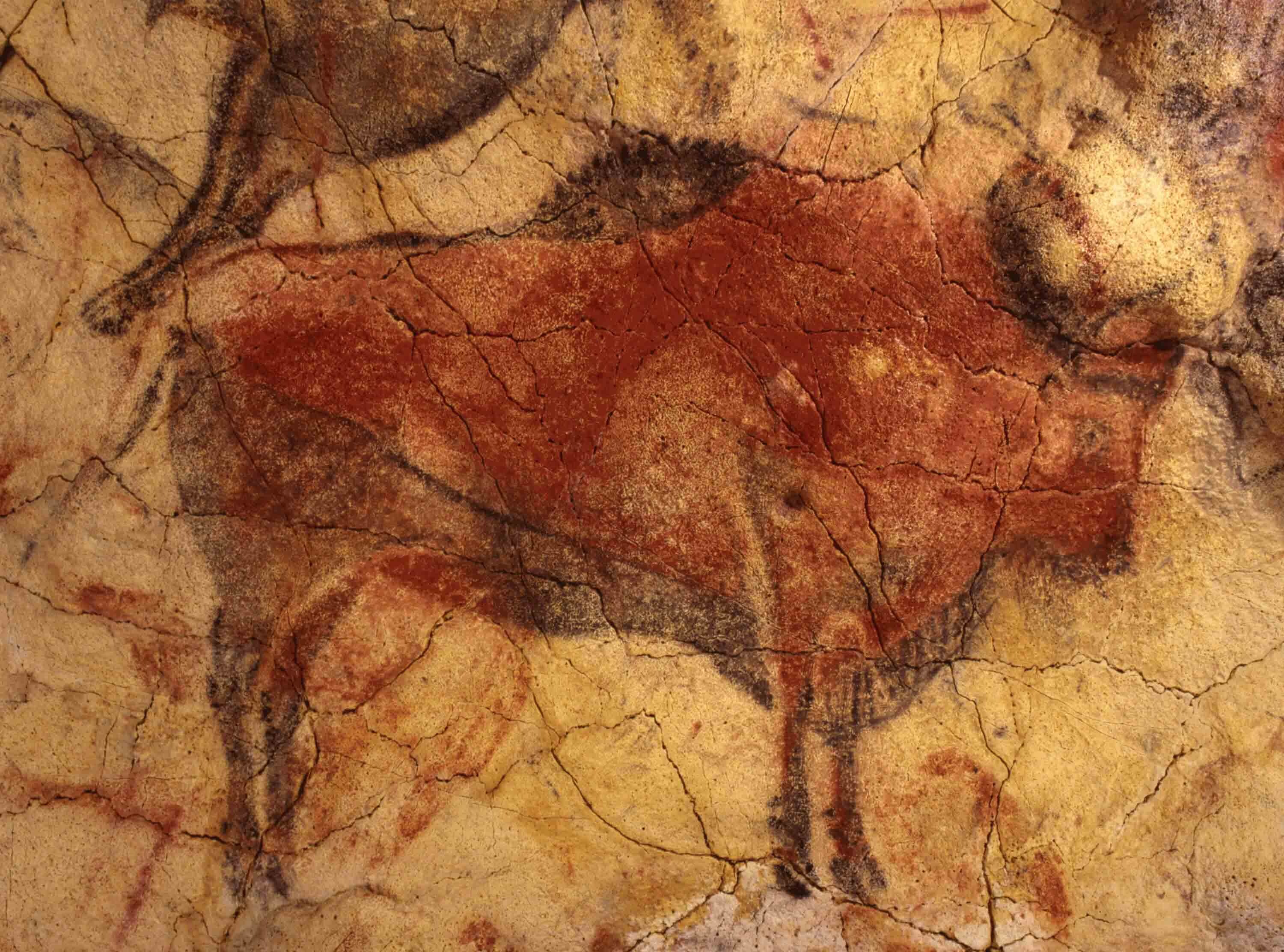
More information
A bison painted on a cracked but otherwise smooth rock surface. The animal, which faces right, is red with a black mane and underbelly.
ALTAMIRA CAVE Located in the Cantabrian Mountains in northern Spain, the Altamira Cave was the first major ancient cave-art site to be recognized in Europe. The amateur archaeologist Marcelino Sanz de Sautuola and his young daughter Maria discovered it in 1879. The authenticity of the cave was challenged in a long-held controversy that lasted until 1902. Scholars simply could not believe that such highly skilled representations of animals could be the work of ancient communities. The walls and ceilings of the cave are populated with colorful drawings of a herd of now-extinct steppe bison (Fig. 1.6). After the bison figures were engraved in the rock, they were painted in rich red and brown iron-based ocher, with black and brown for the outlines of their bodies and other details, showing that the artists had highly developed their control of pigment mixing. The use of shading and different pigments to give dimension to the forms, as well as the careful attention to detail, bring a certain degree of vibrancy to the animals. Anthropologists in the 1980s pointed out that the herd of bison was depicted during its mating season, confirming that the animal representations on cave walls may have portrayed specific, symbolically charged events rather than serving as generic representations of wild animals.
APOLLO 11 CAVE Unlike their counterparts in Europe, ancient artists in Africa do not appear to have painted the walls of deep caves. Rather, throughout the continent, they painted and engraved images in rock shelters and on stone outcrops, thousands of which have been preserved by the dry climate. They also painted on smaller, portable stones, which might have been carried by individuals or communities for purposes that remain unclear. Several small slabs of painted rock in a well-protected rock shelter known as the Apollo 11 Cave in the mountains of Namibia, in southwest Africa, date to around 24,000 BCE. Created with a charcoal pigment, the animal on this slab is the oldest figurative image found in Africa to date. Two fragments of one slab show the profile view of a four-legged hybrid animal, possibly a supernatural figure (Fig. 1.7).
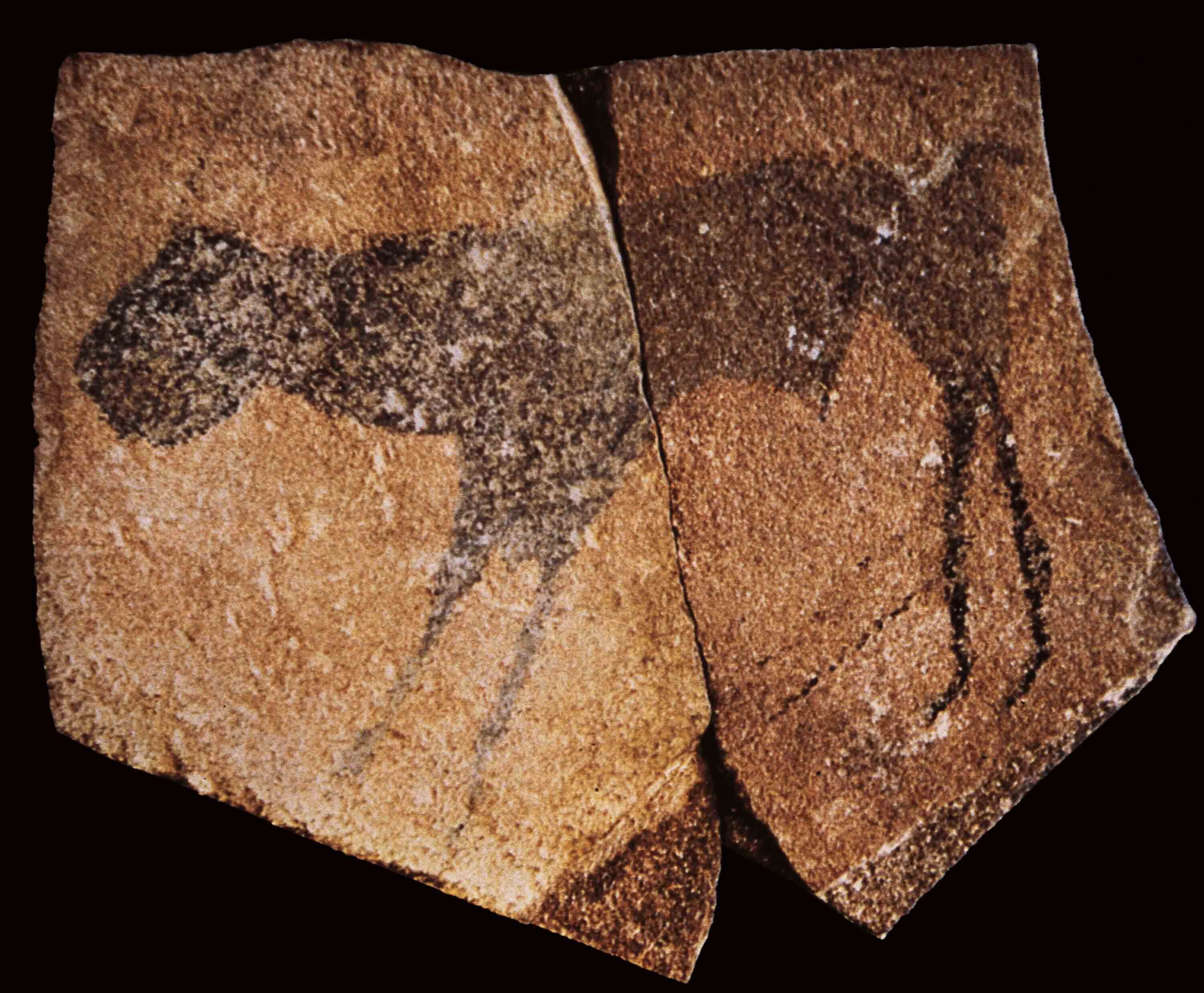
More information
The animal, which faces left, is four-legged with a blunt head. Its back legs are vertical, and its front legs are splayed forward.
Gwion Gwion
GWION GWION FIGURES During the same era, hunter-gatherers in Australia met periodically for ceremonial activities and trade at rock shelters, where they may have believed supernatural beings dwelt or crossed over from this realm to another. Artists in areas known today as Arnhem Land, the Kimberley, and Queensland created paintings on these shelter walls over many years, layering and repainting images of animals, supernatural beings, and—more than in rock paintings in other parts of the world—humans. The Gwion Gwion figures (so-called after their local name among one group in the area where the ancient people who created them lived) of the Kimberley region of Western Australia have been dated to as early as 20,000 BCE (Fig. 1.8). This dating is controversial, however, because experts do not have a direct method for dating the pigments in the paintings. (Indirect methods include dating the mud-wasp nests on top of the painted areas.)
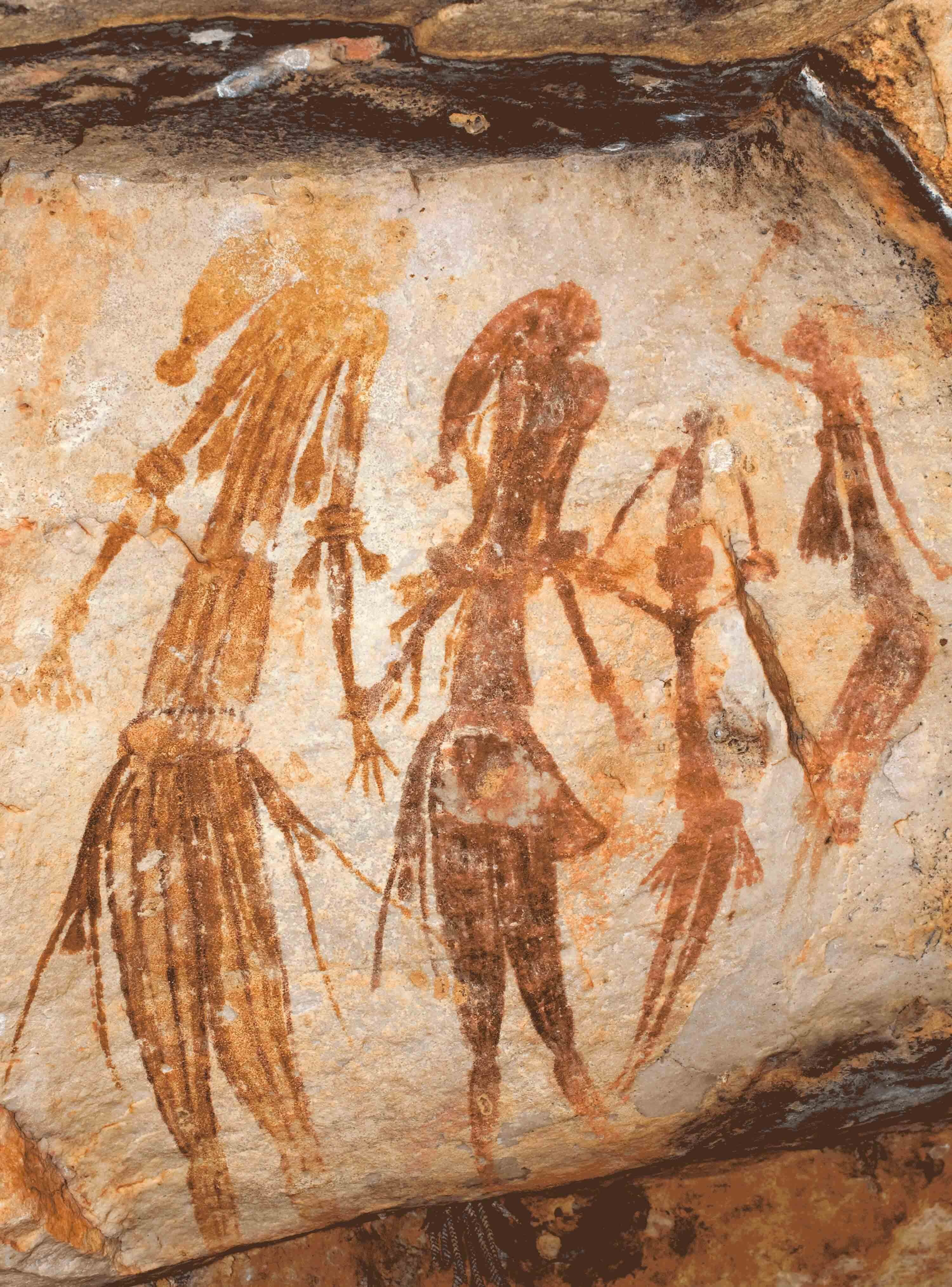
More information
The highly elongated figures are dressed in tasseled costumes and wear their hair in braids or knots. The two figures on the right are smaller than the two on the left.
Frequently painted in groups, Gwion Gwion figures often have their long hair drawn back in ornate hairstyles, or possibly ornamental headdresses. They wear complex skirt-like garments and what appear to be tassels suspended from their shoulders, waists, and elbows. Some carry boomerangs or other implements. Their elaborate attire and the presence of boomerangs, which, in contemporary Indigenous Australian ceremonies, are clapped together in pairs as percussion instruments, suggest that some Gwion Gwion images depict people engaged in rituals. In the neighboring region of Arnhem Land, similar lithe human images may date to at least 12,000 BCE. As in the Gwion Gwion paintings, these figures also have long hair or wear headgear, but they are shown as if they are running or otherwise in motion. They appear both as solitary figures and in scenes that may portray hunting, warfare, and other activities.
Glossary
- figurative
- art that portrays human or animal forms.
- radiocarbon dating
- a scientific method of determining the age of an object, based on the presence of carbon-14 in organic material.
- painterly
- characterized by color and texture, rather than line.
- ocher
- a naturally occurring clay pigment that ranges in color from yellow to red, brown or white.
- hand stencil
- an image created by placing a hand on the wall of a rock shelter or other surface and blowing paint over it to create a silhouetted image of the hand.