menhir
Megalithic Structures
Following the end of the glacial period around 9600 BCE, global temperatures began to rise. These slow shifts in the global environment coincided with changes in the ways humans lived and their relationship to the land. In regions where humans had gathered vegetables, fruits, and wild grains (wheat, rice, flax) for several thousand years, such as New Guinea, East Asia, West Asia, northeast Africa, and South America, humans began cultivating fields, producing harvests, and storing the surplus. The climate and vegetation of the Middle East and the Eastern Mediterranean created a hospitable environment for the domestication of plants and animals and the transition of human communities to settled life. This dramatic transition from a hunting-gathering lifestyle in small groups to a settled life in relatively large communities in year-round villages seems to have happened at different times in different parts of the world, but the earliest archaeologically known transition was in the zone known as the Fertile Crescent in West Asia. In other regions, including northwest Africa and North America, pastoral communities migrated seasonally with animal herds, living in semi-permanent or portable dwellings. These circumstances led to changes in the lives of humans, including their customs of burial and ritual, their economic relationships, their art, and their architectural technologies.
As part of their transition to settled life, people in various parts of the world began to create both simple and complex megalithic structures, erecting massive stones (known as menhirs)— sometimes moving them great distances—to mark a spot in the landscape. In some regions, including South Asia, East Asia, West Asia, and Europe, megaliths were often associated with burials. A common type of megalith is the dolmen, which is composed of one large flat stone laid as a roof across two or more upright ones. The construction of megalithic structures required coordinated labor and the mobilization of large groups of people. Archaeologists have suggested that these sites probably had ritual functions. Some megalithic structures and arrangements of stones appear to have a calendrical or astronomical purpose, such as the large circle of stones created by pastoral people in Nabta Playa in northeast Africa (present-day Egypt), beginning around 6000 BCE. The site also contains a number of human and cattle burials.
Göbekli Tepe
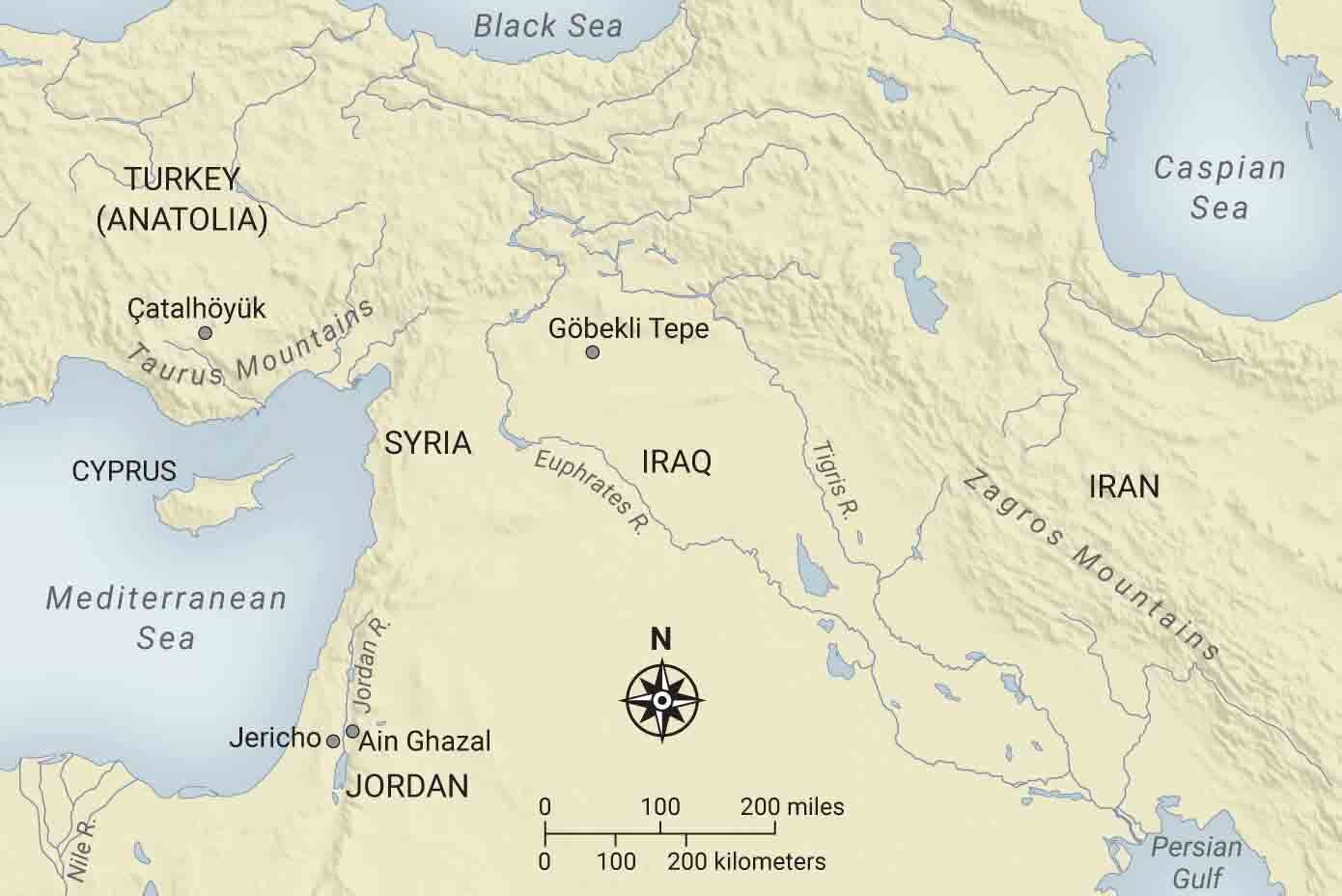
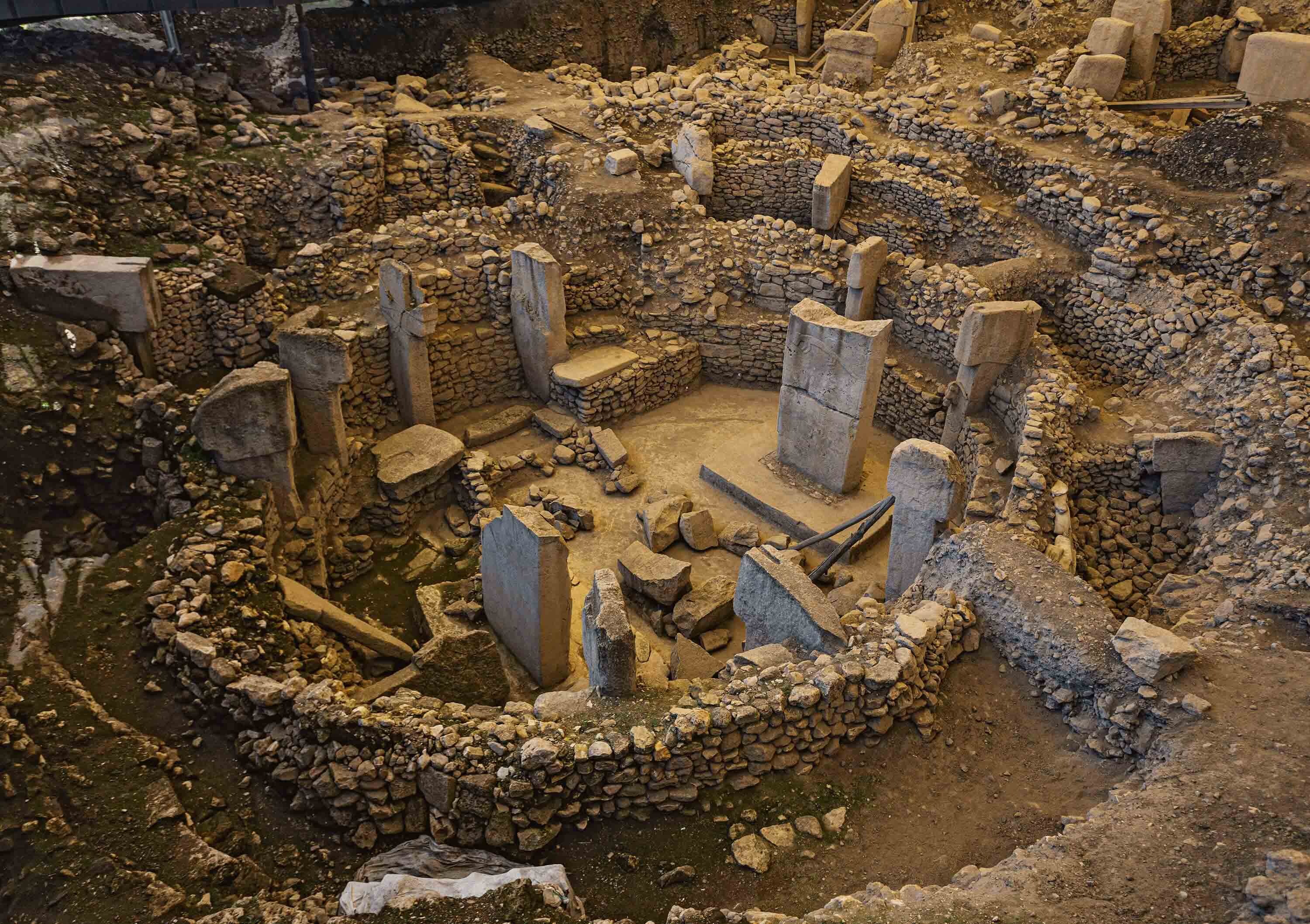
GÖBEKLI TEPE The recently excavated site of Göbekli Tepe in southeastern Turkey is located on a flat limestone plateau on the lower slopes of the Taurus Mountains (see Map 1.2). Around 9600 BCE at this site with an abundance of stone, half-nomadic hunter-gatherers constructed a series of semi-underground, curved, and rectangular stone structures (Fig. 1.12). Benches built alongside the interior walls, and significant quantities of wild animal remains, suggest that rituals and communal feasts took place inside the structures. The non-domesticated plant species recovered by archaeologists suggest that Göbekli Tepe’s builders were probably nomadic hunter-gatherers, rather than engaged in agriculture.
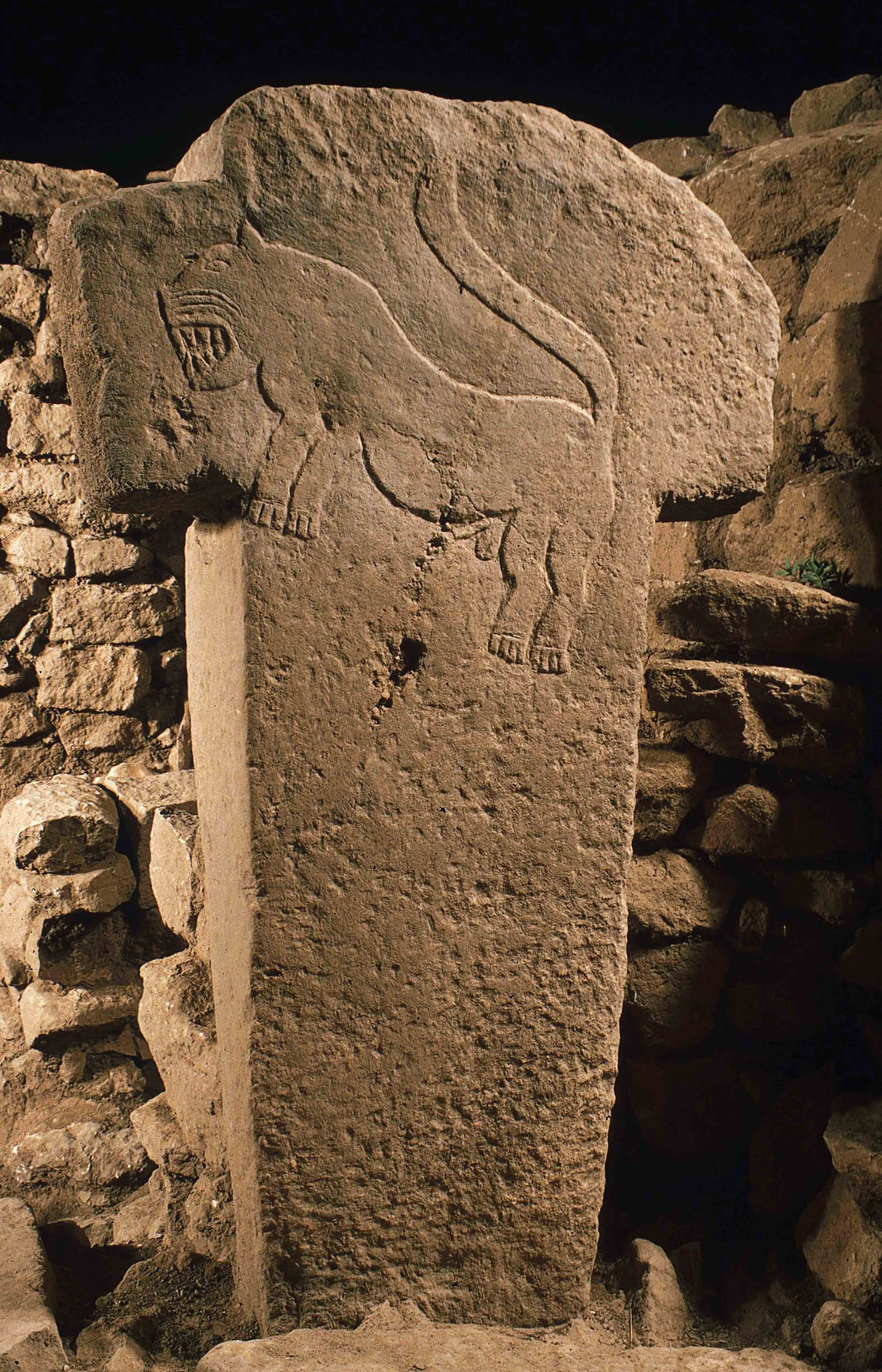
Locally quarried megalithic limestone pillars, some as tall as 15 feet (4.57 m), supported the roofs of those Göbekli Tepe structures that had carved interior walls and pillars. The T-shaped pillars (Fig. 1.13) were carved in low relief with representations of a wide variety of animals—snakes, boars, foxes, cranes, scorpions, aurochs, gazelles, birds of prey, wild asses, boars, lions, leopards, and other unidentified wild species—in various combinations. Some of the pillars depict human arms wrapping around the sides of the pillars, and thus may have symbolized human bodies. Each ritual feasting structure had a lifespan of one hundred to one hundred and fifty years, after which it was ritually demolished and buried, and replaced with a new ritual structure next door.
Building Göbekli Tepe would have been labor intensive and would have required communal activity on an immense scale to haul and position the large stones needed for construction. Because Göbekli Tepe was built by hunter-gatherer groups and was not part of a settled community, its architectural and iconographic complexity provide a wealth of archaeological evidence for ritual life that has revolutionized our understanding of the beginnings of the Neolithic period in the Eastern Mediterranean world. Recent archaeological field research in the close vicinity has located several other sites similar to Göbekli Tepe, suggesting that the mountain sanctuary of Göbekli Tepe was neither unique nor isolated in a complex landscape of hunter-gatherers.
More information
The map shows C¸atalho¨yu¨k in southeastern Turkey, Göblecki Tepe between the Tigris and Euphrates Rivers where they flow out of the mountains, and Jericho and Ain Ghazal by the Jordan River, just north of the Dead Sea.
More information
The structure consists of concentric circular walls built of many small stones, plus massive stone slabs as pillars that could support a roof. A flat central floor is visible.
More information
The T-shaped vertical slab is decorated with a relief carving of a lion rearing up and baring its teeth.
Mnajdra
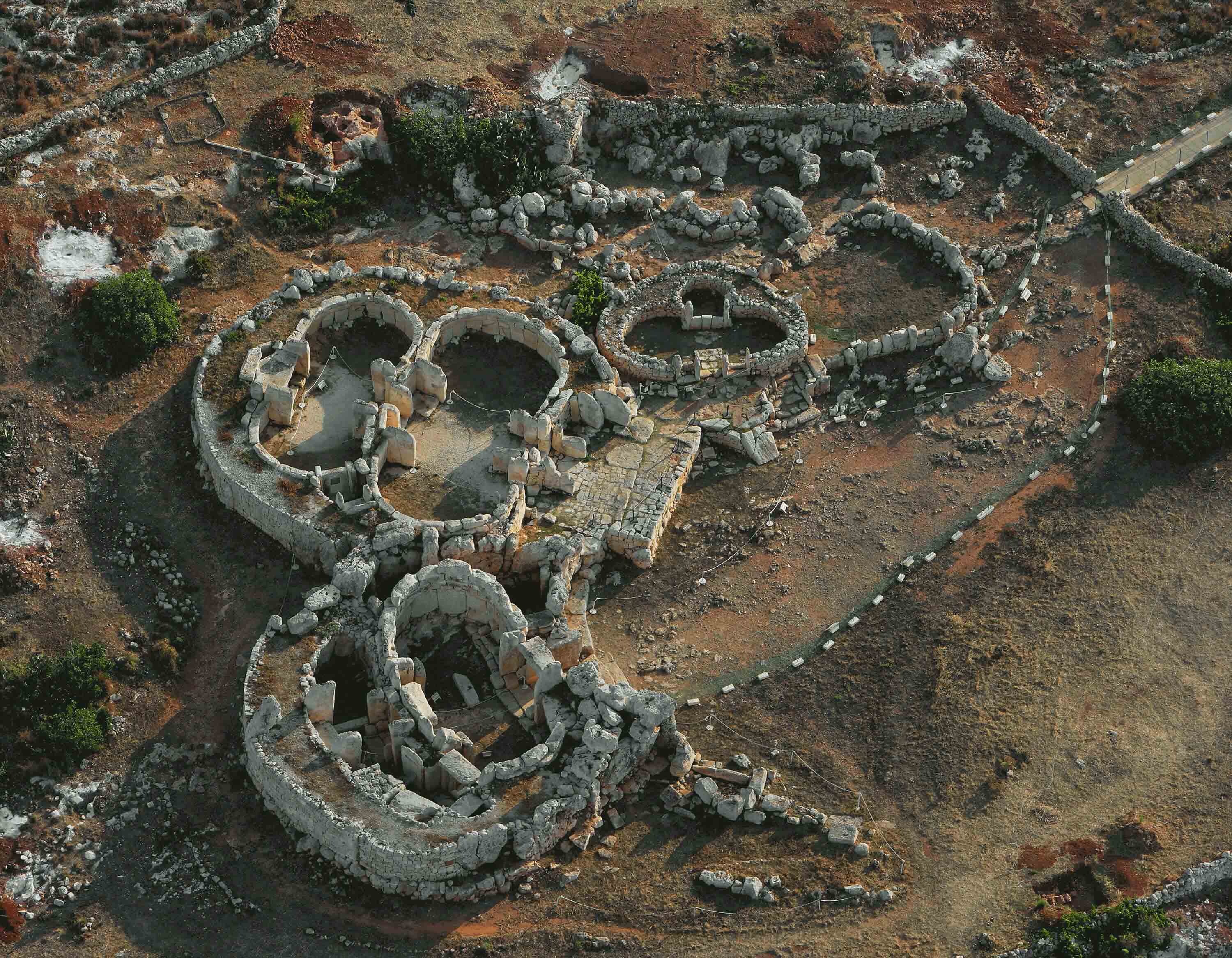
MNAJDRA COMPLEX, MALTA Even though they date considerably later than the sites in Turkey, the closest analogies to the monuments of Göbekli Tepe are found on the Mediterranean island of Malta and in southern England. In Malta, starting around 4000 BCE (5,000 years after Göbekli Tepe), architectural complexes were built using a combination of megalithic and Cyclopean stonemasonry in which the massive blocks are roughly fitted together without mortar. The complexes, such as that at Mnajdra (Fig. 1.14), are designed in a clover-leaf plan with multiple large, apsidal rooms. Mnajdra was built of a relatively hard variety of locally quarried coralline limestone with slightly corbeled walls, suggesting that the apse spaces (semicircular recesses projecting from an external wall) may have been at least partially covered by a stone roof. Upright monoliths or pillars mark entrances and transitional areas between spaces.
More information
Three adjoining structures each have massive, curving exterior walls made of earth and lined with stone both outside and inside. The two larger structures each have two interior spaces with rounded walls. The middle of the three structures has a large, square porch.
Although these complexes are believed to have served as ceremonial sites, they also provided protection from enemies and served as storehouses for food. In addition, their design and their relationship to the surrounding landscape suggest that social activities, such as feasts and religious celebrations, took place there.
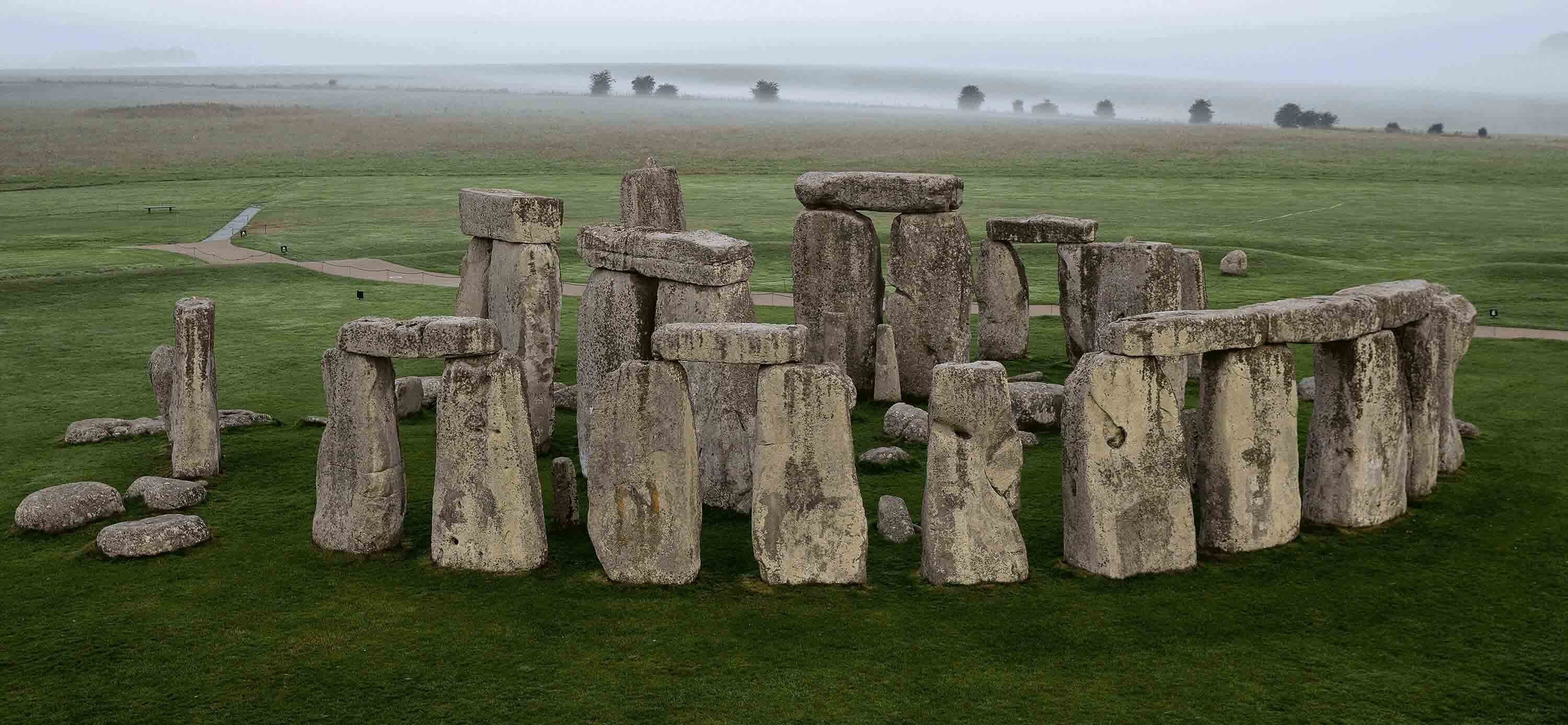
STONEHENGE From its earliest history, Stonehenge, on the Salisbury Plain of Wiltshire in southern England (Fig. 1.15), seems to have been associated with cremated human burials, some of which have been excavated. This megalithic stone circle was built and rebuilt repeatedly over more than a thousand years (2900–1500 BCE), at the end of an episode of megalithic building practices in Neolithic Europe. Farmers in Britain had earlier constructed several concentric-circle earthworks (constructed banks of soil) known as causewayed enclosures. Communal feasting took place within these enclosures, and animal bones were dumped in the ditches. Stonehenge emerged in this landscape of communal gatherings and rituals of the Neolithic British Isles, which were home to more than nine hundred stone circles. Stonehenge maintains its prominent position in the public imagination because of its architectural complexity, the care its builders took in selecting and transporting specific stones, and its expressive monumentality.
Stonehenge itself is both a henge enclosure and a concentric stone circle, built of huge pieces of gray sandstone in a post-and-lintel system. It probably underwent four main stages of construction and several phases of adjustment and rebuilding between 2900 and 1500 BCE. In the earliest stage of construction, a circular ditched enclosure measuring 320 feet (97.54 m) in diameter was built, and this feature was retained in later stages.
In the second stage, which took place during the third millennium BCE (2500–2000 BCE), a double ring of standing bluestones (so named for their bluish color, and weighing 5 tons each) was erected in the center of the ditched enclosure. These heavy bluestones were transported from the Preseli Hills of Wales, a distance of at least 240 miles (386 km). The builders of Stonehenge also used bluestones to make axes, traces of which were discovered on the site.
trilithon
In the third stage of construction, the builders used sandstone monoliths, much more massive than the bluestones, to form a new ringed enclosure consisting of five trilithons. The tallest of these trilithons are 24 feet (7.32 m) high. The five trilithons were arranged in a horseshoe layout facing a break in the circular ditch leading to a 35-foot-long (10.67 m) path. In the fourth and final state of construction in the mid-second millennium BCE (around 1500 BCE), the complex gained its contemporary layout when the builders reorganized the bluestones between the trilithons and the sandstone circle. The alignment of the trilithon horseshoe and other stones with the sun during the winter and summer solstices led to theories that Stonehenge functioned as a calendar and served astronomical purposes. Stonehenge’s purpose continues to inspire debate among scholars.
More information
Some twenty or so massive vertical stones remain of what was once a complete ring. Some of the stones are connected across the tops by somewhat smaller stones lying flat, as lintels. In the center of the ring stand several more upright pairs connected by lintel stones.
Glossary
- low relief
- (also called bas-relief) raised forms that project only slightly from a flat background.
- apsidal
- relating to an apse: a semi-circular recess.
- henge
- an ancient monument with an outer circular ditch and inner bank.
- post-and-lintel
- a form of construction in which two upright posts support a horizontal beam (lintel).
- trilithons
- two upright megaliths topped with a third horizontal stone, the lintel.
- megalith
- a large stone used as, or part of, a prehistoric monument.
- Cyclopean masonry
- a stone-building technique in which large boulders are roughly shaped and fitted together to create well-knit, structurally sound walls.
- corbeling
- an overlapping arrangement of wood, stone, or brick wall projections arranged so that each course extends farther from the wall than the course below.