adobe
Yangshao
Changes in the climate did not always alter where people lived and how they acquired or produced food. In areas rich in game and naturally growing foodstuffs, communities may still have gathered food and hunted animals, and they may have continued to move around, and to develop artistic technologies, such as textile and ceramic production. When the early agricultural communities of West Asia transitioned into a settled lifestyle and started living in much larger-scale sedentary communities, however, many things changed in their lives: their diet and ways of processing food, their relationship with the environment and animals, their customs of burial and ritual, their economic relationships, their architectural technologies, and perhaps most strikingly, their art. These changes in everyday life took place slowly from roughly 9600–6000 BCE, during which time humans domesticated plants, such as wheat, barley, and legumes (including lentils), and animals, such as sheep, goats, and (later) cattle. This long process of selective breeding and experimentation finally allowed communities to survive long, harsh winters by processing and storing food.
adobe
Yangshao
With this settled life, Neolithic communities developed houses, using architectural innovations such as building with mudbrick. These adobe dwellings became the location of artisanal practices, such as textile and figurine production and wall painting. The need for long-term food storage also opened the way to specialized pottery production. Though much of the discovery and excavation of these early settlements has occurred in West Asia, research is advancing at other sites around the world. For example, the Yangshao settlement (at Jiangzhai in modern China) dates to c. 5000 BCE and consists of individual dwellings organized around a central point. Each house was made of a round pit dug into the earth, walls lined with sticks plastered with mud, and a thatched roof. In some other cultures, sites for ceremonial gathering or burial were constructed to be more durable than dwellings, which means that the art and objects that remain today come from a different context than those found in early houses.
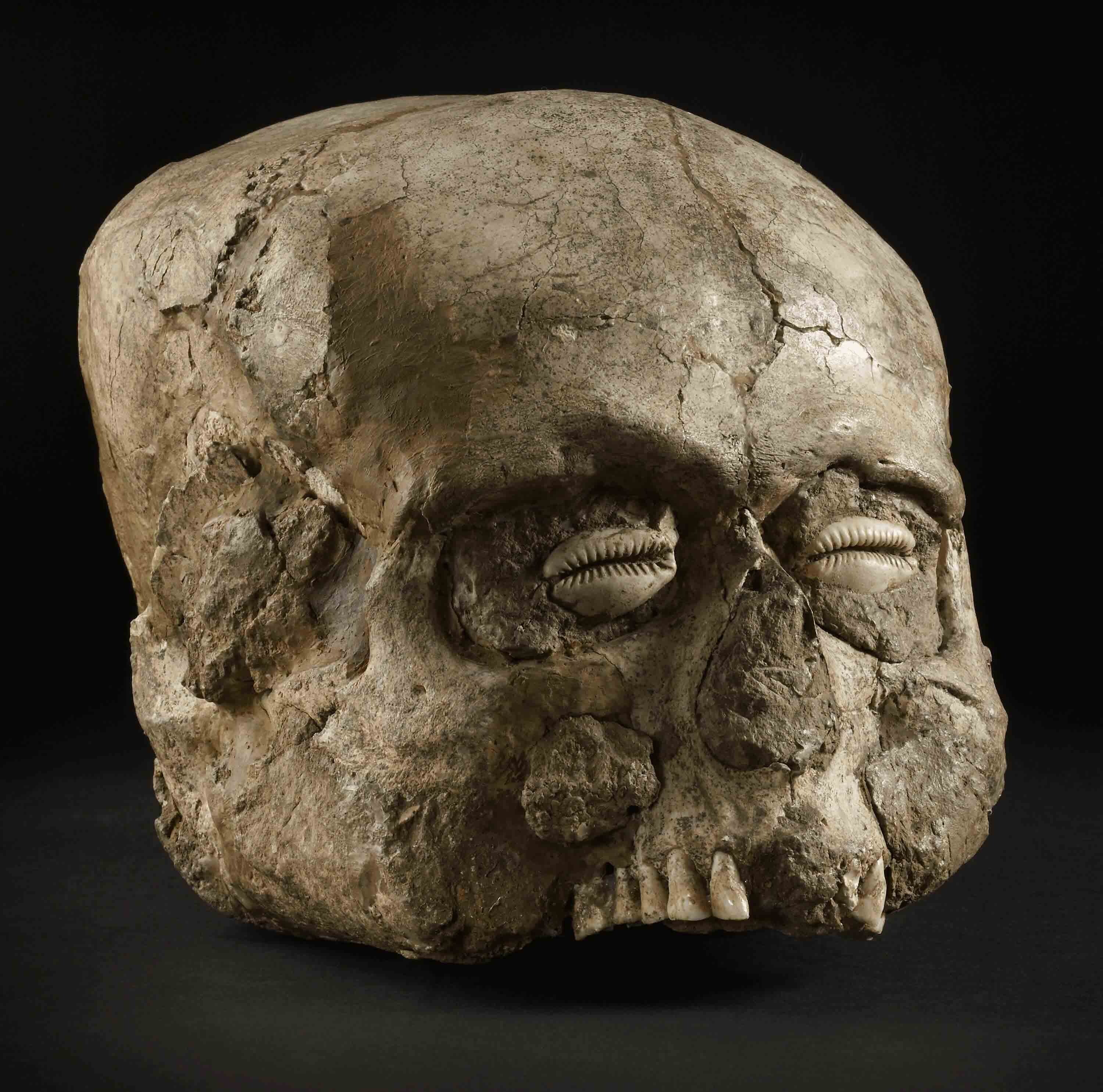
A human skull minus the lower jaw. The cheek areas, nasal cavity, and eye sockets have been filled with plaster, and two shells have been placed to look like eyes.
ANCESTOR SKULL Some inhabitants of early agricultural communities in West Asia seem to have adopted the practice of burying their dead family members under the floors of their houses, under specially designated platforms. People in these communities often revisited and commemorated their buried ancestors by reopening their graves and removing their skulls. Ancestor skulls were modeled or “re-fleshed” with lime plaster; their eyes were inlaid with shells; and pigments were used to add details such as hair (Fig. 1.16). The relatives then returned the plastered and augmented skulls to their graves, suggesting an intimate engagement with dead ancestors.
Çatalhöyük
ÇATALHÖYÜK One well-known settlement on the Central Anatolian plateau associated with increased land cult-ivation and animal domestication was Çatalhöyük (“The Fork Mound”) in south-central Turkey. Built near a marshy landscape with access to water and good agricultural land, this extensive settlement was inhabited for over 1,100 years (7100 to 6000 BCE). Its population of between 3,000 and 8,000 people occupied mostly single-room houses, built of mudbrick (Fig. 1.17). Each house had an entrance in the roof, accessed by a ladder. The densely clustered houses had abutting walls, and the rooftops allowed movement about the complex, in the absence of any streets. This layout strengthened the settlement’s defenses, with the edges essentially serving as a town wall.
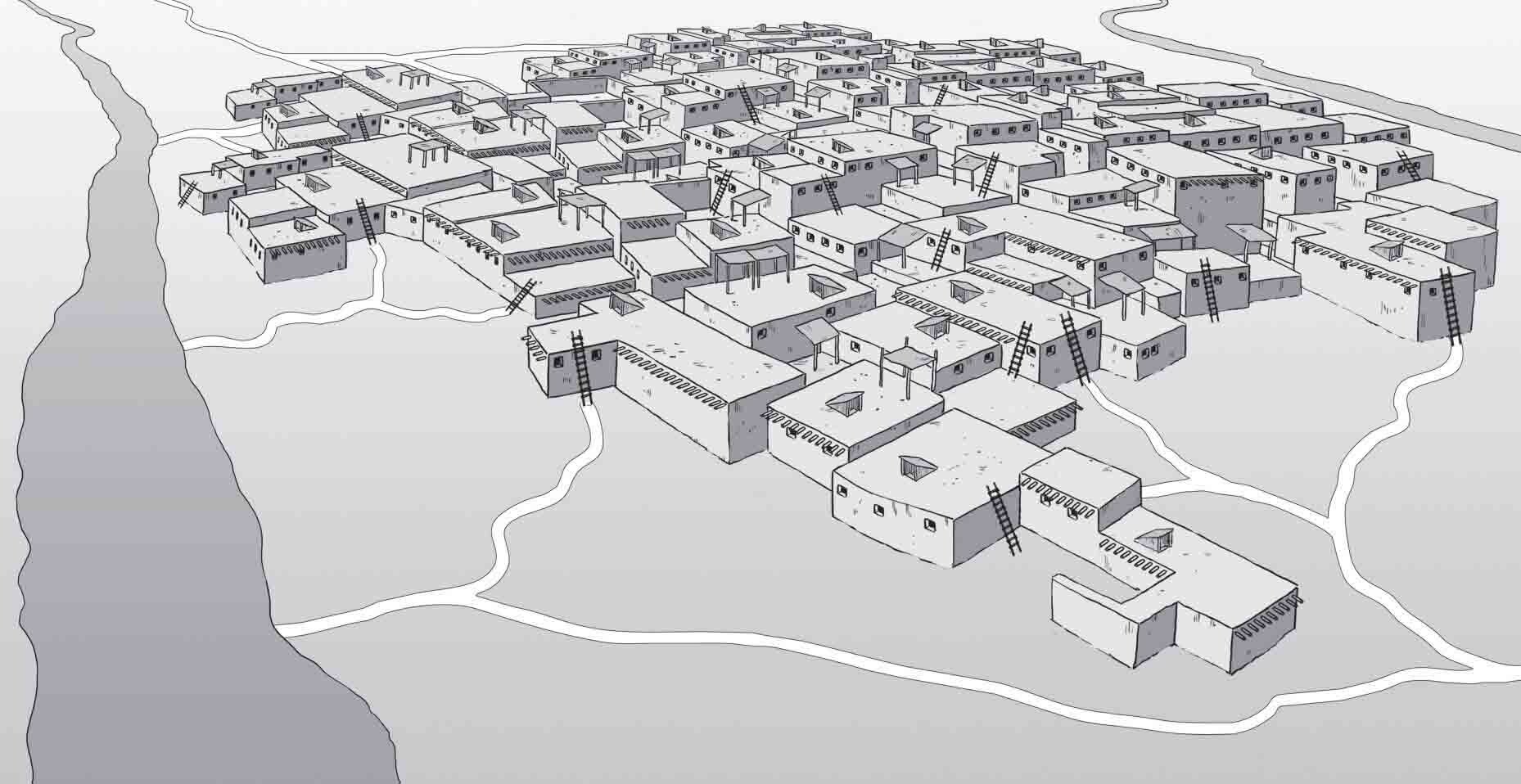
The dwellings are built up against one another, so that travel through the village would take place across rooftops. Here and there, a ladder leads to the ground. Several paths on the ground connect the village to one of the two waterways that run along either side of the village.
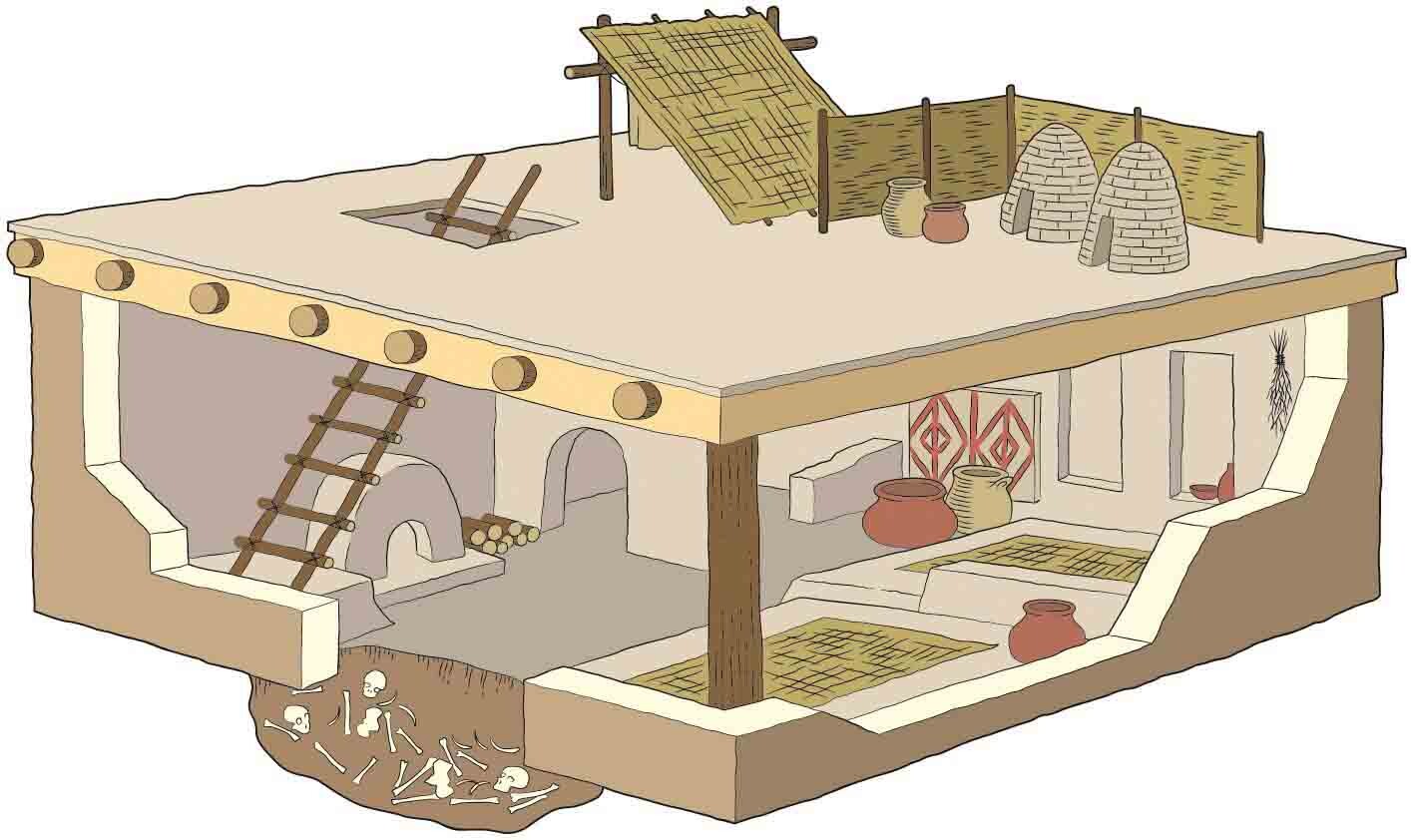
The lower level has a wood-burning oven and two platforms for sleeping, and contains household objects such as large earthenware vessels. Human remains have been buried below the floor at one end. A ladder leads to the upper level through a square opening. There are screens on the upper level, and two structures shaped like beehives stand in one corner of the roof.
The household space was used for everyday functions, such as sleeping, eating, processing and storing food, making clay and stone figurines, producing pottery, and performing rituals. The houses were organized around an oven, and different functions were carried out on diverse rectangular platforms of varying heights (Fig. 1.18). In addition to the main room, many houses featured smaller subsidiary rooms for storage, food processing, and other domestic activities. Houses were used continuously over long periods of time and across generations, and their inhabitants maintained their dwellings by periodically replastering the wall and floor surfaces and repainting the walls. The dead were buried beneath the floors of the houses.
ÇATALHÖYÜK WALL PAINTING The depiction of powerful animals seen in cave paintings continued on the interior walls of some houses in Anatolia, in West Asia. The houses of Çatalhöyük feature wall paintings, many consisting of geometric and repeating patterns. One of the more figurative paintings depicts massive wild animals, such as bulls, stags, and wild boar (Fig. 1.19). Lively human figures, wearing leopard-skin skirts, are positioned around the main creature, as if baiting or teasing it. In some of the Çatalhöyük houses, a variety of animal body parts (including bull horns, cattle or vulture skulls, fox and weasel teeth, bear claws, and wild boar tusks) were used as construction materials or as decorations, either embedded in the walls or on the edges of platforms.
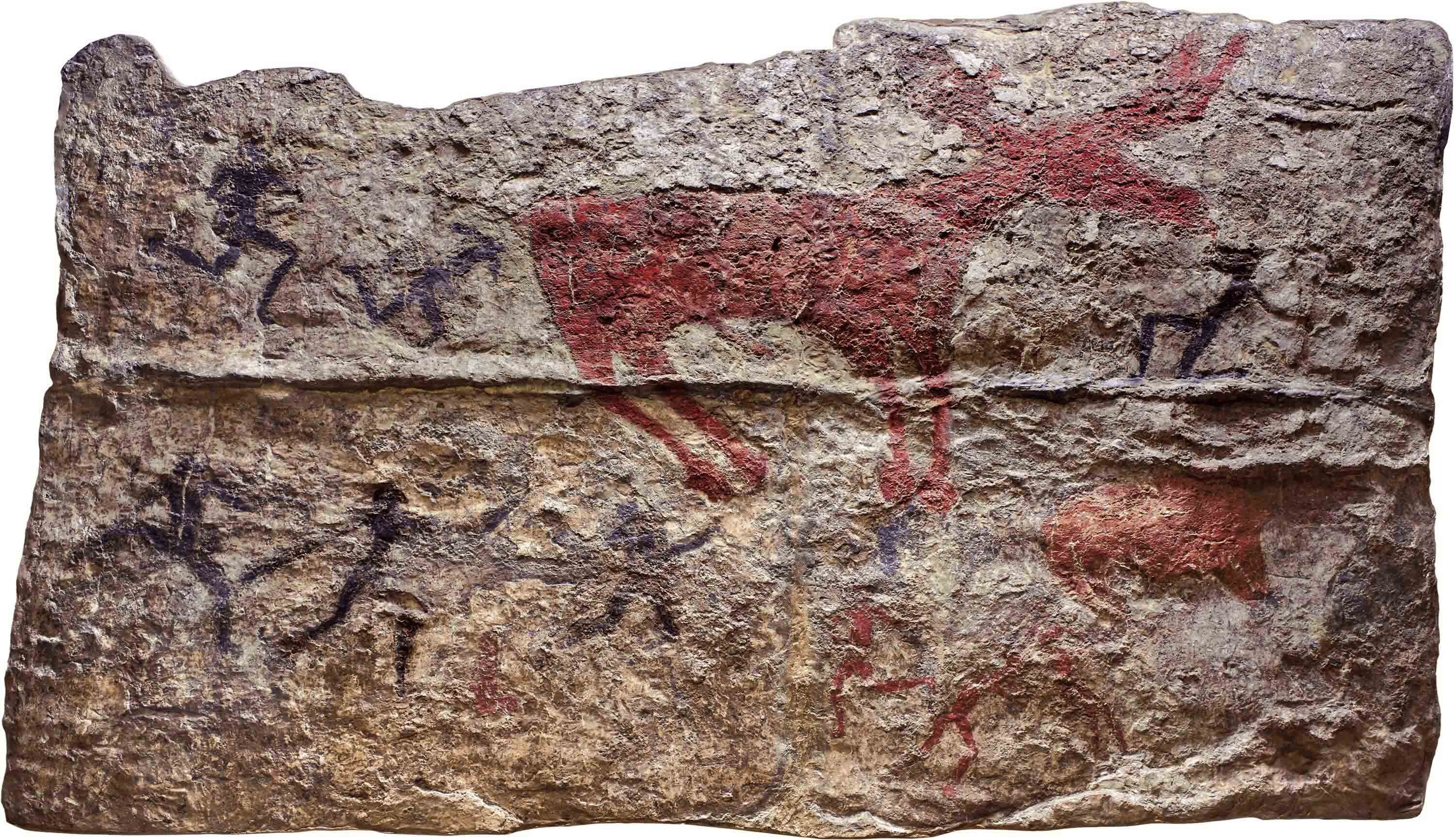
A large quadruped with large antlers stands or runs near a smaller animal. Both are painted in red, and are surrounded by human figures running and gesturing.
ÇATALHÖYÜK FEMALE FIGURINE Excavators also found small figurines of animals and humans at Çatalhöyük. One relatively large figurine (Fig. 1.20) of finely polished marble (a recrystallized limestone) was found under the floor of a platform usually associated with ceremonial functions. Carefully buried in a similar manner to family members, it depicts the body of a naked woman with distinctly carved facial features. The breasts lie flat and to the side, as they would if the woman pictured were lying down. The sagging belly may indicate an older woman who has given birth multiple times. Because the hands and feet are proportionally small, the figurine cannot stand upright.
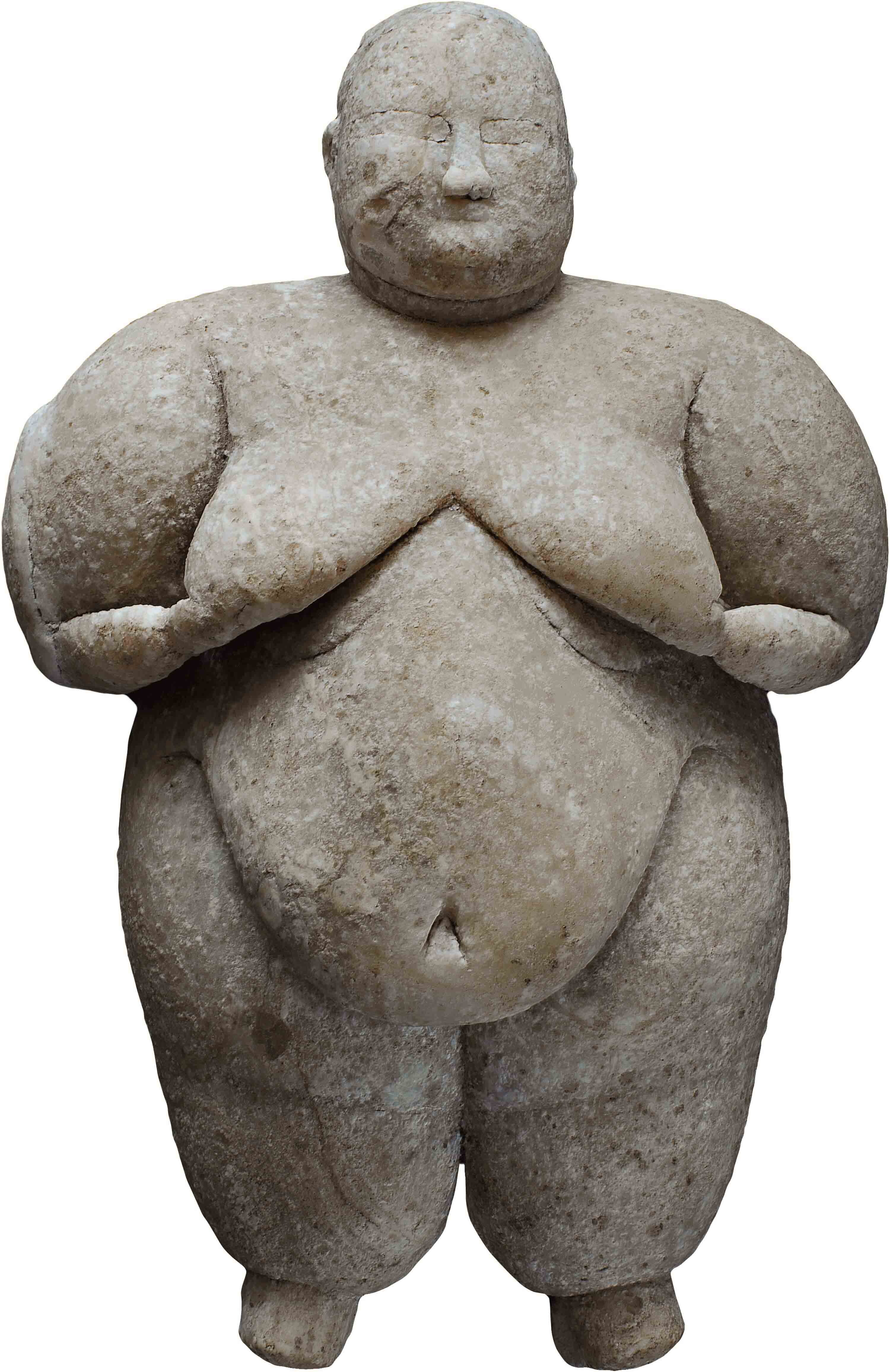
The figure has a massive body, with heavy shoulders and legs, but small feet and forearms. The hands are tucked beneath the breasts and rest above the large, drooping belly. No hair is visible.
Many of the Çatalhöyük figurines appear to have had their heads broken off, either when they were discarded or abandoned in a house that was left behind. Some of them even have detachable heads. The heads were believed to constitute the figure’s concentrated location of power or potency, and this suggests that their identities may have been considered changeable.
Ain Ghazal
AIN GHAZAL STATUES At the Neolithic settlement of Ain Ghazal (“Spring of the Gazelles”) near Amman in Jordan, archaeologists unearthed thirty human-like statues and busts made of reed-bundle-and-twine cores modeled with lime plaster (Fig. 1.21). The faces and other parts of the statues were decorated with red and tawny ochers and white clay. Although the torsos and the legs have a trunk-like roughness, the faces are elaborately shaped, with the eyes carefully formed and painted. Two separate heads emerge from some of the busts, suggesting twins. None of the figures is marked with a clear biological sex. At some point the statues were deliberately damaged and buried together in a pit. The meaning of this burial and the statues’ function are unclear, but they may have played a role in funerary rituals or ancestor worship.
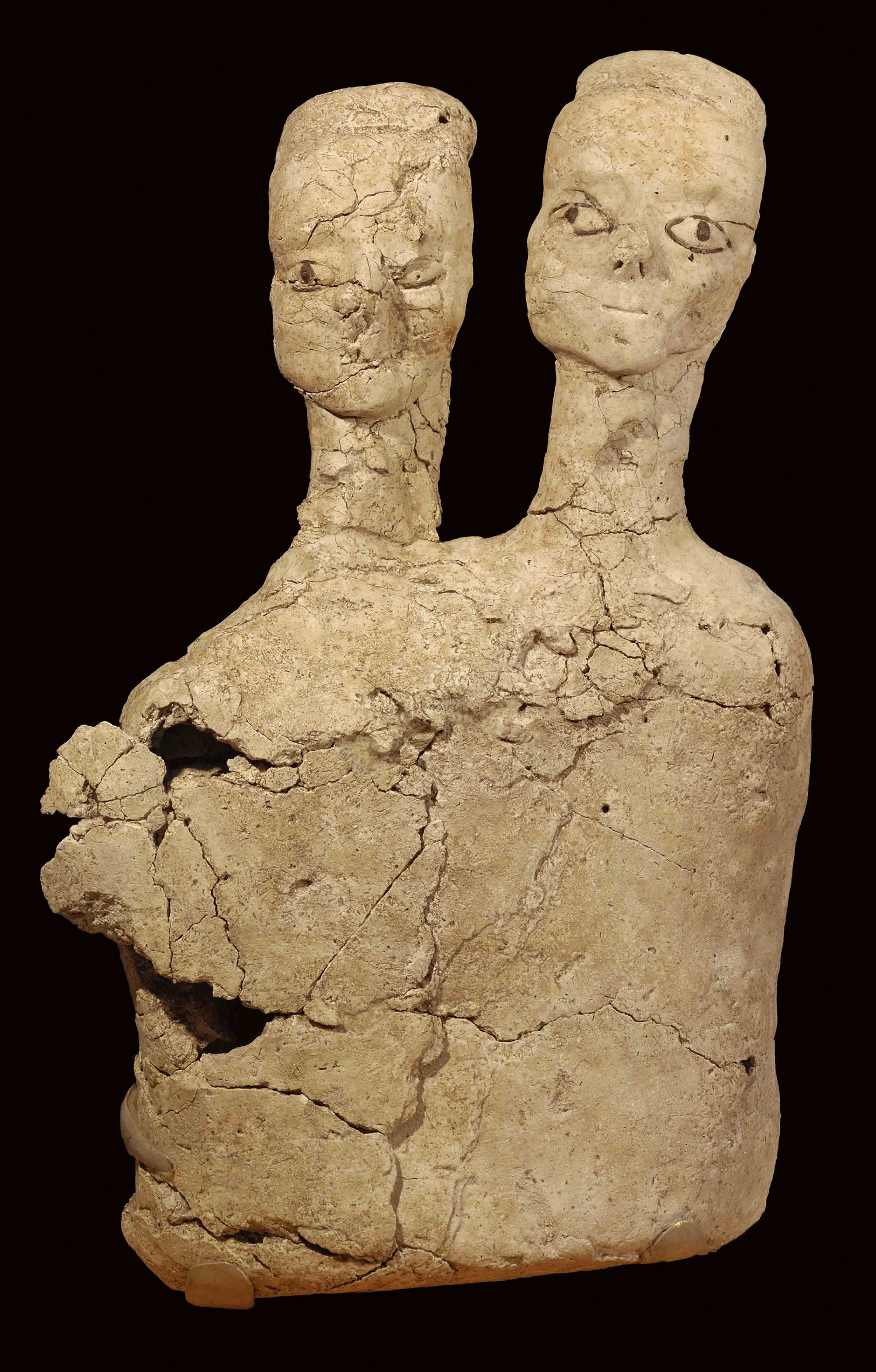
The first figurine is a torso with two heads and no limbs. It has short hair and carefully constructed facial features.
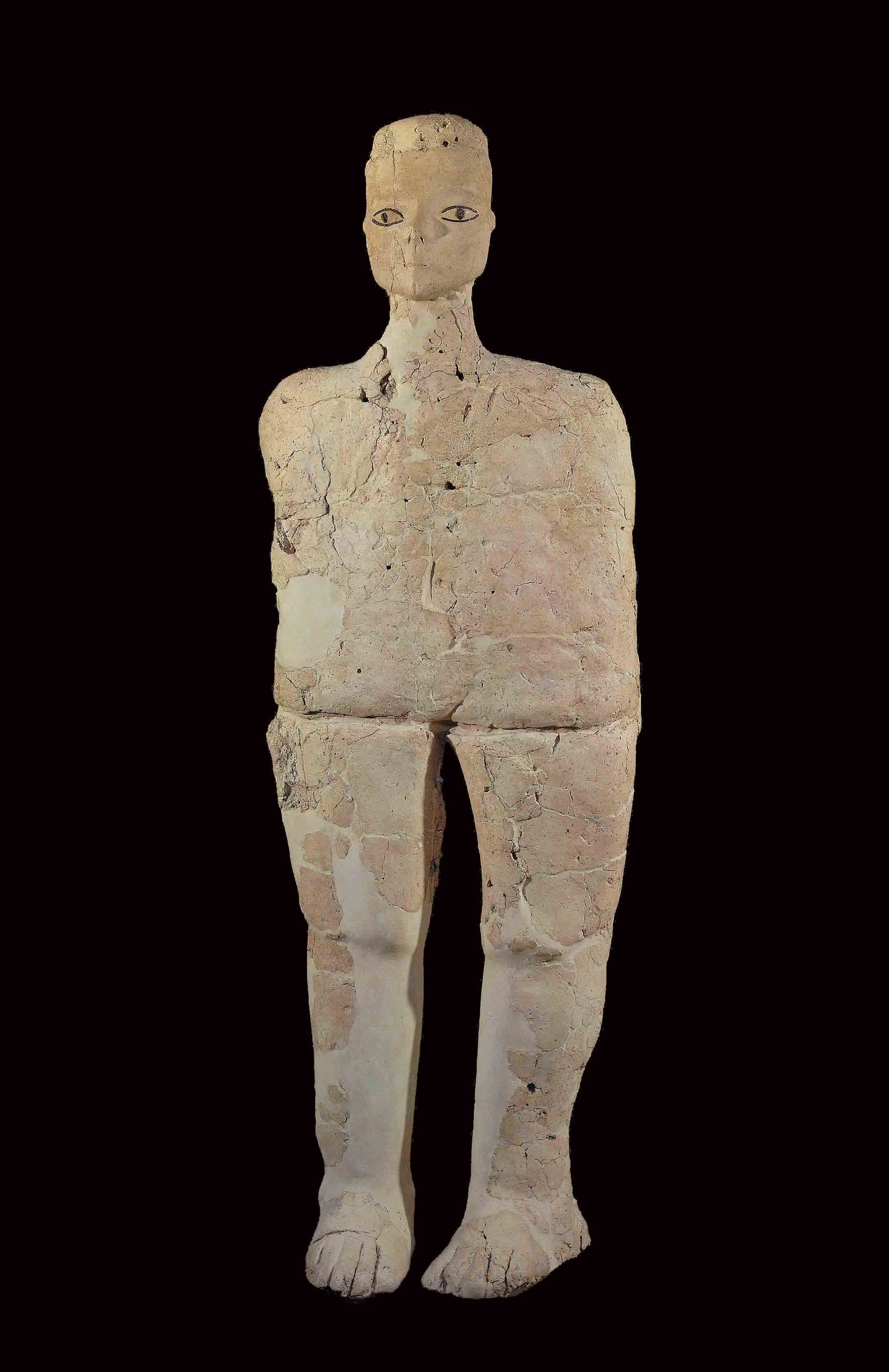
The second figurine has a head, torso and legs but no arms. It has short hair and carefully constructed facial features.
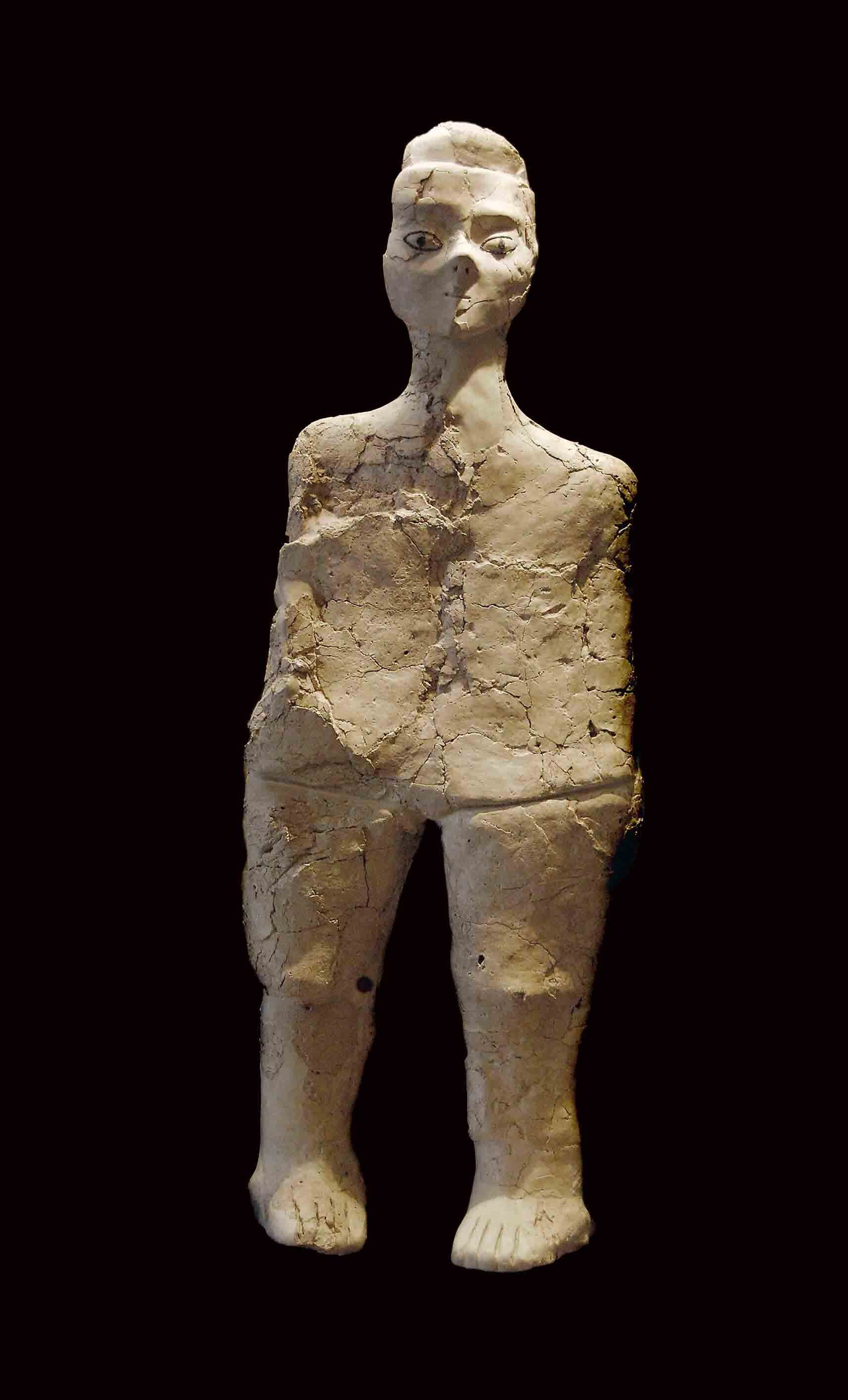
The third figurine has a head, torso and legs but no arms. It has short hair and carefully constructed facial features.
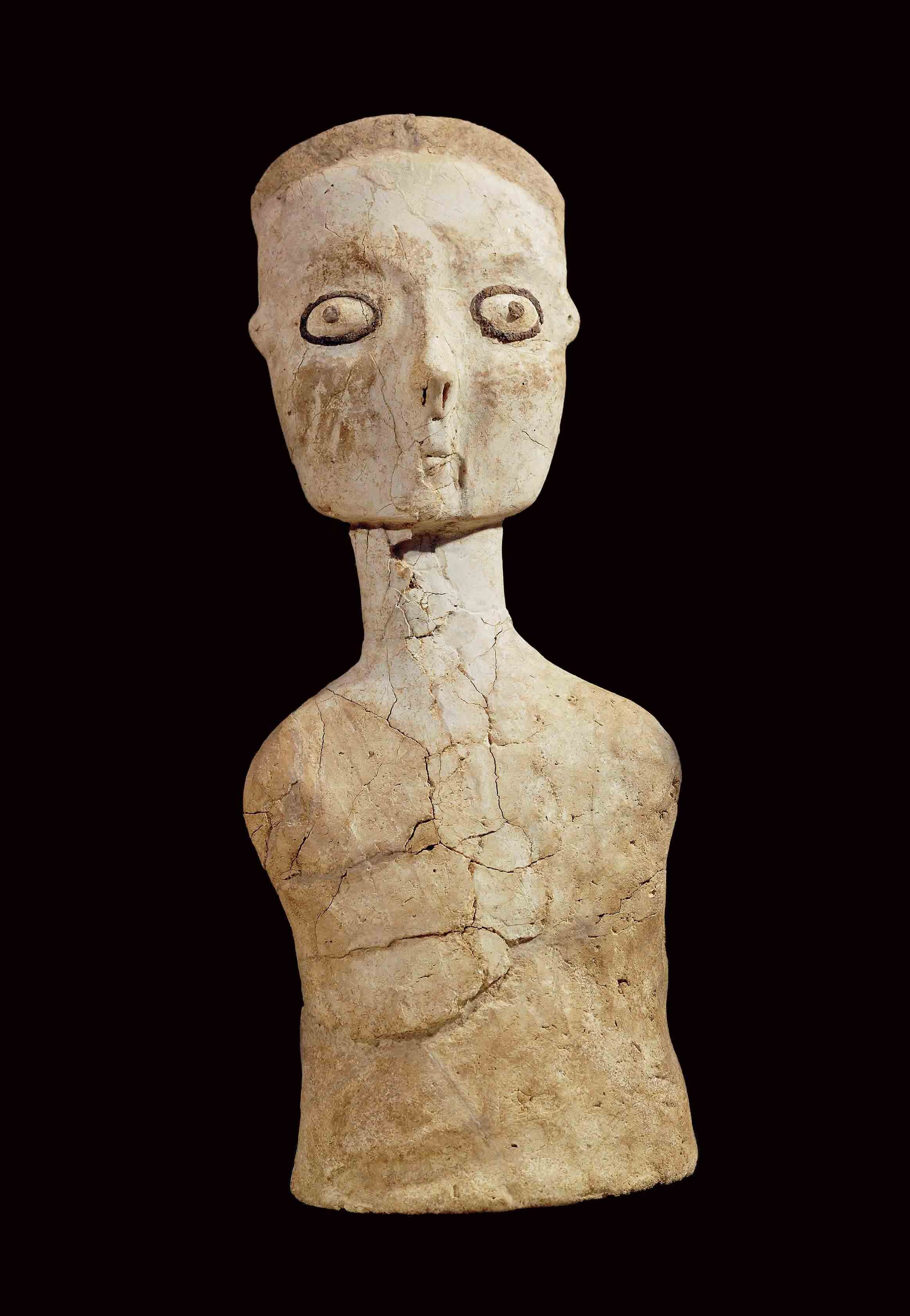
The fourth figurine is a torso with a single head and no limbs. It has short hair and carefully constructed facial features.
Human groups lived in relatively isolated communities during these earliest periods. As groups and societies became more stable and formed tighter connections, they began to develop regional identities with distinct languages, social structures, cultures, and art, which the next several chapters will explore. Although this book examines cultures geographically, it is also clear that human groups were not shut off from one another. Rather, they engaged in economic and cultural exchange both regionally and across long distances, even in very early times. These exchanges affected the materials, styles, and content of art throughout all cultures.