Niger River
Benue River
Niger River
Benue River
Just as the Nile River valley received waves of immigrant communities leaving the increasingly arid Sahara, the grasslands south of the desert attracted migrating pastoralists and early farmers. The western half of this semi-arid landscape, the southern “shore” (Arabic “Sahel”) of the Sahara, is dominated by another great river, the Niger. The Niger River waters a broad range of climatic zones as it curves north from its headwaters into the Sahel, and then bends south through the savannah (Map 2.3). After merging with the Benue River, the Lower Niger enters dense forests and forms a swampy coastal delta almost 2,600 miles from its source before entering the Atlantic Ocean. All along its banks, it nurtures herders, farmers, and fishermen with varied origins and histories. As early as 3,000 years ago, some of these communities were using iron-making technologies that appear to have been invented in the hills northeast of the Niger River and south of Lake Chad. By 1,000 years ago, metalsmiths of the Lower Niger region were casting copper alloys to create intricate and complex artworks. Archaeologists have just begun to explore some of the ancient sites in the watershed of the Niger River, and ongoing excavations are in the process of changing our view of its art history.
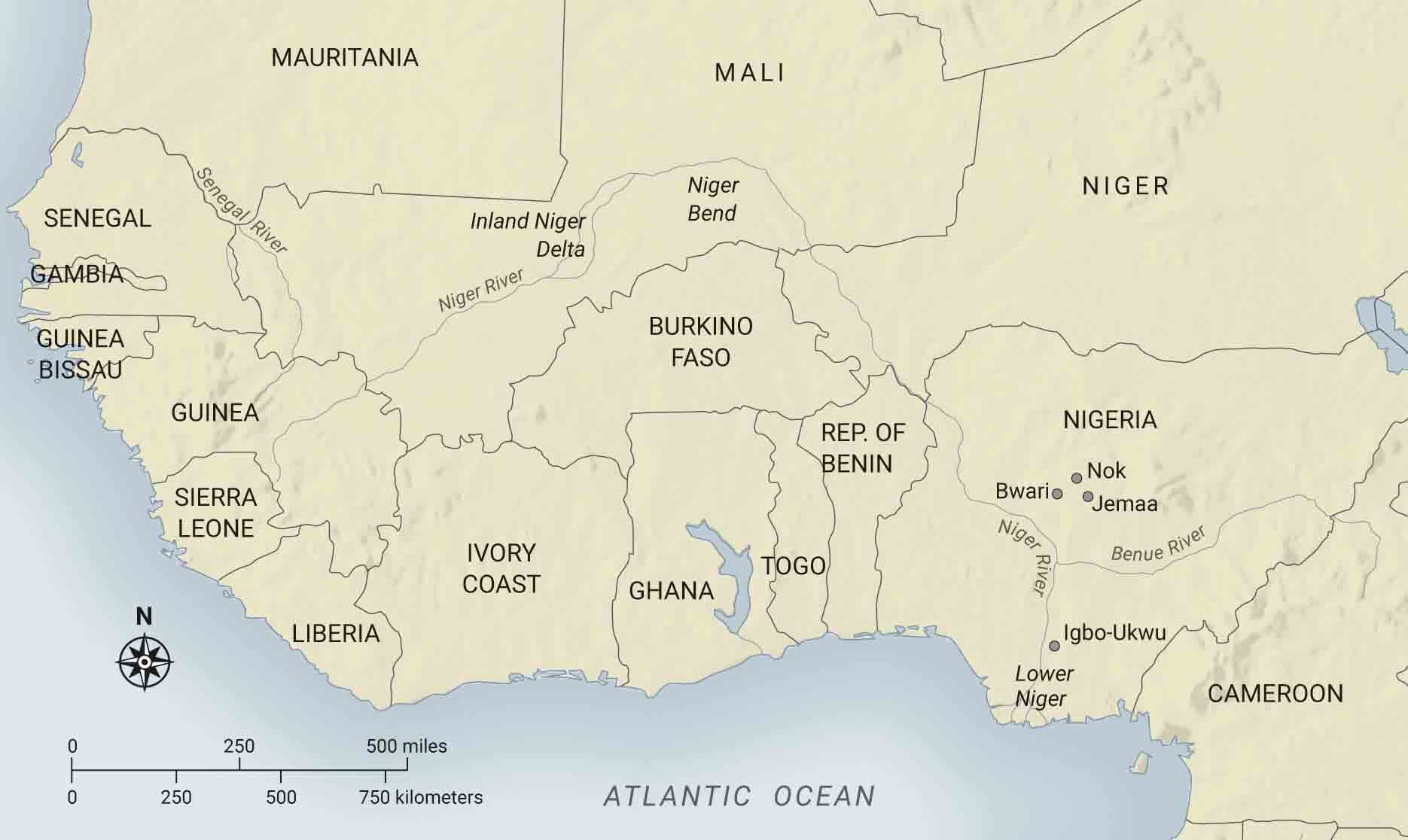
The map shows Nok, Bwari and Jemaa in northern Nigeria, and Igbo-Ukwu in southern Nigeria.
The earliest African sculptures found south of the Sahara Desert come from the hilly plateau north of the confluence where the Niger joins the Benue River, in what is now central Nigeria. These are figures (or partial figures) made around 2,500 years ago by an iron-making population that had mastered the firing of both ceramics and iron ores by about 1000 BCE. The figures are made of terra-cotta, which is a particularly durable material. Their distinctive style is named for Nok, the village closest to the place where the first example was discovered in the early twentieth century, when Nigeria was a British colony.
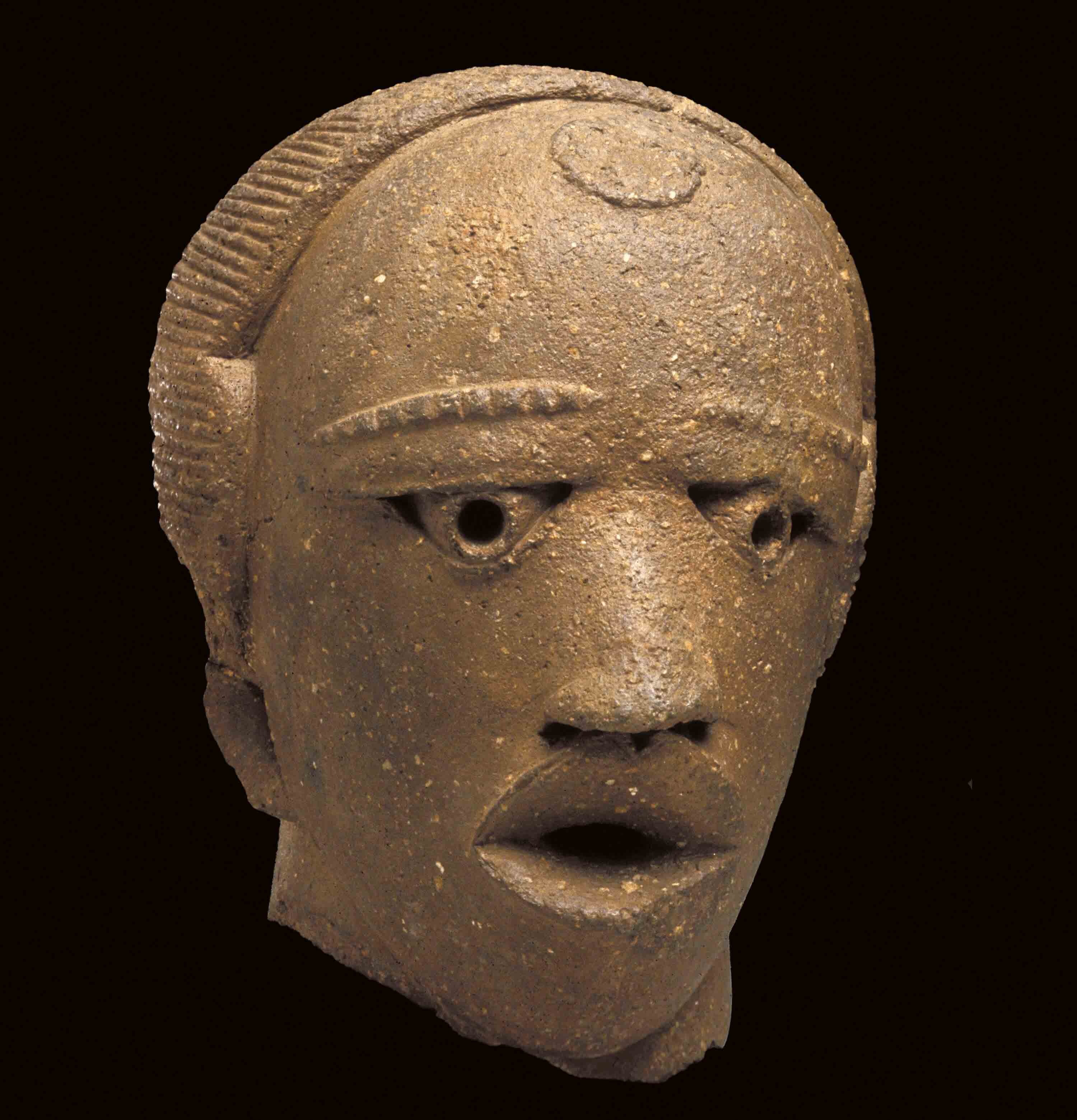
Despite the rough texture of the material, the sculpture is sharply detailed, with striking eyes and lips slightly parted. It has neatly combed hair, and a medallion on the high forehead.
NOK STYLE TERRA-COTTAS A particularly fine near-life-size ceramic head in the Nok Style (Fig. 2.14) was discovered in the Nigerian village of Jemaa and shown to an archaeologist in the colonial era. He compared it to fired clay figures unearthed in tin-mining operations, which had sometimes been swept away from their original locations by floodwaters and buried some 25 feet underground. The stylized facial features include triangular eyes (with each iris dramatically rendered as a circular hole), an open mouth with full lips, and a regular, almost spherical head. All of these qualities are typical of the Nok Style. The neck is broken where the head was once attached to a full figure. The even surface and crisp details of the face suggest that the artist must have used a sharp tool to carve the clay after the surface had partially dried, since if the clay had been modeled instead of carved, the edges would appear much softer. Nok artists might also have applied these techniques to wooden sculpture that did not survive. In recent excavations, archaeologists have found that all the organic materials buried with the fired clay statues had decayed and been absorbed into the surrounding soil.
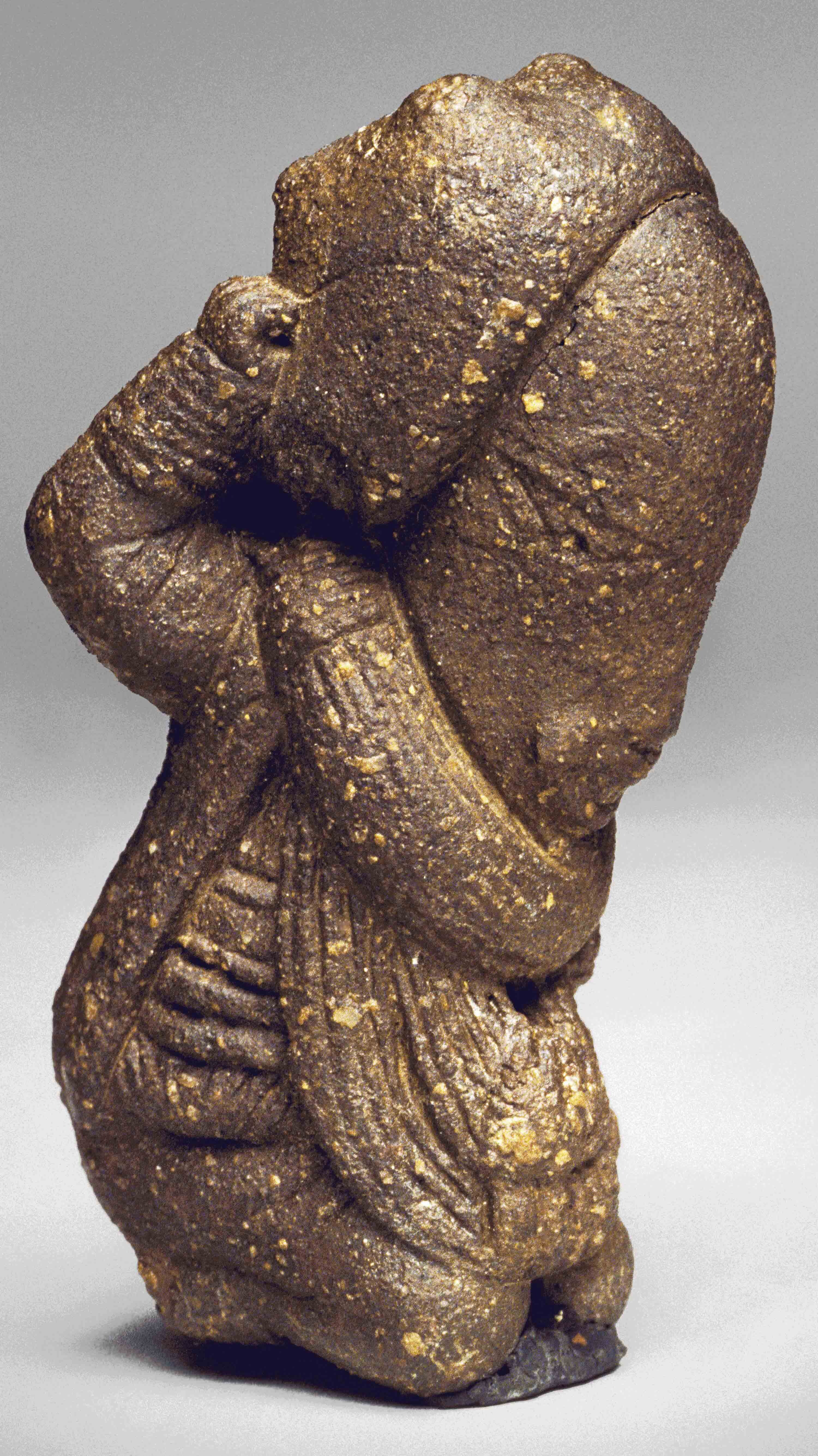
The figure faces rightward and bows its head, which is disproportionately large. The visible arm is raised behind the ear in a fist. A heavy, scarf-like object with striations covers the neck and chest.
Bwari
Yoruba
Another Nok terra-cotta was found in a tin mine near the town of Bwari. This tiny (4¼ inches high) kneeling or seated figure is a solid piece of fired clay (Fig. 2.15). Although the surfaces are worn, the Nok style of the delicately modeled facial features is still clear. Of particular interest is the size of the head in relationship to the rest of the body, as similar proportions were used in much more recent figures from this part of West Africa. For example, twentieth-century Yoruba artists in Nigeria and the Republic of Benin exaggerated the size of the heads of statues to indicate the head’s importance as the center of a person’s destiny and character. This Nok terra-cotta suggests that such ideas about human anatomy may have their origin in the distant past. Furthermore, the heavy loops of beads that hang over the chest of the Nok figure reveal an interest in beadwork, and later cultures have adorned their rulers with beads.
The Bwari figure’s raised left fist and kneeling pose, whose meanings are uncertain, aroused such interest in European collectors that they were copied in some of the many Nok forgeries that flooded the art market during the late twentieth century. Many of these forgeries were composed of pieces of ancient terra-cottas unearthed by Nigerian farmers and then shipped to Europe, in violation of international law. European forgers glued unrelated fragments together to form a core and then coated them with a mixture made from ground pieces of ancient terra-cotta and modern binders. New imaging technologies have since revealed that they are fakes rather than (as their buyers had hoped) exceptionally well-preserved antiquities obtained by illicit means (see Seeing Connections: Stolen Things: Looting and Repatriation of Ancient Objects, p. 219). The forgeries went undetected for several decades because so few Nok works had come from archaeological excavations. In the twenty-first century, a German–Nigerian archaeological team surveying hundreds of looted sites determined that both the production of Nok terra-cottas and local iron-smelting operations were at their peak between 700 and 400 BCE. While some terra-cottas were made before and after this period, all are more than 2,000 years old. Figures from intact sites were not found in dwellings or in burials (some of which had stone grave markers) but were unearthed in shallow deposits scattered across the landscape. For an unknown reason, almost all had been deliberately broken. Researchers thus know that complete Nok figures are probably fakes.
Comparing ancient Nok terra-cottas with the ceramics of twentieth-century populations living in central and eastern Nigeria allows us to speculate on how the Nok figures were used. In these modern small communities, ceramic vessels were used for different purposes. The peaks of thatched, cone-shaped roofs were protected by ceramic objects that often looked like overturned hemispherical pots. Terra-cotta sculpture, and ceramic pots topped with heads or figures, were left in sacred spots in the landscape as offerings to invisible supernatural beings. Similar vessels, dedicated to deceased family members, were placed on graves or smashed during funerals. Pots and terra-cotta figures were also used in private homes during procedures intended to cure various illnesses. The ancient Nok works may have had a similarly complex set of functions.
For many centuries following the end of the Nok Style—about 200 BCE to 1000 CE—a variety of sculpture in fired clay was produced throughout the savannahs north and south of the Niger River. This was also the period of time when the ancestors of Bantu-speaking populations migrated south and southeast; the Lydenburg heads found in the Mpumalanga Valley testify to the arrival of these groups in southern Africa. Other populations who used iron tools were penetrating deeper into the dense forests of West Africa, entering regions formerly occupied by hunting and gathering populations. Although relatively little archaeological work has been done in these forest regions, terra-cottas, stone sculptures, and a variety of intricate metal objects have been found in the Lower Niger River and its broad delta. After being unearthed by locals in the twentieth century, some ancient works in brass or bronze were often reinserted into the religious life of a local community. Therefore they now possess both ancient and modern layers of meaning and use.
Igbo-Ukwu
IGBO-UKWU BRONZES A pair of archaeological excavations, however, unearthed a spectacular assemblage of ancient bronzes in its original context at the Lower Niger site of Igbo-Ukwu, in the homeland of the Nigerian people now identified as Igbo (or Ibo). The bronzes accompanied the burial of a man of high status, whose body was seated on a throne. His limbs were wrapped in strings of thousands of tiny glass beads that had been imported across trans-Saharan trade routes established several centuries earlier. Fixed into the ground before him were wooden staffs topped by bronze finials, which were also decorated with trade beads.
Radiocarbon dating and the form of the beads, which date them to a specific period of manufacture, established that the bronzes in the burial were cast between 800 and 1000 CE. Their unique blend of copper, tin, lead, and silver reveals that they were made from ores mined to the northeast in the Benue River watershed, and created by the process of lost-wax casting. While the Igbo-Ukwu bronzes are the oldest items made using the lost-wax process that have been found thus far in the Lower Niger region, their elaborate forms and intricate surface detail make it very unlikely that they were the first to be made. This level of skill would have taken a long time to master, so there must have been earlier works in bronze or brass that have not yet been discovered, or which are now in locations where they cannot be dated.
Eze Nri
According to oral accounts recorded at the very beginning of the pre-colonial era, high-ranking Igbo elders in this region of Nigeria were appointed to care for the sacred emblems of a divine king known as the Eze Nri, objects that were stored in a secret location. It is possible that two other deposits found at Igbo-Ukwu—one a display that may have been a shrine, and one a cache of ceramic vessels and bronze objects—were the treasures guarded by such elders for an early Eze Nri or a comparable leader. Some of the bronzes (of which there were almost a thousand) were metal reproductions of things that exist in other materials, such as leopard skulls, conch shells, carved gourds, and pots of fired clay. One masterpiece was a reproduction, completely cast of bronze, of a ceremonial ceramic vessel attached to a pierced ceramic base with a net of knotted ropes (see box: Making it Real: Lost-Wax Casting Techniques for Copper Alloys).
PENDANT FROM IGBO-UKWU A copper-alloy pendant from this treasury displays the technical skill of the ancient Igbo artists (Fig. 2.18), while raising intriguing questions about the ideological context for which it was made. It would have been worn or suspended so that the small metal bells hung below it on wires strung with beads. The two large ovoid (egg-shaped) forms are joined at the top by a bird with its wings curved back. Raised patterns on the ovoid objects appear to be stylized flies. Are these objects two eggs, possibly offered as a sacrifice, or is the ensemble a symbol of male genitalia or female breasts? Any answer remains guesswork.
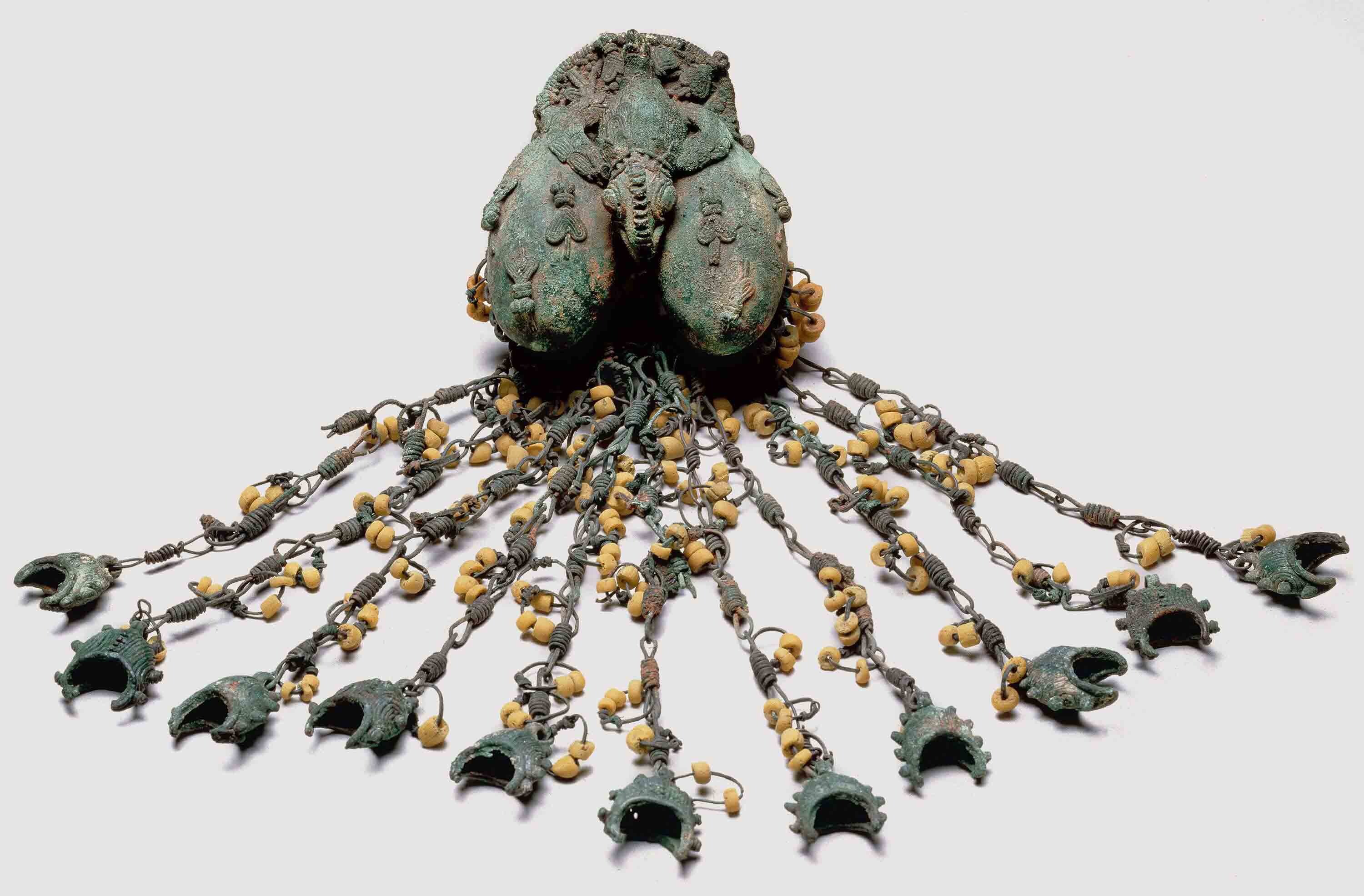
The large central object, which has a mottled green and brown patina, has two lobes that look like testicles or breasts. Centered on top of them is a winged figure with a birdlike head. Each lobe has smaller winged shapes on it that look like flies. The object has eleven attachments, each consisting of a beaded chain ending in a bell-like object in the shape of an open claw.
FLYWHISK HANDLE FROM IGBO-UKWU Among the many other objects buried with the deceased at Igbo-Ukwu was a small equestrian (a rider on a horse), which was either the top of a staff or the handle of a flywhisk (Fig. 2.19). Today, flywhisks are made from the tails of cattle or horses set into holders, and they are still an effective way to brush off flying insects. Across Africa, these whisks have long been associated with leadership and wealth, possibly because the animals used for their tails were so valuable. The top (or end) of this copper-alloy handle is adorned by a small figure who blows on an instrument and rides a horse.
Why is the horse so small? Perhaps the artist had never seen a real horse, or perhaps the scale was deliberate: The animal is less important than its rider, just as the rider’s head is more important than his (much smaller) body. The rider’s face is marked with parallel lines, similar to the permanent scarification (or ichi) incised into the faces of high-achieving Igbo men in the twentieth century. Each set of ichi marks proclaimed that a man had attained a new title and a new set of community responsibilities. The rider is perhaps an early Eze Nri, who would have distributed titles, ensuring that elders served their people with justice, truth, and wisdom. The authority of the last Eze Nri was destroyed by the British when Nigeria became their colony in the early twentieth century, bringing an end to a position of leadership that was at least one thousand years old.
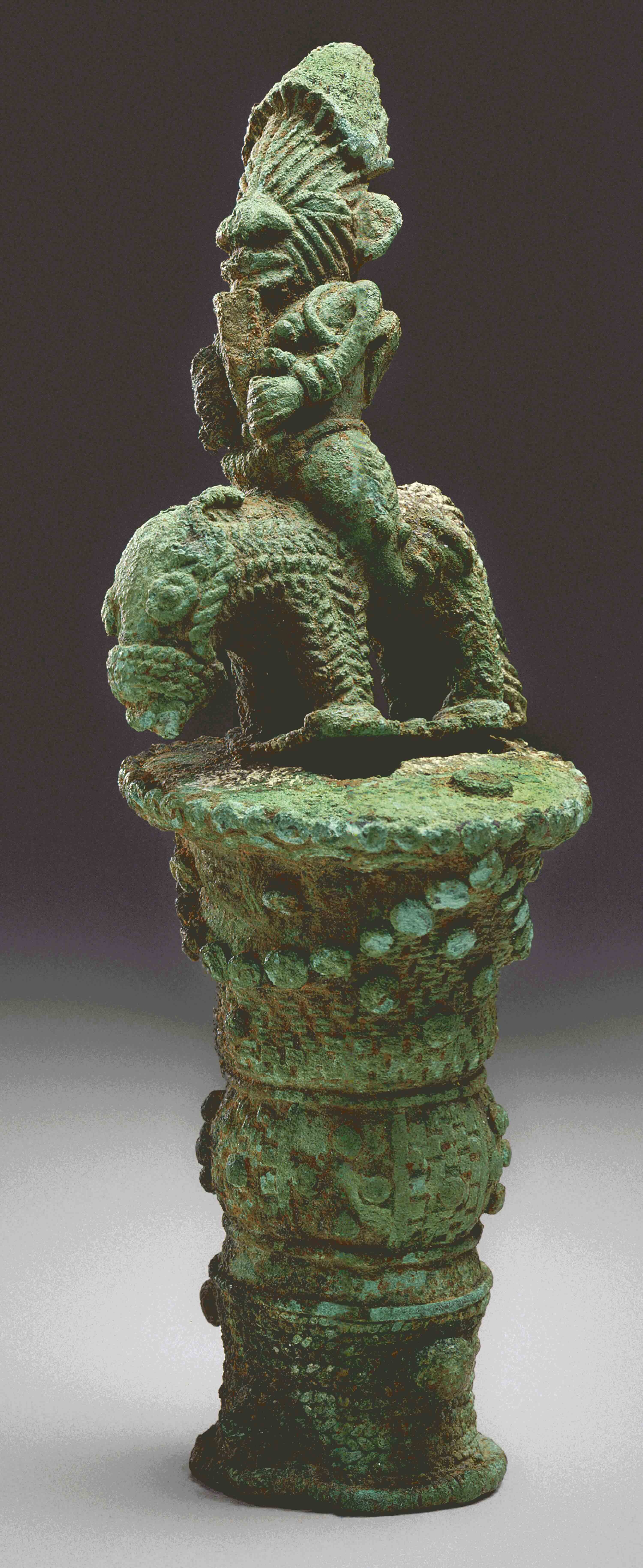
A metal cap with a flat top, like a platform. Mounted on the platform is sculpted a horse with an elaborately costumed rider who holds an object below his chin.
Archaeologists attempt to use art objects such as the bronzes from Igbo-Ukwu to reconstruct Africa’s hidden past. Given the preliminary nature of their research, the vast distances they must cover, the diversity of African populations, and the complexity of ancient religious beliefs and cultural practices on the continent, many of their fundamental questions have yet to be answered.