Ubaid
Regional Cultures in Early Mesopotamia
Several farming communities developed in Mesopotamia during the sixth and fifth millennia BCE. While these communities shared cultural elements and languages, they also developed distinct regional identities, expressed through their art and material culture. The most common objects were ceramic pots, which stored the food that people used daily. These pots provide not only vital information about the identities, daily lives, and belief systems of the people who lived during this period, but also evidence of their creativity and inventiveness. The people of these communities built their houses from bricks molded from mud and dried in the sun. Because sun-dried bricks deteriorate fast when not maintained, the houses were worn down over time by rain and wind, creating a mound (called a tell or a hoyuk in present-day Middle East). New houses were then constructed on the ruins of earlier ones. These houses were often complex structures for extended families, with specific spaces for hospitality, food production and storage, pottery production, and weaving.
In general, Mesopotamian ceramics of the sixth millennium BCE were formed by hand, rather than on a wheel. Some potters of the period constructed large containers by using a coiling technique in which they stacked clay coils one on top of another to build the form, and then smoothed the surfaces. Potters of the later Ubaid cultures, who lived in the fertile southern plains of the Tigris and the Euphrates Rivers between roughly 5500 and 3800 BCE, introduced an innovation in ceramic technologies: the tournette, an early form of potter’s wheel that speeded production by allowing ceramics to be shaped more easily.
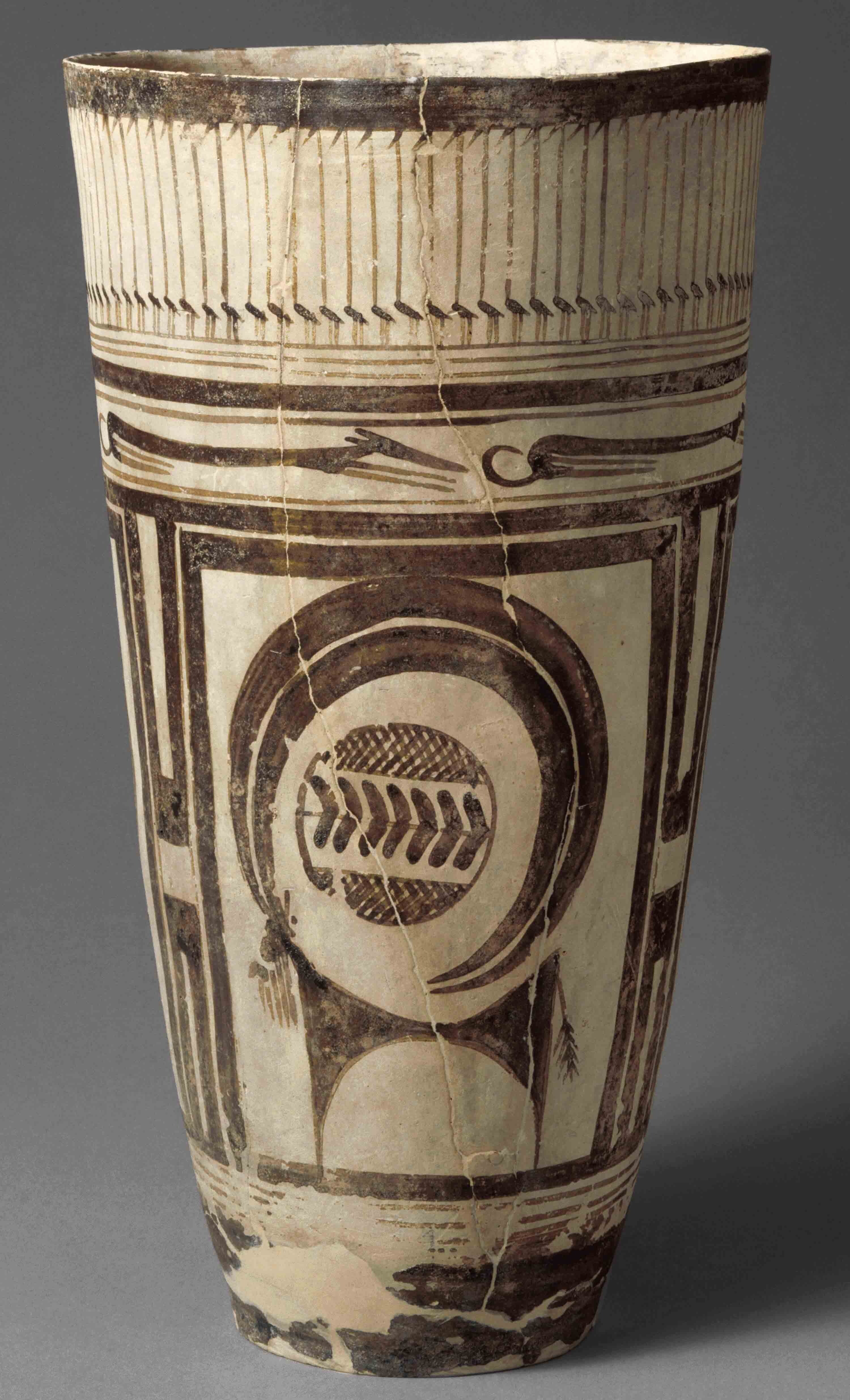
UBAID BEAKER Early ceramics were often adorned with painted animals, architecture, and elements of the landscape. Artists frequently lengthened, exaggerated, or otherwise refined the shapes, and these designs often created slightly abstract forms. See, for example, the carefully crafted decoration on this wide-mouthed beaker found in Susa, a region in western Iran in contact with Ubaid culture (Fig. 3.1). The brown-painted decoration, applied to the vessel’s highly burnished, buff-colored surface, consists of designs framing geometrically abstracted representations of animals, including aquatic birds with long necks, running dogs, and ibexes. The horns of the ibex—a type of mountain goat—are exaggerated to curve around an abstract circular design at the center, and they end precisely at the slenderest part of the goat’s waist. The elongated dogs, depicted above the frame, are clearly running.
More information
The most prominent decoration, occupying a large panel, is a highly stylized rendition of a four-legged animal with enormous curved horns. A small, feathery tail is also visible. Above this decoration, a design encircles the cup. The design repeats an elongated image of a dog.
Glossary
- material culture
- the materials, objects, and technologies that accompany everyday life.
- tournette
- a pivoted work surface that makes the shaping and decorating of pots easier and quicker.