Gudea
Caring for the Cattle Pen and the Sheepfold, c. 2200–2000 BCE
After the collapse of the Akkadian empire around 2200 BCE, the city-states of southern Mesopotamia reasserted their regional power. These rulers in the south—such as the Second Dynasty of Lagash and the Third Dynasty of Ur—were much more closely tied to the long traditions of Mesopotamian sociopolitical life and culture and were eager to claim the heritage of long-term artistic and literary traditions. Whereas Akkadian rulers had based their reign on military power, territorial expansion, and violence, the rulers in the south built their notion of kingship on caring for their subjects. They called themselves “shepherds” and thought of their cities and temples as cattle pens and sheepfolds where their residents were protected. They were relatively peaceful statesmen who were devoted builders of temples and sponsors of the arts and literature. From the time of the kings of Ur and Lagash in the late third millennium BCE, we have an abundance of literary texts, exquisitely made and inscribed statues, and magnificently built temple complexes.
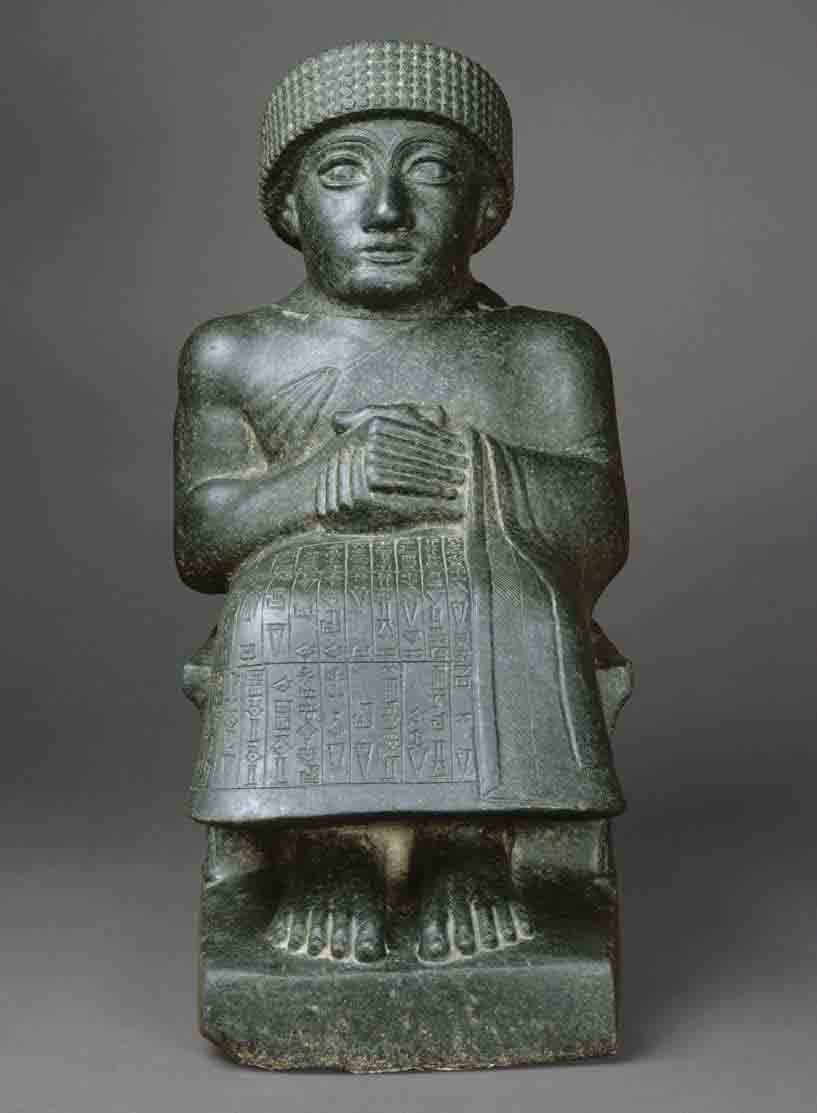
STATUES OF GUDEA Perhaps the best-known ruler of the period is Gudea (ruled 2144–2124 BCE), the ensi (ruler, or “lord of the plowland” in Sumerian) of Lagash. Carving votive statues of rulers from hard, dark, exotic stones, such as diorite, chlorite, or steatite, and dedicating them to a specific deity, was widely practiced by both Egyptian and Mesopotamian rulers in the third millennium BCE as a sign of royalty. Gudea commissioned many statues of himself during his lifetime, including this seated statue dedicated to Ningishzida, god of vegetation and the underworld (Fig. 3.18). The stone’s hard surface is finely finished, well polished, and shiny, creating a dramatic sense of permanence.
There are twenty-seven statues of Gudea in various museums around the world. Some of these were excavated archaeologically between 1909 and 1929 at the site of Girsu (Tello, Iraq), while others have been looted from the site and illegally circulated. In these statues, Gudea is depicted standing in various gestures and poses of veneration and devotion, or seated, as he is here (Fig. 3.18). His prominent hands are clasped, his heavy-rimmed eyes seem attentive, and his body is expressive. Artfully composed and carved texts in Sumerian cuneiform cover the lower parts of his robe. His clean-shaven face and royal woolen cap with stylized curls suggest his religious dedication. Although far more pious in appearance than Naram-Sin, his cloak leaves one of his arms exposed, allowing him to display his well-shaped musculature; his rippling arms are actually discussed in the inscriptions. The stone for these statues was acquired from the Land of Magan (probably somewhere near the present-day United Arab Emirates and Oman), which was a known source of diorite. It seems likely that, although these statues were first and foremost religious and ritual objects that were not for public viewing, Gudea had them created in diorite to announce his control of the stone’s sources.
More information
The figure sits facing the viewer, with hands clasped at the waist. He wears a textured cylindrical cap or crown. Vertical rows of text cover the skirt of his gown.
More information
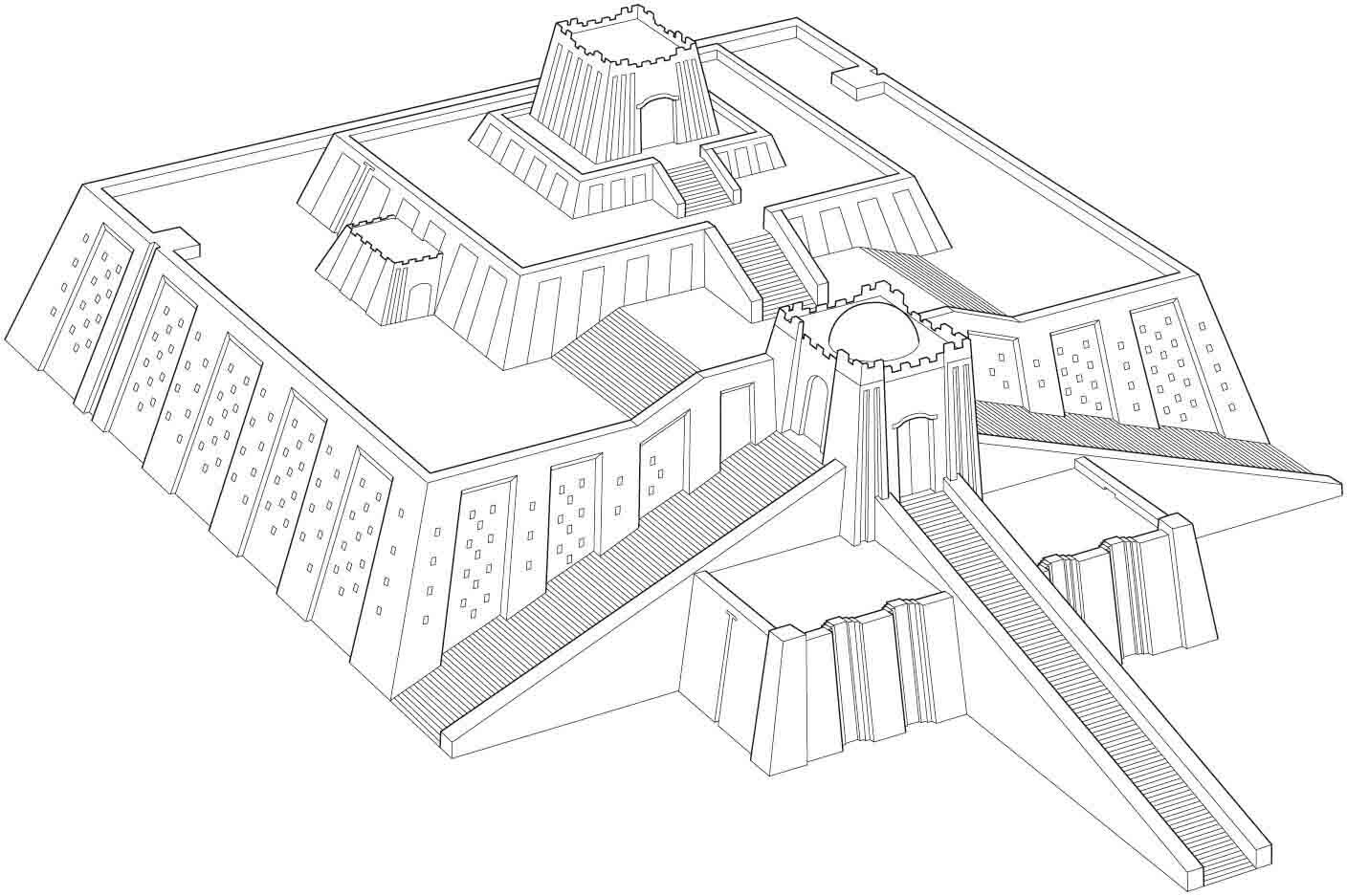
Three staircases converge at the entry point to the first, largest level of the stepped pyramid. A single stair leads from the first level to the second, and a final stair leads from the second level to the third. A central tower rises from the third, highest level.
THE ZIGGURAT AT UR The major sanctuaries at the cities of Ur and Nippur were venerated across all Mesopota-mia and thus transcended the political control of any particular ruler. The kings of the Third Dynasty of Ur played a particularly important role by sponsoring temple building (of which the ziggurat, Fig. 3.19, formed a part), and formalized the architecture of the Mesopotamian temple through several major building projects. By the third millennium BCE, major sanctuary complexes had become collective sites of pilgrimage for the entire Syro-Mesopotamian world, and therefore the sponsorship of building projects at such sites was a matter of competition among Mesopotamian kings. Massive sanctuary compounds were designed with carefully planned courtyards and palace-like structures. The key monument in these expansive temple compounds, and the primary site of religious rituals, was the ziggurat, which raised the holy shrine of the gods and goddesses closer to the heavens. Staircases and gates gave access to the shrine, but the highest spaces were reserved for only the priestesses and priests.
Ur Namma
A prime example of orthogonally planned architecture, the Sanctuary of the moon god Nanna underwent an extensive construction project during the reign of Ur Namma of Sumer (ruled 2112–2095 BCE), accommodating and encasing earlier buildings while far exceeding them in scale. The ziggurat at Ur, built around 2100 BCE, has three large sets of stairs and is encased in baked bricks. Each brick is individually inscribed with the name of Ur Namma as the pious patron who paid for the ziggurat’s construction. Covering the massive structure (210 × 148 feet (64.01 × 45.11 m) at the base, and possibly 100 feet (30.48 m) high) were bricks that protected it against weathering by wind or rain. Little remains of most ziggurats in Mesopotamia, but the one at Ur has been partially restored after its brick structure deteriorated over the millennia.
Around 2000 BCE, the Mesopotamian states and their production of art paused after the collapse of the Third Dynasty of Ur. For the next few centuries, no stable power unified the city-states of Mesopotamia. Conflicts among competing empires caused shifting allegiances and disrupted agriculture and trade. The epic poems, known as the city laments, written after this period speak of the destruction of the cities and their eventual restoration (see Chapter 5).
Glossary
- orthogonal plan
- an architectural or urban plan in which streets or passages intersect at right angles, forming a grid pattern.