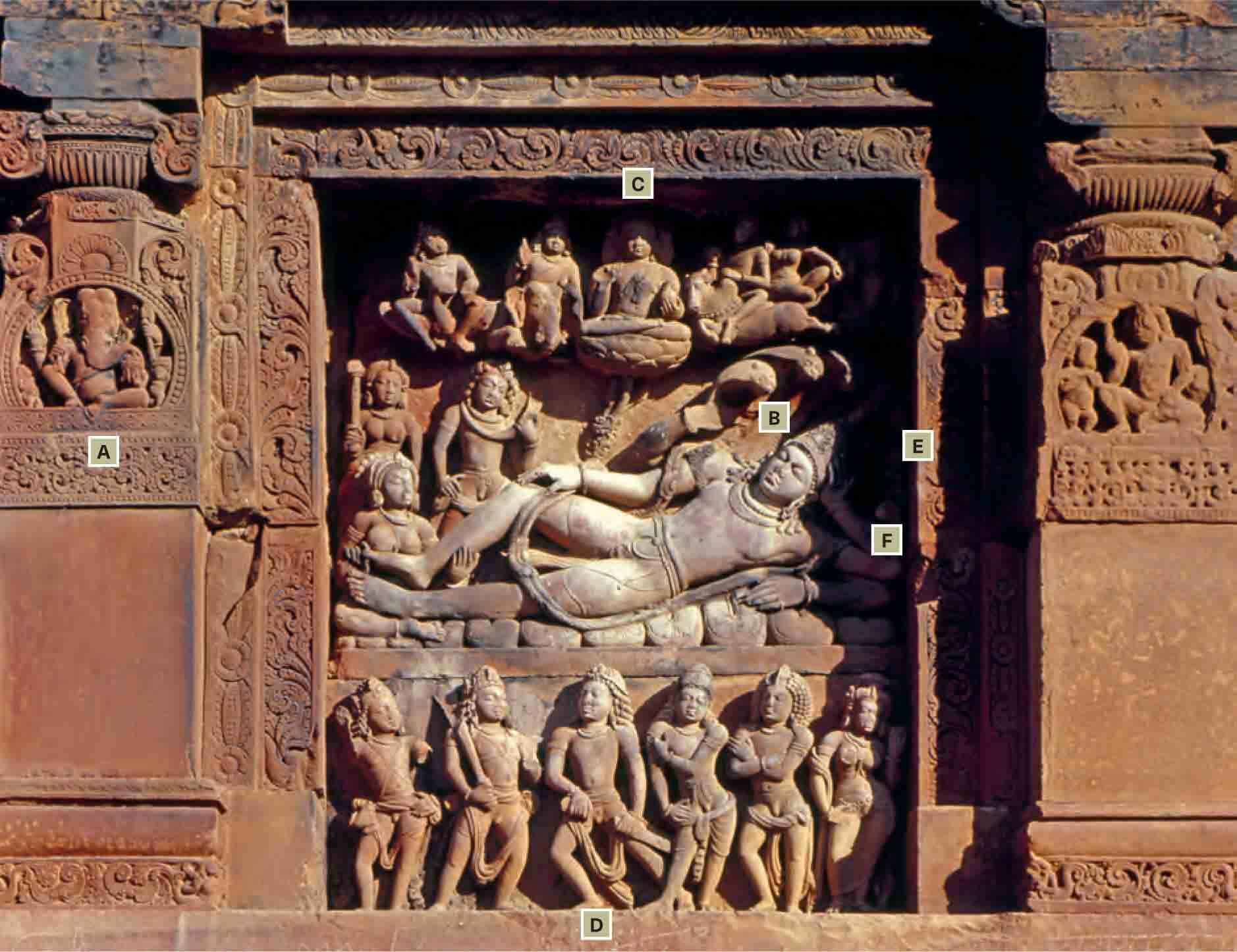
Visually complex and laden with religious meaning, Hindu narrative art sometimes requires step-by-step unpacking. For example, let us take a closer look at the Deogarh temple’s south panel.
VIDEO: Subtractive SculptureShow VideoHide Video
A
First, notice that to the panel’s immediate left is an image of the elephant-headed god Ganesha, remover of obstacles and worshiped at the start of a task. His presence suggests that pradakshina begins here.
B
Next, study the panel’s iconography to determine what is depicted. The royal crown on the central, reclining figure indicates that it is Vishnu. He sleeps cushioned by the serpent of infinity Ananta, identifiable by his multiheaded cobra hood. Here, the hood acts as a protective canopy. Vishnu’s consort, Lakshmi, massages the god’s leg. According to the Puranas, as Vishnu slept and dreamed, a lotus grew from his navel. The blossom eventually opened to reveal Brahma, the god of creation. Here, perhaps for artistic reasons, the lotus vine is not attached to Vishnu’s navel, but rather drapes elegantly along his body.
C
At the top of the panel, Brahma is shown seated on a lotus flower and flanked by other deities there to witness the miraculous event. For example, directly to Brahma’s right are Shiva and Parvati, riding on Shiva’s mount, the bull Nandi.
D
The figures positioned in a row at the base are personifications of Vishnu’s four weapons (at right) stopping two demons (at left) from attacking Vishnu as he sleeps.
E
Next, analyze the relief’s style, which indicates roughly when it was made. In this case, Vishnu’s broad, rounded shoulders, smooth chest, and oval face confirm the relief is in the Gupta style, dominant in central India during the fifth and sixth centuries CE.
F
Finally, consider the visual strategies employed by the artist(s), and how they enhance the viewing experience. Here, the sculptors divided the composition into three rows, or registers, which increase the relief’s legibility. This clarity provides the composition with a sense of stability and calm, echoing that of Vishnu’s long slumber. Vishnu is both the largest figure and the only one positioned horizontally, increasing his prominence in the scene.
More information
In the center, by label B, Vishnu reclines on the body of a multi-headed cobra. Other figures appear above, label C, and below, label D. Label A appears at the far left. Labels E and F appear to the right.