taifa
Almoravid (dynasty)
taifa
Almoravid (dynasty)
In 1009, disgruntled Imazighen mercenaries destroyed the royal palace at Madinat al-Zahra. Civic strife between rivals claiming leadership over the caliphate disrupted political unity, and in 1031 Córdoba became divided into competing taifas, or independent Muslim principalities. The competition between taifa-kings or party rulers for political power made it easier for Christian kingdoms to reconquer land. Desperate for political stability, taifa rulers regularly paid tribute to Christian kings. In 1086, after the taifa-king of Seville solicited support from the Almoravids, a Muslim dynasty that ruled Morocco after the disintegration of the Fatimid caliphate, the Almoravids decided to rule southern Iberia themselves. Their harsh policies against Jews and Christians drove many to move north.
Koutoubiya Mosque
The Almoravid caliphate (1040–1147) did not last long. Their Moroccan rivals, the Almohads, captured the Almoravids’ North African capital city, Marrakesh, in 1147, and they tried to erase all visual traces of their defeated enemy. In Marrakesh, the Almohads (1147–1269) built a hypostyle mosque on the ruins of the Almoravid royal palace. The Koutoubiya Mosque is far less ornate than the Umayyad mosque in Córdoba, corresponding to the Almohads’ religious conservatism and prohibition of wearing expensive or ornate garments. Artistic restraint was not universal, however. For instance, Almohad books were often decorated with exquisite calligraphy and elaborate geometrical patterns.
KOUTOUBIYA MOSQUE Though humble in design, the Koutoubiya Mosque in Marrakesh includes a monumental minaret, over 250 feet (76 m) tall, that can be seen from miles away (Fig. 34.8). The minaret contained a long, winding internal ramp, enabling riders on horseback to reach its original summit. This commanding square-based minaret—a common format in northern Africa (see Fig. 25.11)—calls the faithful to prayer from all four directions. While the primary function of the edifice is religious, it also effectively demonstrates the Almohads’ power.
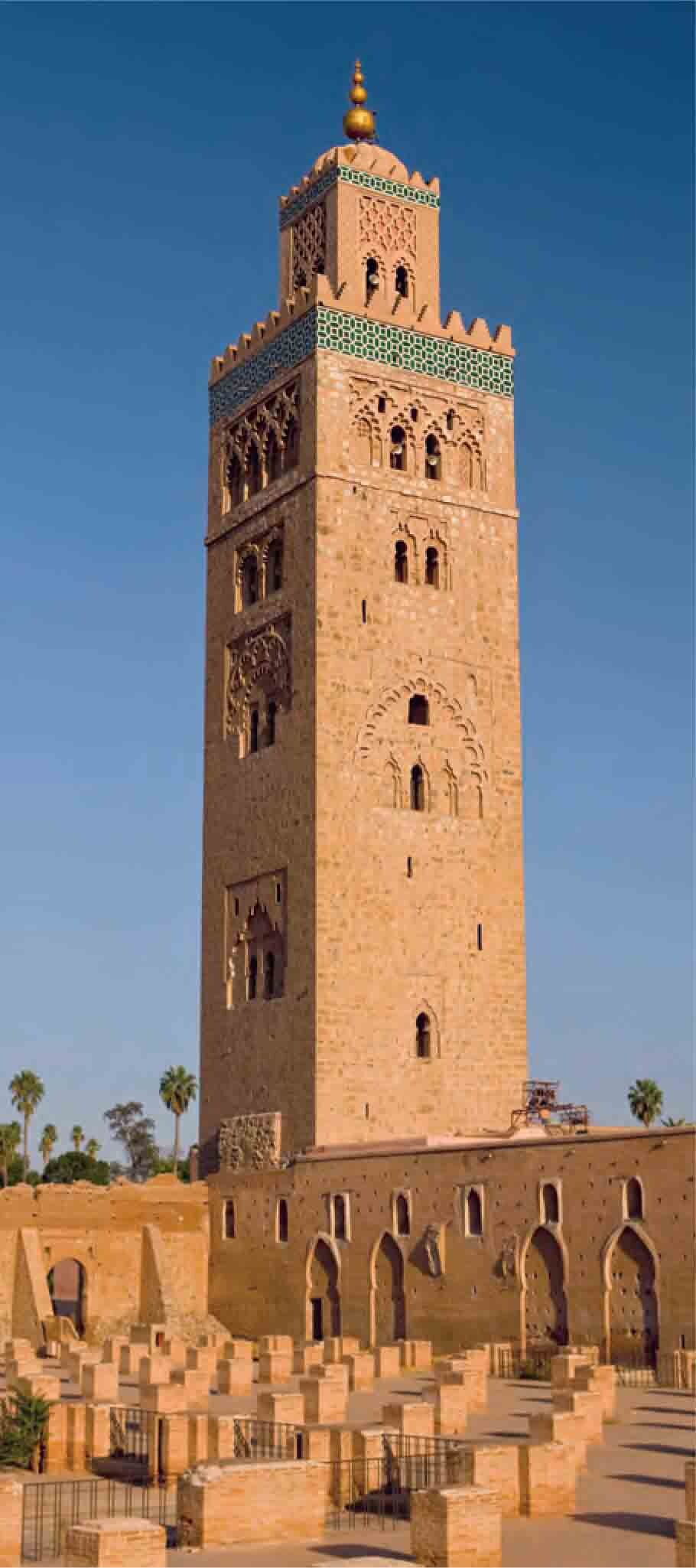
The minaret is square. The platform on top has a crenellated wall around a smaller tower topped by a finial of gilded spheres.
Constructed of brick and sandstone, the crenellated minaret is crowned by a smaller tower and capped with gilded copper orbs and an observation deck that reinforces its function as a watchtower. Although the mosque itself is relatively plain, the exterior walls of its minaret are decorated with elaborate diamond-shaped patterns and scalloped keystone arches located above each opening. Ceramic bands adorn the top of the minaret’s two main sections. The prayer tower’s windows are located at different heights, corresponding to the spiraling ramp inside.
Giralda
GIRALDA, CATHEDRAL OF SEVILLE When the Almohads defeated the Almoravids, they also took control of the Almoravids’ Iberian territory. The Almohads chose the city of Seville as their Andalusian capital and built a substantial mosque there. Its tower, the Giralda, originally served as its minaret (Fig. 34.9) and reinforced Seville’s place within the Almohad caliphate. It closely resembles the prayer tower found in Marrakesh, employing sebka—a refined rhomboid patterning filled with intricate arabesques of intertwining foliage—to decorate the minaret’s surface. These designs were associated with the beauty and order of God’s creation.
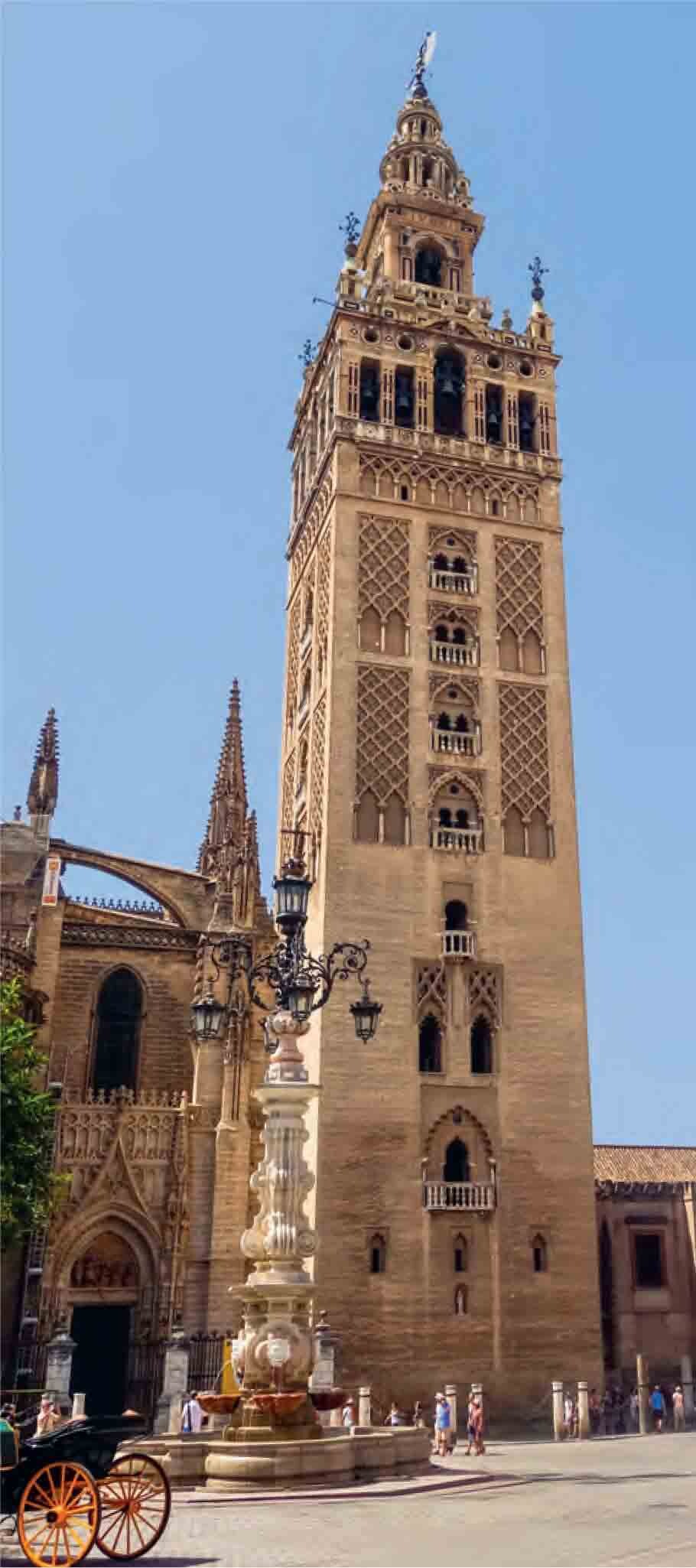
The tower is square. The platform on top has a decorated wall around a smaller tower topped by a finial.
Like the Marrakesh minaret, the Giralda contains an interior ramp that facilitates the call to prayer. Although constructed in brick and designed in manner similar to the Almohad minaret in Marrakesh, the Giralda also includes marble columns that are spolia from Umayyad buildings, thus connecting the Seville minaret with Andalusia’s esteemed past.
Castile
After Fernando III of the Christian kingdom of Castile reconquered Seville in 1248, the mosque was converted into a church. In 1401, the structure was destroyed, and construction began on the huge Seville Cathedral. The Christian victors spared the minaret, converting it into a bell tower; this preservation functioned as a symbol of Muslim defeat. The tower’s top floor, housing the church’s bells, and balconies were added later. Today, the structure is called the Giralda after the weathervane (giralda in Spanish) placed atop the former minaret.
BANNER OF LAS NAVAS DE TOLOSA The Almohads also commissioned expensive textiles. This silk tapestry, which may have been part of a military leader’s tent, includes gold and silver threads (Fig. 34.10). Adorned with geometric and floral motifs, its production was labor intensive. An eight-pointed star at the center dominates its design. The decoration also includes a calligraphic inscription from the Qur’an (61:10–12):
O you who have believed, shall I guide you to a transaction that will save you from a painful punishment? It is that you believe in God and His Messenger and strive in the cause of God with your wealth and your lives. That is best for you, if you shall know. He will forgive you your sins and admit you to gardens beneath which rivers flow and pleasant dwellings in gardens of perpetual residence. That is the great attainment.
Thus, the tapestry reinforces the idea of God as the refuge from evil and praises him as the provider of paradise. Eight circular pendants hang from the cloth. Unfortunately, the words inscribed on these pendants can no longer be read. Nonetheless, like the eight-sided star, these disks correspond to the gates of heaven and to the number of angels said to carry God’s throne on the Day of Final Judgment.
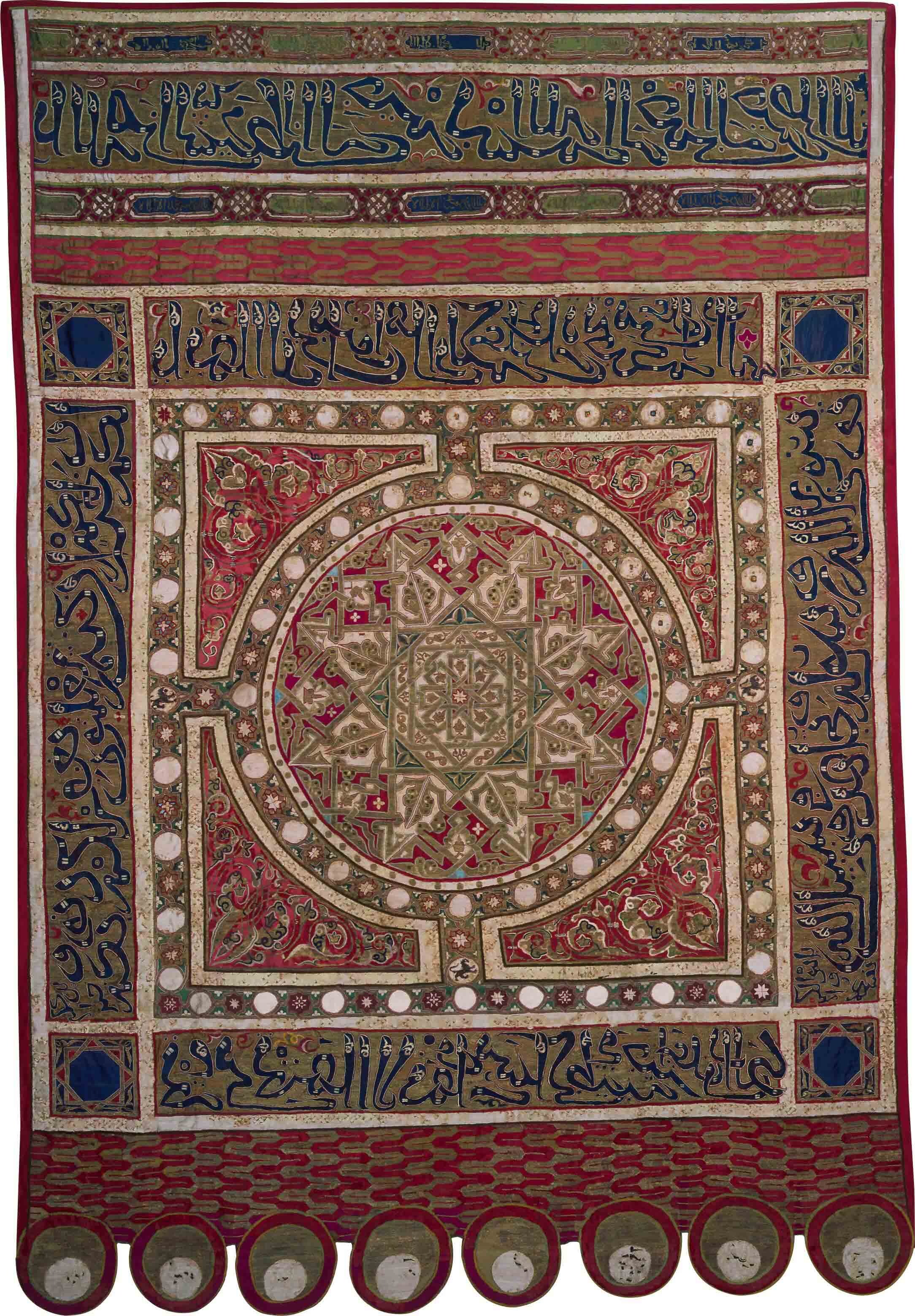
The rectangular banner is made of red cloth and heavily embroidered. Each of the eight scallops along its scalloped lower edge has a silver disk on it. A circular design in the middle of the banner, featuring an eight-pointed star and filled out with geometric and floral motifs, is surrounded by blocks of writing.
The tapestry was once believed to have been taken from its original owner during the Battle of Las Navas at Tolosa (1212), but more likely it was captured later in one of Fernando III’s military campaigns. When Fernando defeated the Almohads, the looted textile acquired an alternative meaning. It was donated to a Cistercian monastery in Burgos in northern Spain, where it served as a trophy commemorating Fernando’s victory in the Reconquista (Map 34.1).
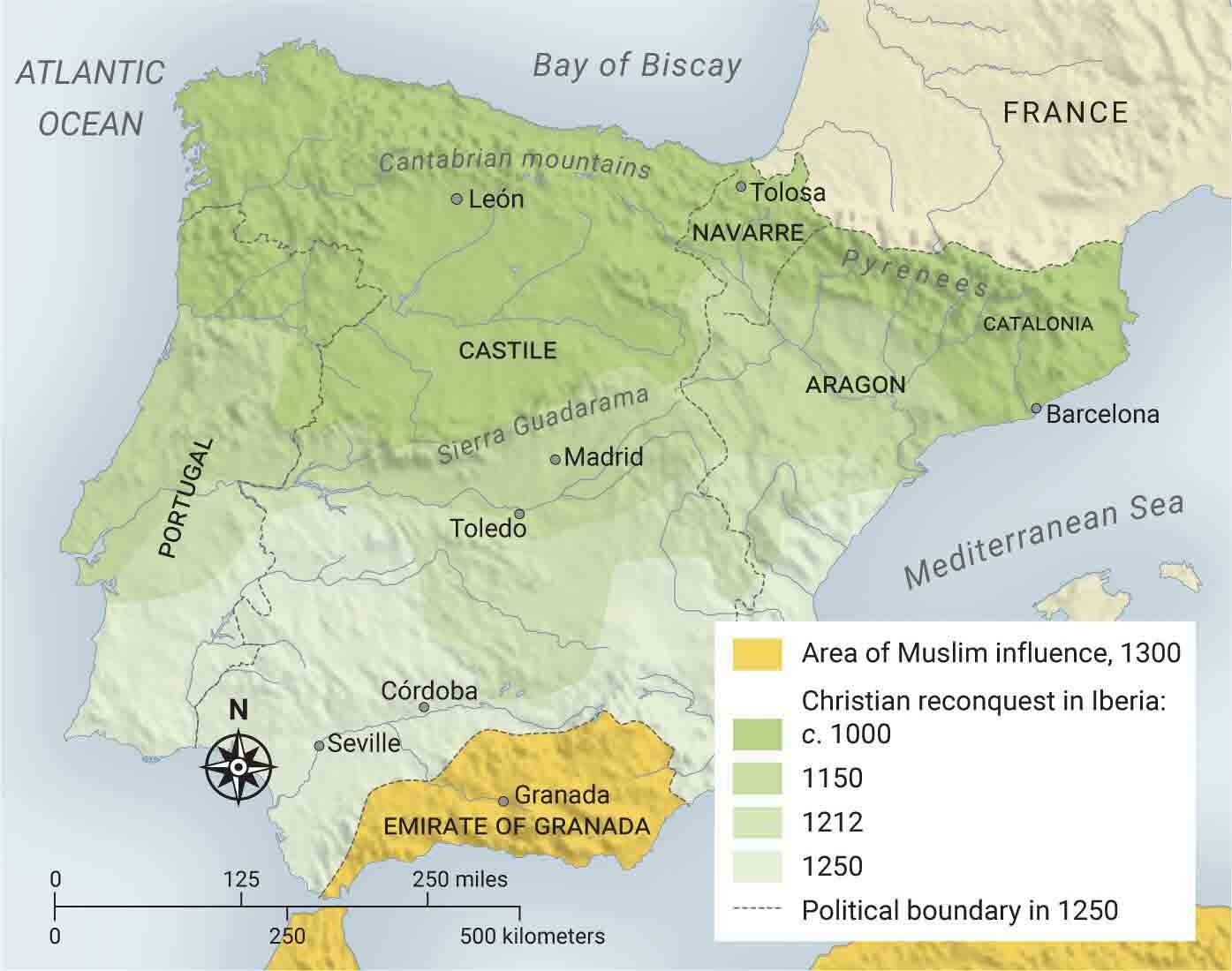
Christian reconquest of Iberia started in the mountains to the north, in 1000, and moved southward over the next several centuries. By 1300, Muslim influence was limited to the Emirate of Granada, which occupied coastal lands just inside the Straits of Gibraltar. Sites of interest include Leon, Tolosa, Barcelona, Madrid, Toledo, Cordoba, Seville, and Granada.
Ibn Shoshan Synagogue
convivencia
IBN SHOSHAN SYNAGOGUE (SANTA MARÍA LA BLANCA) Beyond the borders of the Almohad caliphate, Muslims and Jews continued to live in Iberian territories controlled by Christian monarchs. Within these kingdoms, tensions between adherents of the three Abrahamic religions continued to grow. In addition, Christians to the north periodically criticized Arabized Christians, also known as Mozarabs, for not being sufficiently orthodox. Nonetheless, members of different religious communities maintained enough contact to ensure mutual economic gain and political stability, exchanging artistic styles and occasionally employing the same artisans. At the same time, they kept their own distinct cultural identities, as they had done earlier under the Umayyads. Some historians have labeled these moments of coexistence, which were more common under Umayyad rule but continued until 1492, as convivencia (“living together”). This term recognizes that these religious groups’ interactions were not defined solely by animosity and antagonism.
One example of convivencia is found in Toledo, where the Jewish community commissioned a synagogue resembling a mosque while living under the rulership of a Christian monarch. Later named after its likely chief donor, Joseph ben Meir ben Shoshan, a wealthy son of the finance minister to the king of Castile, the synagogue’s interior includes horseshoe arcades decorated with intricate patterns that are reminiscent of hypostyle-hall mosques and, more specifically, Almohad architecture (Fig. 34.11). The synagogue’s arches are supported by octagonal pillars rather than columns, and its interior is painted pristine white. Today, both of these features are associated with Almohad mosque design. However, it is unclear whether the builders and worshipers of the synagogue would have made the same association or just viewed them as stylish and appropriate design features for a place of worship.
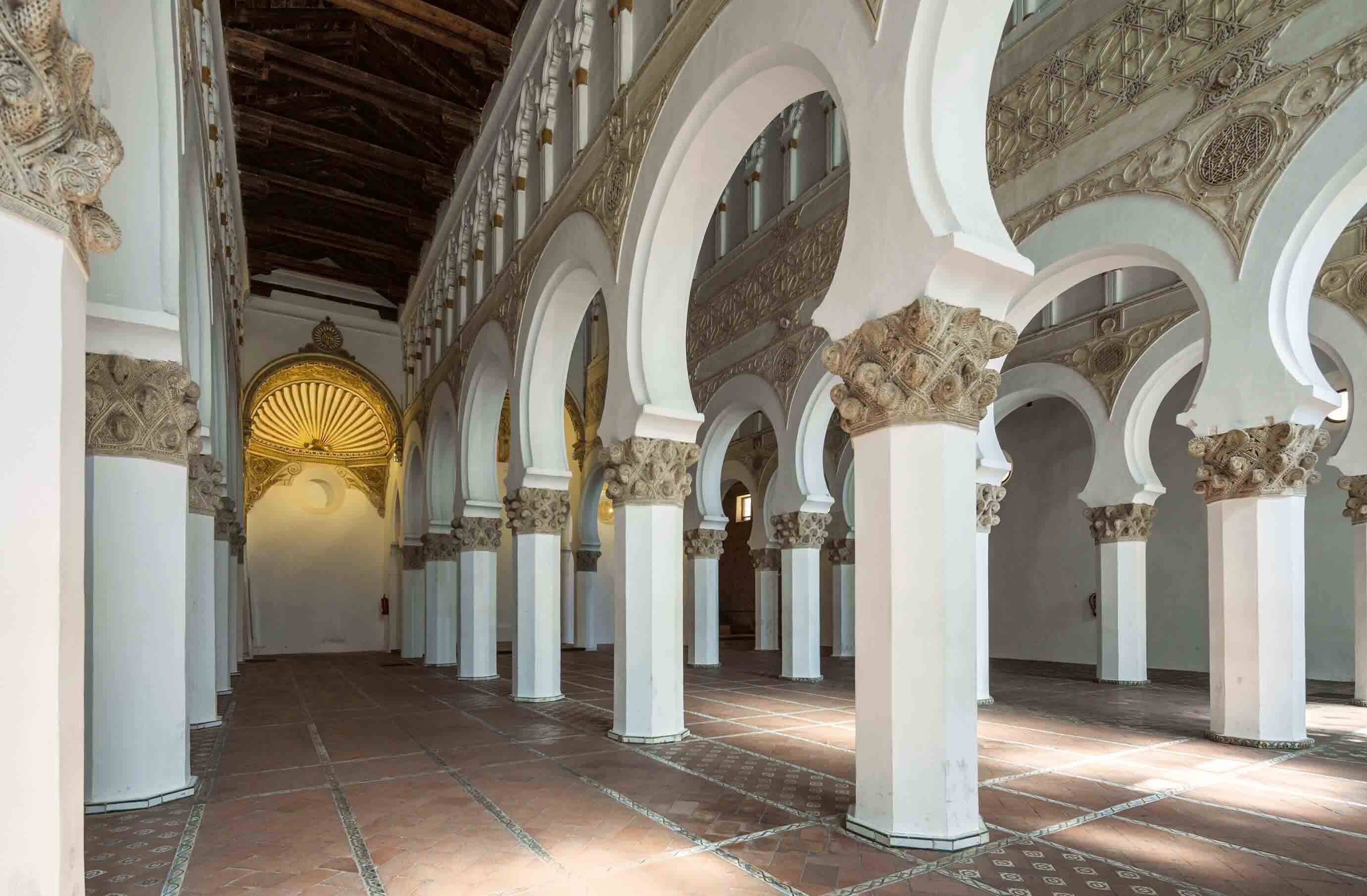
The view takes in a patterned brick floor, several rows of white, plastered octagonal pillars supporting rows of horseshoe-shaped arches, and an illuminated niche in a far wall.
mudéjars
Constructed one hundred years after the taifa kingdom of Toledo fell to King Alfonso VI of Castile, the Toledo synagogue was probably built by mudéjars, Muslims who remained in Christian territories without forfeiting their faith. Unfortunately, convivencia did not last. In 1391, a crowd of local Christians, roused by the anti-Semitic preaching of a Dominican priest, massacred most of the city’s Jews. Soon after, the Toledo synagogue was converted into the monastic church of Santa María la Blanca, a term signifying that the edifice had been “white-washed” or purified of its Jewish past.