Sapi
Sierra Leone
Sapi
Sierra Leone
The first West Africans to encounter European sailing vessels were the populations called the Sapi, or Sape, by the Portuguese sailors who arrived on their sandy shores in 1462. Portuguese navigators called the neighboring hills the Sierra Leone, a name retained by the nation where the descendants of the Sapi still live.
IVORY SCULPTURE Portuguese reports note that Sapi artists were remarkable for their ingenuity and skill, and within a generation or two—by the end of the fifteenth century—sea captains were purchasing varied objects from Sapi artists and commissioning them to sculpt luxury items of ivory. Elephant ivory, which had been traded for centuries across the Sahara and had entered medieval Europe via Muslim territories in North Africa and southern Europe, was both rare and valuable in Europe during this period. When the Portuguese explorers brought the Sapi ivories back to their patrons, Portuguese royalty gifted ivories to their counterparts in Spain, France, and Italy.
Renaissance
Among the most valued art objects produced by Sapi sculptors were lidded bowls, ivory containers that their Portuguese clients could use to hold salt. Because salt was an expensive commodity in Renaissance Europe, these “salt cellars” were displayed on the tables of the wealthy (see Fig. 48.6). The Sapi themselves had no use for such items, which their artists made solely for export. Nonetheless, the sculptors employed their own images and symbolic references when designing each piece.
A fairly complete example (Fig. 49.1) reveals why Europeans were so impressed by the imagination and artistry of Sapi sculptors. Carved from a section of a massive elephant tusk, the bowl and lid form a sphere almost 6 inches (15 centimeters) across, and although the empty salt cellar weighs only about 3 pounds (less than 2 kilos), a courtier would have needed both hands to carry it to its place on the table. The pedestal is encircled by seated figures. Four of them appear to be Sapi women wearing local clothing and hairstyles, and four are dressed as Portuguese men, in hats, tunics, breeches, and fashionable Renaissance codpieces. Although the figures’ facial features are quite similar, the men’s foreign nature is evoked by their straight, stringy hair, which hangs past their shoulders. Some of the surface patterns may be purely decorative, but zigzags over the bottom half of the sphere are expanded versions of the bands of scarification that cross the chests and the torsos of the female figures. The crocodiles that crawl around the lid may refer to Sapi folklore, or they may have been inspired by the personal experiences of the artist or patron. The crocodiles’ jaws, which reach for the heads and genitalia of two naked female figures lying along the same surface, are menacing reminders of the violence of the Sapi-Portuguese encounter; by the time this salt cellar was created, some sailors had already abducted local women and carried them off to Portugal as enslaved people. Perhaps most striking is the interplay of the male and female figures around the base. The women grasp the arms of the men, who appear to have their hands joined in prayer. Perhaps the figures allude to the relationships of local women with foreigners, which later led to the multicultural families who directed international trade in several places along the West African coast in the seventeenth and eighteenth centuries.
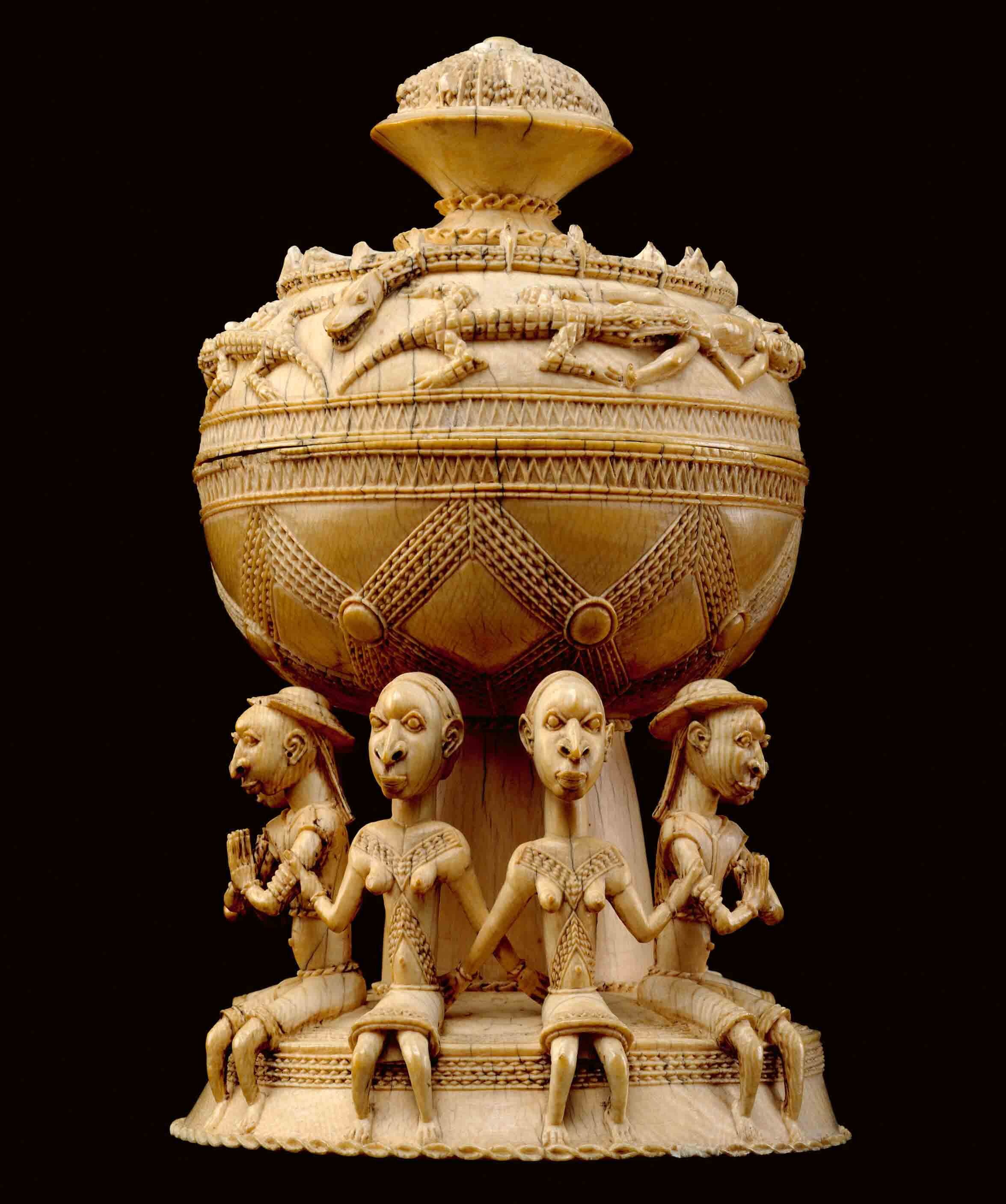
The large lid has a knob on top and reptile decorations in high relief around the side. One reptile looks like a crocodile biting the genitals of a human being. The bowl below is covered with a geometric pattern. The large base is encircled by male and female figures sitting side by side. Patterns on the torsos of the women echo the pattern on the bowl. The women hold the hands of the men, who wear hats and hold their hands clasped, as if in prayer.
Mende
STONE SCULPTURE Portuguese documents show that Sapi artworks in ivory were no longer exported to Europe by the middle of the sixteenth century. Sapi sculptors seem to have ceased their work after the armed invasions of populations from the northeast. These invaders brought new styles and new forms of patronage to the coastal regions. Prior to the incursions of these new immigrants, whose descendants include populations known as the Mende, Sapi sculptors apparently carved stone as well as ivory and wood. After the sixteenth century, however, stone figures were made only by artists of populations, such as the Temne and Kissi, who lived further inland.
The stone carvings unearthed by Mende farmers in the twentieth century are quite similar to the ivories that the Sapi sold to the Portuguese. For example, one male figure (Fig. 49.2), the surface of which is pitted and abraded after centuries of being buried in a field, has the prominent eyes and full forehead of the ivory figures on the salt cellar. Lines across the torso could be a twisted rope, but they could also represent a scarification pattern similar to that on the salt cellar’s female figures. Such formal similarities suggest that these stone figures, like the ivories, were made by Sapi artists before 1550.
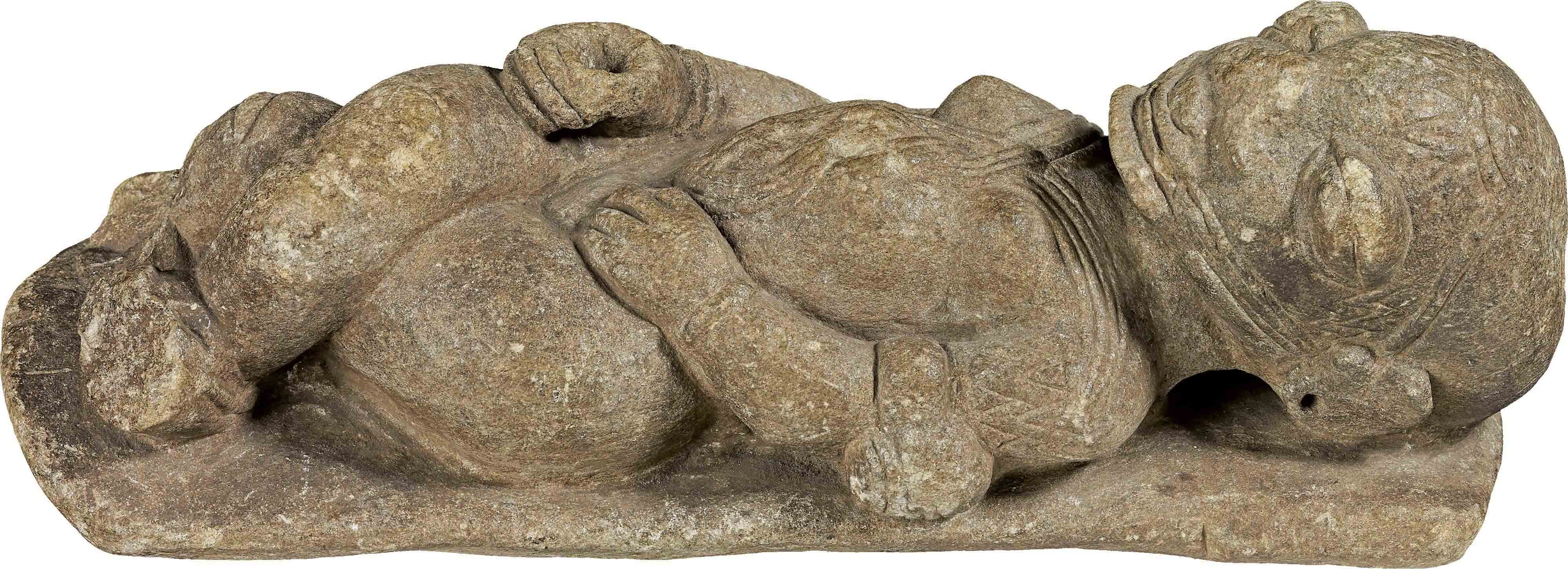
The eyes are closed but bulge, and the legs are crossed. Scar-like lines run across the cheeks and the upper chest.
Because the tradition of carving stone figures no longer exists in Mende territories, art historians have asked Temne and Kissi populations, who still make stone sculpture, for insights into their meaning and function. In Temne and Kissi communities today, stone figures are displayed at the funerals of distinguished leaders. The figures may be lashed to planks carried aloft as if they were corpses being carried on a frame. This Sapi figure from coastal Sierra Leone appears to be reclining on a flat surface, suggesting that he may be shown lying in state at his own funeral.