Manikongo
Art of Kongo and Allada
After landing in Sierra Leone, Portuguese explorers sailed further south, arriving in 1483 at the mouth of the Congo River. The federation of small kingdoms based in the territory north and south of the river was populated by diverse groups, which scholars today spell as the “Kongo” to distinguish them from the present-day nations (the Republic of Congo and the Democratic Republic of Congo) where many Kongo populations now live. Other parts of the Kongo homeland are now in the neighboring countries of Angola and Gabon, and in the enclave of Cabinda.
When the Portuguese met the supreme ruler of the Kongo polity, the Manikongo, they regarded him as a monarch equal in rank to their own. The Manikongo sent emissaries, accompanied by gifts, to European monarchs and to the Pope. These gifts included ivory horns, the pierced and incised elephant tusks that were played during royal ceremonies, and elaborately woven baskets. Europeans especially admired Kongo’s textiles—mats, cushions, and table coverings. Many of these sixteenth- and seventeenth-century artworks are found today in museums in Europe and the United States.
VIDEO: The Met, The Artist Project: Pat Steir on the Kongo Power FigureShow VideoHide Video
Mbanza Kongo
KONGO EMBROIDERED RAFFIA CLOTH Written accounts from the seventeenth century describe embroidered panels, screens, and carpets that formed a backdrop to the Manikongo as he sat in state in his capital, Mbanza Kongo (later known as Saõ Salvador). Like the soft and durable cloth used for clothing, rugs and cushions were made of fibers from the fronds of the raffia palm tree, woven on a small loom into squares or rectangles. Individual pieces were then carefully embroidered, usually in raffia thread of the same golden color. Some embroidery stitches were cut to form a type of velvet, a textured pile, that highlighted (or contrasted with) other patterns sewn on the cloth with flat or looped threads.
mpu
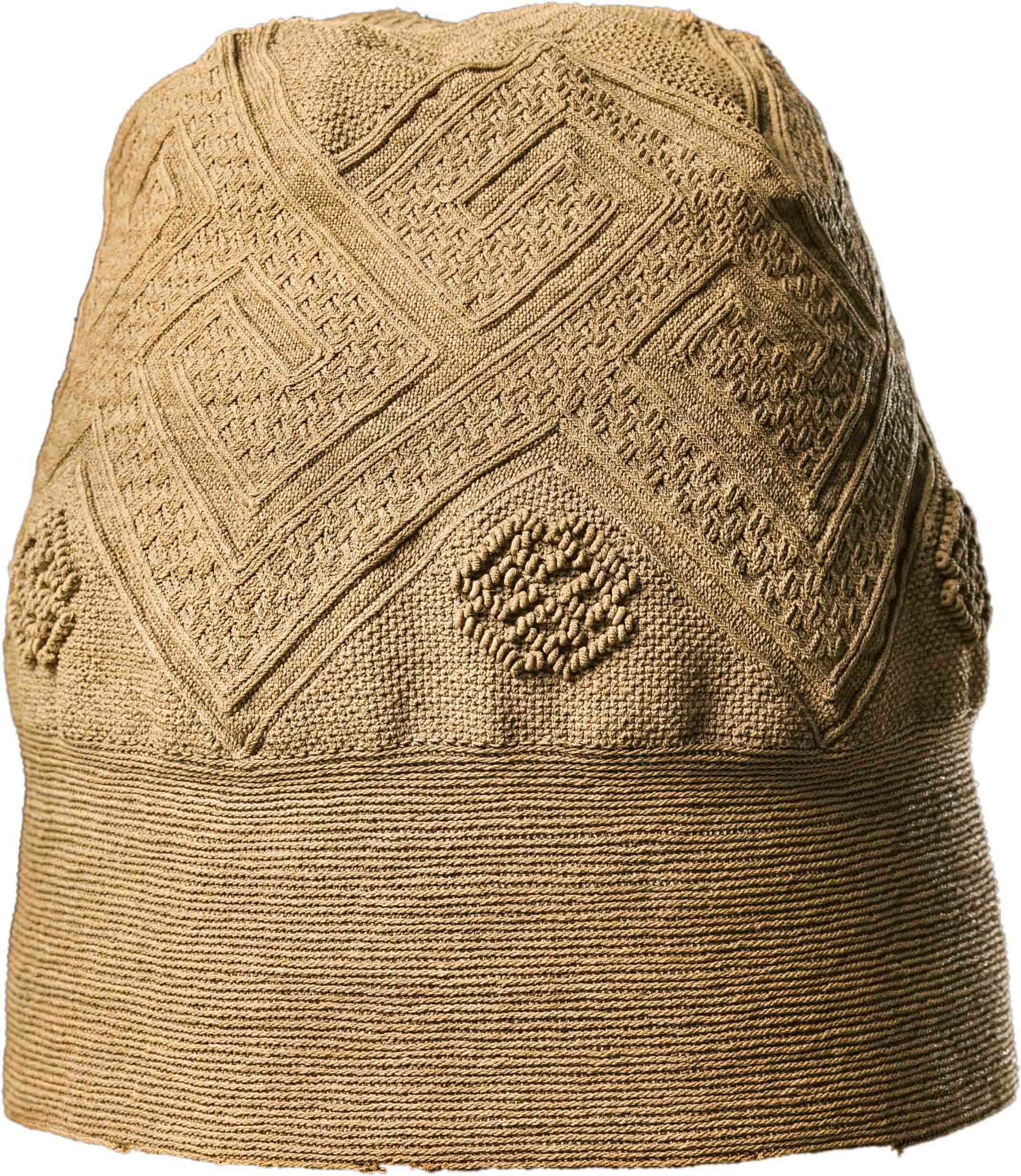
Such varied embroidery techniques give visual variety to a cap or mpu (Fig. 49.3) listed in a 1674 inventory for a king of Denmark. Such caps were perhaps the most prestigious gifts that a Kongo king might offer to a European ally, or that a wealthy man might give to a foreign trader. A man’s cap was his personal crown, a visual statement of his distinct status that was also thought to act as a defense against disorder, jealousy, and other negative forces. A mpu was constructed from a strand of raffia fibers spiraling down from the top in a continuous line that ends along the bottom edge. The concentric circling motion required to weave a mpu forms a spiral, the sacred Kongo sign for energy and longevity, bestowing those qualities on its wearer. In the widest part of this mpu are three raised diamond-like shapes, simple versions of a four-sided Kongo cosmogram, which represents the universe and its origins. References to the cosmogram are also created by the rectilinear lines of embroidery that cross the cap diagonally. The four directions in which the lines point are a visual shorthand for the path taken by the sun as it travels from east to west, bisecting the world into north and south. This movement across time and space is itself a metaphor for the human journey from life into death and the afterlife.
More information
The cap has a broad band at the base and a crown woven in complex a geometric pattern that includes raised medallions around the bottom and square spirals above.
KONGO CROSS WITH TONI MALAU The first Manikongo to become a Christian king was baptized as João I in 1491, and distinctive forms of Christianity have survived among the Kongo people into the twenty-first century. By 1570, raiders were taking entire populations captive, and marching them to coastal ports. From there, Portuguese (and later, Dutch and English) ships transported these Kongo people directly to sugar plantations in the Americas. Throughout five hundred years of history, the symbolic visual language of Kongo religion meshed with imported Christian images. Because the crossed lines of the cosmogram referring to the path of human life were similar to the crosspieces of the cross displayed by Jesuit missionaries, images of the crucifix (Jesus nailed to the cross) were quickly assimilated into local religious arts. The crucifix then became a symbol of political as well as religious authority, an ideal emblem for kings who desired divine blessings for themselves and for their people. By the end of the seventeenth century, Kongo metalsmiths cast variations of the crucifix in brass and copper for local leaders as a sign of protection against evildoers.
Sixteenth- and seventeenth-century Portuguese visitors were particularly devoted to St. Anthony of Padua, a Franciscan preacher who had been born in Lisbon in the twelfth century, and whose Portuguese name (Saõ António de Lisboa) became Toni Malau in the Kongo languages. The Portuguese brought wooden statues and paintings to the Kongo that depicted the saint holding a cross in one hand and supporting the baby Jesus with the other. In Kongo versions of the imported wood statues, the gestures of the saint and the Christ child correspond to poses and gestures that held local meanings.
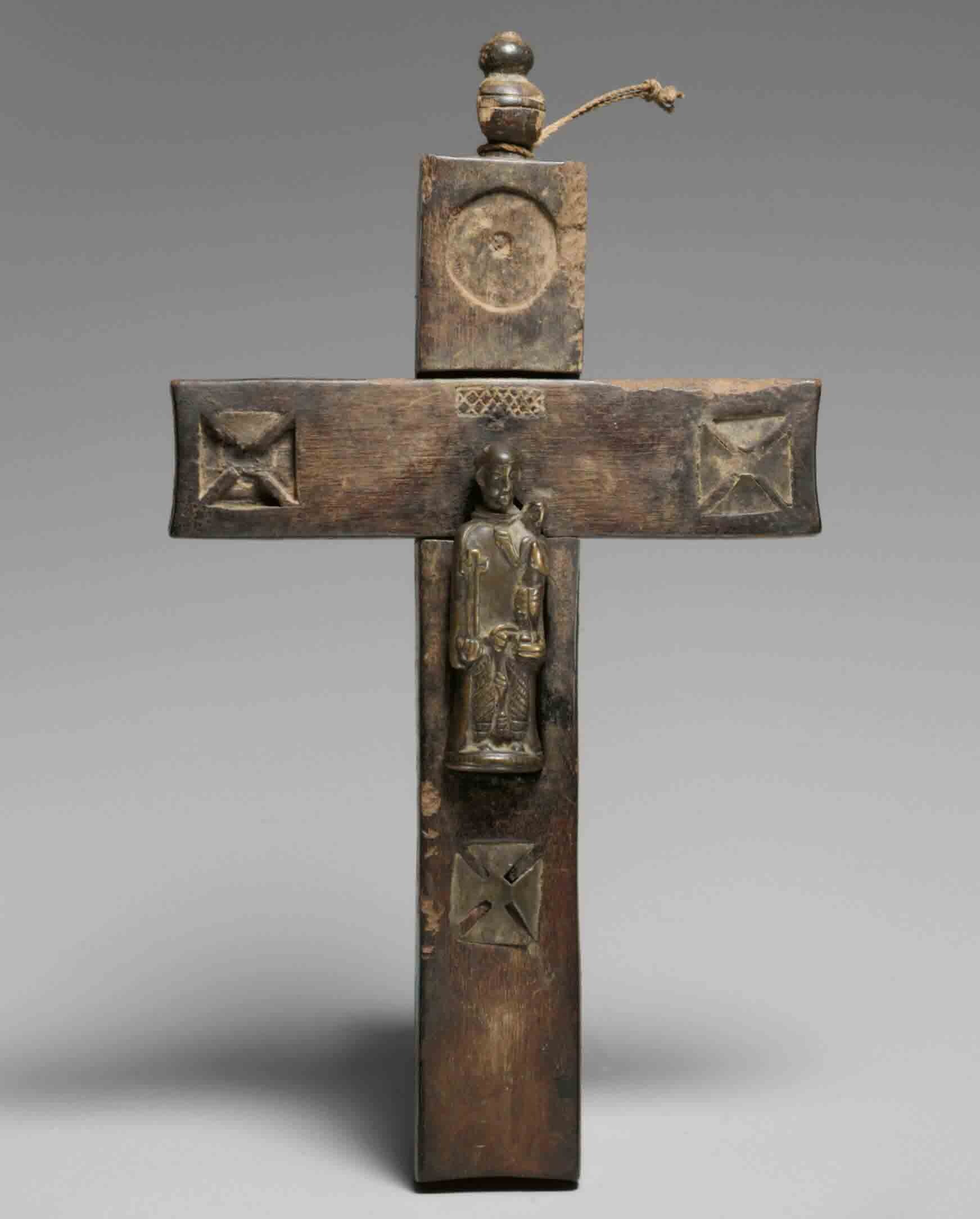
One small pendant of Toni Malau was cast in bronze or brass (Fig. 49.4), and may have been worn on the body of its original owner. Like many Kongo works in copper alloy, it cannot be dated, but it may have been made as early as the sixteenth century. The pendant was set into a wooden cross, perhaps during the nineteenth century; the cross would have been placed on a staff owned by a ruler. This sacred artwork is multivalent—that is, it has more than one set of meanings and values. Fully aligning an imported saint with Central African values, it is a clear reference to the Christian narrative of Christ’s sacrifice and resurrection, although here Toni Malau takes the place of the crucified Christ. The crossed wooden slats point to the four directions, while the flat, four-sided metal inserts that were once affixed to them refer to the crossroads that are central to Kongo religious thought. Furthermore, as Toni Malau is a robed figure of ambiguous gender who holds a child in one arm and a cross in the other, the object was believed to protect mothers and their offspring. Finally, the cross was a symbol of political authority that was thought to help its royal owners care for their people.
More information
The cross is like a crucifix, but instead of Jesus, the cross has a bronze or brass statue of a clothed saint mounted on it. A piece of string is attached to a small knob on top.
Yoruba
Dahomey
GIFTS FROM ALLADA In addition to offering artworks as diplomatic gestures, African leaders used art in trade negotiations. In the middle of the seventeenth century the king of Ardra, or Allada, gave a collection of objects to a young German merchant. Located in the present-day Republic of Benin, Allada was then a multiethnic trading center. The Aizo population was in contact with the Yoruba kingdom of Oyo, to the north; paid tribute to the distant kingdom of Benin; and was eventually conquered by a close neighbor, the Fon kingdom of Dahomey, in 1724.
Among the items the Allada king gave to the merchant were several ivory carvings that art historians have attributed to the Yoruba kingdom of Owo, located about 450 miles inland, though the origin of all the works remains uncertain. After the trader returned to Europe, he sold them to a German collector who entered his notes into an inventory of 1659.
Two items of clothing in the collection were worn by the king of Allada, and the inventory notes that one was also appropriate for a nobleman. The inventory also describes their “really large and broad sleeves,” which would have extended far beyond the ends of the arms of most men wearing these garments. Both cotton robes were dyed with indigo, and one of them incorporates panels woven in white and indigo blue (see Fig. 49.5 and box: Art Historical Thinking: Clothing and Formal Analysis). These robes seem to be the only seventeenth-century garments from West Africa that still exist, and they thus provide information on how male fashions in Africa have changed, and how they have stayed the same, over time.
opon ifa
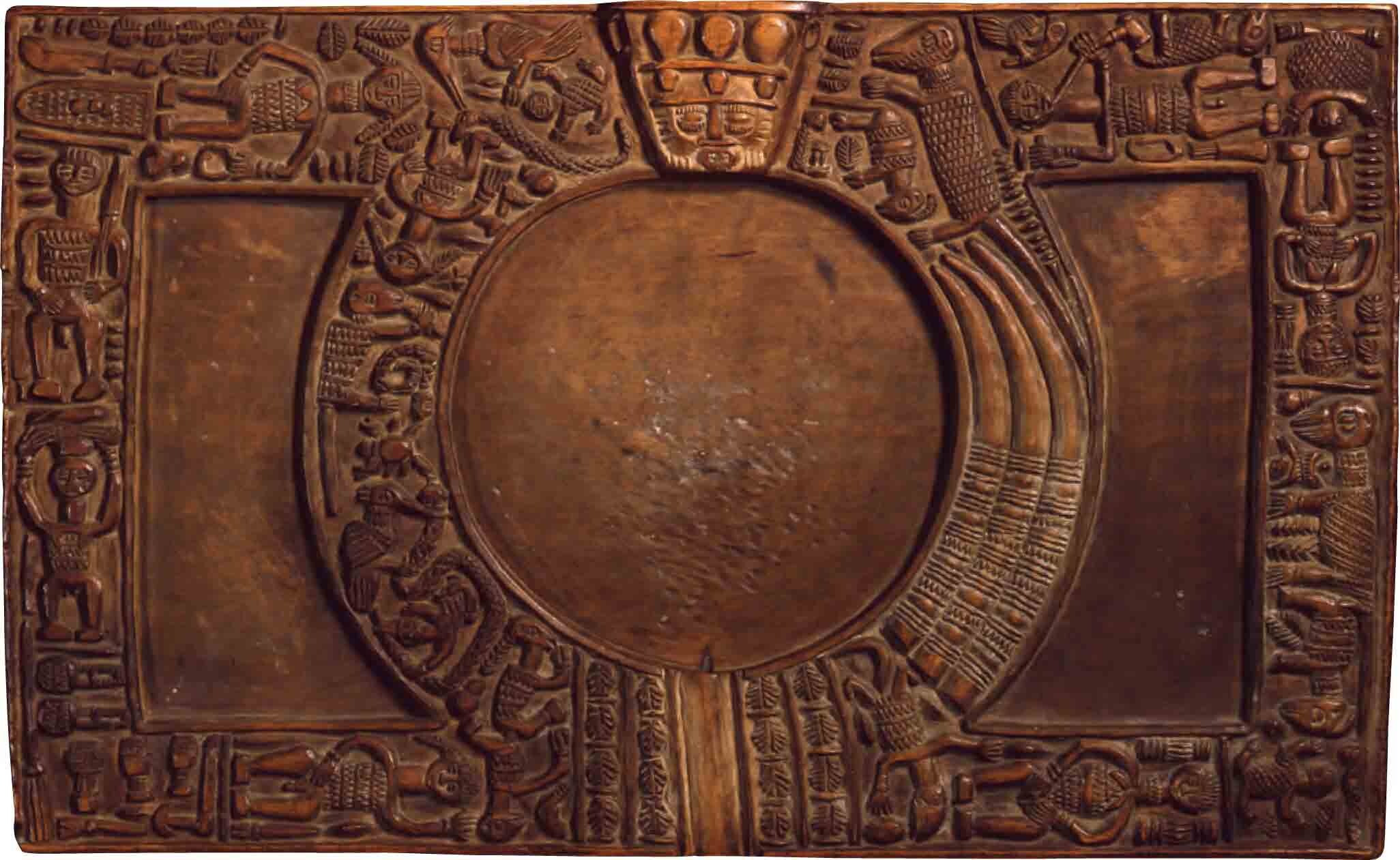
DIVINATION TRAY FROM ALLADA Another item the king of Allada gave to the German trader is clearly tied to the religious practices of the Yoruba (see Chapter 25). This art object is recognizable as a divination tray, or opon ifa (Fig. 49.6), of a type still used in Africa, the Americas, and Europe to determine an individual’s destiny by appealing to Ifa, the spirit of divine order. Self-knowledge is particularly critical for a ruler, and the inventory claims that this carved wooden tray was actually used by the king of Allada. It may document the spread of religious beliefs from Yoruba city-states to kingdoms such as Allada, but it may also show that aspects of these ancient religious practices were shared by populations throughout a wide geographical region.
More information
The tray has a border in carved relief and a circular area in the middle, also defined by a relief border. The relief contains images of a deity’s head, and many smaller images of human beings and animals.
At the top of the tray, in the very center, is a bearded face, shown frontally and wearing some form of hat or hairstyle that incorporates three narrow gourds. Known as Elegba or Eshu, the only deity (orisha) who appears regularly in Yoruba art, this supernatural being embodies disorder and confusion, the conditions that required the king to consult a diviner. The diviner tossed the hard fruit of a palm tree into the tray’s smooth center, noting the results of each roll in a series of marks. The marks referred the diviner to a proverb from an extensive body of oral literature he had memorized, and that proverb suggested the possible courses of action the king might take. The animals and figures along the edges of the tray brought the experiences of the wider world into the consultation, providing the diviner and king with talking points about past and future situations.
The seventeenth-century European buyer described this tray as an implement used in satanic rituals: “an offering plate carved with sublime, wonderfully rare and abominable pictures of devils which the King … uses in sacrifices to their gods or fetishes.” His conflicted views about African lands he had never visited are evident in the contradictory terms “sublime” and “abominable.” Historians argue that such ambivalence was typical of European attitudes in the seventeenth and eighteenth centuries, when any admiration that authors might have felt for Africans was diluted, or even suppressed, due to European entanglements with the transatlantic trade in enslaved people.
Glossary
- fetish
- a European term for a human-made substitute for God; used inaccurately to refer to objects related to African religious practices or beliefs.
- incised
- cut or engraved.
- embroidery
- decorative stitching usually made with colored thread on woven textile.