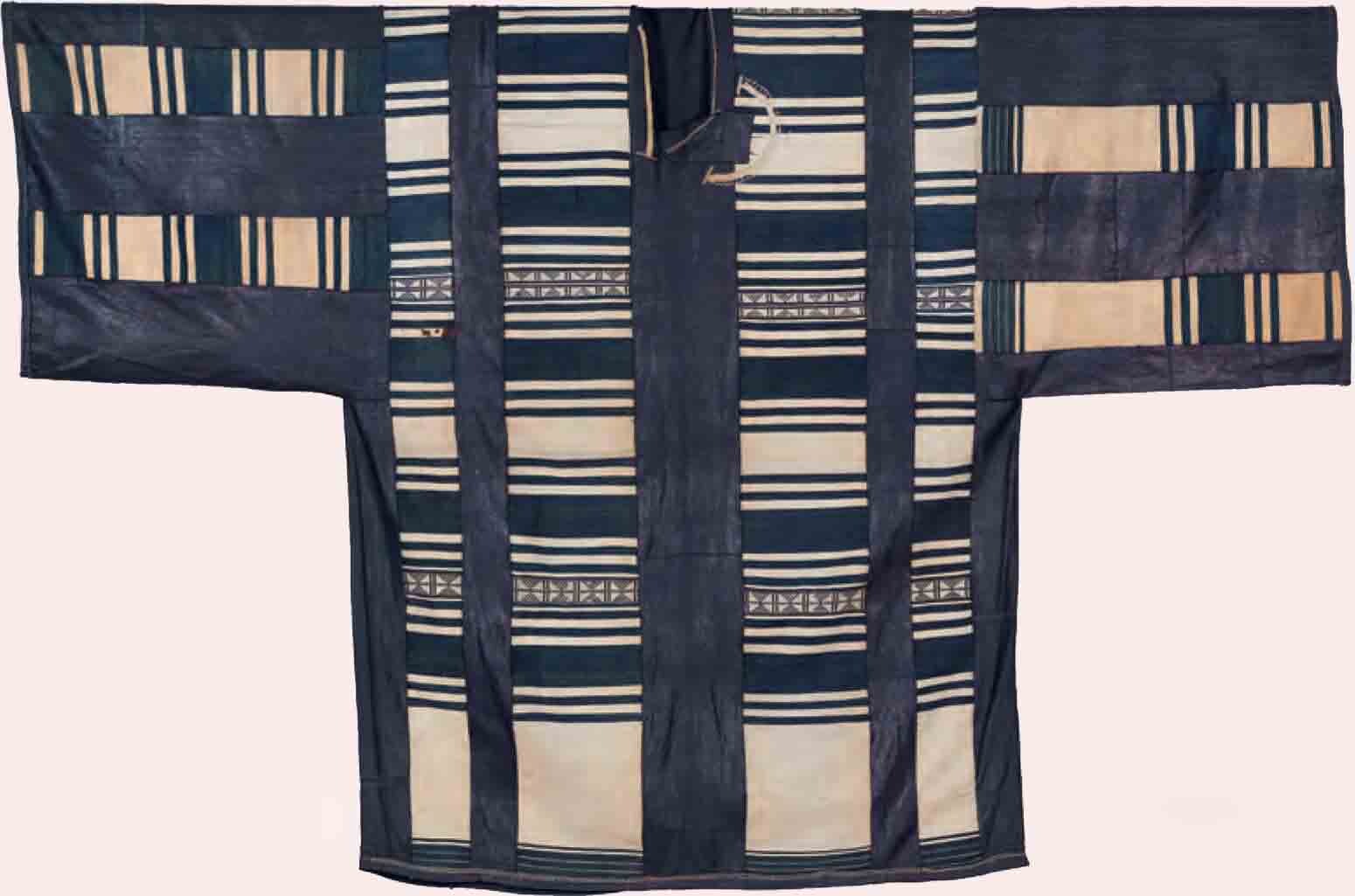
Evaluating the formal elements of an item of clothing requires us to consider its visual context, just as an analysis of a theatrical costume’s design requires us to consider the performance in which it appears. What can we see in this royal robe (Fig. 49.5), woven sometime before 1659? The answer depends on the context in which we view it. For example, if a museum chose to hang this textile on the wall as a two-dimensional example of fiber art, we might evaluate its varied geometric shapes and the contrasts of light and dark. We could describe its composition, its strong, vibrant rhythm as the eye moves across the surface from top to bottom, and from side to side. We could note the use of the parallel bars of indigo to unify the piece, and we could point to the variety provided by the discrete rows of triangular patterns across the top left shoulder and in two bands across the center. We would describe the design as asymmetrical, for it balances smaller narrow shapes at the top with larger shapes at the bottom, and longer shapes on one side with shorter segments on the other; it is not the same on both sides.
Alternately, if the museum were to display the robe on a mannequin, it would invite viewers to consider the robe as dress or apparel—as an object designed to be worn on the human body and to be seen in movement. The lines and form would shift as the wearer walks, dances, stands, or sits. In its original context, the robe would have been part of a larger visual ensemble composed of the ruler’s additional garments, headgear, footwear, and jewelry, all seen in juxtaposition with the many items of clothing and adornment worn by courtiers, attendants, and visitors, which would in turn have been situated against the architectural backdrop of the palace. In addition, the sunlight that originally illuminated the robe might be very different from the low lighting of a museum display.
More information
The robe has broad blue-black stripes down the torso and along the sleeves. Between these stripes is a dark-on-white pattern of stripes running at right angles to the large stripes.