Asante
Art and Conflict: Asante and the Bidjogo
The kingdom of Asante developed later than the kingdoms of Kongo, Benin, and the Kuba. This centralized state, one of the many kingdoms of the Akan, did not gain ascendancy over its neighbors until around 1700, two centuries after rival Akan kingdoms had established mutually advantageous trading relationships with the Europeans who lodged in the fortresses along the coasts of what is now Ghana. In 1717, a pirate ship capsized off the coast of Massachusetts, and twentieth-century salvage crews discovered that it had been transporting Akan beads and pendants cast in gold. The golden jewelry proved that Akan kingdoms sold gold as well as captives to the traders of enslaved people who sailed to and from the Americas during Asante’s wars with its neighbors.
Osei Tutu
Asantehene
Sika Dwa Kofi
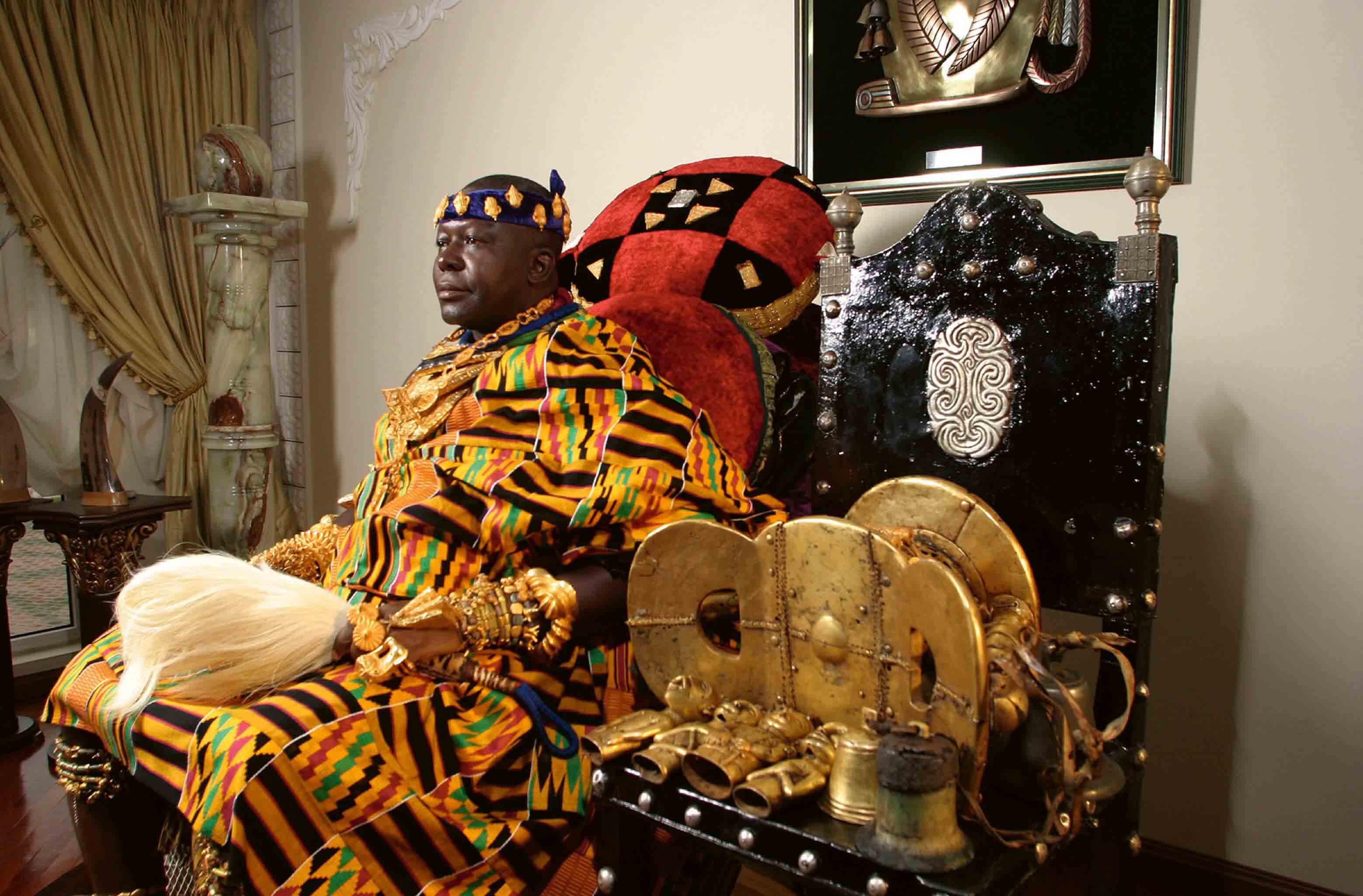
SIKA DWA KOFI OF THE ASANTE The victory of Asante over its rivals is embodied in a sacred object that appeared during the reign of Osei Tutu I (ruled c. 1675–c. 1717) and that is still displayed by Asantehene (or king of Asante), Osei Tutu II, who began his rule in 1999 (Fig. 49.14). According to legend, the high priest of the Asante state assembled all of the region’s kings and elders. In what was believed to be a dramatic miracle, a throne made of solid gold descended from heaven and came to rest on the knees of the Asantehene. It was named Sika Dwa Kofi, literally “gold throne (or ancestral treasure) born on a Friday.” The priest asked all of the assembled leaders to swear their allegiance to this powerful emblem, which would then hold the spirits of their combined royal ancestors.
More information
The king sits on his throne, dressed in brightly-colored kente cloth. To his left, on a throne of its own, sits a large gold object that looks like a handled stool turned on its side. A row of four human figures is attached to one edge of the chair. These figures are arrayed in front of the throne as it lies.
Sika Dwa Kofi is a golden version of the personal thrones made of wood upon which Akan leaders and elders were seated in the eighteenth century. A cylindrical column connects its round base to a curved oval seat. Sika Dwa Kofi is also an ancestral altar, the solid gold equivalent of wooden thrones that were, and still are, turned on their side during their owners’ funerals and blackened with soot and layers of blood and other sacrificial materials. Dangling from golden strips are four partial figures cast in gold that represent defeated opponents. In a photographic portrait of Asantehene Osei Tutu II (see Fig. 49.14), Sika Dwa Kofi rests on its side, the seat facing outward, and is placed beside the king. Sika Dwa Kofi sits on an ornate chair that serves as its own throne.
kente
In this portrait, the Asantehene wears a voluminous robe known as kente. Made for him in the town of Bonwire, it was sewn from long strips of cloth handwoven on a narrow loom. Around 1700, Osei Tutu I would have worn robes woven of cotton, but by the middle of the eighteenth century, Asante weavers were unraveling imported silk cloth to use the bright fibers in their own creations. Unfortunately, no examples of kente from the 1700s or early 1800s seem to have survived.
ASANTE GOLD JEWELRY OF KOFI KATAKARI An early nineteenth-century trader to the Asante capital, the city of Kumase, sketched his impressions of the patterns ornamenting the town’s elegant houses, palaces, and shrines, as well as the processions that brought royal musicians and the richly attired elite through the city’s broad streets. He was dazzled by the gold jewelry worn by Asante men and women, and the Asantehene gave him a few small golden pendants during his stay.
akrafokonmu
adinkra
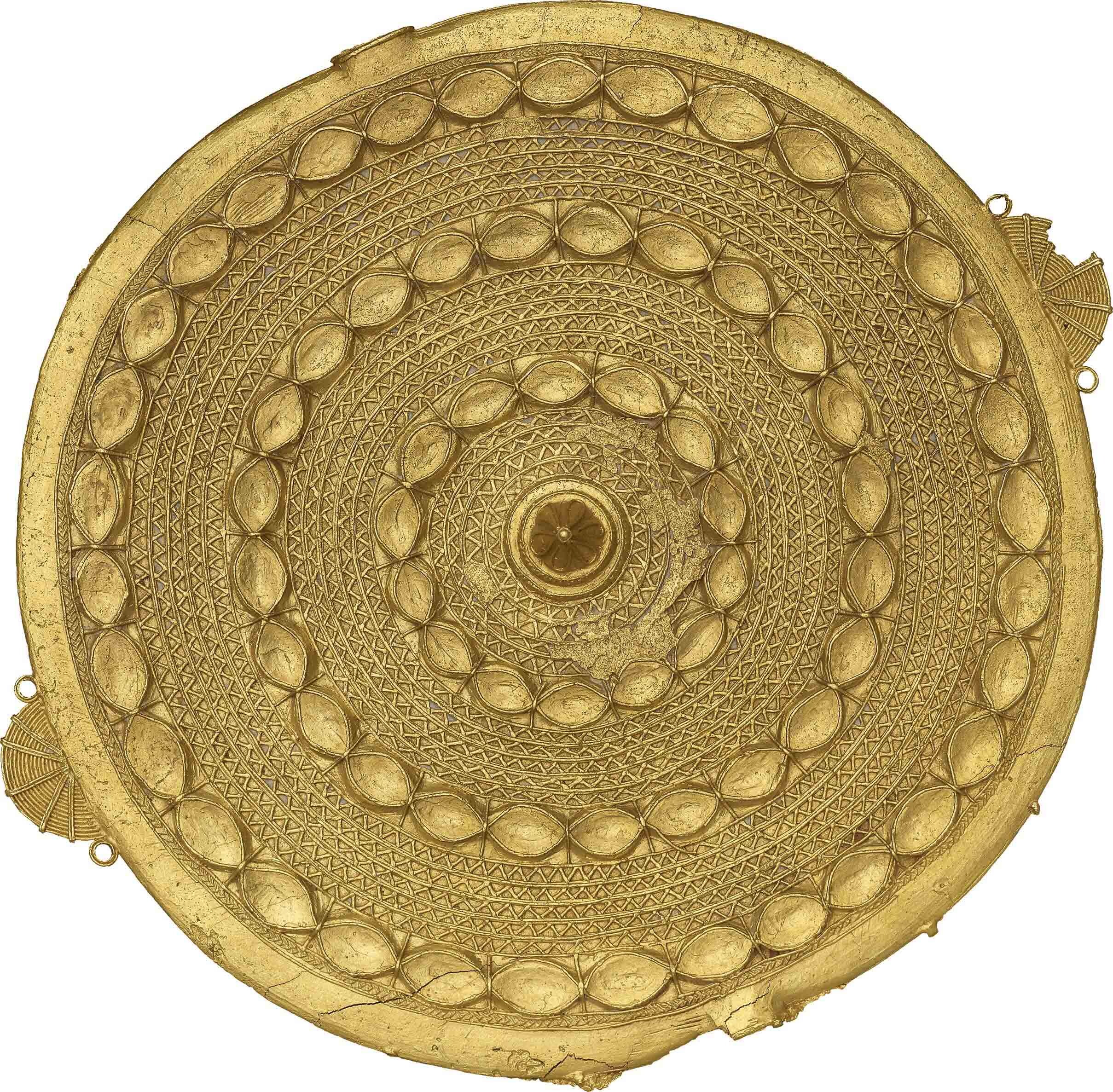
The golden emblems that were commissioned before 1874 by Asantehene Kofi Katakari are more substantial. Each of his large gold disks (Fig. 49.15) has a unique pattern of concentric rings in high and low relief. Their size, shape, and delicate designs seem to have been inspired by similar gold disks made much further north in Mali and Senegal, in regions linked to Asante by active trade routes. This large disk, called akrafokonmu or the soul of the ruler, was made to be displayed on the chest of an attendant, attracting and deflecting the jealous glances that might harm the king. In the Akan designs called adinkra, which appear on cloth, in architectural reliefs, and in other forms of visual language, various circular motifs symbolize the presence of God in heaven, suggesting that there is an element of divine protection in this gold disk. The adinkra sign for leadership and greatness is formed of three concentric circles, and is an abbreviated image of this akrafokonmu.
More information
The pendant, with its three concentric circles, looks like a round, flat shell, or a round, braided rug.
Bidjogo
orebok
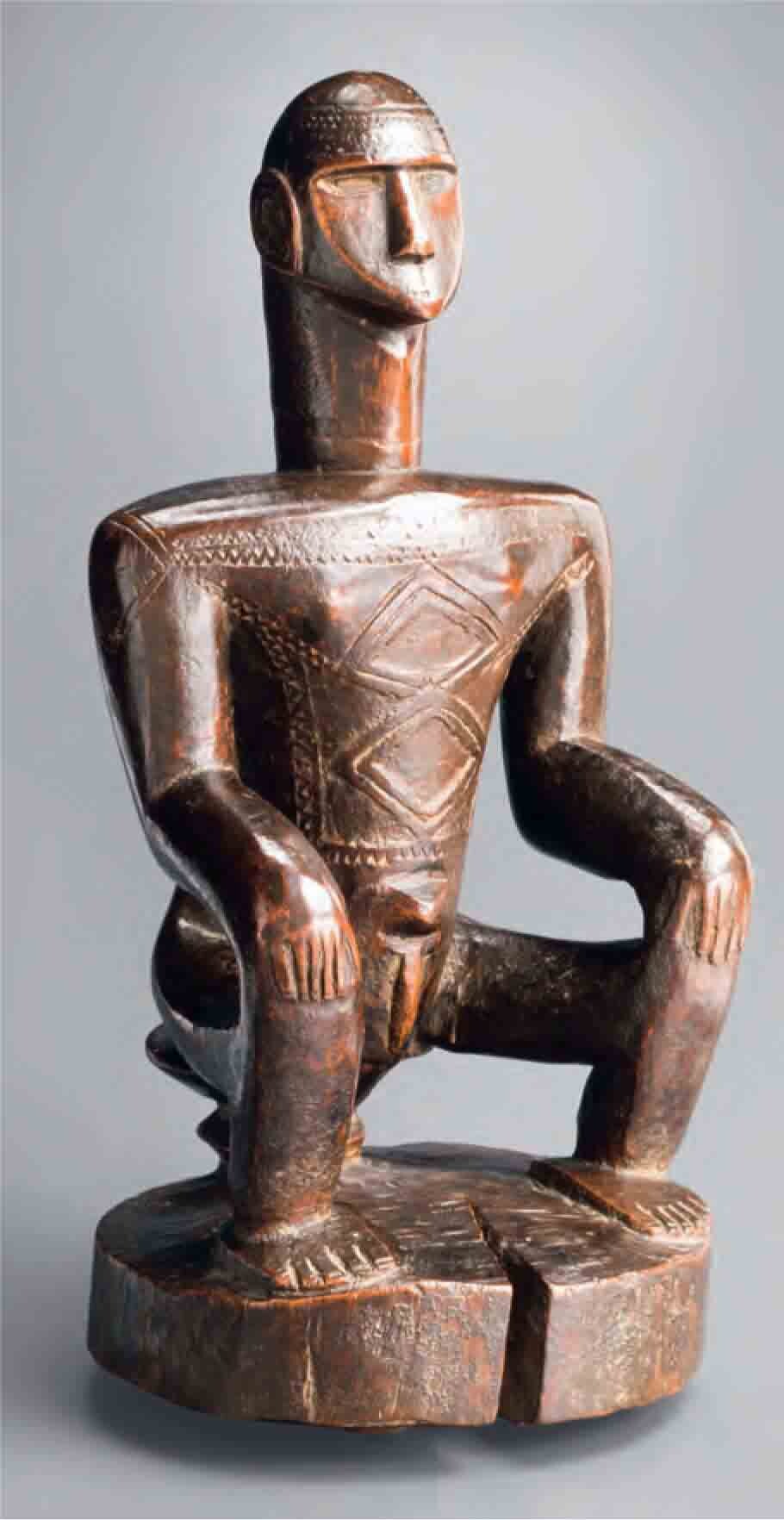
STATUE FROM A BIDJOGO SHRINE Another nineteenth-century art object connected to ancestors and to divine protection (Fig. 49.16) was created by a Bidjogo sculptor in the Bissagos Islands, off the coast of what is now Guinea Bissau. The equivalent of one of the brass heads of Benin City, or the Kuba ndop, this wooden figure commemorated a royal ancestor. Originally housed in a shrine maintained by a female delegate of the king who ruled the island of Caravela, the statue honored a royal ancestor who had served the sacred forces honored by the shrine, conceptualized as orebok. As was the case for the altars in the palace of the Oba of Benin, the entire installation, rather than the statue itself, provided religious sustenance for the island. Like the Kuba ndop, the figure was a valued reminder of a heroic leader, even though the statue is so abstracted that the ancestor’s strength of character took precedence over physical appearance. The figure’s broad chest and seated pose convey his authority, while the scarification patterns emphasize the strong lines of his forehead and torso.
The king depicted here would once have led war canoes through the swift ocean currents separating the Bissagos Islands from the mainland, and it was an act of war that later took the statue from its shrine. In 1845, the French government had set up an military outpost on the island of Gorée, near Dakar, Senegal. Its ships patrolled the coast, controlling trade routes and demanding supplies of food and water from local communities. When the inhabitants of Caravela attacked one of these patrols and drove it away, the French commander at Gorée organized a retaliatory raid. In 1853, he destroyed the island community, seized this statue from its shrine, and took it home to France.
The Bissagos orebok statue may have been the first African artwork to be seized by a European military force, but it was not the last. In 1874, a British army conquered Kumase, detonated the stone palace of Kofi Katakari, and demanded that the Asantehene surrender his ancestral gold. Twenty-six years later, when a British official demanded that Sika Dwa Kofi be brought to him so that he could sit on it, the Asante rebelled, and hid the throne for decades. By 1894, the French had conquered the kingdom of Dahomey and shipped the contents of the royal treasuries and shrines back to Paris for display (see Seeing Connections: Art and War), and in 1906, German colonial officers led a military force that conquered Karagwe and carried off the iron regalia belonging to King Rumanika I. But the most spectacular collection of booty was seized by the expeditionary force mounted by the British to invade Benin City in 1897. The thousands of artworks they found in the palace of the Oba of Benin include the five treasured objects described in this chapter. Unlike the artworks from Kongo and Allada, which were given as gifts or exchanged for protection or trade goods, the ancestral treasures of Asante, Karagwe, Benin, and the Bissagos Islands were not part of the global economic trade in goods and enslaved people that persisted until the beginning of the nineteenth century. Instead, they were taken by the soldiers who were dividing the African continent into colonies that would be ruled by European nations until the 1960s. The current status of Africa’s ancestral arts is now being reassessed in the context of the postcolonial world.
More information
The figure sits in a squatting position, hands on knees. His head, rising on a long neck above square, broad shoulders, gives an impression of authority. The chest is decorated with an incised geometric pattern.
Glossary
- low relief
- (also called bas-relief) raised forms that project only slightly from a flat background.