Aotearoa
Polynesia
The islands of Polynesia lie primarily within the immense region of ocean called the “Polynesian Triangle.” Its corners lie at Aotearoa (New Zealand), Hawai‘i, and Rapa Nui (Easter Island) in the central and eastern Pacific (see Map 52.1). All Polynesian groups (and those in much of Micronesia and some portions of Melanesia) are descended from a single ancestral culture, known as Lapita (see Chapter 7), the cultural and artistic influences of which endure among the many societies descended from it.
In Polynesia, the thirteenth through the eighteenth centuries brought the flowering, or maturity, of many of the region’s most iconic art traditions. By 1400 the Polynesians had lived in the archipelagos of Samoa, Tonga, and Fiji in western Polynesia for more than two millennia. By contrast, the first Polynesian settlers did not reach the islands of central and eastern Polynesia until roughly 1000 CE, and they made their initial landfalls on some islands as late as 1300. Hence, by the time the first Westerners arrived in the region, some of central and eastern Polynesia’s rich diversity of regional artistic traditions, though of ancient ancestry, were less than five hundred years old.
Like the Melanesians and Micronesians, Polynesians are agriculturalists who live in permanent settlements. In pre-contact times, the largest of the settlements might have had a population of many hundred people. Most Polynesian societies were ruled by hereditary chiefs, and in many Polynesian cultures today, chiefs maintain considerable political and social influence. The authority of these chiefs varied greatly, from individuals who governed a single village or small group of communities to those whose power extended over whole islands or archipelagos. As in Micronesia, the most powerful chiefs could command vast amounts of labor and resources, enabling the construction of monumental art and architecture, such as the imposing figures and temple platforms of Rapa Nui (from the thirteenth to early seventeenth centuries) and the stone-built temples of Hawai‘i (from c. 1400 to the early nineteenth century).
mana
A central element in Polynesian arts and cultures is the concept of mana. Ultimately of divine origin, mana is thought to be manifest in gods and other supernatural beings, but it can also be present in humans, places, structures, and manufactured or natural objects. In Polynesian cosmologies, chiefs were believed to be more directly descended from the gods than the general population and thus to have inherited more mana, giving them divine authority over the people. Objects worn or used by chiefs or religious specialists, such as personal ornaments, garments, and weapons, became imbued with mana, making them supernaturally powerful. Nearly all Polynesian sculpture consists of sacred images in human or other forms, which served as supernatural vessels into which the mana of the beings they represented was summoned during religious rites. After the being left the image, a portion of its mana remained within it, rendering it powerful and sacred.
ahu
moai
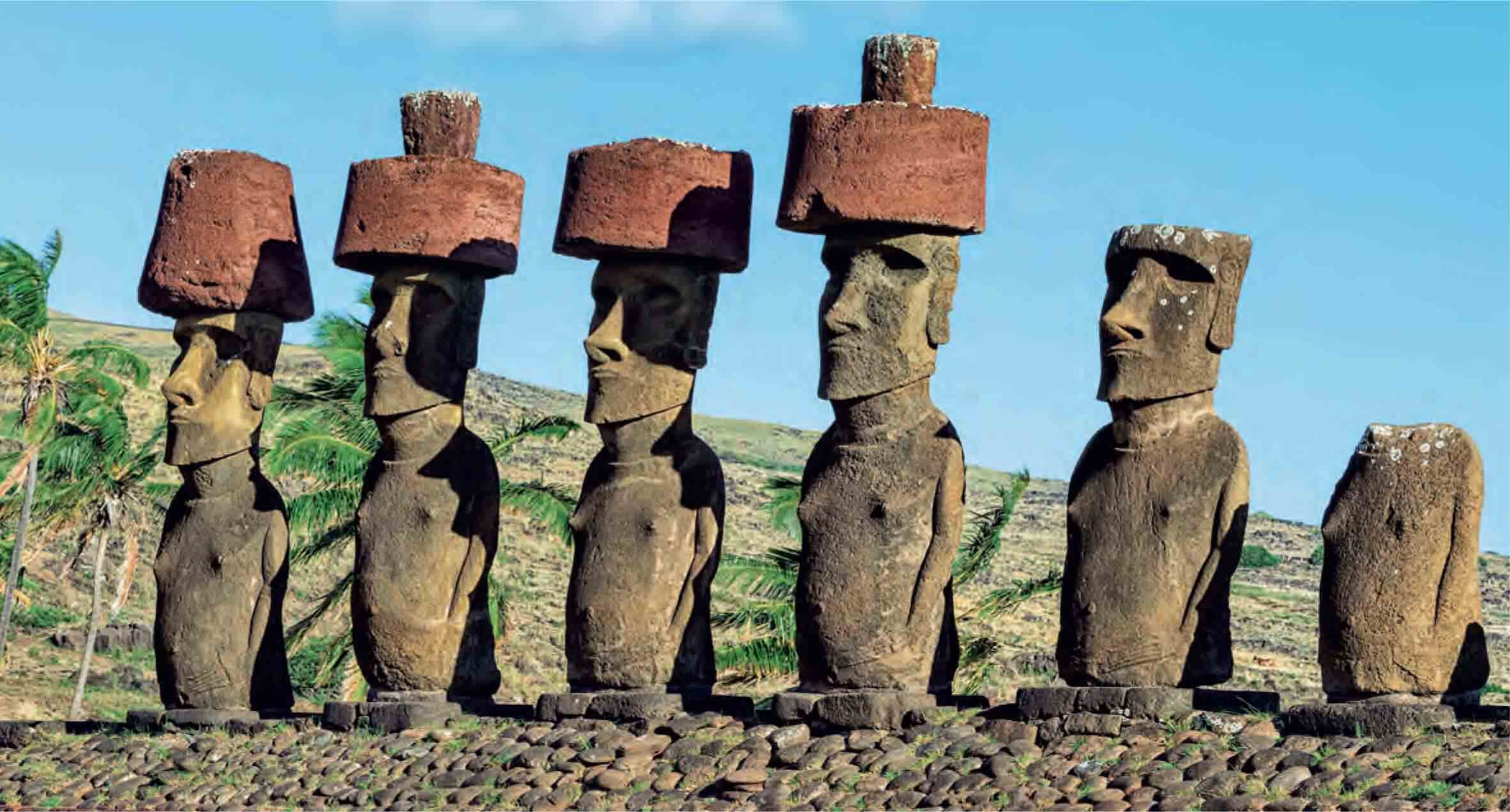
MOAI The creation of the most famous and recognizable of all Oceanic sculptures, the towering stone figures of Easter Island, now known by the Polynesian name Rapa Nui (Fig. 52.9), had reached its apogee by the fourteenth century. First made as early as c. 1200, these stone figures, known as moai, represented ancestral chiefs whose powers were thought to sustain and protect their descendants and their communities. Every sizable Rapa Nui community erected massive moai—symbolizing the power of their particular ancestral chiefs—on a long, rectangular temple platform, or ahu. Most ahu were located near the coast and built parallel to the seashore, with the moai positioned facing inland to watch over their descendants.
PANORAMA: 360Cities: Ahu Akivi, Rapa Nui
VIDEO: Subtractive SculptureShow VideoHide Video
According to surviving historical accounts, a single master sculptor was responsible for the creation of each moai, which a team of sculptors carved under his supervision. Approximately 95 percent of the more than one thousand known moai were carved at a single quarry on the island, the extinct volcanic crater known as Rano Raraku. Carved with stone tools from tuff, a soft stone made from compressed volcanic ash, the moai range from 8 feet (around 2.5 meters) high to an unfinished figure some 71 feet (more than 21 meters) high. The average moai is a bit more than 13 feet (around 4 meters) high and weighs between 9 and 11 tons. While numerous examples of moai remain at the quarry, upon completion many moai were transported to the coastal villages, probably dragged on wooden rollers or sleds using ropes, although exactly how they were transported is still debated by archaeologists.
More information
The statues are of green-gray stone. The four on the left wear round, generally cylindrical headdresses of red stone. The last statue on the right is headless.
Once at the village, each moai was erected on the ahu. In some instances, the heads of moai were crowned with pukao, massive cylindrical blocks carved from red scoria (another type of soft volcanic rock), probably representing headdresses or hairstyles (see Fig. 52.9). Many moai also have eye sockets, carved to receive separately made eyes fashioned from white coral with pupils made from red scoria. The eyes probably were not left permanently in place but were kept instead by the high priests, who placed them in their sockets only for important religious ceremonies, to awaken the mana of the ancestral chiefs within the images.
The last moai were probably carved in the early seventeenth century, after which the construction of ahu and moai gradually ceased, due, according to some theories, to growing social disruption on the island, caused by overpopulation, famine, and war. While many moai still stood on their ahu when the first European explorers reached Rapa Nui in the eighteenth century, by the middle of the nineteenth century all of them had been toppled from their platforms through warfare or neglect. Archaeological restoration of the ahu began in the mid-twentieth century, and today most moai stand once again as eloquent testimony to the power of Rapa Nui’s chiefs and the skills of its sculptors.
Māori
UENUKU While the stone figures of Rapa Nui are perhaps the most familiar Polynesian art form, the vast majority of Polynesian sculptors worked in wood. Due to the perishability of wood in the moist tropical and subtropical climates of the region, few examples of Polynesian wood sculpture survive from before the eighteenth century. Notable exceptions are a number of early wood carvings from the Māori of Aotearoa (New Zealand). The earliest of these carvings probably date to the fourteenth century, shortly after the initial Polynesian settlement. Primarily recovered from swamps, in which they were submerged to protect them during times of war, many are exceptionally well preserved and offer unique insights into the beginnings of Māori wood sculpture.
Uenuku
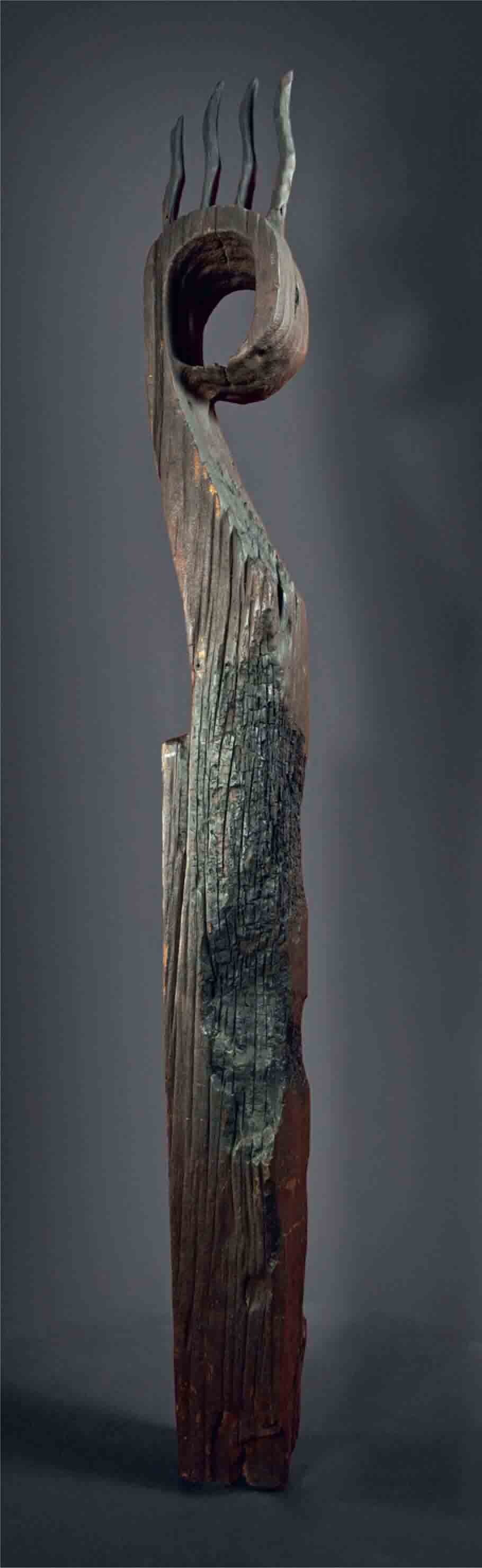
Among the most culturally important of these early Māori wood sculptures is Uenuku, which was probably created between 1200 and 1250 CE (Fig. 52.10). According to tradition, the sculpture was fashioned to contain the mana of the god Uenuku, who is said to have been brought to Aotearoa aboard Tainui, one of the ancestral waka (canoes) on which the first Māori settlers arrived. During the voyage, Uenuku is believed to have occupied a stone from which he was transferred to this carving, which was fashioned from local totara wood shortly after settlement. Today, his mana is said to reside within the curving, circular form at the top of the image.
Like many other early Māori images, Uenuku lacks the intricate surface decoration typical of eighteenth-century and later Māori wood-carving. This lack of ornamentation, along with the spike-like projections on the top that resemble those seen on some Hawaiian wood sculptures, probably reflects the influence of early art traditions from central Polynesia, the ancestral homeland of both Māori and Hawaiians. In addition to his image, Uenuku is believed to manifest himself as a rainbow, and the four projections at the top of the sculpture, together with the three spaces between them, are said to symbolize the rainbow’s seven colors. While his image is now centuries old, Uenuku remains a vital and living presence among contemporary Māori.
More information
The sculpture, of dark wood, consists of a vertical post that at the top curves into a loop, like a lowercase letter p. The loop has four slender, wavy filaments rising up from it that look like hair. The lower part of the carving has been charred by fire.
A’a
Rurutu
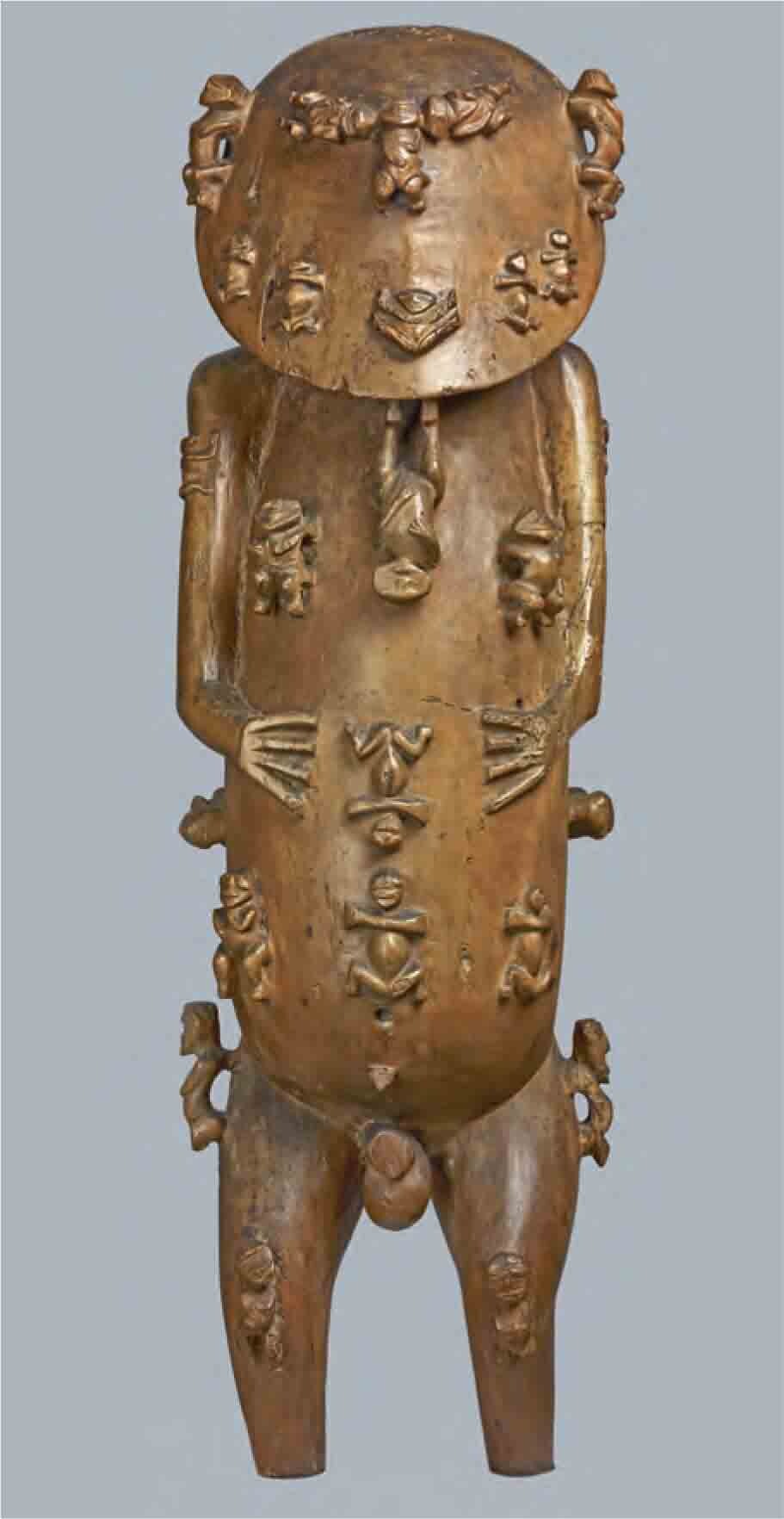
A’A FIGURE A remarkable example of Polynesia’s diverse regional traditions of early wood sculpture is a figure from the island of Rurutu in the Austral Islands (Fig. 52.11), which carbon-14 dating suggests was created between roughly 1590 and 1650. In the 1820s it was presented to the Reverend John Williams of the London Missionary Society, who stated that the figure represented A’a, the national god of Rurutu. However, the precise nature and identity of the being represented by the image are uncertain. Unlike the vast majority of Polynesian images, which are solid wood, the head and body of the A’a figure are hollowed out, and the sculpture is equipped with a removable back panel that allows objects to be placed inside. When presented to Williams, A’a contained twenty-four objects that Williams described as “smaller gods.” These have since become separated from the main figure and, while they may still exist in museum collections, cannot now be reliably identified. However, the size and form of the hollow cavity in the head and torso suggest that this figure was created to contain the skull and bones of a prominent individual, perhaps a founding ancestor of Rurutu who was later deified and venerated through the image.
More information
The figure looks like a naked, pot-bellied man holding his hands against the sides of his stomach. The features on his broad, round face are formed by tiny human figures in various poses. More such figures appear on his legs and torso.
Regardless of its exact identity, this figure, like all Polynesian religious images, served as a vessel into which the mana of the being it represented was summoned during religious ceremonies to be venerated, consulted, and presented with offerings. Carved in the form of a standing male figure with an enlarged head and prominent belly on which the hands of its flexed arms rest—imagery that appears in a variety of sculptural traditions across Polynesia—the figure is distinctive for the numerous smaller human images that make up its facial features and nipples and adorn the front and back sides of its body. The meaning of these features and adornments is unknown, but they suggest associations with human fertility and procreation, perhaps signifying the generations of people descended from the founding ancestor.
Mangaia
MACE GODS While many sacred images took human form, the mana of the diverse gods, ancestors, and other beings venerated by Polynesians also could be manifest in less representational forms, ranging from stylized versions of spears and adzes (axe-like woodcarving tools in which the blade is mounted horizontally, resembling that of a garden hoe) to natural objects such as stones or shells. Some of the most abstract and intriguing of these nonfigurative images are the so-called “mace gods” from the island of Mangaia in the Cook Islands (Fig. 52.12). Carved in the form of wooden clubs that somewhat resemble the European weapons known as maces, mace gods have tapering openwork heads adorned with numerous arching forms that appear geometric, although some scholars suggest they represent stylized human figures with arched backs. Originally, the heads of mace gods were probably adorned with feathers attached with fiber cord.
The central portion of a mace god's shaft is typically wrapped in cord made from finely plaited coconut fiber; this secured upward-pointing bundles of shorter lengths of cord, which may have been tipped with tufts of feathers. In certain examples, such as the one seen here, the lower portion of the shaft is further wrapped in cord made from human hair.
Far from being merely decorative, the feathers, coconut fiber, and human-hair cordage may have been the actual source of the mace god’s mana. In many central Polynesian cultures, feathers were believed to be imbued with supernatural power, especially feathers that were red (a sacred color in Polynesia) or yellow. In Tahiti and the Society Islands, red feathers attached to some images were believed to be the source of their supernatural potency, and the feathers were frequently removed in order to deconsecrate the images before they were presented to Christian missionaries. In the Cook Islands, red feathers were the source of the mana for some images from Rarotonga, and traces of feathers remain attached to a number of mace gods and other nonfigurative sacred images from other parts of the archipelago.
Originating from the head, believed to be the most sacred part of the body in all Polynesian cultures, hair was also thought of as a supernaturally powerful substance, and the coils of hair cord wrapped around the base of this mace god endowed it with additional mana. Indeed, the process of wrapping images in cord, accompanied by the appropriate chants and incantations, was a widespread means of literally binding mana into an image in Polynesia, and the fineness and intricacy of the coconut fiber and hair-cord wrapping here strongly suggest this was the intention with this mace god. Thus, the wooden “mace” itself may not have been the most sacred part of the work, but rather an intricately carved wooden core to which more powerful materials were attached.

More information
The mace is generally club-shaped, with a wrapped handle. The head is formed of wooden openwork. The pommel below the handle is also of openwork.
tapa
TAPA As in virtually all Pacific Island cultures, artistic activity in Polynesia was customarily gender specific. Arguably the most important women’s art form in Polynesia is the making of barkcloth, often called by one of its Polynesian names, tapa. Tapa is produced from the inner bark of certain tree species, predominantly the paper mulberry. The bark is stripped, soaked, and pounded with club-like mallets on long wood (or, more rarely, stone) anvils to form thin, paperlike sheets of cloth. These are then felted (pounded until the fibers at the edges of adjacent pieces intermingle, fusing them together) or glued to one another to create larger cloths, which range in size from small pieces to enormous ceremonial textiles more than 100 yards (around 91 meters) long.
Tapa was the primary form of cloth in Polynesia prior to Western contact. It was created by all Polynesian groups except the Māori in Aotearoa (New Zealand) and the Moriori in Rekohu (the Chatham Islands), where no suitable tree species grew. Essential to both daily and religious life, tapa was used to make everyday clothing and ceremonial garments, to wrap objects, and to create room dividers, wall hangings, and sitting mats, among countless other purposes. In ceremonial contexts, tapa was used to wrap sacred images and form pathways on which chiefs or divine beings traveled, and it was often itself considered to contain, protect, or imbue other objects with mana.
More information
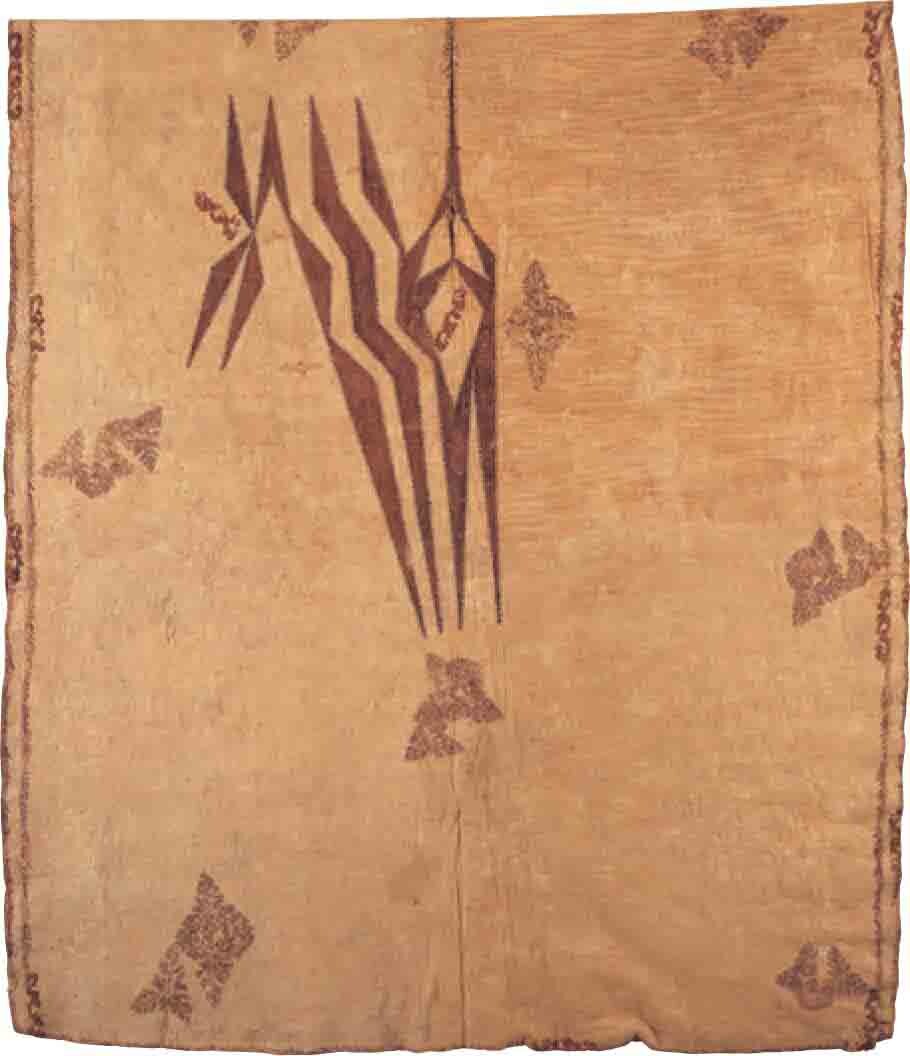
The poncho is has an abstract geometric image on it that from a distance looks somewhat like a zebra facing left.
tiputa
In Tahiti and other areas of the Society Islands, male chiefs often wore tiputa, poncho-like garments made from fine, soft tapa, while women wore shawl-like cloths called ahufara. Often scented with perfume made from sandalwood or aromatic flowers, both types of garments were decorated with painted or printed designs. On the upper center of this tiputa (Fig. 52.13) the artist painted a complex geometric motif, composed of thin triangular elements. A unique feature of the decoration of Society Islands tapa cloths was the use of fern fronds or the stems of club moss, which were dipped in paint and then pressed onto the surface of the cloth, creating delicate foliate designs, examples of which also appear in this work. This process was observed and described by Captain William Bligh (whose crew on the HMS Bounty famously mutinied after leaving Tahiti in 1789). Bligh noted, “They stain [tapa] in a variety of forms, but the prettiest and most natural, as well as the most expeditious, is the impression of a leaf … the underpart of it being wetted with the colour it is laid on the Cloath and with a pat of the hand the impression is complete.” The results are spare and elegant compositions attesting to Polynesian women’s mastery of the textile arts.
‘ahu ‘ula
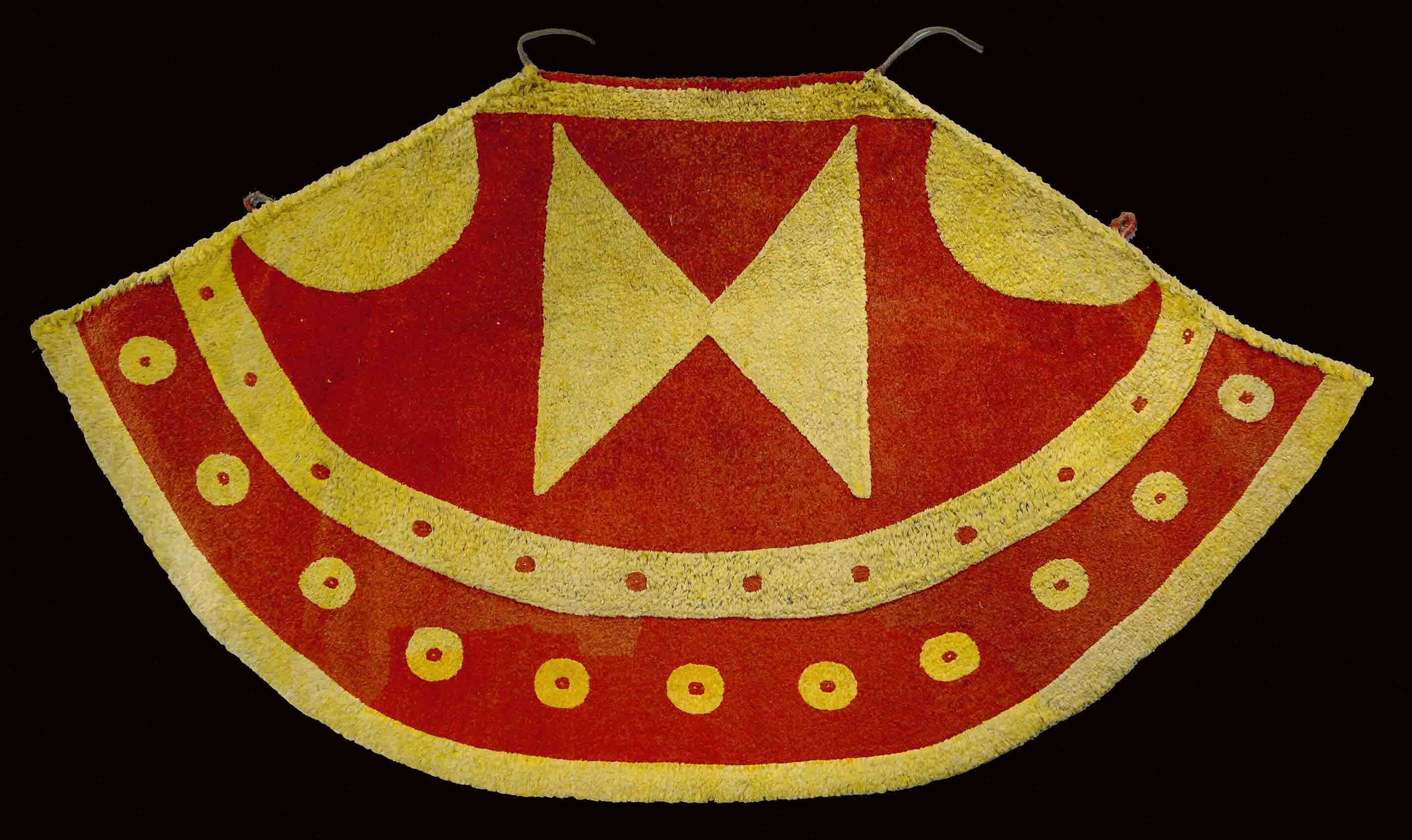
‘AHU‘ULA In addition to the creation of religious images, a major focus of Polynesian art was the production of luxurious forms of clothing and accessories to adorn the bodies and mark the exalted status of the region’s ruling chiefs. Among the most spectacular of these accoutrements were the feather cloaks, known as ‘ahu ‘ula, worn by the ruling chiefs of Hawai‘i (Fig. 52.14). These cloaks were made by male priests, who created a fine, net-like mesh foundation from the fiber of olona, a native Hawaiian plant, to which small bundles of feathers were tied so that they completely covered the mesh beneath. As they wove the mesh, the priests probably chanted, incorporating prayers and sacred incantations permanently into the cloak, enhancing its mana. In many cases, tens of thousands of feathers, requiring the capture of hundreds or even thousands of the comparatively small birds that provided them, were needed to complete a single cloak, making these garments perhaps the ultimate symbol of chiefly sanctity and power. The meaning of the designs on the cloaks, consisting primarily of crescent-shaped, triangular, and circular motifs, as seen in Fig. 52.14, is almost entirely unknown, though it is likely that certain designs or patterns were associated with particular families.
Individual feather cloaks appear to have been made for specific chiefs and, like the crown jewels of European royalty, were passed down to their successors as symbols of their ancestry and right to rule. The chiefs wore the cloaks, sometimes together with feathered helmets, on important ceremonial or dangerous occasions, including in battle. Cloaks captured from defeated enemies were considered among the most prestigious and supernaturally powerful spoils of war.
More information
The white-on-red design features a large bowtie-shaped image in the middle of the back, flanked by two half-disks that would meet over the chest to form a complete disk when the cloak is worn. The hem is decorated with a row of white disks with holes in them.
Kamehameha I
Kūkā‘ilimoku
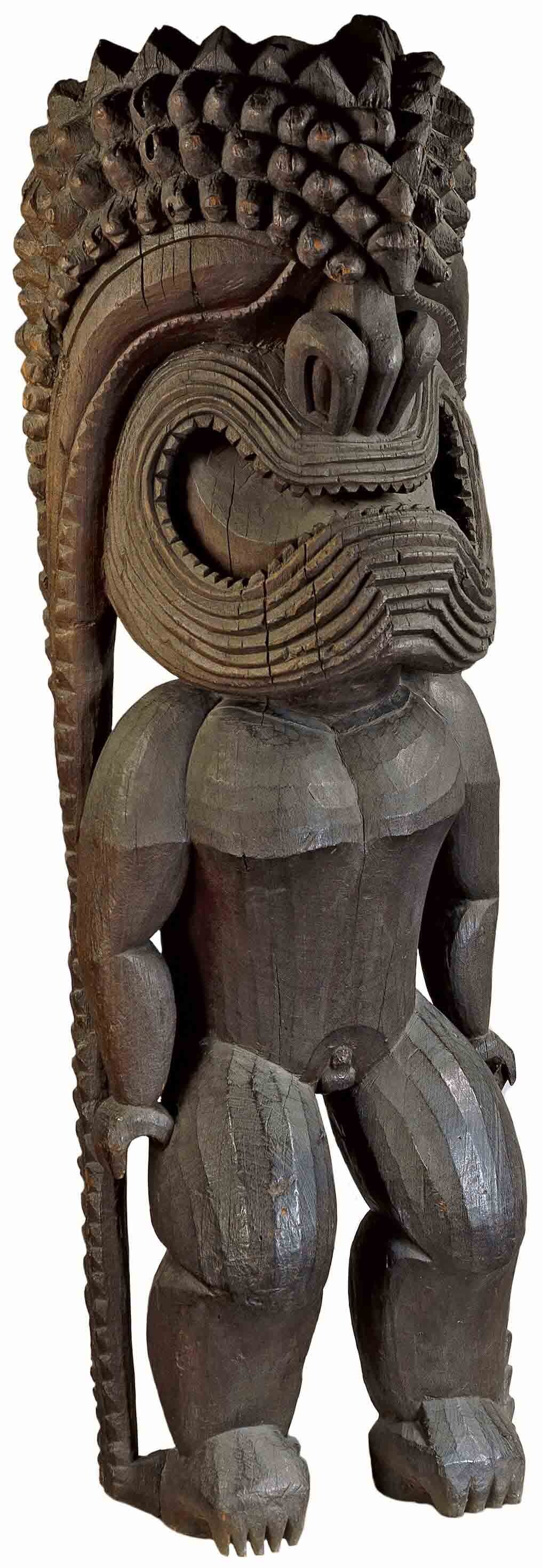
KŪKĀ‘ILIMOKU FIGURE In the closing years of the eighteenth century, the power of Hawaiian chiefs reached its highest point in Kamehameha I, a chief from a high-ranking but junior line of succession who overthrew his more senior relatives and other rival chiefs to become the high chief of the island of Hawai‘i. A brilliant military commander, Kamehameha eventually succeeded in conquering or otherwise bringing under his authority all of the islands of the Hawaiian archipelago, becoming Hawai‘i’s first king in 1810. Reliant on military and political power rather than birthright for his authority, Kamehameha associated himself with a war god, Kūkā‘ilimoku (“Ku the snatcher of islands”), as his patron deity, ultimately establishing him as the principal god of Hawai‘i and building a series of temples to venerate him. Although the sacred precincts of these temples included images of a number of different deities, each temple is thought to have had a central image representing Kūkā‘ilimoku, such as the one illustrated here (Fig. 52.15).
In total, three examples of these temple images, widely believed to represent Kūkā‘ilimoku, survive today. All share the same taut, bent-kneed stance, muscular bodies, and greatly enlarged heads with long, descending tresses of what is usually identified as hair. The eyes, as seen here, often seem to merge into the hair. The nose, with its large, flaring nostrils, and the figure-eight-shaped mouth, with its prominent teeth and jutting chin, dominate the face. Thrusting the chin forward in such a manner was considered a gesture of contempt and disrespect, and the representation of this gesture in the images may reflect Kūkā‘ilimoku’s and Kamehameha’s disdain for their defeated enemies and rivals. The triangular head of an animal, possibly a pig or dog, which were both important sacrificial animals in religious ceremonies, appears at the center of the brow. When standing in the temple, the figure would originally have been clothed with a barkcloth waistcloth (now lost) wrapped around its loins. Embodying the divine and chiefly authority that maintains the fabric of Polynesian societies, and poised as if to spring upon all challengers and rivals, the image of Kuka’ilimoku at once invokes the domineering mana of the powerful war god it represents, as well as the political power of the earthly regime he supported.
More information
The body is like that of a nude human male. The oversized head has lips contorted into a fearsome grin, with the chin thrust forward. The hairdo or headpiece hangs down to the ground in back.
By the 1790s, the first Christian missionaries began to arrive in Polynesia, converting nearly all of its people by the mid-nineteenth century. During the widespread iconoclasm that followed Christian conversion, the vast majority of Polynesian sculpture, which consisted primarily of sacred images depicting gods, ancestors, and other supernatural beings, was destroyed. Ironically, the same missionaries who ordered the destruction of Polynesia’s sacred sculpture were also responsible for preserving most of the examples that remain, which they sent back to their homelands to be kept in missionary, and later museum, collections.
Glossary
- adze
- a carving tool with a horizontal blade that—unlike an ax—allows a sculptor to use downward strokes.
- openwork
- decoration created by holes that pierce through an object.
- barkcloth
- a type of cloth made from the inner bark of certain species of tree, often the paper mulberry; produced almost exclusively by women, it was the primary form of cloth throughout the Pacific Islands before Western contact.
- iconoclasm
- the intentional destruction or rejection of images on religious or political grounds.
- mana
- supernatural power; mana can be manifest in many forms including humans, divine beings, animals, places, and natural or human-made objects.