exemplum virtutis
History Painting and the Academy
Jean-Antoine Houdon was a member of the French Royal Academy, where he received his training and professional credentials. Though commercial galleries and alternative venues for displaying art were becoming more common, art academies held enormous power over the art world in eighteenth-century Europe. They offered training to aspiring artists that was largely based on imitation of Classical models and Renaissance art theory. Academies also held regular exhibitions, often called the Salon after the French term for it, to exhibit works of art to the public, thus conferring professional recognition on its members.
Throughout the eighteenth century, numerous countries across Europe established art academies in their major cities—and in some colonial cities—to train artists and regulate the production of art. Most academies followed the French model by promoting history painting as the most elevated type in the hierarchy of genres because it required not only knowledge of history and literature but also purportedly demanded the intellect and moral sense to interpret them properly. History painting was also considered the most appropriate type of painting for the public, as it had the potential to educate and provide moral examples. Such art was intended to function as an exemplum virtutis, as in the case of Houdon’s George Washington, which provided what was perceived to be a virtuous model of a person that was intended to instruct and inspire viewers.
In practice, both private patrons and the public remained enthusiastic about other types of art, including genre painting and portraiture, which were more emotionally charged and seemed less intellectually demanding than history painting. In response, Academic history painting in the eighteenth century became more innovative, attempting to meet the lofty goals of intellectual and moral instruction while providing emotional drama and contemporary resonance.
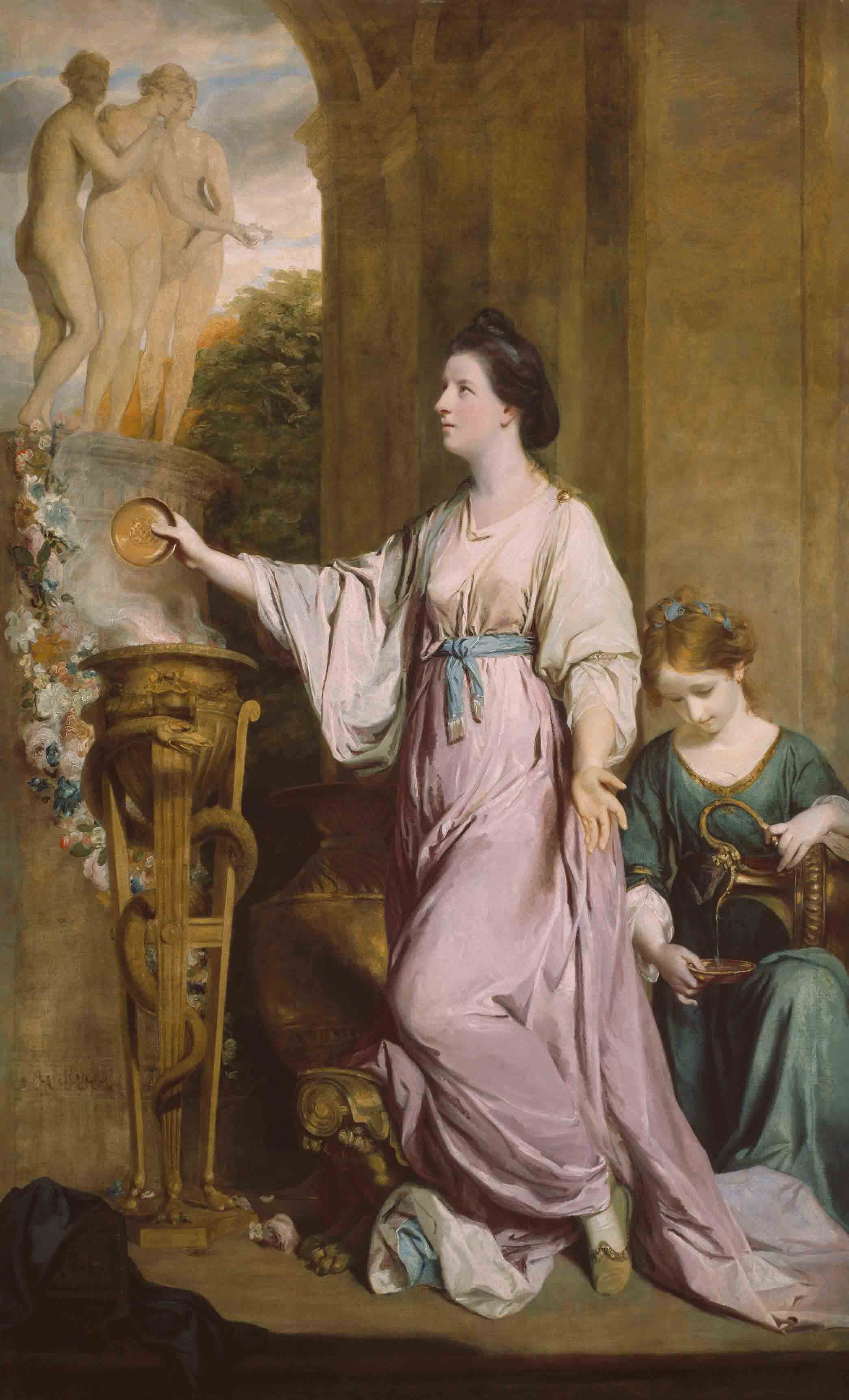
JOSHUA REYNOLDS, LADY SARAH BUNBURY SACRIFICING TO THE GRACES In addition to being the first president of the English Royal Academy, Joshua Reynolds (1723–1792) was one of the foremost portrait painters of his day. His work combined an Academic focus on history, virtue, and the Classical ideal with the modern demand for portraiture. In Lady Sarah Bunbury Sacrificing to the Graces (Fig. 57.9), Reynolds developed a style that became known as the Grand Manner. Grand Manner portraiture flattered the nobility of the sitter and elevated the status of the portrait painter.
More information
The young woman, dressed more or less like an ancient Greek or Roman noblewoman, kneels with one knee on a stool. She has just poured liquid from a shallow dish onto coals burning in a three-legged incense burner, and the steam is rising up as an offering to three goddesses whose statues stand high in the background. Behind the woman, a servant girl pours more sacrificial liquid into another dish, from a large metal jug.
Lady Sarah Lennox (1745–1826) was well known for her beauty, attracting the attention of King George III when she was fifteen and marrying Sir Thomas Charles Bunbury at the age of seventeen to become Lady Sarah Bunbury. Sir Thomas commissioned Reynolds to depict his wife in this portrait shortly after their marriage. The full-length portrait depicts Lady Sarah dressed in a style that seems vaguely reminiscent of the ancient Romans, and paying tribute to a statue of the Three Graces, a trio of Greek mythological goddesses associated with charm, beauty, and creativity who were frequently featured in art. The painting includes many references to ancient Roman culture. The tripod (three-footed) incense burner, stool, large urn, and the ewer (jug) and plates held by Lady Sarah and her youthful attendant are all modeled on specific examples from eighteenth-century books on ancient art and objects. The latter, along with the massive stone arch and Italianate landscape beyond, situate Sarah Bunbury as an honorary citizen of the ancient world, but do so in a distinctly modern way. Her face is painted so white as to appear paler than even the white marble statue she pays tribute to. The slight blush on her cheeks picks up on the colors of her pale white and pink dress to further highlight the whiteness of her skin. Just as Neoclassical sculpture and architecture (such as Figs. 57.3 and 57.6) emphasized the aesthetics of white surfaces, eighteenth-century European portraits communicated contemporary racial ideology that established whiteness as a supposedly superior racial category, in part because of its apparent connection to the venerated ancient civilizations of Greece and Rome.
In keeping with the principles of Neoclassicism, Reynolds did not simply copy ancient art. Rather, he built on existing artistic models to make something new. Reynolds’s inclusion of the Three Graces in this portrait is novel in its focus on the action taking place between Lady Sarah and the statue. Kneeling on one knee, she offers liquid that wafts up to the statue as fragrant steam. The middle Grace in the statue seems to come alive to return the honor, reaching out to offer Lady Sarah a tiny laurel wreath. In this way, Reynolds draws a circular connection between the Graces and Lady Sarah, conferring on his subject the Graces’ charm, beauty, creativity, and imagined racial purity.
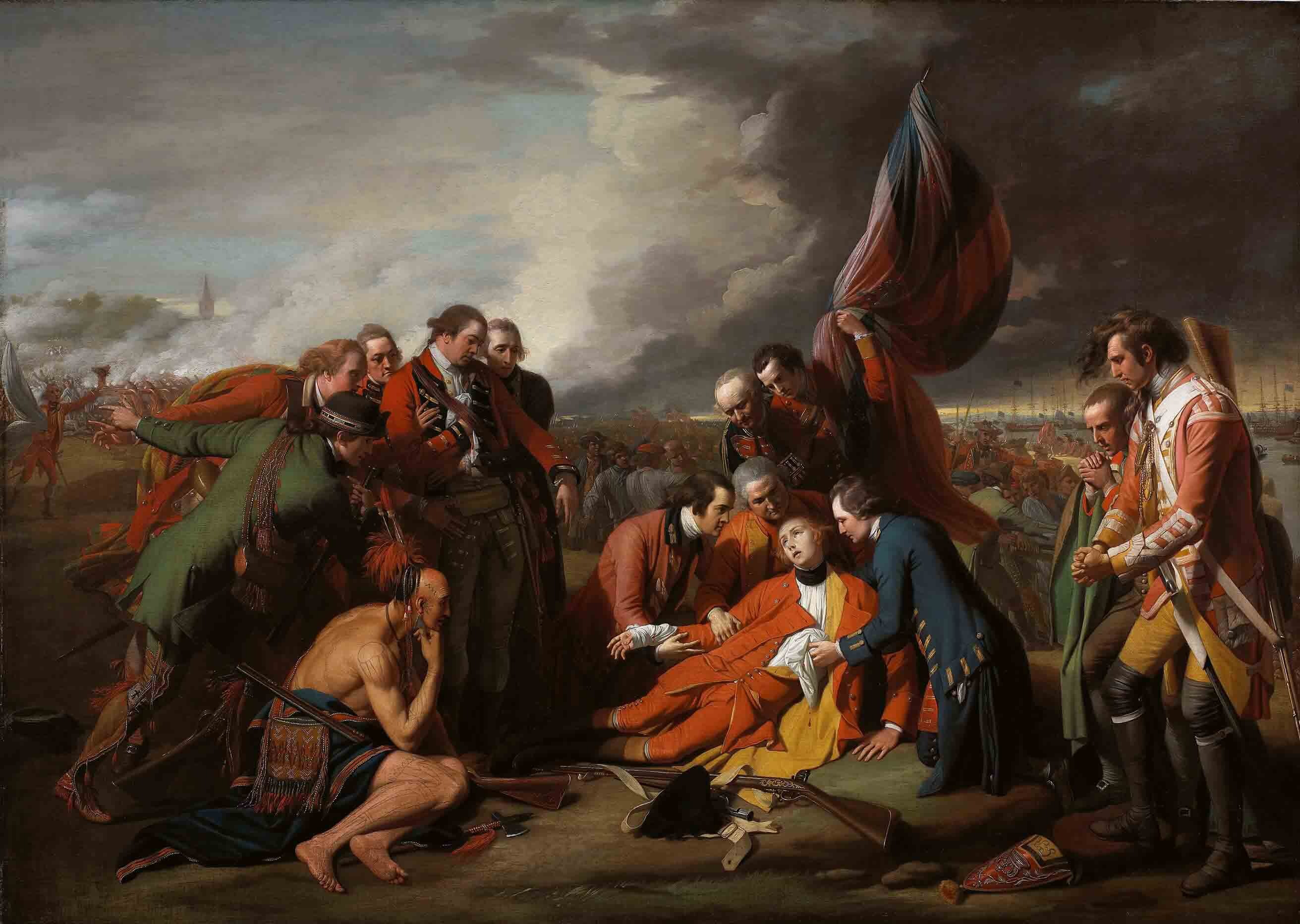
BENJAMIN WEST, THE DEATH OF GENERAL WOLFE The Grand Manner showed that close attention to historical models and traditions could nonetheless be creative. One artist who took a more daring approach was Benjamin West (1738–1820), an American who settled in London in 1763. West submitted The Death of General Wolfe (Fig. 57.10) to the Royal Academy in England for exhibition in 1771. The painting depicts the heroic death of General James Wolfe (1727–1759), who in September 1759 masterminded a risky military strategy to take Quebec from the French. The strategy resulted in both a decisive British victory in the ongoing Seven Years’ War and in Wolfe’s death during the battle.
More information
A general in a red uniform lies mortally wounded. He cannot hold his head up straight. He is surrounded by subordinates who do their best to comfort him. Most of them are also dressed in red, but one soldier, to the far left, wears a green jacket and beaded leather trousers. He and another man, who has a tartan sash over his shoulder, are gesturing, trying to tell the general that the enemy is being routed. Sitting pensively on the ground beside the man in green is an Iroquois warrior with a double-barreled shotgun across his lap.
In creating this contemporary history painting, West made some conventional and unconventional choices. In keeping with the Academic norms of depicting historical events, his interpretation is high on drama and loose with facts. General Wolfe’s actual death was a lonelier and more mundane event than West’s picture of the martyred general on a windswept battlefield, surrounded by senior commanders and loyal subordinates as a figure on the far left rushes in with news of the British victory. Wolfe’s pose and the triangular composition of the central figure group around him mimic that of Christ’s descent from the cross in countless earlier Christian works (see Fig. 40.12), rendering the general a Christlike martyr for a patriotic cause. This dramatic interpretation of Wolfe’s death was an acceptable approach for Academic history painters because it highlighted the moral lesson of the subject and communicated a larger story—the victory of the British at Quebec—in clearer terms than a more strictly truthful image could.
At the same time, West’s painting was revolutionary in several ways. First, in depicting a scene of British martial victory, he chose to represent an actual contemporary event rather than a more conventional subject from ancient history or the Bible, which viewers would be expected to connect metaphorically with contemporary events. Second, just as George Washington would later insist of his portrait sculpture (see Fig. 57.8), West clothed his modern subjects in contemporary dress rather than in the Roman togas and tunics that were thought to lend a timeless, universal effect. Finally, in the left foreground of the picture West included a warrior of the Iroquois Confederacy, a ranger who identified with both Native American and European culture (dressed in green), and next to the ranger a Scottish Highlander (whose tan-red-and-green tartan wraps around his waist and over the shoulder of his British military red coat). The inclusion of these men brings three groups that were central to British victory in North America into this scene of imperial glory. West’s decision to depict these figures in modern dress may seem obvious to viewers today, but it was considered radical at the time. Audiences were unaccustomed to viewing large-scale history paintings depicting resolutely contemporary subjects, and the effect was jarringly realistic. West’s gamble paid off, and the painting and its several copies came to be considered a new model of contemporary history painting.
Angelica Kauffman
Zeuxis
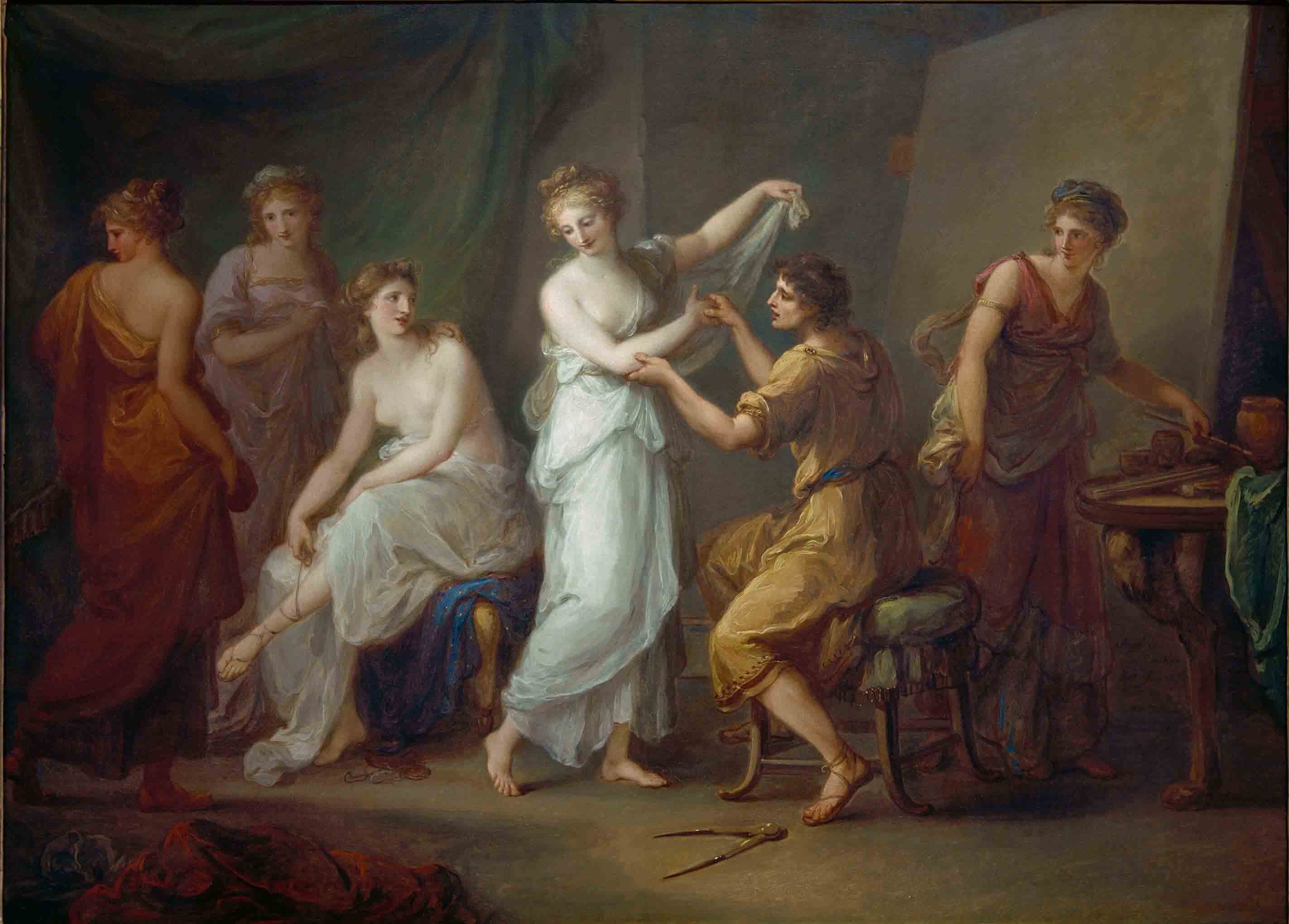
ANGELICA KAUFFMAN, ZEUXIS CHOOSING HIS MODELS FOR HIS PAINTING OF HELEN OF TROY History painting’s elevated status in the hierarchy of genres offered artists the greatest opportunity to attempt major artistic innovations and communicate their ambition to the public. Angelica Kauffman (1741–1807) was a history painter who positioned herself as uniquely qualified to innovate in this genre. Kauffman was born in Switzerland and trained with her father. She began her career in Italy, and she attained membership in the art academies in Florence, Bologna, and Rome before moving in 1766 to England, where she became a founding member of the English Royal Academy in 1768. Kauffman was one of only two women elected to the Royal Academy, where they were nevertheless forbidden from attending life drawing sessions. Likewise, the French Royal Academy in the eighteenth century capped the number of female members to no more than four at a time, and also excluded them from the life drawing studio, which was considered a principal resource for the multifigure compositions that history painters were expected to make. This institutional hostility to female artists makes Kauffman’s status as one of the most successful Academic history painters of the period even more notable. Her Zeuxis Choosing His Models for His Painting of Helen of Troy (Fig. 57.11), which is characteristic of her learned subjects and complex figural arrangements, subtly reconfigures the role of women as subjects and tellers of history.
VIDEO: Angelica Kauffmann: A Pioneering Female ArtistShow VideoHide Video
More information
The seated artist examines the right arm of the model standing in front of him. Three more models wait their turn, each in a different pose. A fifth model, behind the artist, has approached a large, blank canvas and has picked up a brush. She wears a businesslike expression.
The painting tells the story of Greek painter Zeuxis, who sought to portray Helen of Troy as the most beautiful woman in the world by choosing individual attributes from five different models to combine into an ideal image of female beauty. Kauffman shows Zeuxis examining one of his models. Her stance is based on the Roman statue Venus Kallipygos of the first century BCE. Three other models line up to prepare for the artist’s inspection, showing their bodies from the back, front, and side to reveal their component parts. The fifth model, however, defies this familiar pictorial convention. Stepping behind Zeuxis, she picks up his brush and moves toward the empty canvas. Here, the model becomes the maker, a sly reference to Kauffman’s own status as a female painter of history. The point is made more concrete by the inclusion, on the lower right corner of the blank canvas between her leg and the table leg, of the artist’s signature: Angelica Kauffman pinx (“painted by Angelica Kauffman”). In Zeuxis and numerous other works, Kauffman depicted women as active subjects of history. In this work she goes a step further, showing a woman as also a teller and indeed maker of history and using the Neoclassical style and Academic traditions to revise conventional notions of women’s place in professional artistic practice.
Jacques-Louis David
The Oath of the Horatii
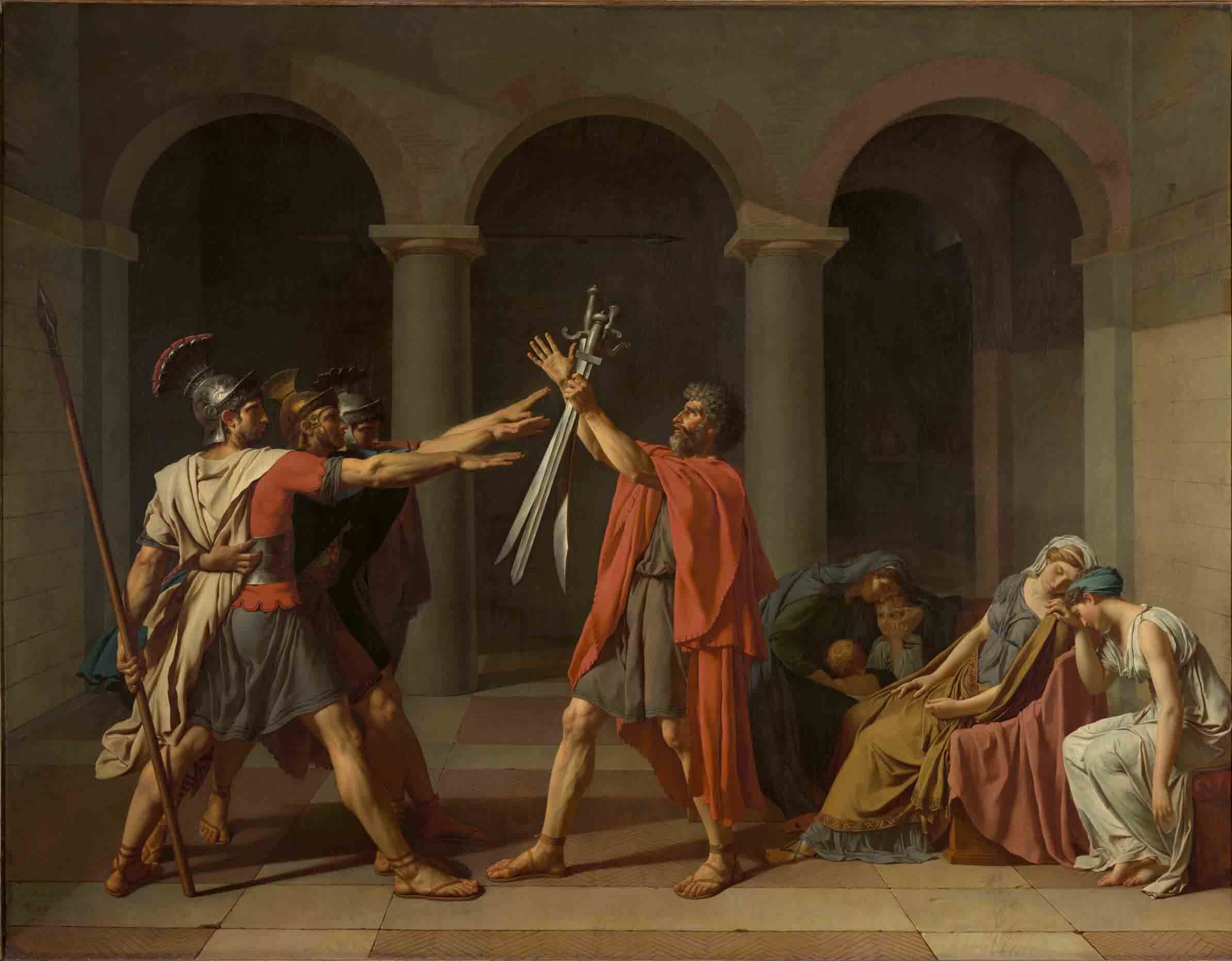
JACQUES-LOUIS DAVID, THE OATH OF THE HORATII The use of Academic tradition to innovate was grandly achieved by one of the most ambitious painters of the late eighteenth century, French artist Jacques-Louis David (1748–1825). During his long career, David consistently adapted his art to speak to the changing social and political climate of the time. David’s The Oath of the Horatii (Fig. 57.12) is a high point of the Academic approach to history painting, brilliantly articulating its intellectual, artistic, and social goals.
More information
In the center, a middle-aged man holds three swords high and looks heavenward. To his left, three younger, helmeted men strike the same pose, with the right hand and leg forward, toward the swords, and the left leg back. On the right, women and children huddle in distress.
The Oath of the Horatii depicts a story based on Roman historian Livy’s account of the war between Rome and the neighboring town of Alba Longa in the seventh century BCE. After years of war, the two sides agreed to settle the conflict with a battle to the death between three sons from each town: the Horatii from Rome and the Curiatii from Alba. David studied Livy and others’ subsequent accounts, but he invented this particular moment, in which the Horatii brothers receive their swords from their father and take an oath to defend the honor of Rome. In this way, David’s work satisfies the goals of eighteenth-century Academic history painting, which depended on both a scholarly knowledge of ancient history and the creative capacity to translate that knowledge into a convincing picture that brings the story alive for viewers.
Artistically, The Oath of the Horatii deftly synthesizes the pictorial aims of both Neoclassicism and Academic art theory. David painted the work while living in Rome, and the composition and attention to the human figure were based on his study of ancient Greek and Roman art. Following French Academic convention, David placed a distinct emphasis on vigorous and clear lines as the primary expressive vehicle of the work. The colors are muted, with vivid red used as punctuation in the main active figures, who are lit by a strong side light. The detailed articulation of the men’s musculature and the forms of their bodies, visible even through the surface of their clothes, demonstrates David’s skill with the Academic focus on the human figure. Compositionally, the painting is rigorously ordered, with a focal point directly at the father’s hand grasping the swords. The scene takes place in a shallow foreground on a grid-like pavement delineating three parts. The repetition of threes in the arches in the background, the brothers, their swords, and the three women to the right, along with multiple triangular forms within those figure groups, create a sense of solidity and rationality.
At the same time, the work is firmly binary. The rigid, angular poses of the stoic men on the left are diametrically opposed to the curving, collapsing poses of the emotional women and child on the right. The woman dressed in white is Sabina, sister of the Curiatii and married to one of the Horatii brothers. She rests her head in a mournful pose on the chair of Camilla, a sister of the Horatii who is engaged to one of the Curiatii and who tilts her head down in sympathy and sorrow. No matter what the outcome of the battle, these women will lose their partner, their brother, or both. In the end, as the story goes, when the remaining Horatii brother returns home victorious, he finds his sister Camilla weeping over the death of her fiancé and murders her on the spot for placing her own feelings above the glory of Rome.
By using ancient Roman history to tell a story of patriotism and its personal cost, David provided both intellectual and moral instruction to viewers, who enthusiastically praised this work when it was exhibited at the Paris Salon in 1785. Though the work was commissioned by Louis XVI, The Oath of the Horatii seemed to offer a model of selfless patriotism at a moment when public outrage over the excesses of the French aristocracy in the face of national bankruptcy was growing—an outrage that would reach breaking-point in just five years with the start of the French Revolution.
Glossary
- Salon, the
- an official French exhibition of art held annually or biennially, sponsored by the government through the French Royal Academy of Painting and Sculpture from 1667 until 1881.
- history painting
- a genre of painting that takes significant historical, mythological, and literary events as its subject matter.
- hierarchy of genres
- an Academic system of ranking types (genres) of paintings, including history, portraiture, genre, landscape, and still life, in descending order, according to their perceived level of intellectualism and difficulty.
- genre painting
- an art historical category for paintings that show scenes of everyday life.
- Grand Manner
- a style that incorporates visual references to ancient and Renaissance art and culture to lend an air of nobility and timelessness to modern subjects.
- focal point
- in any composition, a dominant area that draws a viewer’s eyes more often than any other area.
- exemplum virtutis
- an artwork with themes that are moral lessons or examples of virtue to be emulated.