Bodhidharma
chinsō
Even as great energy poured into the rebuilding of such major temples as Tōdaiji, new Buddhist institutions and sects took root in Japan. Prominent among these is Zen Buddhism, which recognizes the Indian monk Bodhidharma as its patriarch and traces its beginnings to Tang dynasty China, where it is called Chan (Chapter 31). Zen (as well as its Chinese and Korean equivalents, Chan and Seon) literally means “meditation,” and over the centuries an association between Zen and meditation became prevalent. Zen includes widely shared Buddhist practices, too, such as the use of icons. One type of icon with special importance in Zen Buddhism is known as chinsō. Used for ritual purposes and memorial services, painted chinsō provided evidence of religious lineage when teachers bestowed such images on their disciples. As sacred objects of devotional worship, sculpted chinsō preserve for followers the spiritual essence of important clergy, both male and female.
Bodhidharma
chinsō
PORTRAIT (CHINSŌ) OF MUGAI NYODAI This replica of a sculpture chinsō (Fig. 32.8) captures the likeness of the first female Zen master, Mugai Nyodai (1223–1298). In the Kamakura period, Mugai founded the head temple of the Five-Mountain Convents Association. (A parallel Five-Mountain Monasteries system existed for Zen monks.) In this portrait sculpture, the elderly abbess sits in a meditative position, bringing her hands together and gazing steadily. Mugai’s expression suggests she is neither agitated nor relaxed, but rather quietly alert, bearing some similarity to the Nara-period portrait of Ganjin (Fig. 27.14). In keeping with her religious position, Mugai has a shaved head and wears priestly garb. The original chinsō featured a high-backed chair (a type of furniture foreign to Japan and, at this time, adapted for use by Zen clergy, see Fig. 32.3), and her clothing drapes over the seat.
Mugai Nyodai
Kamakura
Zen portraits, or chinsō, whether paintings or sculptures, combine realism and convention to commemorate revered clergy. Informed by the Kei school style, the unknown sculptor captured the shapes of Mugai’s facial features and set crystals into her eyes, enhancing the statue’s lifelike quality. At the same time, the costume and composition adhere to formulas common to chinsō. The costume includes Mugai’s monastic robe and the clasp and ribbon, which are meant to fasten the robe, on her left shoulder; the composition combines the rigid shape of the chair with Mugai’s formal posture of meditation.
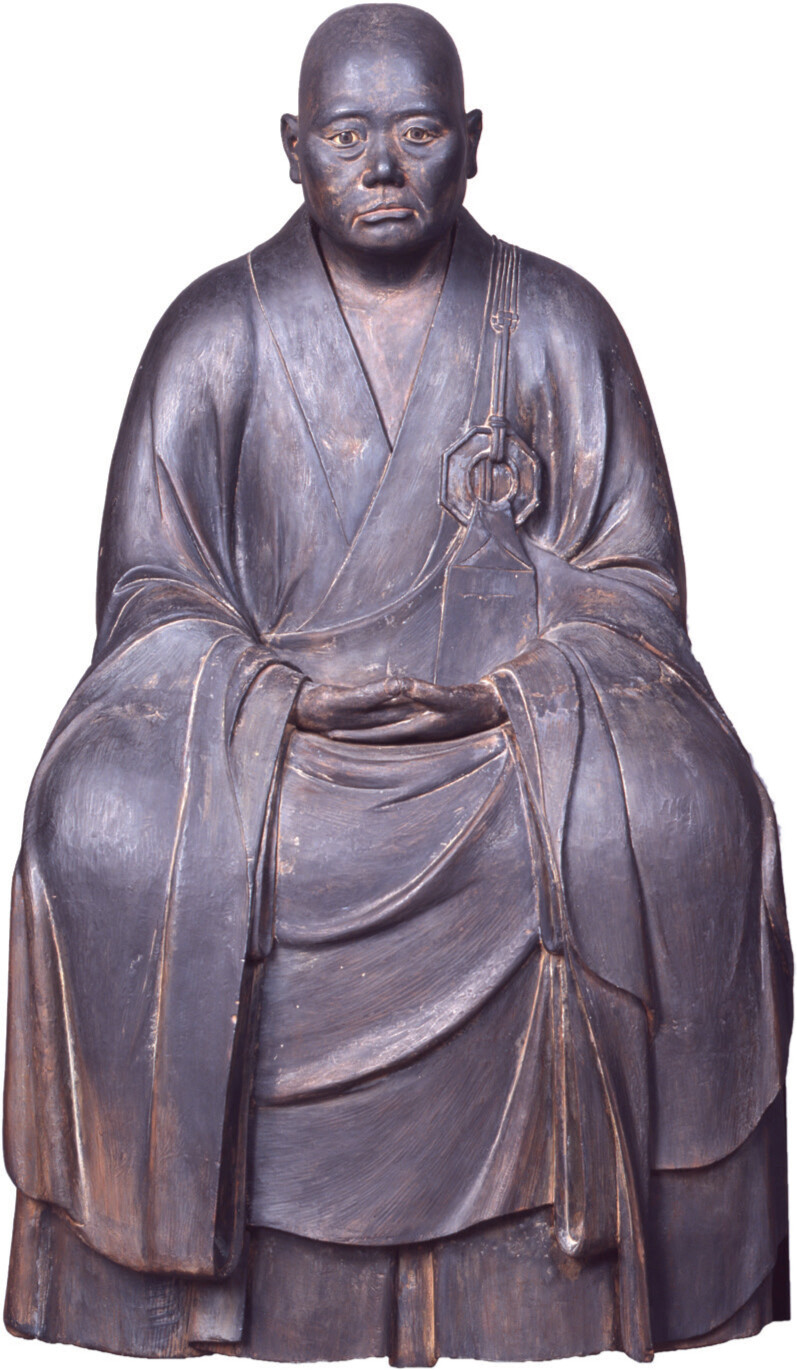
The story of Mugai Nyodai’s enlightenment describes a mundane event: Mugai carrying a bucket of water. When the bucket’s bottom fell out, the water and the moon’s reflection drained away, and Mugai realized reality was like the moon’s false reflections held in a bucket of her own delusions. This story captures one aspect of Zen: its novel proposition that enlightenment may be experienced suddenly and in the course of everyday activities. By contrast, the portrait sculpture demonstrates continuity in the sect’s espousal of making icons. Additionally, this chinsō conveys respect for discipline and hierarchy; it is a serious expression of reverence to an important religious teacher. The characteristics of novelty, tradition, and strictness resonated in the Kamakura warrior culture, and in subsequent periods Zen found support among shogun and samurai families.
JOSETSU, THE GOURD AND THE CATFISH Foreign invasions and domestic rivalry marked the late Kamakura period. From the Korean peninsula, the Mongols launched (unsuccessful) invasions of Japan in 1274 and 1281. Memory of the attempted invasions has survived in histories, handscroll paintings, and the word kamikaze, or the “divine winds” that helped repel the Mongol Goryeo fleet. These invasions tested Kamakura military capability and political strength.
Nanboku-chō
Ashikaga Yoshimitsu
Muromachi
Ultimately, it was not foreign invasion but domestic rivalry that upended the Kamakura bakufu. Sixty years of division began in 1333, when the emperor mounted a return to imperial rule. Although the Kamakura bakufu fell, the emperor could not consolidate power. Military forces placed an alternate royal on the throne and drove the emperor from Kyoto, resulting in a period of rivalry known as the Nanboku-chō (literally, “south and north courts”) period (1336–92). The Ashikaga bakufu was established before 1392, but only in that year did the third Ashikaga shogun, Yoshimitsu (1358–1409), reunify the Southern and Northern Courts. The Northern Court prevailed in questions of imperial succession, and so began the Ashikaga, or Muromachi, period (1392–1573), when the seat of power moved to the Ashikaga headquarters in Kyoto’s Muromachi district.
Shōkokuji
Once again, Kyoto became a major center for art and culture, as Ashikaga shoguns built private gardens and exquisite pavilions, and in direct competition with the imperial court collected and commissioned paintings and sculpture, too. The Muromachi period was an especially vibrant time for Zen Buddhism, with the shoguns among the leading patrons of the numerous temples in Kyoto. Yoshimitsu, for example, founded Shōkokuji, one of the prestigious and powerful Five-Mountain Zen temples. Shōkokuji was dedicated in 1392, the first year of the Muromachi period.
VIDEO: The Met, The Artist Project: HIROSHI SUGIMOTO on Bamboo in the Four Seasons, attributed to Tosa Mitsunobu
Josetsu
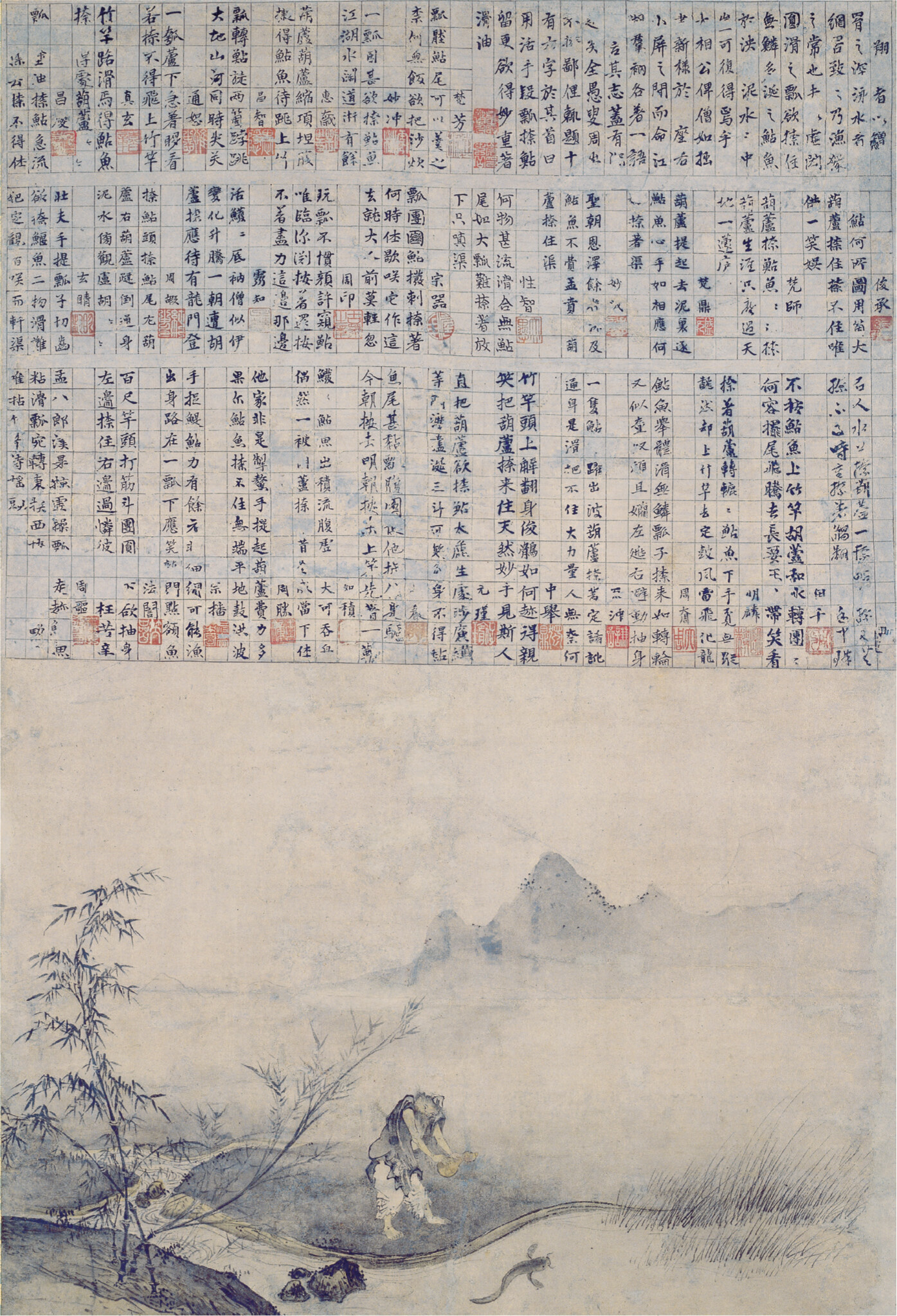
Many strands of Muromachi culture come together in a painting by a monk-artist of Shōkokuji, Josetsu (active c. 1405–23). Josetsu depicts a curious and impossible activity: trying to pin down a catfish with a gourd (Fig. 32.9). With ink and light colors on paper, the artist represents a coarse-looking man awkwardly grasping a gourd. While the man struggles rather clumsily, his would-be prize, the catfish, glides away. Visually, the gently undulating curve of the riverbank—more like a stroke of calligraphy than the meeting of earth and water—echoes the fish’s lithe body. By contrast, the coarse-looking fellow shares with the heavy rocks both angular shape and dark accents of ink, suggesting a rough-hewn quality. Josetsu sets this strange drama in an idyllic landscape featuring an asymmetrical composition, and he uses bamboo stalks as a device to frame the figure and to bridge the misty distance to the pale mountains in the background. Such stylistic traits demonstrate awareness of Southern Song styles as exemplified in the work of such artists as Ma Yuan, Li Song, and Muqi (Chapter 31).
Ma Yuan
koan
Josetsu’s painting was made for the fourth Ashikaga shogun—Yoshimitsu’s son, Yoshimochi (1386–1428). Currently in the form of a hanging scroll, The Gourd and the Catfish positions calligraphy and poetry above Josetsu’s painting, but originally the two halves were mounted side-by-side as a small folding screen. The inscriptions begin at the (viewer’s) upper right with a preface in which Yoshimochi’s religious advisor, the monk Daigaku, poses a question: “How, in the muddy expanse, is one to pin down a catfish, smooth and covered with slime, using an empty capacious gourd, slippery and rotund?” In a series of linked poems (renga), thirty-one monks, including Daigaku himself, respond, thereby transforming a subject that otherwise had no presence in Buddhism into a particular religious lesson, known in Zen practice as a koan. The most famous koan asks paradoxically, “What is the sound of one hand clapping?” Through riddles and contradictions, koan aim to dislodge conventional thinking, to measure religious progress, and ultimately to demonstrate the fundamental Buddhist truth of the illusory nature of things. In this regard, The Gourd and the Catfish invites viewers to join the seriously playful discussion of the impossibility of “pinning down a catfish with a gourd,” or, in a metaphorical sense, grasping one’s mind with one’s mind. Placed in Yoshimochi’s private quarters in a newly built palace, this artful furnishing proclaimed the shogun’s up-to-date taste as well as his impressive religious affiliations.
karesansui
Ryoanji
DRY LANDSCAPE GARDEN AT RYŌANJI Perhaps the most famous artwork associated with Zen is not an icon or a painting but rather the karesansui at Ryōanji (Fig. 32.10). In a nearly rectangular 75 × 29-foot (22.9 × 8.8 m) space (the northern edge is slightly lengthened toward the east, resulting in a 90-degree indent near the large grouping of rocks at the eastern edge of the garden), moss and fifteen rocks are clustered into five groupings. Today, visitors do not walk into this garden, but instead sit along the veranda at the garden’s northern side. To some degree, the garden’s appearance is a function of time, weather, and season, the latter affecting especially the “borrowed scenery” of trees and distant vistas beyond the garden walls. Still, with so little competing for attention, eyes become attuned to subtleties of pattern and texture, and the mind entertains a plethora of possible meanings. A late eighteenth-century guidebook to gardens in Kyoto describes the garden as “tiger cubs crossing the river,” with the arrangement of rocks representing a mother tiger carrying cubs on her back. In viewers’ minds, gravel turns to water and back again; stones morph into creatures and back again.
PANORAMA: 360Cities: Dry Landscape Garden, Ryōanji
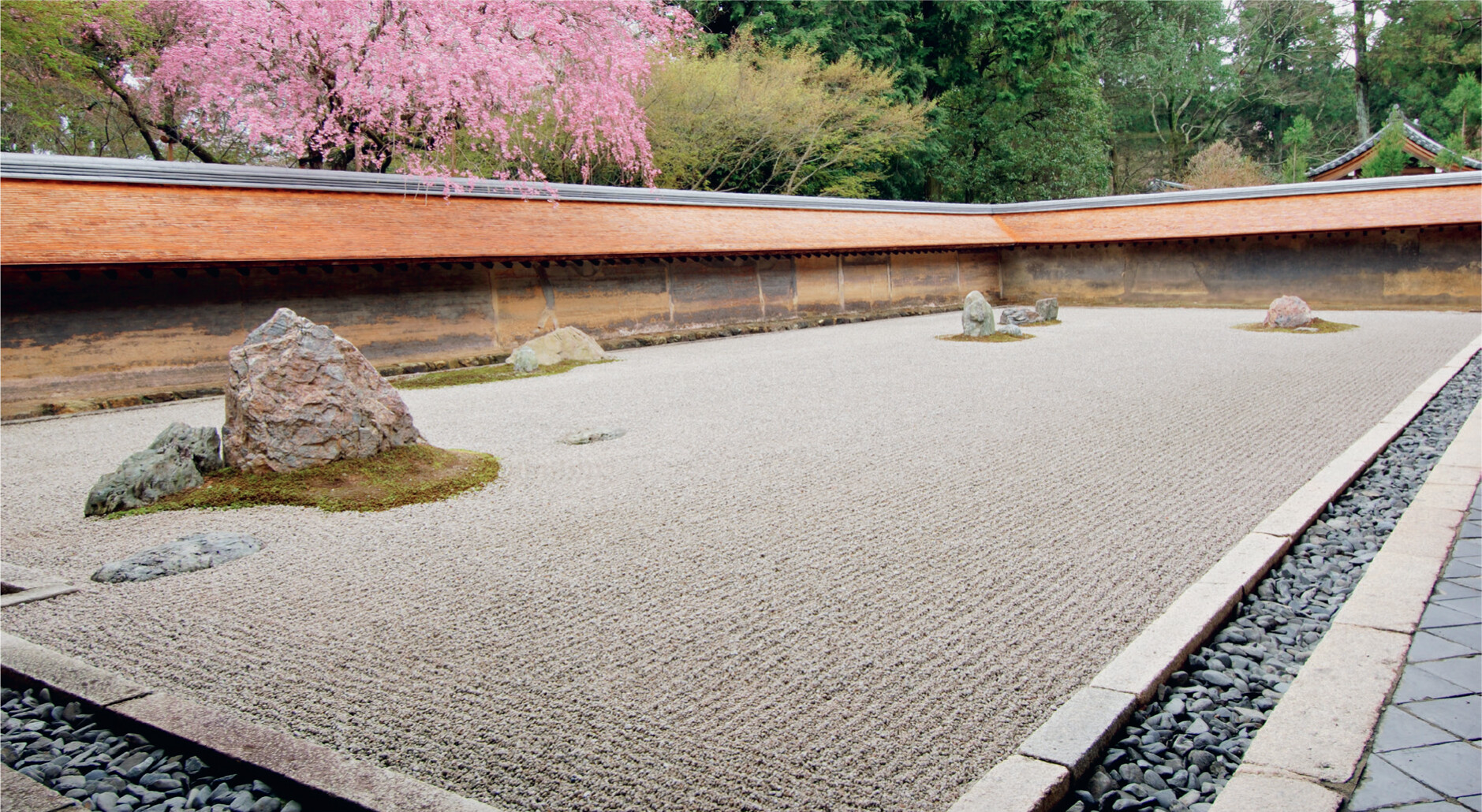
That these illusory effects may occur now as they did approximately two centuries ago is an argument for the garden’s timeless appeal. But, in fact, the dry landscape garden at Ryōanji came to prominence only in the second half of the twentieth century. For a period of time, the garden was by turns neglected, the site of a stray plant here or there, and possibly entered, as documented by an early twentieth-century photograph featuring marks that resemble footprints or tracks in the unraked sand. (The photograph was taken by Tamura Tsuyoshi (1890–1979) and is reproduced and discussed by Shoji Yamada in his book, Shots in the Dark: Japan, Zen, and the West.)
Attempts to determine the origins of Ryōanji’s dry landscape garden result in unclear and unfixed attributions, and what emerges from greater scrutiny is a more complicated reality. Credit for the garden has gone variably to the artist Sōami (d. 1525), a favorite of Ashikaga shoguns; to Hosokawa Katsumoto (1430–1473), a deputy to the shogun and founder of Ryōanji; to Kotarō and Seijirō (or Hikojirō), two otherwise unknown individuals—possibly hailing from the low class of kawaramono, or riverbed people—whose names are inscribed onto one of the rocks; and to unnamed monks at Ryōanji. Long after its initial creation, Ryōanji’s dry landscape garden garnered worldwide acclaim, bolstered by growing interest in Zen Buddhism in the post-World War II period. In this regard, the garden is not unlike underappreciated artists whose fame had to await changed tastes, different values, and later audiences.