Prix de Rome
Italian Art and the Grand Tour
In the eighteenth century, people gained their knowledge of ancient Greece and Rome through books, prints, and objects, but they experienced it most directly through travel. For wealthy Europeans and some Americans, the Grand Tour—a trip of anywhere from six months to several years throughout Europe, but especially to Italy (Map 56.1), to study language, art, and culture—was considered a standard accompaniment to a Classical education. Many artists and architects also went on a Grand Tour, either as members of a nobleperson’s entourage or through a scholarship known as the Prix de Rome (“Rome Prize”) from the French Royal Academy. Others went on their own to study Italy’s vast artistic and architectural history.
Rome was the highlight of the Grand Tour itinerary. From the fifteenth century onward, successive popes had sought to revive Rome’s imperial grandeur, evident in the development of pilgrimage routes, Baroque public spaces and monuments (such as Figs. 44.12 and 52.13), and museums such as the Pio-Clementino Museum, which in 1771 opened the Vatican’s vast art collections to the public. These newer elements merged with ancient Roman monuments to create a vibrant city that was both historical and modern.
veduta; vedute
Giovanni Paolo Panini
Pantheon
GIOVANNI PAOLO PANINI, INTERIOR OF THE PANTHEON, ROME The thrill of seeing these sites was vividly captured in veduta, a type of painting that became extremely popular in Italy in the eighteenth century to satisfy Grand Tourists’ appetites for souvenirs. Giovanni Paolo Panini (1691–1765) was one of the most successful Roman vedutisti, producing views of the key architectural monuments of Rome in vivid detail. In Interior of the Pantheon, Rome (Fig. 56.1), Panini combines minutely described renderings of a real building with imaginative scenes of everyday life.
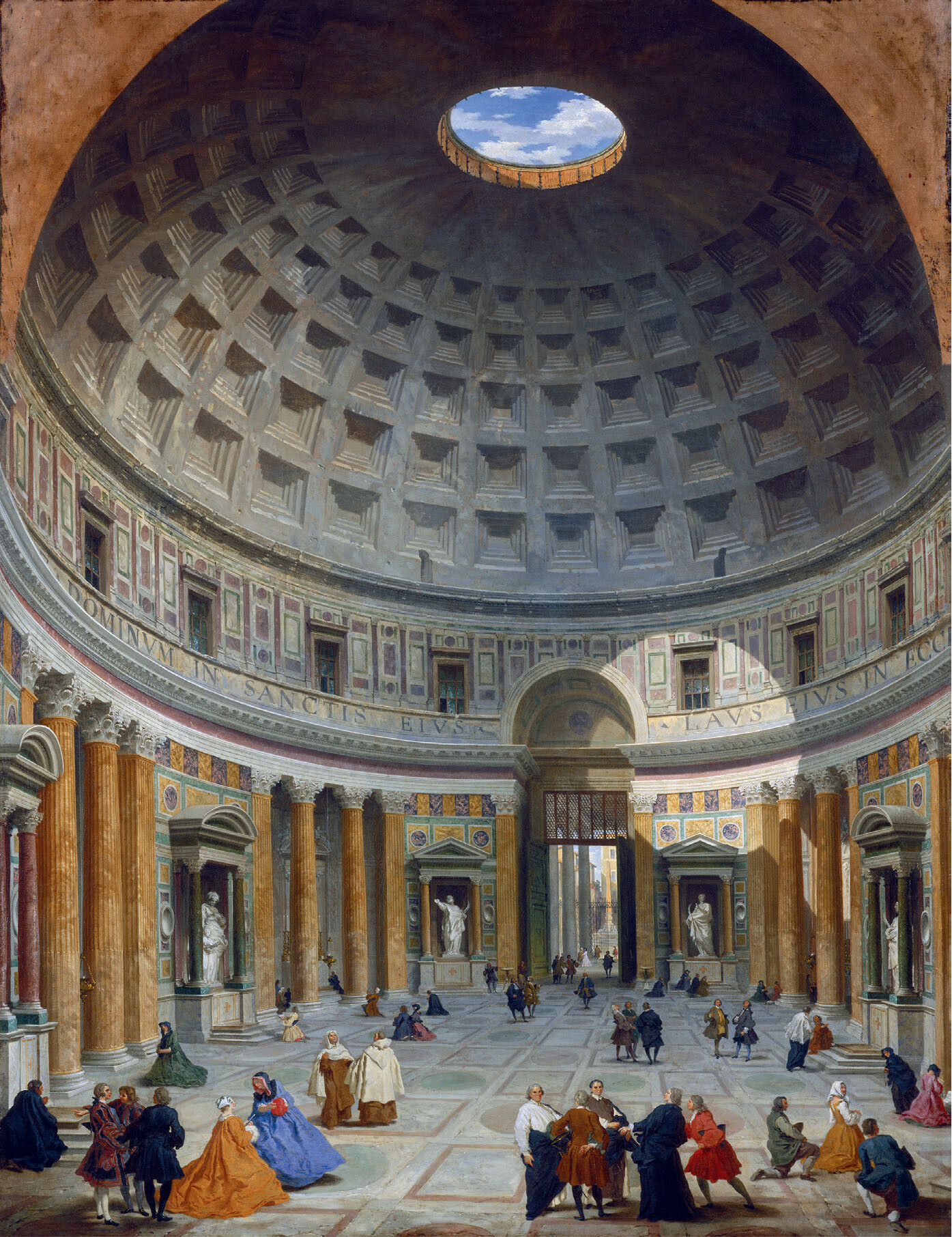
Interior of the Pantheon, Rome shows a view of the Pantheon (Fig. 20.14) with a deep viewpoint within the circular building, allowing the viewer to take in the massive columns and the domed ceiling within a single view. The light of a brilliant blue sky pierces through the oculus at the top of the dome to project onto the wall opposite the viewer. Panini’s attention to architectural detail, such as the colored marble and recognizable statues in their niches, provides a documentary representation of the interior of the Pantheon as eighteenth-century visitors would have seen it.
At the same time, Panini provides a bit of fleeting human drama and intrigue, populating his picture with foreign visitors and Romans from all walks of life. People are dwarfed by the architecture as they converse, gaze in wonder at their surroundings, and pray (the Pantheon had been converted from a Roman temple to a Catholic church in the seventh century CE). An elaborate predecessor of the modern postcard, Panini’s vedute were intended to remind tourists of the magnificent sites and supposedly exotic people they saw on their travels.
namban byōbu
→LINKAGE As travel to foreign countries increased in the Early Modern era, depictions of travelers and the locales they frequented increased in popularity. Though he probably was not familiar with them, Giovanni Paolo Panini’s veduta had an earlier precedent in Japanese namban byōbu (Fig. 32.13) that depicted the Portuguese merchants that arrived in Japan in the sixteenth century. Compare the visual strategies of each, considering that veduta were mostly created for foreigners as travel souvenirs, while namban byōbu were largely made for Japanese audiences.
Rosalba Carriera
ROSALBA CARRIERA, PORTRAIT OF CHARLES SACKVILLE Such reminders of the Grand Tour also took the form of portraiture, which flourished in Italy in the eighteenth century in part to supply tourists’ demand for images purchased abroad. Rosalba Carriera (1673–1757) created sensitive and intimate pastel drawings of visitors to her studio in Venice. Her Portrait of Charles Sackville, 2nd Duke of Dorset (Fig. 56.2), depicts the British nobleman at around the age of twenty on his Grand Tour. Pigment-dense pastel crayons can produce sketchy, fleeting effects or can be blended to produce the highly finished detail and subtle tonality we see in Sackville’s face. Skilled pastel artists, such as Carriera, could produce a finished portrait in just a few days with minimal and inexpensive materials, making pastel portraiture a lucrative artistic practice. Her success as a professional artist was a testimony to her skill and also to the new opportunities that the Grand Tour created for artists.
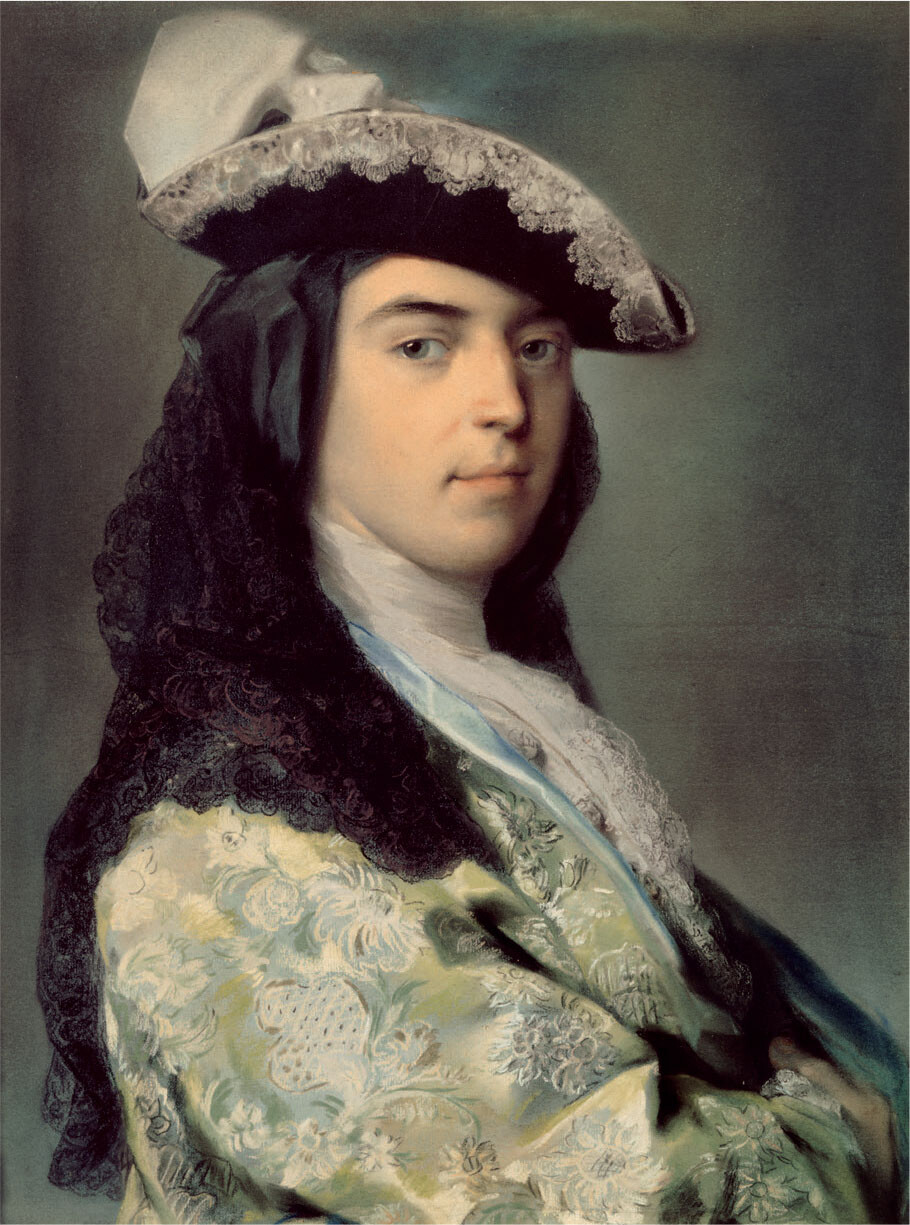
Carriera depicts Sackville’s elaborate costume, soft white skin, and penetrating gaze with a high level of illusionism. She initially trained as a lacemaker, a skill that is evident in her detailed rendering of Sackville’s black scarf, white cravat (neckcloth), and lace ornament on his tricorn (three-corner) hat. Venice was a center of the European lace and silk industries and was famed for its Carnival, an annual festival where social and sexual revelry was sanctioned while people wore masks. The profusion of lace and the embroidered silk jacket in Sackville’s portrait, along with the carnival mask nestled into his hat, depict him as tourist-gone-native in full Venetian dress.
ANTONIO CANOVA, CUPID AWAKENING PSYCHE Grand Tourists brought to Italy enormous wealth and a keen desire to collect both ancient and modern works of art, thus creating new markets for such painters as Panini and Carriera. Italian sculptors also benefited from this patronage, and Rome became a major center of sculptural production in the eighteenth century. The foremost Neoclassical sculptor of the period was Antonio Canova (1757–1822), who defined Neoclassicism as the “true style” of sculpture that took inspiration from Classical models but rendered them even more austere and refined. In 1779 Canova moved from Venice to Rome, where he was strongly influenced by the Vatican’s and other museums’ collections of ancient art, as well as Johann Joachim Winckelmann’s ideal of the “noble simplicity and calm grandeur” of Classical art (Art Historical Thinking: Winckelmann: Style and the Origins of Art History).
Psyche
In 1787 while on his Grand Tour, Scottish patron John Campbell commissioned Canova’s Cupid Awakening Psyche (Fig. 56.3). Canova chose to depict a climactic moment in the ancient Roman poem Metamorphoses, in which Psyche has fallen into a trance, having breathed fumes from a flask that the goddess Venus, jealous of Psyche’s beauty, demanded that she retrieve from the underworld. Venus’s son Cupid was hopelessly in love with Psyche and revived her with a touch from his arrow. Canova based his composition on a painting of this story discovered at Herculaneum. He includes Cupid’s quiver and the flask (not shown in the photo), key details that allude to the precise moment in the Metamorphoses that would have been familiar to educated viewers.
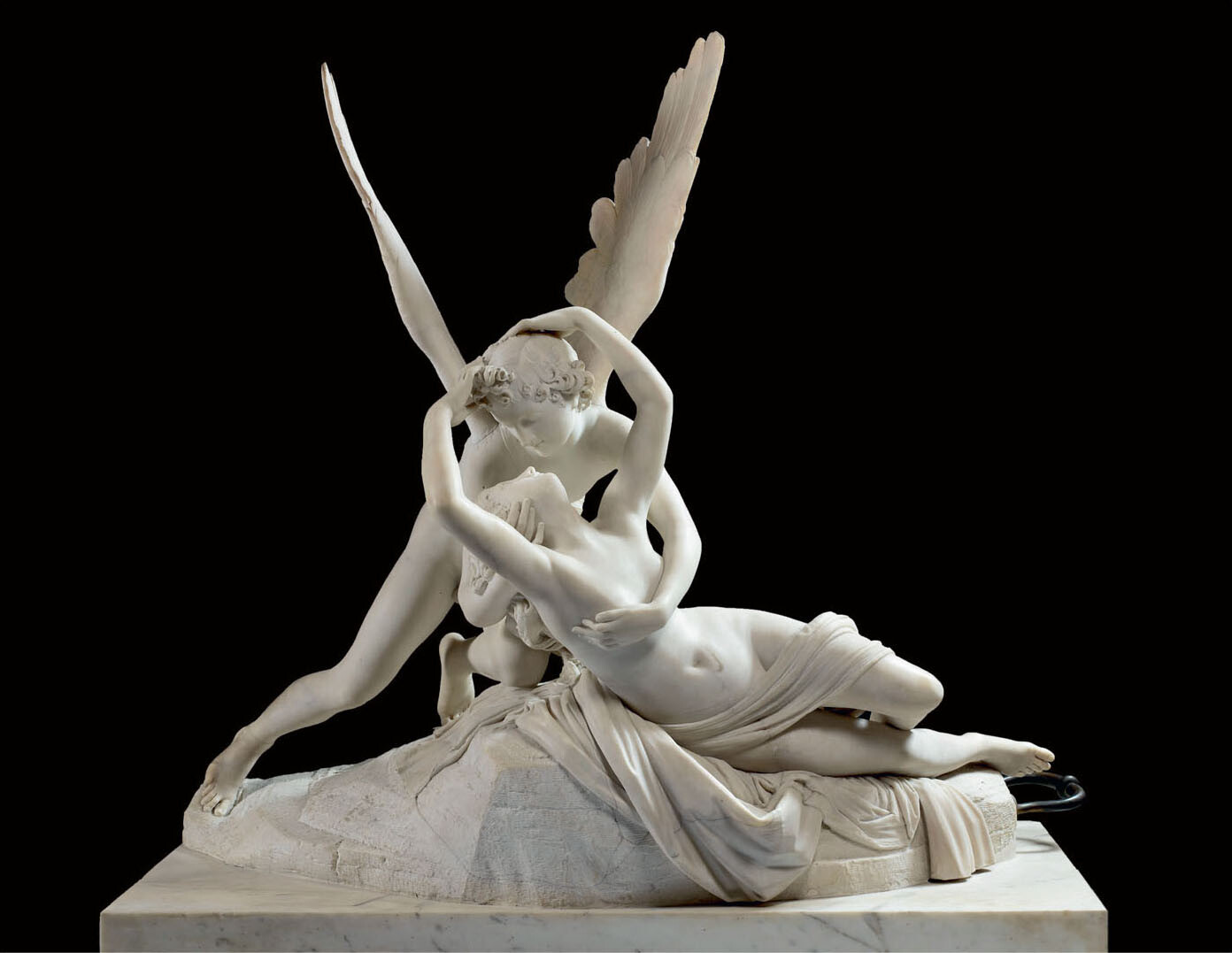
Rather than show Cupid’s touch with the arrow, Canova imagines the lovers’ subsequent embrace. The dramatic tension of their barely touching limbs, and the charged negative space between their faces on the verge of a kiss, exemplify Canova’s Neoclassicist approach to figural composition—restrained with minimal surface ornament and a focus on linear form. The refined lines of Cupid and Psyche’s idealized bodies show not a muscle, hair, or fold out of place, emphasizing the elegance of the composition. Canova treats the sculpture in the round, with various viewpoints and compositions. To encourage viewers to appreciate the animated nature of this threedimensional composition, the sculpture was mounted on a base with a handle that allowed viewers to stand in one spot and rotate the large sculpture.
VIDEO: Subtractive Sculpture
patina
The surface of the sculpture also continues Canova’s refinement of the Classical form. Marble carved to look like muslin fabric is draped around Psyche’s waist to contrast with the polished smoothness of Psyche and Cupid’s flesh and the rough texture of the rock beneath them, all carved out of marble. While the ancient Greek and Roman statues that Winckelmann and Canova appreciated were often originally brightly colored (Figs. 13.9a and 19.1a), and many still retained traces of that polychromy in the eighteenth century, Canova’s choice of marble and clear patina deliberately emphasized the whiteness of his marble figures. By reimagining ancient Classical sculpture as a pantheon of white figures, Neoclassical sculpture contributed to eighteenth-century racial ideology that linked whiteness to hierarchies of civilization.
Though Cupid Awakening Psyche was commissioned by a private patron, the sculpture was an immediate public sensation. Visitors to Canova’s sculpture workshop in Rome requested replicas of the statue in varying sizes in either marble or plaster, and throughout the nineteenth century the composition was copied in porcelain and bronze, as well as in prints and painting.
Glossary
- Baroque
- a style of art and decoration in western Europe c. 1600–1750, characterized by a sense of drama and splendor achieved through formal exuberance, material opulence, and spatial projection in order to shape the viewer’s experience.
- veduta (plural vedute)
- Italian for “view,” a genre of painting or prints that depicts a highly detailed view of a cityscape, place, or other vista.
- oculus
- a round, eye-like opening in a ceiling or roof.
- pastel
- powdered pigment mixed with gum and used in stick form for drawing.
- pigment
- any substance used as a coloring material in paint, such as dry powders made from finely ground materials.
- illusionism
- making objects and space in two dimensions appear real; achieved using such techniques as foreshortening, shading, and perspective.
- patronage
- a person or institution that commissions artwork or funds an enterprise.
- Neoclassical
- a style of art and architecture that emerged during the 18th century in Europe and the Americas, inspired by Classical Greek and Roman examples, and characterized by order, symmetry, and restraint.
- negative space
- areas of a composition not occupied by objects or figures.
- sculpture in the round
- a freestanding three-dimensional sculpture that can be viewed from every angle; for example, by walking around it.
- polychromy
- displaying different colors.
- patina
- a thin layer of color applied to, or occurring naturally over time upon, an object.