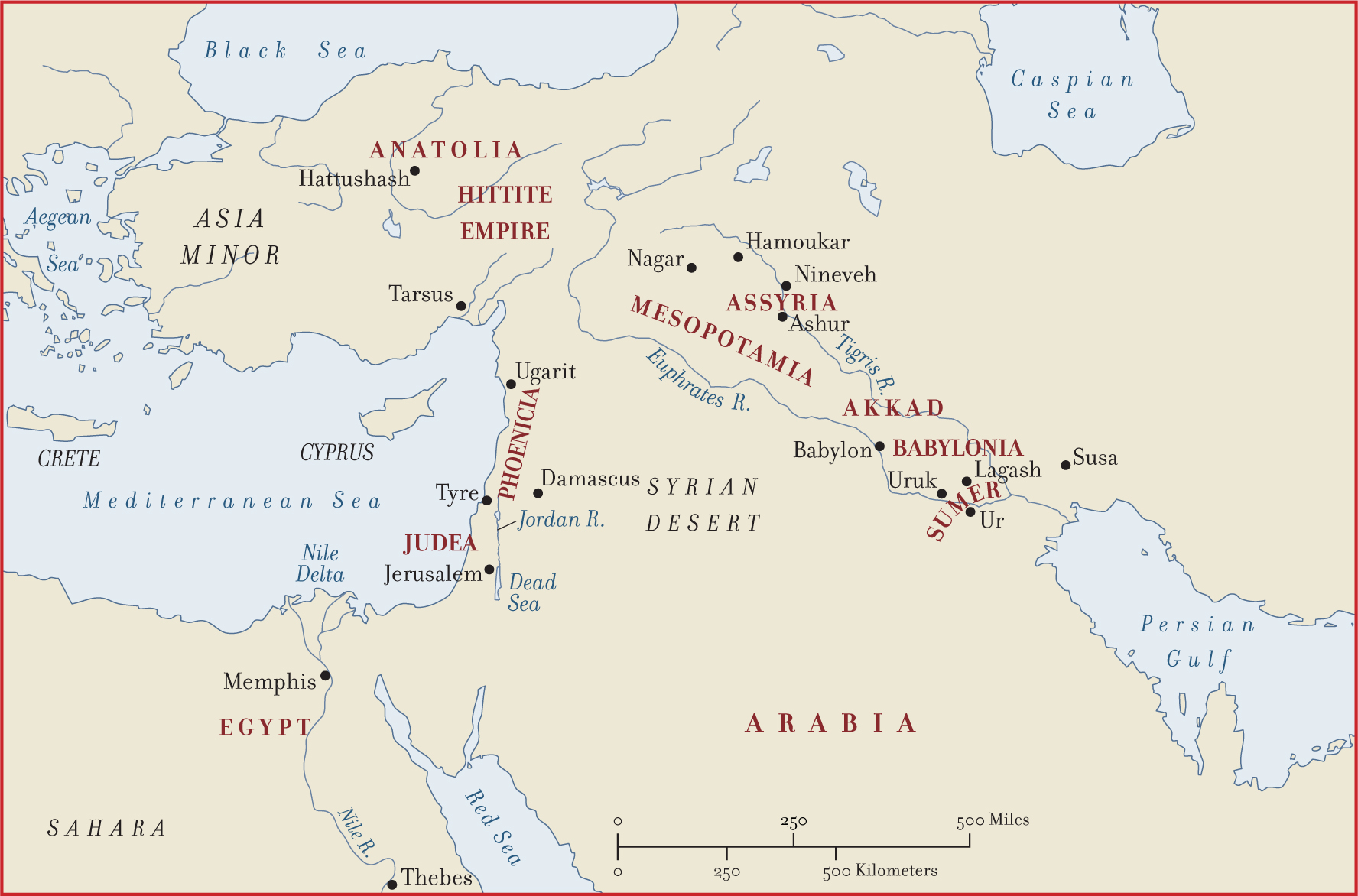
Mesopotamia, the land between the Tigris and Euphrates Rivers (now part of Iraq and Syria), was home to a number of peoples in ancient times. The map in Figure 1.2 shows several of the most important civilizations that developed there and in nearby regions over a span of more than two thousand years. Here in the fourth millennium BCE, the first true cities and civilizations emerged—from Nagar and Hamoukar in the north to Uruk in the south—and the Sumerians developed one of the first known forms of writing, using cuneiform (wedge-shaped) impressions on flat clay tablets. This system was adopted by later civilizations, including the Akkadians and the Babylonians. Many tablets have been deciphered, and some mention music.
FIGURE 1.2The ancient Near East, showing the location of the main cities and civilizations of Mesopotamia and Egypt.
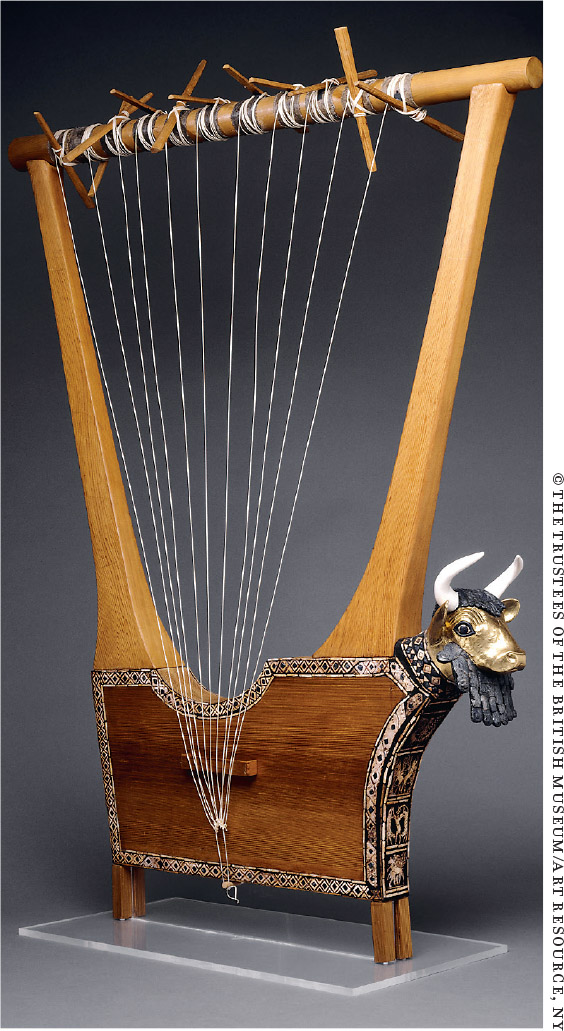
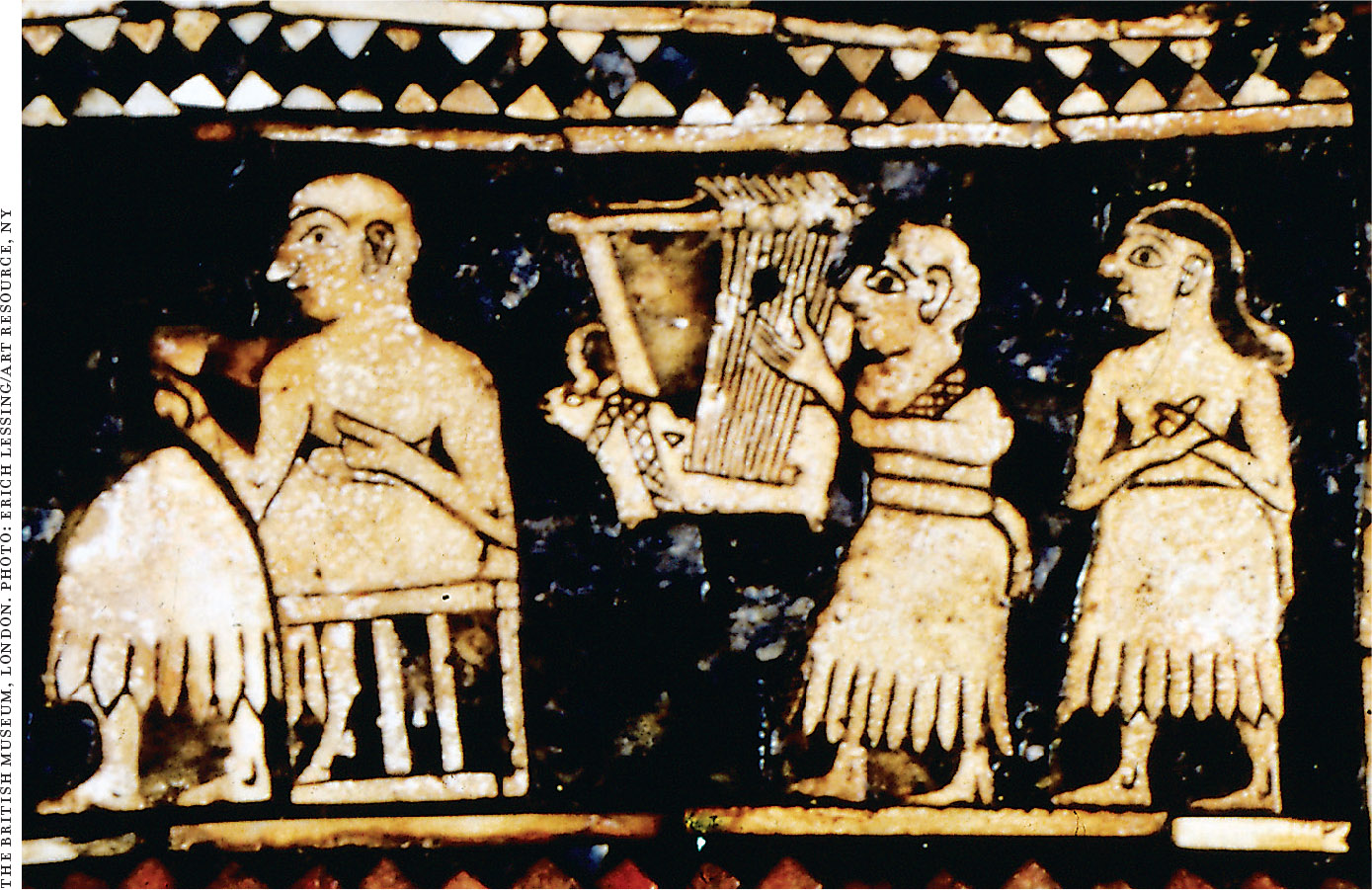
Archaeological remains and images are still crucial for understanding the music of this time. Pictures show how instruments were held and played and in what circumstances music was used, while surviving instruments reveal details of their construction. For example, archaeologists exploring the royal tombs at Ur, a Sumerian city on the Euphrates, found several lyres and harps, two kinds of plucked string instruments, as well as pictures of them being played, all from ca. 2500 BCE. In a lyre, the strings run parallel to the resonating soundboard, passing over a bridge that transmits their vibrations, and attach to a crossbar supported by two arms; in a harp, the strings are in a plane that is perpendicular to the soundboard, and the neck that supports them is attached directly to the soundbox. Figure 1.3 is a reconstruction of one of the instruments from Ur: a bull lyre, a distinctively Sumerian lyre whose soundbox features a bull’s head, which had religious significance. Figure 1.4 is part of an inlaid panel depicting a musician playing a bull lyre at a victory banquet. The player holds the lyre, supported by a strap around his neck, perpendicular in front of him and plays it with both hands. Together image and instrument reveal that the lyre had a variable number of strings running from a bridge on the soundbox to the crossbar, where they were knotted around sticks that could be turned to change the tension and thus the tuning of each string. Other instruments of the period included lutes, pipes, drums, cymbals, clappers, rattles, and bells.
Written records Combining written records with images of music-making allows a much fuller understanding of how Mesopotamian cultures used music, showing that their repertories included wedding songs, funeral laments, military music, work songs, nursery songs, dance music, tavern music, music for entertaining at feasts, songs to address the gods, music to accompany ceremonies and processions, and epics sung with instrumental accompaniment. All but the last of these are uses that continue today. As is true for every era until the nineteenth century, we find the best evidence for music of the elite classes, primarily rulers and priests, who had the resources to induce artisans to make instruments, musicians to make music, artists to depict it, and scribes to write about it.
FIGURE 1.3Reconstruction of a Sumerian bull lyre from the Royal Cemetery at Ur, ca. 2500 BCE.
Written sources also provide a vocabulary for music and some information on musicians. Word lists from ca. 2500 BCE on include terms for instruments, tuning procedures, performers, performing techniques, and genres or types of musical composition. The earliest composer known to us by name is Enheduanna (fl. ca. 2300 BCE), an Akkadian high priestess at Ur, who composed hymns (songs to a god) to the moon god Nanna and moon goddess Inanna; their texts, but not her music, survive on cuneiform tablets.
Around 1800 BCE, Babylonian musicians began to write down what they knew instead of passing it on by word of mouth only. Their writings describe tuning, intervals, improvisation, performing techniques, and genres, including love songs, laments, and hymns. Here again we find many aspects of music that continued into later times.
Among the writings are instructions for tuning a string instrument that indicate the Babylonians used seven-note diatonic scales. They recognized seven scales of this type, corresponding to the seven diatonic scales playable on the white keys of a piano. These scales have parallels in the ancient Greek musical system as well as in our own, suggesting that Babylonian theory and practice influenced that of Greece, directly or indirectly, and thus European music.
FIGURE 1.4Inlaid panel from Ur, ca. 2600 BCE, showing a bull lyre being played at a victory banquet.
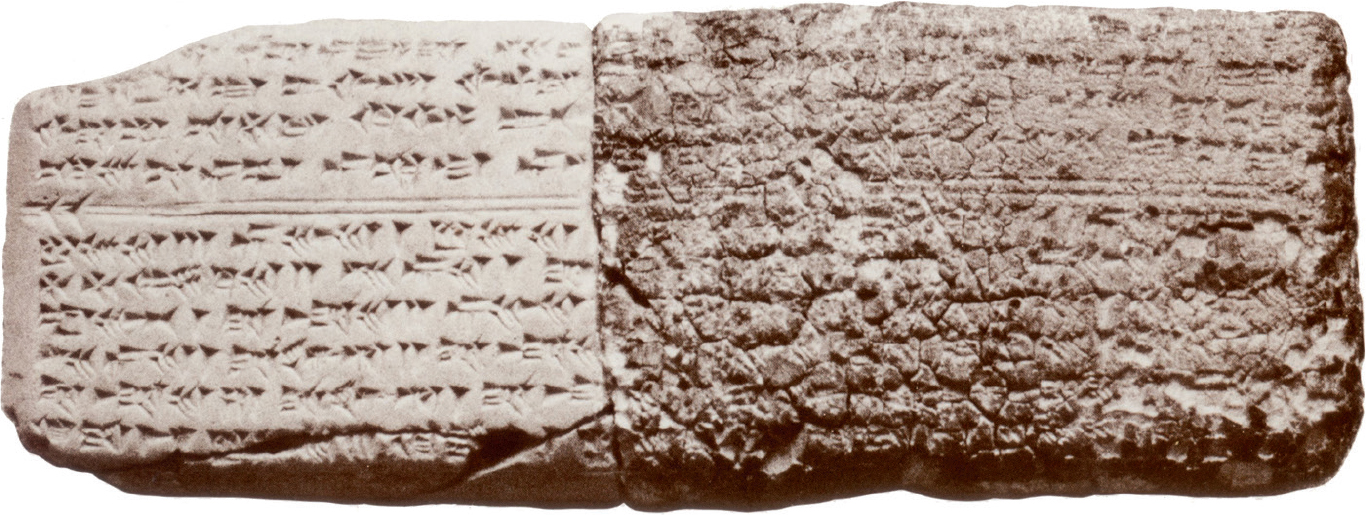
The Babylonians used their names for intervals to create the earliest known musical notation. The oldest nearly complete piece, from ca. 1400–1250 BCE, is on a tablet shown in Figure 1.5 that was found at Ugarit, a merchant city-state on the Syrian coast. Scholars have proposed possible transcriptions for the music, but the notation is too poorly understood to be read with confidence. Despite the invention of notation, most music was either played from memory or improvised. Musicians most likely did not play or sing from notation, as modern performers do, but used it as a written record from which a melody could be reconstructed, as cooks use a recipe.
FIGURE 1.5Clay tablet from Ugarit, ca. 1400–1250 BCE, with text and musical notation for a hymn to Nikkal, a wife of the moon god. The words are written above the double line, the music below. DAMASCUS NATIONAL MUSEUM. PHOTO: DR. ANNE KHMER
OTHER CIVILIZATIONS
For other ancient cultures we also have instruments, images, and writings that testify to their musical practices. India and China developed independently from Mesopotamia and were probably too distant to affect Greek or European music. Surviving sources that shed light on Egyptian musical traditions are especially rich, including many artifacts, paintings, and hieroglyphic writings preserved in tombs. Archaeological remains and images that relate to music are relatively scant for ancient Israel, but music in religious observances is described in the Bible. Although some scholars have tried to discover and decipher musical indications in Egyptian hieroglyphics and wall paintings and in ancient copies of the Bible, no consensus has been reached that musical notation is even present. Through physical remains, images, and writings about music we can gain a sense of a vibrant musical life in the ancient Near East, but without actual music to perform, it remains almost entirely silent.
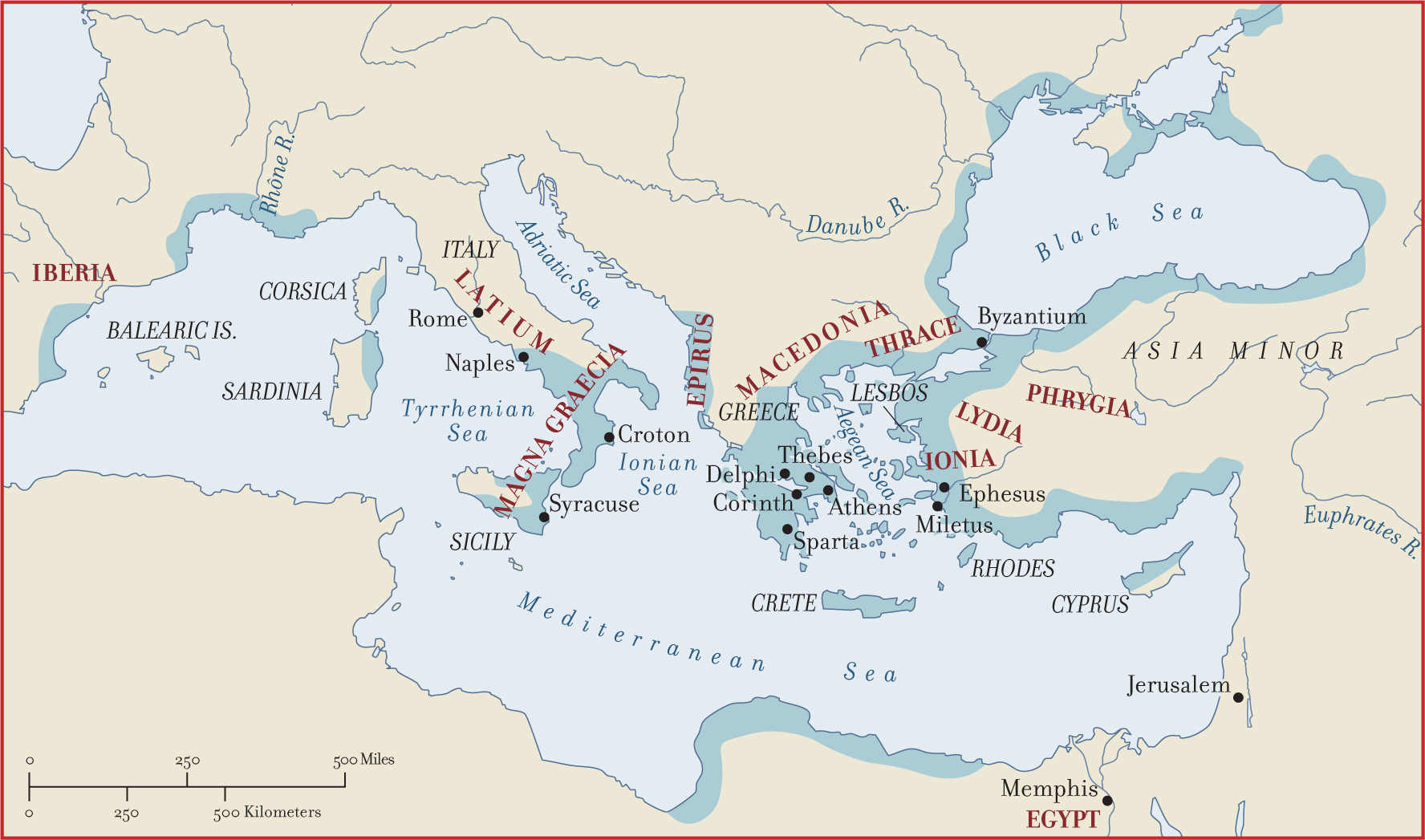
FIGURE 1.6Greece and Greek settlements about 550 BCE (shown in blue). The main centers of Greek population and culture were the Greek peninsula, the Aegean Islands, the west coast of Asia Minor (modern Turkey), and southern Italy and Sicily, known to the Romans as Magna Graecia (Greater Greece).
TIMELINE
ca. 3500–3000BCE Rise of Sumerian cities
ca. 3100 Cuneiform writing established
ca. 2500 Royal tombs at Ur
ca. 2300 Enheduanna composes her hymns
ca. 1800 Babylonian writings about music
ca. 1400–1250 Oldest nearly complete piece in notation
Plucked string instrument with a resonating soundbox, two arms, crossbar, and strings that run parallel to the soundboard over a bridge and attach to the crossbar.
Plucked string instrument with a resonating soundbox, neck, and strings in roughly triangular shape. The strings rise perpendicular from the soundboard to the neck.
(1) In ancient Greek music, adjective describing a tetrachord with two whole tones and one semitone. (2) Name for a scale that includes five whole tones and two semitones, where the semitones are separated by two or three whole tones. (3) Adjective describing a melody, chord, or passage based exclusively on a single diatonic scale.
A system for writing down musical sounds, or the process of writing down music. The principal notation systems of European music use a staff of lines and signs that define the pitch, duration, and other qualities of sound.