Christianity sprang from Jewish roots, and some elements of Christian observances reflect those origins, chiefly the chanting of Scripture and the singing of psalms, sacred poems of praise from the Hebrew Book of Psalms.
Temple rites The second Temple of Jerusalem, built in the late sixth century BCE on the site of the original Temple of Solomon and expanded by Herod the Great in 19–20 BCE, was a place for public worship until its destruction by the Romans in 70 CE. Observances centered around a sacrifice—usually of a lamb—performed by priests, assisted by Levites (members of the priestly class, including musicians), and witnessed by lay worshippers. Depending on the occasion, priests and sometimes worshippers ate some of the offering. Sacrifices were celebrated twice daily, with additional services on festivals and the Sabbath. During the ritual, a choir of Levites sang psalms assigned to that day, accompanied by harp and psaltery. Trumpets and cymbals were also used.
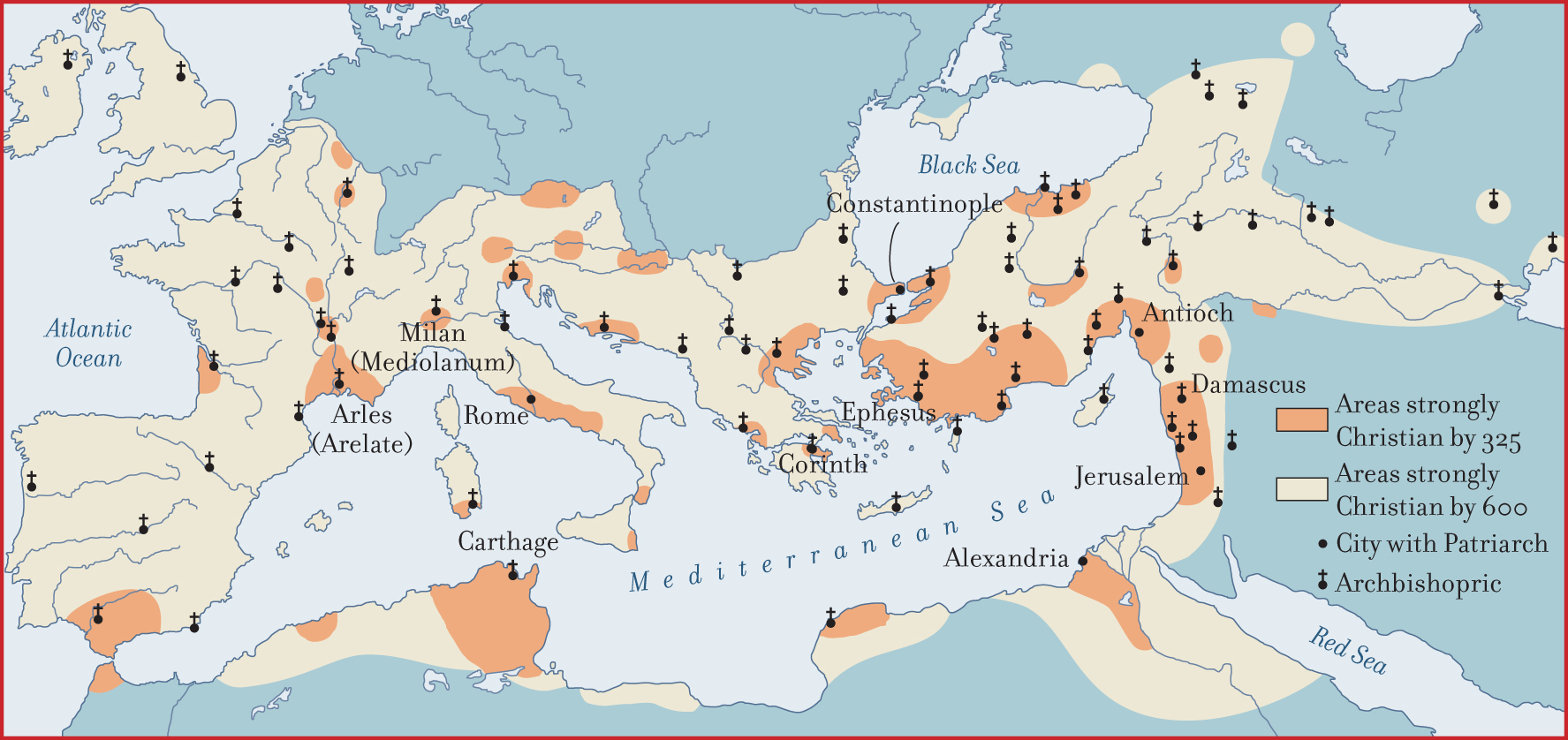
FIGURE 2.1The diffusion of Christianity.
In ancient times, synagogues were centers for readings and homilies rather than worship. Public reading from Scripture was probably performed in chant, as in later centuries, employing a system of cantillation (chanting of sacred texts) based on melodic formulas that reflected the phrase divisions of the text. Certain readings were assigned to particular days or festivals.
There are parallels between the Temple rites and the Christian Mass of later centuries (described in Chapter 3), including a symbolic sacrifice in which worshippers and priests partake of the body and blood of Christ in the form of bread and wine. Singing psalms assigned to certain days became a central element of all Christian observances, as did the synagogue practice of gathering in a meeting house to hear readings from Scripture and public commentary upon them. Yet the Christian services arose independently, with no direct derivation from either the Temple or the synagogue. The most immediate link to Jewish practice lies in the Mass, which commemorates the Last Supper Jesus shared with his disciples and thus imitates the festive Passover meal. Whether the melodies Christians used for singing psalms and chanting Scripture were drawn from those used in Jewish observances cannot be known, since none were written down until many centuries later.
TIMELINE
ca. 530s–ca. 516BCE Second Temple built in Jerusalem
63 Rome conquers Jerusalem
ca. 33CE Jesus’s crucifixion
70 Romans destroy Temple of Jerusalem
135 Romans destroy Jerusalem and expel the Jews
313 Emperor Constantine I legalizes Christianity in Edict of Milan
392 Christianity becomes official Roman religion
395 Separation of Eastern and Western Empires
early5thcentury Martianus Capella, The Marriage of Mercury and Philology
476 End of Western Empire
ca. 500–10 Boethius, De institutione musica
590–604 Reign of Pope Gregory I (the Great)
by late 7th century Schola Cantorum established
751–68 Reign of Pippin the Short, king of the Franks
ca.754 Pippin orders use of Roman liturgy and chant
768–814 Reign of Charlemagne
800 Charlemagne crowned emperor by pope
ca.850–900Musica enchiriadis and Scolica enchiriadis
A poem of praise to God, one of 150 in the Book of Psalms in the Hebrew Scriptures (the Christian Old Testament). Singing psalms was and is a central part of Jewish, Christian, Catholic, and Protestant worship.