NAWM 3a Anonymous, Mass for Christmas Day: Introit: Puer natus est nobis
ADDITIONS TO THE AUTHORIZED CHANTS
Even after the chant repertory began to be standardized in about the ninth century, church musicians continued to add to it. Besides composing new melodies for the Mass Ordinary and revising Office services, they supplied music whenever a new saint’s day, commemoration of the Virgin Mary, or other feast was added to the calendar, creating new chants or adapting existing ones for the day’s Mass Proper and Office. More than fifty composers known by name, and hundreds of anonymous ones, composed such chants, most for observances in honor of local saints. Moreover, church musicians developed three new types of chant as additions to the authorized liturgy: tropes, sequences, and liturgical dramas.
TROPE
A trope expanded an existing chant in one of three ways: by adding (1) new words and music before the chant (an introductory trope) or before each phrase of the chant (an intercalated trope); (2) melody only, extending melismas or adding new ones; or (3) text only (usually called prosula, or “prose”), set to existing melismas. All three types increased the solemnity of a chant by enlarging it, and all offered musicians an outlet for creativity in the margins of the authorized repertory, paralleling the way medieval scholars sometimes added commentary in the margins of Bible texts. Moreover, the added words provided a gloss, an explanatory note or comment that interprets the chant text and usually links it more closely to the occasion.
Introductory trope Examples of all three kinds of trope appear in NAWM 5, from a manuscript copied around 1025 for an abbey near Limoges in central France. The Introit antiphon from the Mass for Christmas Day (NAWM 3a) uses a text from the Old Testament, Isaiah 9:6, a passage Christians view as a prophecy of Jesus’s birth. Prefacing it with an introductory trope makes this interpretation explicit. The trope is in the form of a dialogue, Quem queritis in presepe (NAWM 5a), shown in Figure 3.6 as it appears in an earlier manuscript from the late tenth century. Midwives attending Mary ask the shepherds whom they seek in the manger. The shepherds answer that they are looking for the Savior, the infant Christ. Told that they have found the one Isaiah foretold, the shepherds rejoice, their words(here in italics) leading directly into the Introit: “Now truly we know that Christ was born on earth, concerning which let all sing with the prophet, saying: A child is born to us, and a Son is given to us. . . .”
NAWM 5a Tropes on Chants from Mass for Christmas Day: Tropes on “Introit, Puer natus: Quem queritis in presepe and melisma”
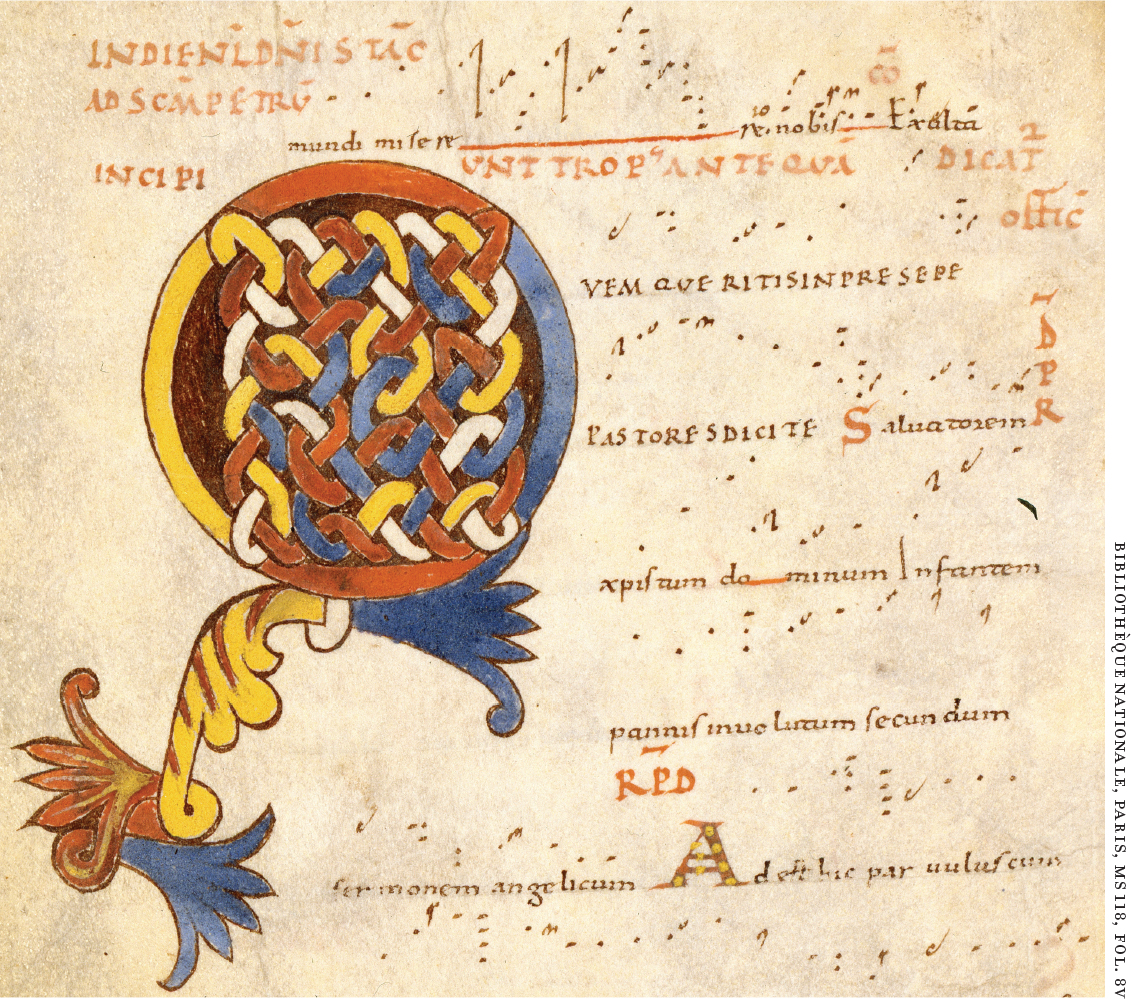
Intercalated trope The Offertory from the same Mass, Tui sunt caeli (NAWM 3g), draws its text from a psalm. Adding the intercalated trope Qui es sine principio (NAWM 5c), with a new phrase of music and text before each phrase of the original chant, connects the psalm directly to Christmas by addressing its words to Jesus, linking him to the other members of the Trinity, and proclaiming that “for us today, from a virgin, God was born as a man.” The added phrases, which were likely sung by a soloist, are in the same mode and style as the original chant and share some melodic figures with it, so that the troped Offertory sounds like a coherent whole.
NAWM 3g Anonymous, Mass for Christmas Day: Offertory: Tui sunt caeli
NAWM 5c Tropes on Chants from Mass for Christmas Day Troped Offertory: Qui es sine principio—Tui sunt caeli
Added melisma The manuscript also includes a textless melisma sung after the closing phrase of the Introit’s antiphon(see the end of NAWM 5a), representing the second kind of trope, a purely musical addition to the chant.
Prosula The third type, adding text to existing melismas, is illustrated by the prosula Natus est nobis—Multis loquutionibus (NAWM 5b), adapted from Alleluia Multipharie olim Deus by replacing “Alleluia” with a prose text set mostly syllabically to the music of the respond and interpolating words into the text of the verse to make it syllabic as well. The new texts relate the essence of the Christmas story. As is typical of prosulas, the vowels in the new words often match those of the syllables they replace, creating an echo of the original text that the monks singing the prosula would have readily perceived.
NAWM 5b Tropes on Chants from Mass for Christmas Day: Alleluia Multipharie olim Deus with prosula Natus est nobis—Multis loquutionibus
Rise and decline of troping Trope composition flourished especially in monasteries during the tenth and eleventh centuries. Musicians in France, England, Germany, Italy, and Spain composed hundreds of tropes, some adopted widely but most sung only in certain locales. The use of tropes declined during the twelfth century, and all were banned by the Council of Trent (1545–63; see Chapter 11) in the interest of simplifying and standardizing the liturgy. Tropes testify to the desire among medieval church musicians to embellish the authorized chant by adding music and words. This is of crucial importance for the development of polyphony, which embodies the same impulse.
SEQUENCE
The sequence was a genre popular from the late ninth through the thirteenth centuries in the region including France, England, Germany, Switzerland, northern Italy, and Spain. Sequences are sung after the Alleluia at Mass and are set syllabically to a text that is mostly in couplets. Early sequences are in prose, later ones more often poetic with regular meter and rhyme. Like tropes, but in more elevated language, sequences elaborate on the themes of the service of which they are a part. Both tropes and sequences were additions to the liturgy, but while tropes were attached to existing chants, sequences were freestanding chants.
SOURCE READING
Notker Balbulus on Writing Sequences
The most famous early writer of sequence texts, Notker Balbulus (“the stammerer,” ca. 840–912), a Frankish monk at the monastery of St. Gall in Switzerland, explained how he learned to write words syllabically under long melismas. He appears to be describing the practice of writing new texts for existing sequence melodies. Though historians once interpreted this as a description of the invention of the sequence, it is clear that Notker is refining a practice that developed elsewhere.

When I was still young, and very long melodies—repeatedly entrusted to memory—escaped from my poor little head, I began to reason with myself how I could bind them fast.
In the meantime it happened that a certain priest from Jumièges (recently laid waste by the Normans) came to us, bringing with him his antiphonary, in which some verses had been set to sequences; but they were in a very corrupt state. Upon closer inspection I was as bitterly disappointed in them as I had been delighted at first glance.
Nevertheless, in imitation of them I began to write Laudes Deo concinat orbis universus, qui gratis est redemptus, and further on Coluber adae deceptor. When I took these lines to my teacher Iso, he, commending my industry while taking pity on my lack of experience, praised what was pleasing, and what was not he set about to improve, saying, “The individual motions of the melody should receive separate syllables.” Hearing that, I immediately corrected those which fell under ia; those under le or lu, however, I left as too difficult; but later, with practice, I managed it easily—for example in “Dominus in Sina” and “Mater.” Instructed in this manner, I soon composed my second piece, Psallat ecclesia mater illibata.
When I showed these little verses to my teacher Marcellus, he, filled with joy, had them copied as a group on a roll; and he gave out different pieces to different boys to be sung. And when he told me that I should collect them in a book and offer them as a gift to some eminent person, I shrank back in shame, thinking I would never be able to do that.
Notker Balbulus, Preface to Liber hymnorum (Book of Hymns), trans. in Richard Crocker, The Early Medieval Sequence (Berkeley and Los Angeles: University of California Press, 1977), 1.
The origin of the sequence is uncertain, but it derives its name and place in the liturgy from an earlier practice called sequentia (Latin for “something that follows”), a melisma added at the end of an Alleluia. Composers of sequences sometimes drew melodic material from an Alleluia, but most melodies were newly composed. Manuscript collections of sequences customarily present them in two forms, with text and as extended melismas on “Alleluia.” New texts were often written for existing sequence melodies (see Source Reading).
Form Most sequences consist of an initial single sentence; a series of paired sentences or phrases; and a final unpaired sentence. Within each pair, the two sentences or phrases generally have the same number of syllables and are set to the same music. Both syllable count and music change for each new pair, creating the form A BB CC . . . N. The length of the paired phrases tends to rise or fall in a simple pattern. The tonal focus is usually clear, with most phrases ending on the modal final.
Victimae paschali laudes These characteristics are evident in the Easter sequence Victimae paschali laudes (NAWM 6a), attributed to Wipo (ca. 995–ca. 1050), chaplain to the Holy Roman emperor. The text emphasizes the main themes of the Easter liturgy: Christ’s suffering and resurrection, the testimony of Mary and the angel that he is risen, his victory over death, and redemption for his followers. The length of verses increases from the opening through the next-to-last pair, then decreases, creating a satisfying arch. Short musical phrases, all ending on the final or reciting tone of the mode, give the music coherence, reinforced by melodic similarities at the beginning or end of some phrases.
NAWM 6a Attributed to Wipo, Victimae paschali laudes
Later sequences In the twelfth century, rhymed poetry in verses of even length became more common for sequences, and many sequences lacked the unpaired verses at beginning and end. The sequences by Adam of St. Victor (d. 1146), who was active in Paris, are typical in the allegorical quality of their texts, which comment on the liturgy of the day, and in their poetic form: verses of three lines in trochaic meter(alternating accented and unaccented syllables), with eight, eight, and seven syllables respectively, paired in the rhyme scheme aab ccb. The melodies are still primarily syllabic but often include short groups of two or three notes.
Dies irae An outstanding example of the late sequence, and one of the most famous poems of the Middle Ages, is Dies irae (NAWM 6b), attributed to the Italian monk Thomas of Celano (ca. 1190–ca. 1260), friend and biographer of St. Francis of Assisi. The original poem is in rhymed verses of three lines, each line eight syllables long in regular trochaic meter. In the first six verses, the poet paints a vivid picture of the Day of Judgment, drawing on biblical imagery from the Psalms and Old Testament prophets through Jesus’s own words in the Gospels to the letters of Peter and the book of Revelation. In the next six verses, he begs Jesus to save him, recalling that the reason Jesus came to earth and suffered on the cross was to redeem sinners like him. Then he cites Jesus’s own actions and words, from the absolution he offered the sinners around him to his images of the last judgment, and pleads for mercy. The three sections of the poem are highlighted by a threefold repetition in the melody, which takes the form AA BB CC / AA BB CC / AA BB C / D E; the last two verses, in the form of a prayer, were appended when Dies irae was made the sequence for the Mass for the Dead (the Requiem Mass).
NAWM 6b Attributed to Thomas of Celano, Dies irae
Significance of sequences Like tropes, sequences embellished the liturgy and provided an outlet for creativity. During the heyday of sequence composition from the ninth through the twelfth centuries, church musicians composed thousands, including some of the most profound and engaging songs of the entire Middle Ages. Some sequences were widely used, but local practice varied. Seeking greater uniformity, the Council of Trent banned most sequences, retaining only four of the best known, including Victimae paschali laudes and Dies irae.The importance of the sequence as a genre of chant is masked by this later history, when all but a few of them were expunged from the repertoire.
LITURGICAL DRAMA
As we have seen with the Christmas trope Quem queritis in presepe, some tropes took the form of dialogues, bringing long-ago events to life in the present. The earliest was the tenth-century Quem queritis in sepulchro, preceding the Introit for Easter. In the dialogue, the three Marys come to Jesus’s tomb, and the angel asks them, “Whom do you seek in the sepulcher?” They reply, “Jesus of Nazareth,” to which the angel answers, “He is not here, He is risen as He said; go and proclaim that He has risen from the grave” (Mark 16:5–7). Accounts from the period show that this dialogue was sung responsively and accompanied by appropriate dramatic action.
Such dialogues that were added to the liturgy have become known as liturgical dramas. They were recorded in liturgical books and performed in church, with processions and stylized actions. The Easter and Christmas dialogues were the most common and were performed all over Europe. Several other plays survive from the twelfth century and later that enact the events commemorated in the Church year, some performed within the liturgy and others staged separately. These include ten plays in a codex from the Benedictine monastery of Fleury in central France and the early-thirteenth-century Play of Daniel from Beauvais (north of Paris). The music for these plays consists of a number of chants strung together, sometimes joined by songs in more secular styles. All parts, even women’s roles, were usually sung by the male clergy and choir, except in a few locales where nuns participated.
- trope
Addition to an existing chant, consisting of (1) words and melody; (2) a melisma; or (3) words only, set to an existing melisma or other melody.
- sequence
(from Latin sequentia, “something that follows”) (1) A category of Latin chant that follows the Alleluia in some Masses. (2) Restatement of a pattern, either melodic or harmonic, on successive or different pitch levels.
- liturgical drama
Dialogue on a sacred subject, set to music and usually performed with action, and linked to the liturgy.