NAWM 7 Hildegard of Bingen, Ordo virtutum: Closing chorus, In principio omnes
HILDEGARD OF BINGEN
Women were excluded from the priesthood, and as the choir took over the singing in services, women were silenced in church. But in convents—separate communities of celibate religious women—they could hold positions of leadership, except for officiating at Mass, and participate fully in singing and composing music. As in monasteries, convent life revolved around singing the eight daily Office services and Mass. Here women learned to read Latin and music and had access to an intellectual life available to few women outside convent walls.
In this context, Hildegard of Bingen (1098–1179) achieved great success as abbess of her own convent and as a writer and composer (see Figure 3.7 and biography). There are more surviving chants by Hildegard than by any other composer from the entire Middle Ages. Most of her songs, for which she composed both words and music, praise the Virgin Mary, the Trinity, or local saints. Her works, mostly composed for Office services, vary from syllabic hymns to highly melismatic responsories. Her sequences are unusual in that the paired lines often differ in syllable count and accent, and Hildegard varies the music accordingly. Her melodies often exceed the range of an octave by a fourth or fifth. She repeatedly uses a small repertoire of melodic figures in constant variation. Some patterns derive from chant, such as a rising fifth and stepwise descent, or circling around a cadential note; others are extraordinary, such as successive leaps and other patterns that quickly span an octave or more. The music serves to prolong the words, encouraging contemplation of their meaning through sung prayer.
Ordo virtutum Hildegard’s most extended musical work is Ordo virtutum (The Virtues, ca. 1151), a sacred music drama in verse with eighty-two songs. It is a morality play with allegorical characters, including the Prophets, the Virtues, the Happy Soul, the Unhappy Soul, and the Penitent Soul, in which the female Virtues lead the fallen soul back to the community of the faithful. All sing in plainchant except the Devil, who can only speak; the absence of music symbolizes his separation from God. The final chorus of the Virtues and Souls (NAWM 7) is typical of Hildegard’s expansive and individual melodies.
HILDEGARD OF BINGEN
(1098–1179)
Born to a noble family in Bermersheim in the Rhine region of Germany, Hildegard at age eight was consecrated to the church by her parents. Six years later she took vows at the Benedictine monastery of Disibodenberg, and was elected magistra of the attached convent in 1136. Led by a vision, she founded her own convent around 1150 at Rupertsberg near Bingen, where she was abbess.
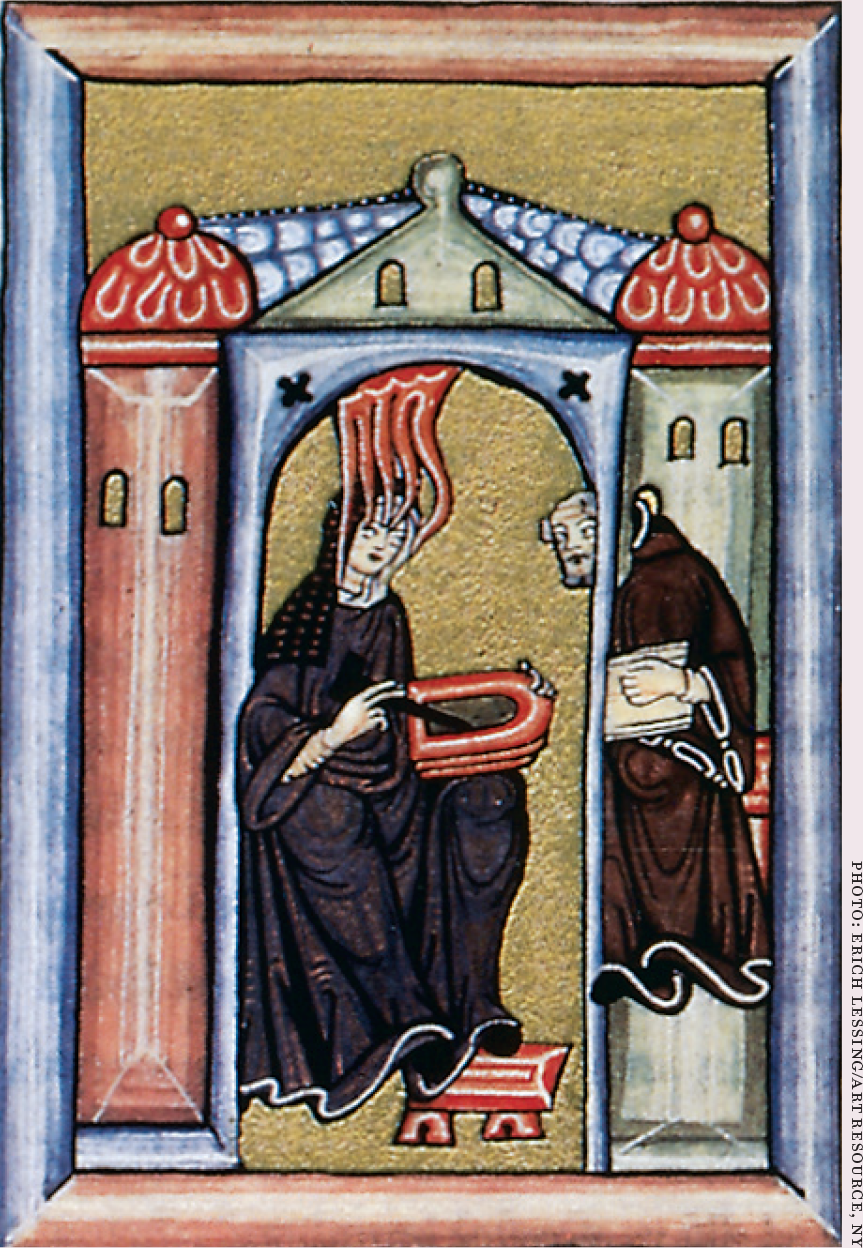
Famous for her prophecies, Hildegard corresponded with emperors, kings, popes, and bishops and preached throughout Germany. Her many prose works include Scivias (Know the Ways, 1141–51), an account of twenty-six visions, and books on science and healing, Physica and Causae et Curae, which present a holistic approach using natural medicines for many ailments.
Hildegard wrote religious poems as well as prose, and by the 1140s she was setting them to music. Her songs, primarily antiphons and responsories for the Office and sequences for Masses dedicated to local saints, are preserved in two manuscripts organized in a liturgical cycle, with indications that many were sung in her convents and nearby monasteries and churches. Her Ordo virtutum (The Virtues, ca. 1151) is the earliest surviving music drama not attached to the liturgy. In a male-dominated church with a prescribed liturgy and repertory of chant, Hildegard had to make a place in the margins, for herself and for her compositions.
MAJOR WORKS Ordo virtutum, 43 antiphons, 18 responsories, 7 sequences, 4 hymns, 5 other chants
Reputation Hildegard claimed that her songs, like her prose writings, were divinely inspired. At a time when women were forbidden to instruct or supervise men, having a reputation for direct communication from God was the only way she could be heard outside the convent. She was renowned as a visionary, but her music, like that of countless other composers, was apparently known only locally. Her writings were edited and published in the nineteenth century, her music only in the late twentieth century when she was rediscovered in the search to reclaim the history of music by women. She quickly became the most recorded and best-known composer of sacred monophony, and one of very few known to have written both the music and the words.