STUDY UNIT1.1Introduction to Interactive Psychology: People in Perspective
Explore...
What is psychology?
What different perspectives do psychologists use to examine the human mind and behavior?
How does science benefit from a diversity of approaches, populations, and scientists?
How can psychologists study abstract topics, such as love, scientifically?
Your alarm goes off, and you hit snooze because you want ten more minutes of sleep. Once you’re dressed, you head out to get your morning coffee—without the caffeine, you’ll fall asleep in class. On a street corner, you obey the red “Don’t Walk” signal to get across the street. You were supposed to do something before class, but you can’t remember what it is. Usually, you’re an easygoing person, but lately you’ve felt stressed because you have so much to do and so little time. Later, after you eat dinner, you spend an hour on social media before you climb into bed.
If this was your day (or if pretty much anything else was your day), psychology played a role in everything that happened to you. When your alarm wakes you up, your mind moves into a state of consciousness—what one expert has defined as “what you lose when you fall into a deep sleep at night and what you gain when you wake up in the morning” (Sanders, 2012, p. 22). The caffeine in your coffee gave you energy, demonstrating the link between what you eat (or drink) and your bodily states, such as sleepiness or awareness. On the street corner, structures in your eyes, called cones, allow you to see the red in the “Don’t Walk” sign. Being unable to remember the errand you were supposed to run reminds you that your memory can be unreliable. Your personality makes you typically calm and reliable, but because you’re feeling blue, you might develop a case of depression for which you might need treatment or therapy. Like almost all human beings, you need social interaction, and social media helps you stay in touch with people.
In short, psychology—the scientific study of mind and behavior—is everywhere (FIGURE 1.1). The psychological concepts, terms, and ideas that you will learn in this interactive ebook not only will increase your understanding of yourself; they also will help you analyze and interpret the world around you, giving you the insights and information you need to succeed in college, make good decisions, become a valued employee, maintain healthy and happy relationships, take care of yourself physically and emotionally, empathize with others, and think critically about local, national, and world events and controversies.
More information
A flat character vector art shows males and females involved in various activities. The activities are: Running; Clicking pictures; Going to work place; Cycling; Celebrating with cake; Delivering parcels; Riding kick push roller boards; Riding segway.
FIGURE 1.1 Psychology Is Everywhere
Psychology helps you better understand yourself and others.
Because human behavior is extremely complex, it is best understood from a number of different perspectives. When combined, these perspectives yield a far richer and more complete picture than would have been available from any single perspective alone. TABLE 1.1 summarizes some of the different perspectives that psychologists use to approach a problem or search for the answer to a question. We examine each of these perspectives briefly in study units later in this chapter and in more depth later in this book. As we will see, each perspective offers rich insights but also has its limitations. Only by combining different perspectives can we develop a fuller understanding of the mind and behavior. As you will discover, there are several “big ideas” regarding the human mind and behavior that arise from these different perspectives. Specifically:
Psychological, biological, social, and cultural factors interact to influence behavior and mental processes.
Behavior is shaped by conscious understanding and by unconscious processes.
Human perceptions and biases filter our experiences of the world through an imperfect personal lens.
Human behavior involves typical functioning and disruptions to typical functioning, both providing insight into how the mind and behavior operate.
Applying psychology can change our lives, organizations, and communities in positive ways.
By combining different perspectives, we can also develop a fuller understanding of how psychology operates, as a field. Specifically, you will discover that:
Psychology relies on empirical evidence and adapts as new data develop.
Psychology seeks to identify which aspects of behavior are universal to all people and which aspects vary across individuals and groups.
Psychology values diversity, promotes equity, and fosters inclusion in pursuit of a more just society.
Ethical principles guide psychology research and practice.
TABLE 1.1
Psychological Perspectives and Unifying Themes of Psychology
Each of the perspectives corresponds to a subfield of psychology.
EXPLAINING BROADER PATTERNS OF BEHAVIOR
Evolutionary perspective
Identifies aspects of behavior that are the result of evolutionary adaptations
Cultural perspective
Investigates how cultural context affects people’s thoughts and preferences
UNDERSTANDING CURRENT THOUGHTS AND FEELINGS
Cognitive perspective
Studies the mental processes that underlie perception, thought, learning, memory, language, and creativity
Emotional perspective
Examines how the human capacity to feel, express, and perceive emotions plays an important role in decision making, behavior, and social relationships
IDENTIFYING THE ROLES OF THE BODY AND BRAIN
Biological–neuroscience perspective
Studies the biological underpinnings of how we think, act, and behave
ACKNOWLEDGING BOTH STABILITY AND CHANGE IN BEHAVIOR ACROSS TIME AND SITUATION
Developmental perspective
Examines how people change physically, cognitively, socially, and emotionally as they age
Personality perspective
Seeks to understand aspects of behavior that are relatively stable over time and situation
Social perspective
Considers the ways in which immediate social contexts influence thoughts, feelings, and behaviors
Clinical perspective
Focuses on the causes and treatments of psychological disorders, with the goal of improving human well-being, daily functioning, and social relationships
In addition to applying different perspectives to any given behavior, it is also important to study the phenomenon in different populations. We must guard against the assumption that what is true in Western cultures will also be true elsewhere in the world (Henrich et al., 2010).
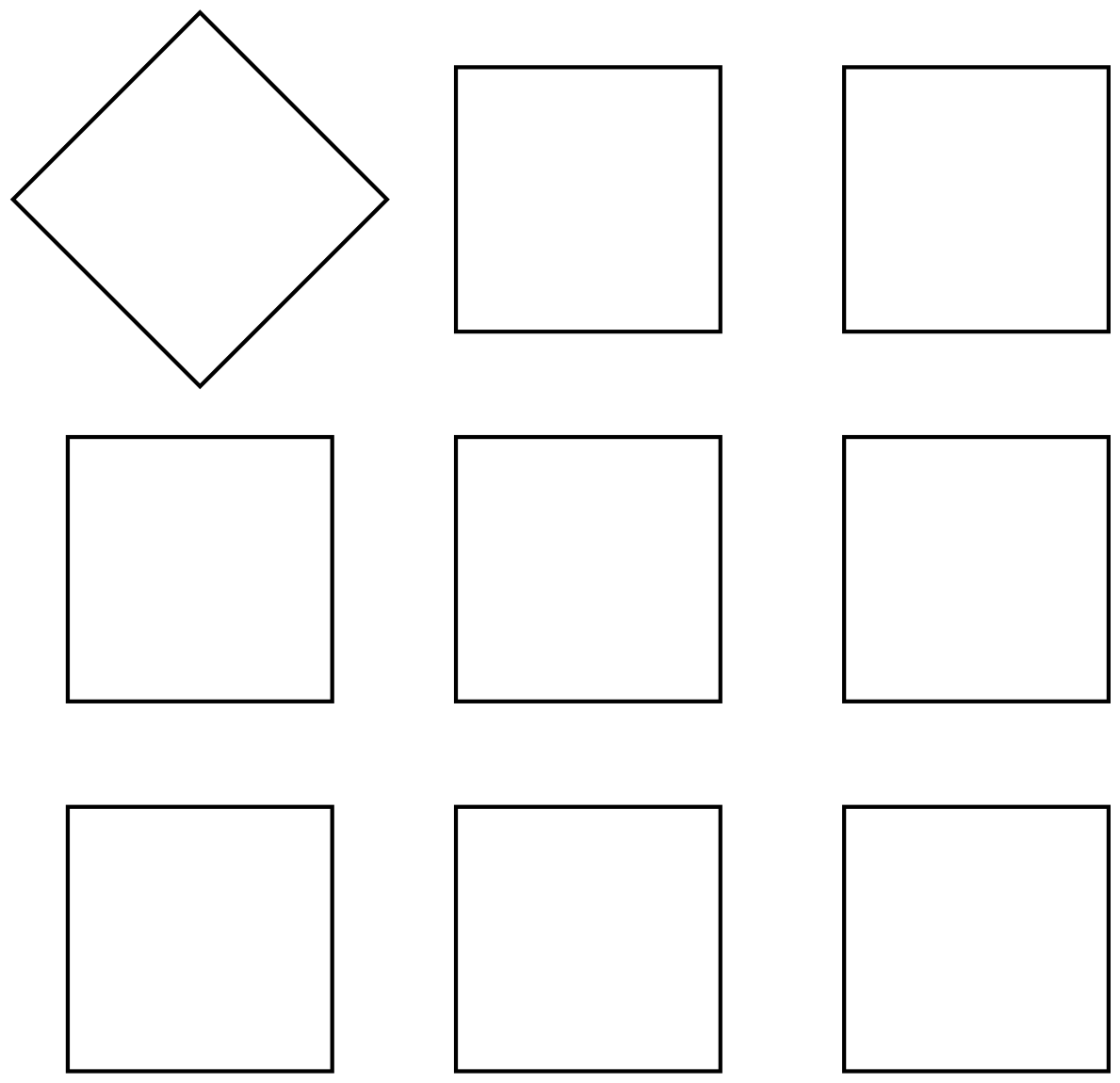
Indeed, psychologists have uncovered cultural differences in vision, psychological disorders, and personality. For example, look at FIGURE 1.2, and rank your preference for each of the small shapes that make up the larger shape. Do you prefer the square that is different from the others, or do you prefer the shapes that fit together? If you are European American, the off-kilter square in the upper-left corner is more likely to be one of your top three favorite shapes than if you are Chinese American (H. Kim & Markus, 1999; H. S. Kim & Sherman, 2008).
FIGURE 1.2 Culture Differences in a Preference for Uniqueness Versus Harmony
Which of the small shapes do you prefer? Your cultural background may influence whether you prefer shapes that conform or shapes that depart from the overall pattern. (Kim & Markus, 1999)
This preference may be just one small example of a larger cultural phenomenon whereby the Western world promotes and values uniqueness and individuality. In contrast, the Eastern cultures of China, Japan, and Korea place more value on harmony and conformity. However, these general cultural preferences do not always override individual preferences, so in any given culture there will always be people whose preferences differ from those of the larger group. Still, as we build an understanding of human behavior, we need to be mindful of cultural variation.
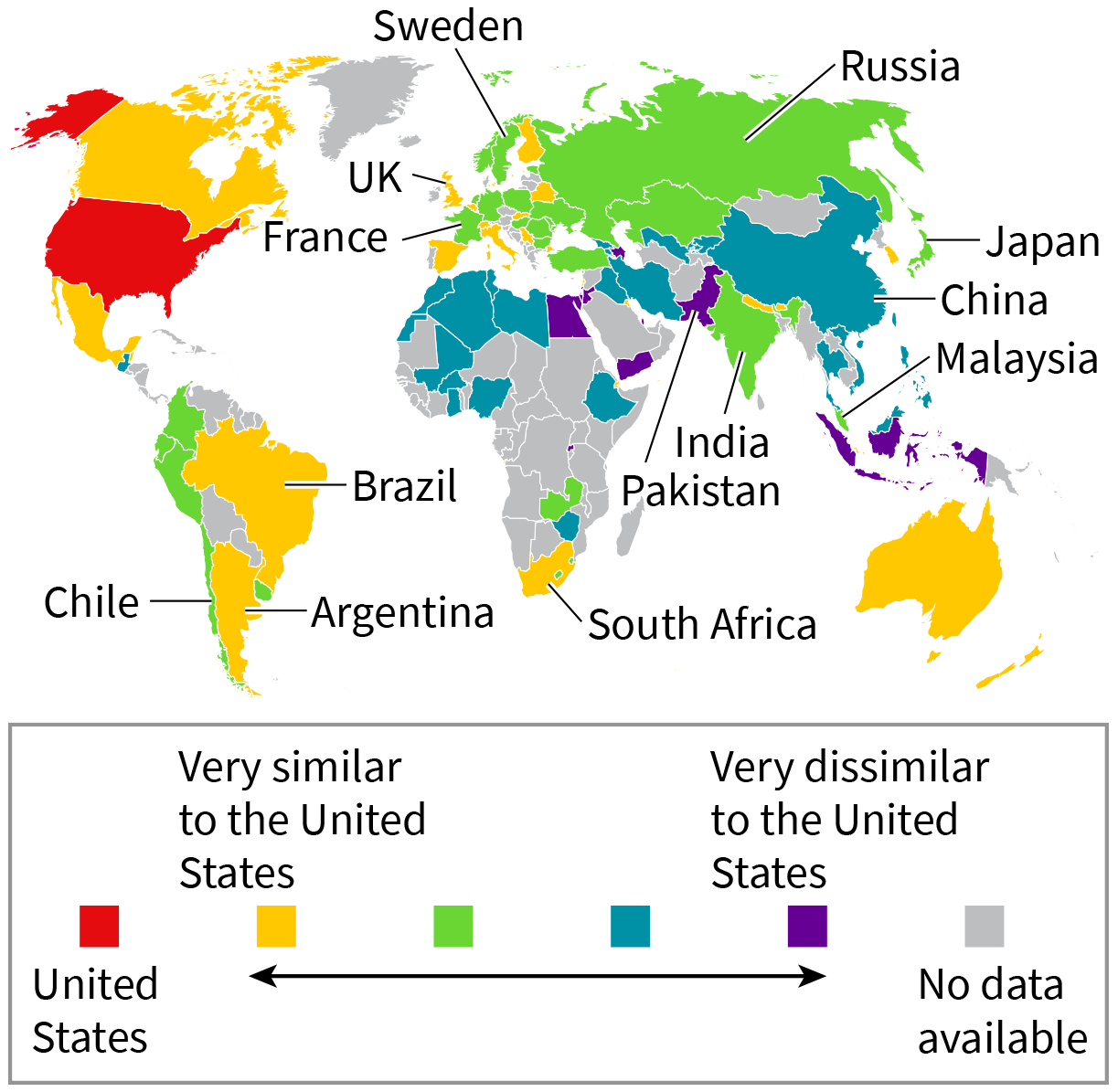
Some psychologists note that much of the existing knowledge base in psychology is based on WEIRD samples—research participants from Western, educated, industrialized, rich, and democratic backgrounds (Henrich et al., 2010). For example, a large percentage of research in psychology is carried out in the United States, but as FIGURE 1.3 shows, many parts of the world are psychologically and culturally dissimilar from the United States. There is literally a world of behavior the field has yet to explore, though progress is being made and you will see many examples of the field’s broadening focus throughout this interactive ebook.
More information
A map of the world uses various colors to demonstrate how similar or dissimilar a country is to the United States. A scale of very similar to the United States to very dissimilar to the United States is shown at the bottom.
The key at the bottom of the map shows that the United States appears in red. Countries that are very similar to the United States appear on the map in yellow and include Canada, Mexico, Brazil, Argentina, UK, Spain, Italy, Finland, Nepal, Australia, New Zealand, South Korea, Belarus, Djibouti, Kuwait, Bhutan, and Denmark. Countries that are similar to the United States appear in green and include Columbia, Ecuador, Peru, Chile, Uruguay, Sweden, Norway, Germany, France, the Netherlands, Poland, Ukraine, Romania, Bulgaria, Russia, Kazakhstan, Turkey, India, Malaysia, and Japan. Countries that are more dissimilar than similar to the United States appear in blue and include Guatemala, Western Sahara, Morocco, Algeria, Libya, Mali, Burkina Faso, Ghana, Ethiopia, Georgia, Syria, Iraq, Uzbekistan, Kyrgyzstan, China, Thailand, and the Philippines. Countries that are very dissimilar to the United States appear in purple and include Egypt, Israel, Azerbaijan, Pakistan, and Indonesia. All other countries are shaded gray to signify no data available.
FIGURE 1.3 Cultural Distance From the United States
Based on survey responses from around the world, this map shows other countries’ levels of cultural and psychological similarity or dissimilarity to the United States. (Muthukrishna et al., 2018)
One way to increase the chance that scientists will examine more psychological phenomena, using more diverse perspectives, in more cultural contexts is to encourage people from different backgrounds to become psychological scientists and to work together, perhaps collaborating across oceans or continents. For example, our current understanding of the cultural differences between Eastern and Western cultures is informed by a long collaboration that started in the 1980s between Hazel Markus, originally from the United States, and Shinobu Kitayama, originally from Japan. Together, their research has revealed how people in Western cultures tend to see themselves as independent entities, whereas those in the Eastern cultures are more likely to define themselves by their relationships with others (H. R. Markus & Kitayama, 1991, 2003).
Psychological science has a truly vast scope. It is concerned with understanding the full range of humans (from very young to very old, and across every culture and context), as well as the full range of human mental activities (from sensing to acting, and everything in between). It uses an astonishing array of approaches and methods, frequently seeking insights from nonhuman animals as well as from other related disciplines in both the sciences and humanities. To make progress, psychology strives to adopt and integrate diverse perspectives, seek out and examine diverse populations, and attract and develop scientists with diverse experiences and skills. Only in this way will we develop a more complete understanding of what it means to be human.