2.4How the Budget Line Changes
When prices and incomes change, the set of goods that a consumer can afford changes as well. How do these changes affect the budget set?
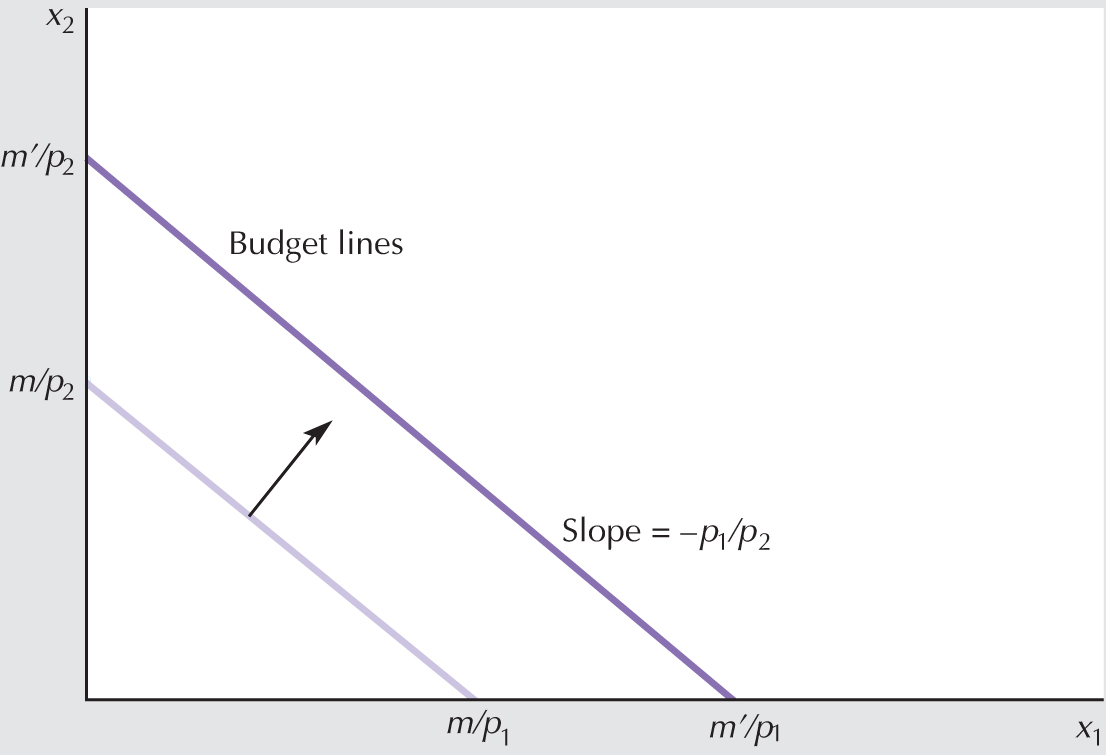
Let us first consider changes in income. It is easy to see from equation (2.4) that an increase in income will increase the vertical intercept and not affect the slope of the line. Thus an increase in income will result in a parallel shift outward of the budget line as in Figure 2.2. Similarly, a decrease in income will cause a parallel shift inward.
More information
A budget line shift, shown with x 1 on the horizontal axis and x 2 on the vertical axis. The initial budget line is a straight line with horizontal intercept m over p 1 and vertical intercept m over p 2. The shifted budget line is parallel to the initial one but farther from the origin. It has horizontal intercept m prime over p 1 and vertical intercept m prime over p 2. Both budget lines have slope negative p 1 over p 2.
FIGURE 2.2 Increasing income. An increase in income causes a parallel shift outward of the budget line.
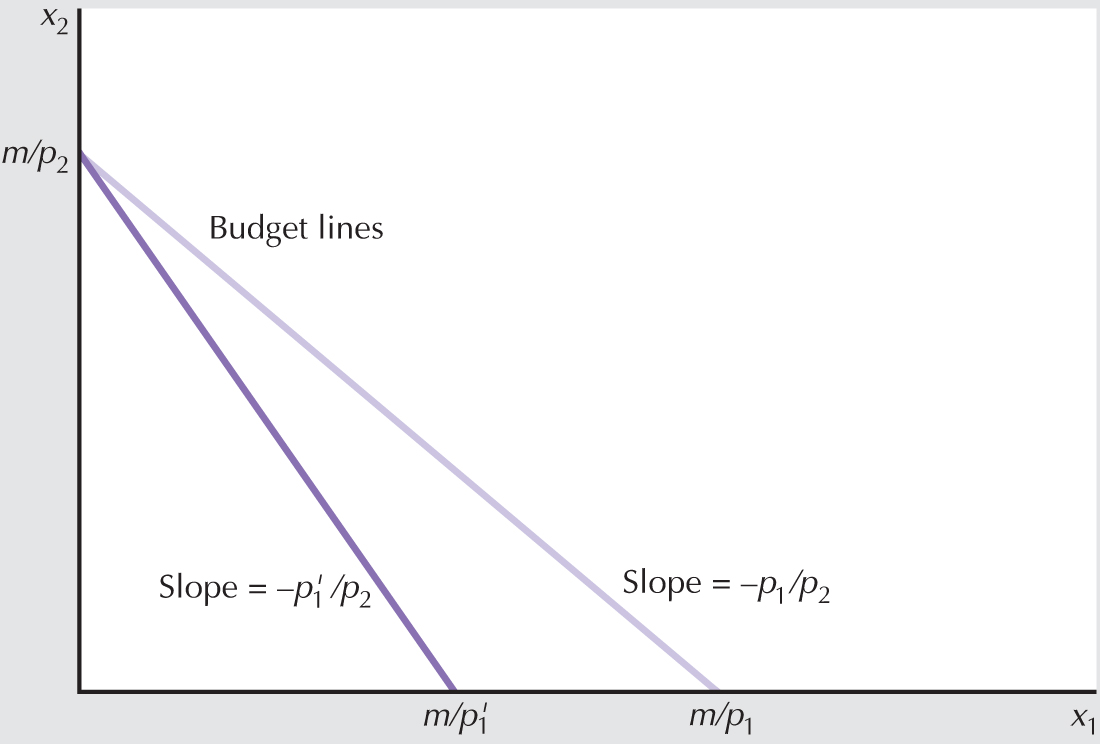
What about changes in prices? Let us first consider increasing price 1 while holding price 2 and income fixed. According to equation (2.4), increasing will not change the vertical intercept, but it will make the budget line steeper since will become larger.
Another way to see how the budget line changes is to use the trick described earlier for drawing the budget line. If you are spending all of your money on good 2, then increasing the price of good 1 doesn’t change the maximum amount of good 2 you could buy—thus the vertical intercept of the budget line doesn’t change. But if you are spending all of your money on good 1, and good 1 becomes more expensive, then your consumption of good 1 must decrease. Thus the horizontal intercept of the budget line must shift inward, resulting in the tilt depicted in Figure 2.3.
More information
The effect on a budget line when the price of good 1 increases while the price of good 2 remains the same. The initial budget line has horizontal intercept m over p 1 and vertical intercept m over p 2. Its slope is negative p 1 over p 2. The price increase causes the budget line to rotate clockwise about the vertical intercept, so that the vertical intercept does not change but the horizontal intercept moves leftward, to m over p 1 prime. The new slope is negative p 1 prime over p 2.
FIGURE 2.3 Increasing price. If good 1 becomes more expensive, the budget line becomes steeper.
What happens to the budget line when we change the prices of good 1 and good 2 at the same time? Suppose for example that we double the prices of both goods 1 and 2. In this case both the horizontal and vertical intercepts shift inward by a factor of one-half, and therefore the budget line shifts inward by one-half as well. Multiplying both prices by two is just like dividing income by 2.
We can also see this algebraically. Suppose our original budget line is Now suppose that both prices become times as large. Multiplying both prices by yields But this equation is the same as Thus multiplying both prices by a constant amount is just like dividing income by the same constant . It follows that if we multiply both prices by and we multiply income by , then the budget line won’t change at all.
We can also consider price and income changes together. What happens if both prices go up and income goes down? Think about what happens to the horizontal and vertical intercepts. If decreases and and both increase, then the intercepts and must both decrease. This means that the budget line will shift inward. What about the slope of the budget line? If price 2 increases more than price 1, so that decreases (in absolute value), then the budget line will be flatter; if price 2 increases less than price 1, the budget line will be steeper.