THE ENSEMBLE
A jazz orchestra usually consists of trumpets, trombones, saxophones, piano, bass, and drums; a piano trio usually includes a piano, bass, and drums; a quintet usually consists of saxophone, trumpet, piano, bass, and drums. Yet jazz masterpieces have also been created for unaccompanied piano or saxophone; trumpet and piano; piano, bass, and guitar; organ, guitar, and drums; combined big band and symphony orchestra; multiple percussionists; and so forth, to the limit of instrumental resources and artistic imagination. At present, there is no jazz masterwork for turntable, but tomorrow there may be.
Wind Instruments (Horns)
In jazz, the largest category of instruments consists of those that produce sound by moving air—all referred to in jazz (unlike classical music) as wind instruments, or horns. The physics of wind instruments is fairly simple. Blowing on or into a tube sets a column of air in vibration, producing a particular sound. (Most wind players generate a slight wobble in pitch, known as vibrato.) Musicians can modify that sound by adjusting the length of the tube, or by blowing with increased intensity. The latter involves changing the embouchure, the positioning of the lips and other facial muscles—this forces the vibration to suddenly jump to a new level, raising the pitch.
BRASS: The trumpet has an unmistakable timbre: a brittle, crisp attack with brilliant overtones. A player can vary his timbre by half-valving: depressing one or more of the valves only halfway. Another technique is the shake, a quick trill between two notes that mimics a wide vibrato. And many trumpet players carry with them a small arsenal of mutes, each with its own distinctive possibilities.
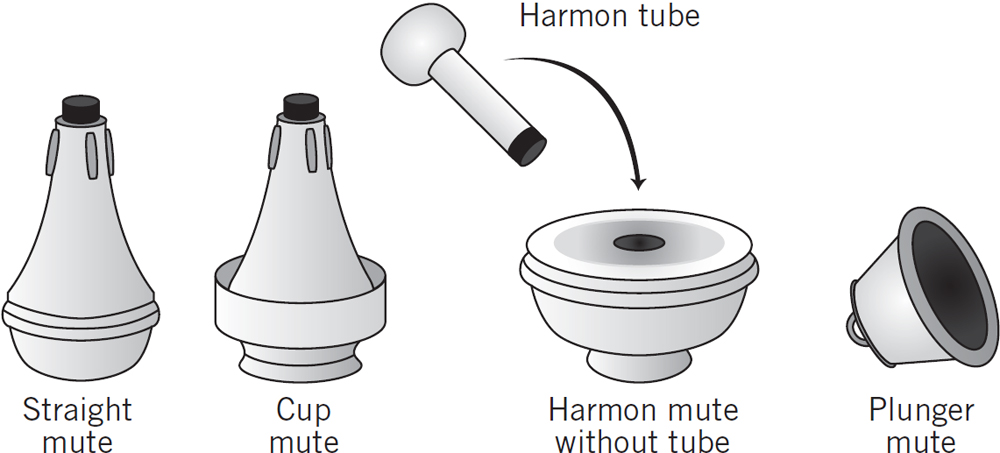
The straight mute, inserted directly into the bell of the instrument, quiets the sound without too much distortion. The cup mute adds an extension that more or less covers the bell, further attenuating the sound while rounding it out. The Harmon mute is a hollow mute with a hole in the center; originally the hole was filled with an adjustable sliding tube, suitable for comic effects, but most jazz musicians simply discarded the tube, creating a highly concentrated sound. Finally, the plunger mute is as simple as the name suggests: it’s the rubber end of a sink plunger. By moving the plunger in various positions away from the bell, the player can adjust the sound so expertly that it resembles human speech. Often these mutes are used in combination. Bubber Miley, a soloist with the early Duke Ellington band, developed an unearthly sound by modifying his trumpet, already muted with a tiny, straight pixie mute, with a plunger—all the while growling in his throat.
TRUMPET OR CORNET?
The similarity between the trumpet and the cornet causes much confusion in discussions of early jazz. The two instruments look and sound alike: the cornet has an extra layer of tubing and a deeper mouthpiece, producing a slightly mellower timbre. They are so similar that it is often impossible to distinguish which of the two is heard on recordings made in the 1920s. Adding to the confusion is the inclination of some commentators and musicians to refer to the trumpet as a cornet, and vice versa. Although the cornet dominated jazz at first, by 1926 it began to lose favor to the trumpet, with its brighter, more piercing sound.
The trombone’s occasionally comical slide enables the player to glide seamlessly from one note to another, an effect known as a glissando, or smear. Given how difficult it is to play pitches accurately by pumping a single slide, the achievement of virtuoso jazz trombonists is remarkable.
REEDS: The clarinet, a slim, cylindrical, wooden tube that produces a thin, occasionally shrill sound, was a standard component of the New Orleans jazz style. It achieved greater renown during the Swing Era of the 1930s, when two of the most popular bandleaders, Benny Goodman and Artie Shaw, offered an inadvertent rivalry that excited fans. Beginning in the early 1960s, thanks chiefly to Eric Dolphy, the bass clarinet (pitched lower than the regular clarinet) found acceptance by musicians and is still often heard.
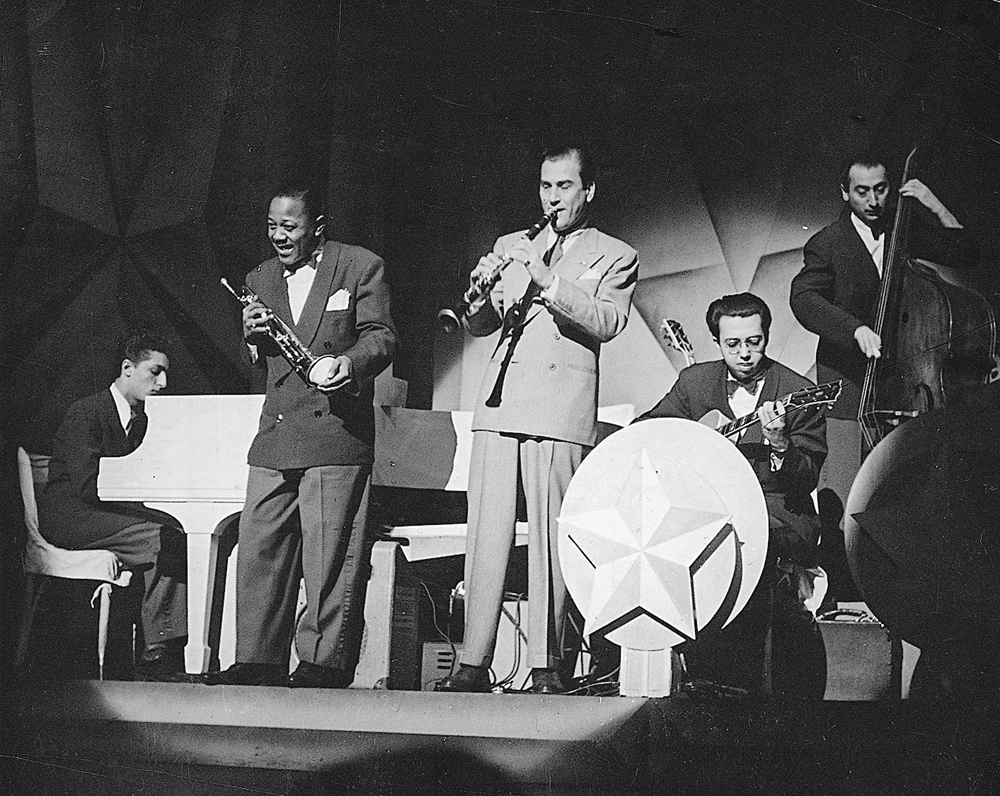
During the Swing Era, Artie Shaw rivaled Benny Goodman for popularity on the clarinet. Here, Shaw leads one of the few integrated small groups in 1945: Dodo Marmarosa (piano), Roy Eldridge (trumpet), Shaw, Barney Kessel (guitar), Morris Raymond (bass).
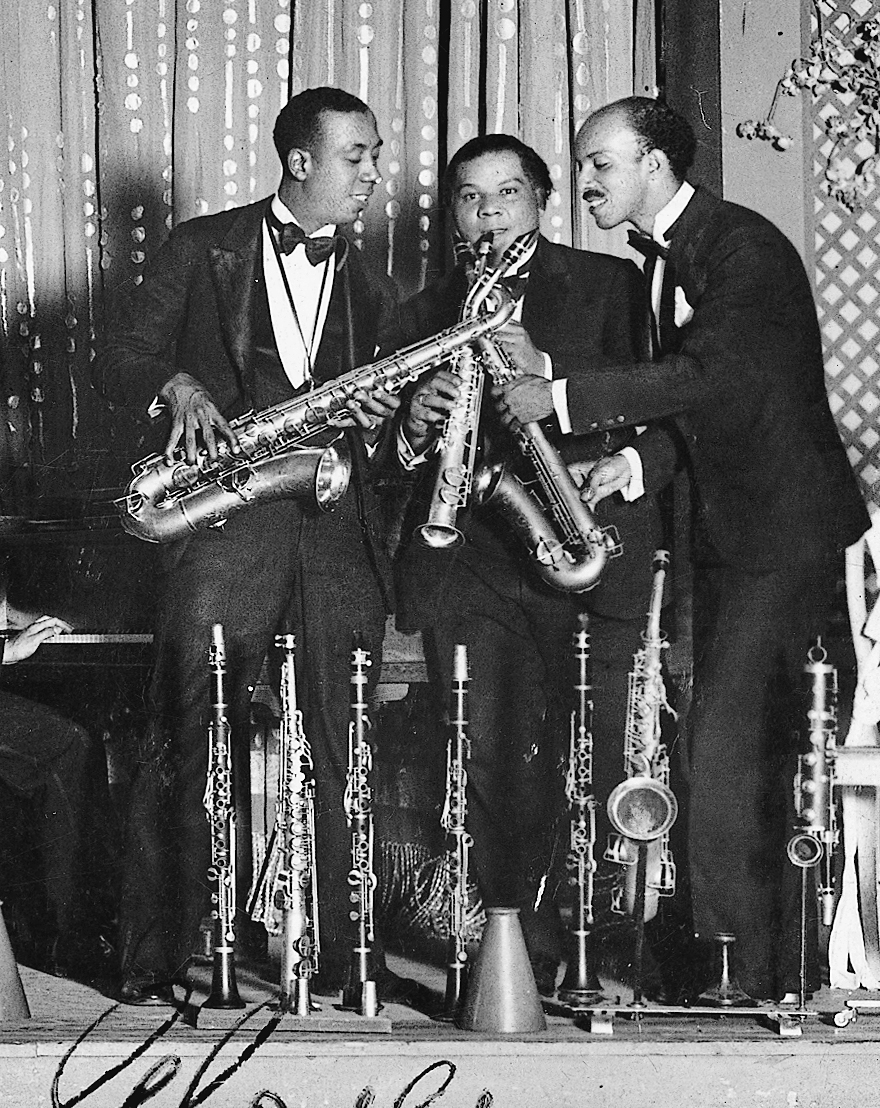
New Orleans virtuoso Sidney Bechet (center) was trained on the clarinet (several are lined up on the stage floor), but he soon switched to the soprano saxophone, a straight instrument that contrasts visually with the alto saxophone (held by Otto Hardwick, right) and the tenor (Frank “Big Boy” Goudie). In the Noble Sissle band, 1928.
Far more common in jazz is the saxophone, the one wind instrument jazz can claim as its own. The kinds used most often are the alto, tenor, soprano, and baritone saxophone. In the early twentieth century, dance bands and vaudeville performers embraced the instrument as much for its parody potential as musical versatility. By 1930, thanks to such premier players as Sidney Bechet (soprano), Coleman Hawkins (tenor), Johnny Hodges and Benny Carter (alto), and Harry Carney (baritone), the saxophone had become the soul of American music: an all-purpose instrument able to play sweet or hot while suggesting tenderness or aggression.
With both saxophone and clarinet, musicians can vary the quality of pitches by flicking their tongue against the mouthpiece, growling into the instrument, or blowing intensely enough to produce more than one pitch, known as multiphonics.
Rhythm Section
PIANO: The members of the accompanying rhythm section have changed over time, as jazz has changed, but they usually number three or four, and their functions have remained stable: to provide harmony, bass, and percussion. Some instruments are naturally designed to play chords (harmony), including the vibraphone, organ, synthesizer, electric piano, guitar, and, in the earliest years, banjo. The most important, though, is the acoustic piano. Pianists may use the wide range of the keyboard (over seven octaves) to imitate the sound of a full orchestra or pound on the keys like a drum.
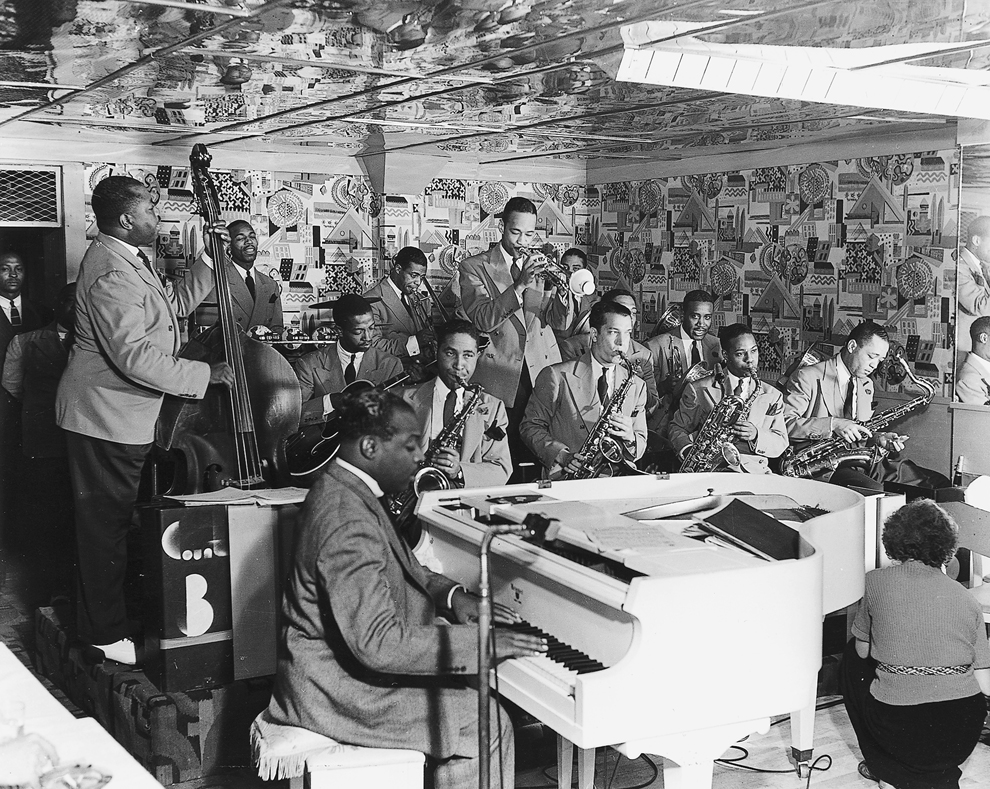
The “All-American” rhythm section of the Count Basie band was light yet powerful. From left to right: Walter Page, bass; Jo Jones, drums; Freddie Green, guitar; and Basie, piano. The rest of the band, crowded into the tiny bandstand at New York’s Famous Door in 1938, from front row to back: Herschel Evans, Earl Warren, Jack Washington, and Lester Young, saxophones; Buck Clayton (standing), Ed Lewis, Harry Edison, trumpets; Benny Morton, Dan Minor (hidden behind Clayton), Dicky Wells, trombones.
BASS: The bass is the rock on which the jazz ensemble is built. In a performance, we are naturally inclined to pay attention to the trumpet or saxophone soloist, while also registering the drums and pianist. The bass can get lost in the undercurrent unless we focus on it. Musicians are always focused on it. It has, roughly speaking, two crucial functions: playing notes that support the harmony, and providing a basic underlying rhythmic foundation. The most common instrument to fill this role is the string bass (also known as double bass), the same instrument used in symphony orchestras. Classical musicians usually draw a horsehair bow across the strings, a technique known as arco. Jazz musicians also use the bow, but they prefer the technique known as pizzicato: plucking the strings with their fingers. The plucked string has a percussive power that is much better suited to jazz’s rhythmic nature. In the past half century, the string bass has often been supplanted by the guitar-like electric bass, which, though lacking the powerful natural resonance of the string bass, has the advantages of loudness and portability.
DRUMS: The drum kit, or traps (short for “contraption”), is a one-man percussion section within the rhythm section within the band. While every jazz drummer configures the drum set in his own manner, the basic arrangement is fairly stable. The drummer sits on a stool in the center of a semicircular assembly of drums and cymbals, with the powerful bass drum front and center. The snare drum, with its penetrating, rattling sound, stands on an adjustable stand at knee level. Spreading out from it are two or more middle-size drums without snares, called tom-toms, which are tuned according to taste and come in various sizes.
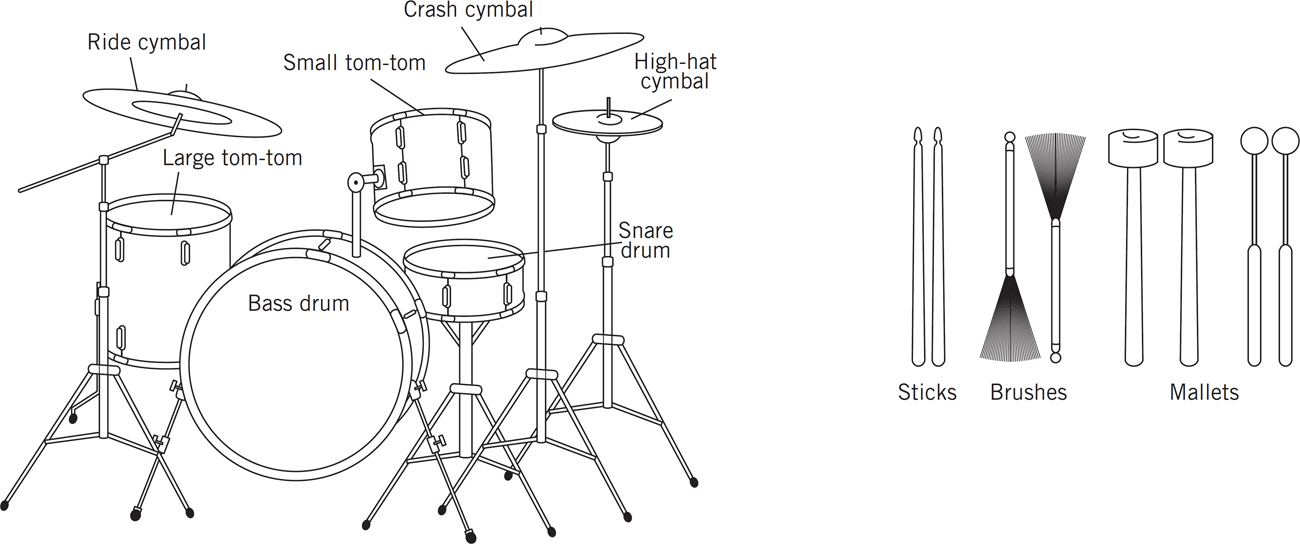
A forest of cymbals provides a steely contrast to the drums below them. Two are suspended. The medium-size ride cymbal has a clear, focused timbre and is played more or less continuously—the band “rides” on its lithe rhythmic pulse. The slightly smaller crash cymbal has a splashy, indeterminate pitch, not unlike a small gong, and is used for dramatic punctuations. The third essential cymbal, the high-hat, consists of two shoulder-level cymbals on an upright pole with a foot pedal at its base. The pedal brings the top cymbal crashing into the lower one with a distinct chunk.
A jazz drummer will typically use his right foot on the bass drum pedal, his left on the high-hat pedal, his right hand wielding a stick on the ride cymbal, and his left holding a stick to play the snare drum or tom-tom. Along with wooden sticks, the drummer may use wire brushes to strike or literally brush the drumheads, or mallets for conveying a soft, quiet rumble. What distinguishes jazz drumming is the sheer virtuosity—the flexibility and subtlety—that keeps other musicians and the listener involved, a task very different from merely keeping the beat. The drummer is free to respond to whatever the soloist plays and is expected to be attentive and quick-witted enough to fill in the empty spaces or to know when not to.

Latin percussion
Some drummers don’t play the traps at all. These are the masters of Latin percussion. Congas are tall drums of equal height but different diameters, with the smaller one assigned the lead role. The much smaller bongos have two drumheads, one larger than the other, compact enough to sit between the player’s knees. The timbales consist of two drums mounted on a stand along with a cowbell and are played with sticks by a standing musician. Among other percussion instruments are shakers (the maraca is a gourd filled with beans) and scrapers (the guiro is a gourd with ridges). In recent decades, jazz bands often include—in addition to the regular drummer—a percussionist who works with dozens of instruments: shakers, scrapers, bells, blocks, and noisemakers of every description. Percussion, like music, is a world without end.