TEXTURE
The balance between harmony and melody produces texture, of which there are three basic types: homophony, in which a melody is supported by harmonic accompaniment; monophony, where a melody exists on its own, without harmonic accompaniment; and polyphony, in which two or more melodies of equal interest are played at the same time.
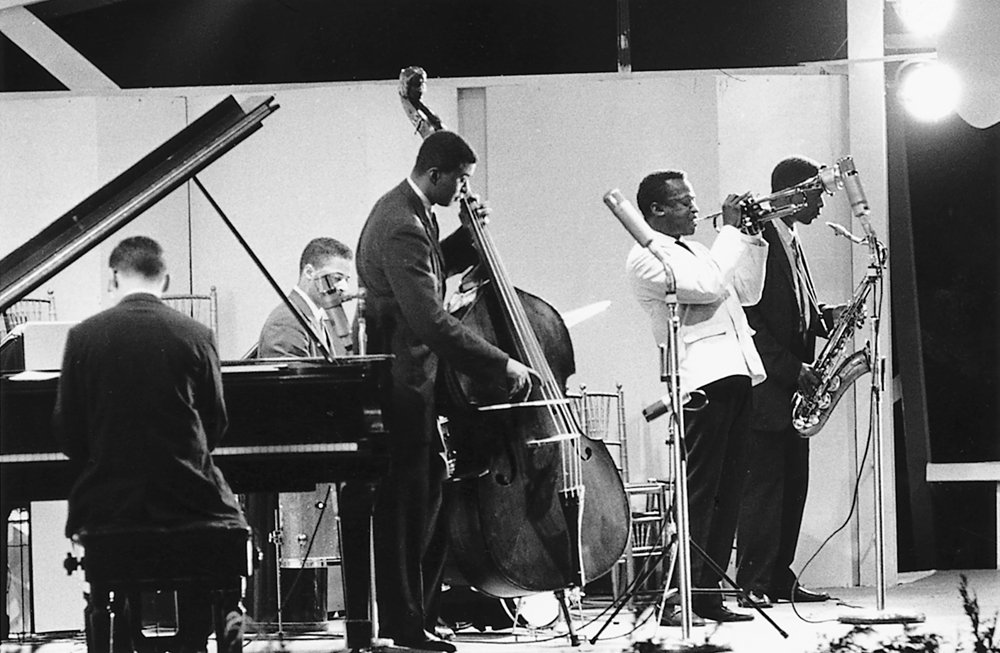
The year before he released his landmark album Kind of Blue (1959), on which “So What” is featured, Miles Davis took his new band on the road. This picture shows five of its six members at the Newport Jazz Festival in July 1958: Bill Evans, Jimmy Cobb, Paul Chambers, Davis, and John Coltrane.
Homophony

Block-chord texture
Most music in and out of jazz is homophonic. We’re used to hearing a strong main melody supported by a harmonic accompaniment. With homophony, the melody and the harmony are usually in separate musical layers: a guitar accompanying a singer, for example, or the pianist and bassist playing harmonies beneath Charlie Parker’s saxophone in “Now’s the Time.” But in one important sub-category of homophonic music, the melody and harmony exist in a single layer: two or more instruments play the same phrase in the same rhythm, but with different pitches filling out the harmony, as in barbershop quartets. In jazz, this is called block-chord texture. Big bands depend on block chords. The first vocal trio in Paul Whiteman’s “Changes” sings in block-chord harmony; the two-note harmonized figure played by three wind instruments in the theme of “So What” is also an example of block-chord texture.
Countermelody
Another sub-category is countermelody, or obbligato, where the subordinate instruments have melodic interest of their own, but not enough to compete with the main melody. In “A Sailboat in the Moonlight,” Billie Holiday sings the main melody and tenor saxophonist Lester Young accompanies her, creating melodic ideas so rich they race shoulder to shoulder with her. Still, Young knows his place, emerging at full volume only in the rests (silences) between Holiday’s vocal phrases.
Monophony
Breaks
When you sing in the shower, play a flute in the woods, or pick out a tune on the piano with one hand, you’re creating monophony: a melody with no harmonic accompaniment. If 50,000 people sing “The Star-Spangled Banner” (melody only) in a baseball stadium without a band, it’s still monophonic texture. In jazz, monophony usually occurs in solo breaks, when the rest of the band briefly stops playing to let a musician solo. A break, usually just two or four bars long, is a commonplace in early New Orleans jazz. It is at once a surprise that stimulates the audience and a challenge to the musician who has to fill the sudden space with a worthy moment. No matter how far jazz evolved, the break never lost its ability to impart a thrilling level of tension.

Stop-time
Another instance of monophonic texture involves stop-time rhythm, created when the ensemble plays a short chord at brief intervals—say, once every bar or once every other bar—and the soloist improvises with just these interruptions from the band prodding him on. Unlike the break, which rarely lasts more than two or four bars, stop-time is open-ended, lasting as long as the musicians want.
And monophonic texture is often used to begin or end a piece. Armstrong begins “West End Blues” with what many regard as the single most significant monophonic outburst in jazz history—a radiant trumpet fanfare, or cadenza, that keeps us on the edge of our seat until the rest of the band finally enters. In “Body and Soul,” the monophonic texture comes toward the end, as Coleman Hawkins lets the band drop out, leaving him with an unaccompanied passage that allows a heated performance to cool down.
Polyphony
In polyphonic texture, two or more melody lines compete for our attention simultaneously. Polyphony is a special province of classical music, where J. S. Bach epitomizes the art of counterpoint (the intertwining of several equal voices). In jazz, polyphony is treated more casually. New Orleans jazz often features polyphonic passages in which three instruments—trumpet, trombone, and clarinet—improvise at the same time, with no one melody standing out. Polyphony faded from jazz once New Orleans style was replaced by big-band swing, with its homophonic textures. Then in the 1950s, many musicians tried to revive this technique, often by imitating models from classical music. And in avant-garde jazz, players go to great lengths to institute equality between all the members in a band.