IMPROVISATION
How can ensemble music made up on the spot make sense? How do musicians manage to keep together? In short, what is improvisation and how does it work? As usual with jazz riddles, the place to begin is in the rhythm section, where each instrument fills multiple roles while working to create a supple and unified underpinning.
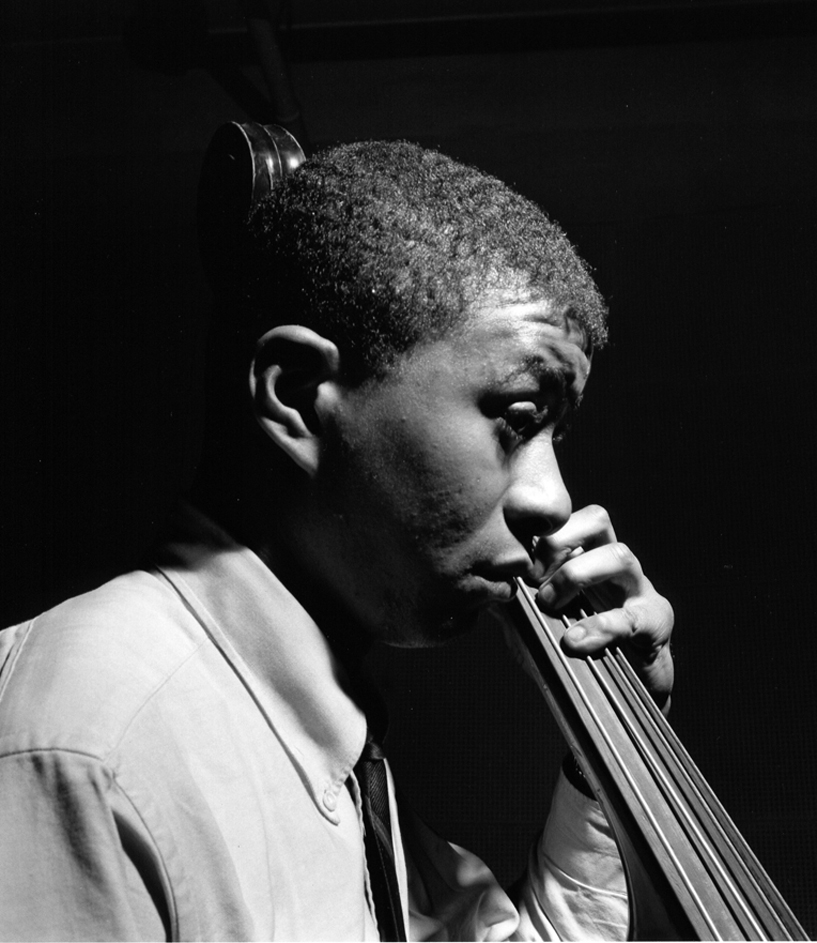
Paul Chambers, seen here in 1956, was the foundation of the Miles Davis rhythm section in the 1950s, and a bassist in demand for hundreds of recording sessions.
Rhythm Section: Bass
Traditionally, the bass has the most restricted role. It provides a rhythmic foundation layer, keeping steady time in a swing groove with a continuous and even string of notes. Because this sound is the neutral backdrop for every other rhythmic gesture, the bassist has little choice but to stick to the basic pattern. But at the same time, the bass plays a crucial harmonic role. Whenever a new chord appears on the chart (the musical score that serves as the basis for jazz performance), the bassist is responsible for playing that chord’s root. This creates a daunting challenge: he or she must produce a steady and consistent beat while fitting into a harmonic puzzle. Today’s bassists do this with ease.
During Miles Davis’s solo on “So What,” Paul Chambers’s bass line lies underneath, never calling attention to itself and never failing to fulfill its basic rhythmic and harmonic duties. Yet the line has a graceful melodic shape, a product of Chambers’s creative imagination. A good bass line is a subtle form of improvisation, constantly supporting and sometimes inspiring the soloist.
Piano
The primary harmony instrument in the rhythm section—usually a piano, but sometimes guitar, organ, vibraphone, or electric keyboards—has a different role. Every chart specifies the chords that must be played, with musical shorthand: Cmaj7, for example, means a C major triad (C-E-G) with a major seventh (B) added. But exactly how the chords are to be played is left open. At any given moment, the pianist can play the chord in any voicing (arrangement of notes) or add extra notes. He or she can also use harmonic substitutions—harmonies that replace the existing chord progression. Compare the first and fourth choruses of Armstrong’s “West End Blues.” In the first, pianist Earl Hines sticks to the script, playing basic chords on the beat. By the fourth, where he is the featured soloist, he replaces these chords with a dense harmonic thicket, carving his own path through the blues form with his broad knowledge of harmony.
The pianist also provides a variable rhythmic layer, constantly adding to the rhythms to enliven the groove. He or she listens closely to the rhythmic gestures of the drummer while “feeding” chords to the soloist, or comping.
Drums
In a typical swing groove, the drummer will play a more or less constant “ride” pattern with his right hand, while accenting the backbeat on the high-hat cymbal with his left foot. The right foot, controlling the bass drum pedal, plays thunderous accents (during and just after World War II, this was referred to as dropping bombs), while the left hand swoops over the rest of the drum kit, adding sharp responses on the snare drum, tom-tom, or crash cymbal. This is the default rhythm. When the drummer wants to add an improvised passage, or fill, he can use both feet and hands to create more complicated patterns. A good drummer can play many kinds of rhythm, shifting from swing to funk to Latin to a soft ballad to free jazz.
Listening to the rhythm section ought to be a delight in itself. Still, the limelight in a jazz performance shines most on the soloist. How exactly does the saxophonist or trumpet player decide which notes to play? We can offer a few general paradigms.
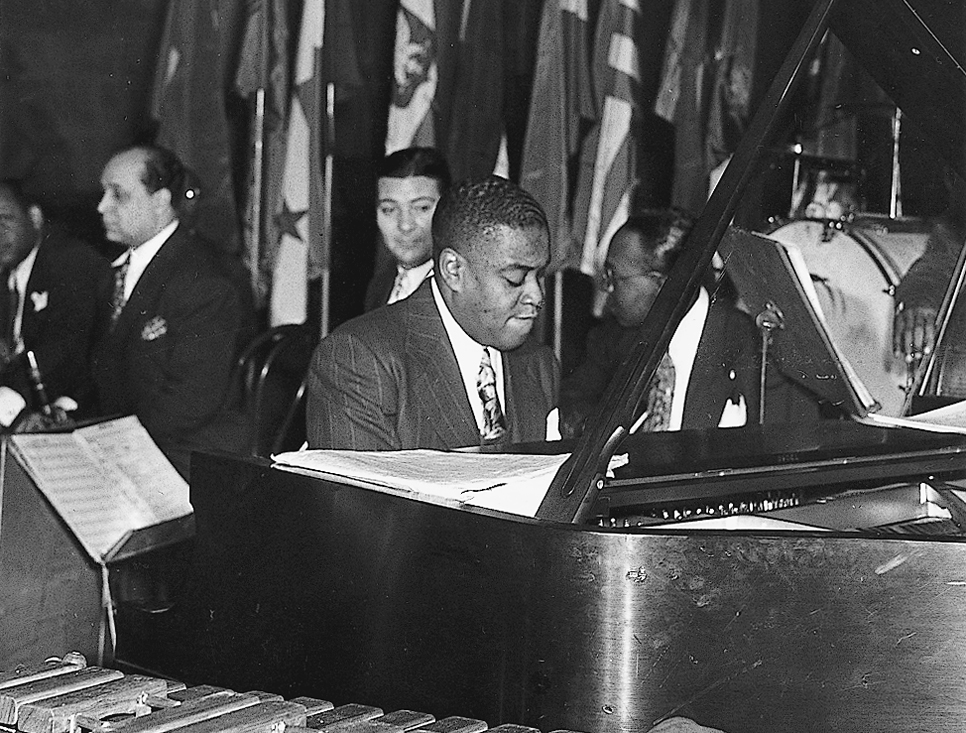
Art Tatum established the gold standard for jazz virtuosity as a piano recitalist, influencing generations of musicians with his startling harmonic substitutions. He’s shown here at a celebrated jam session with clarinetist Barney Bigard, trombonist Jack Teagarden, and guitarist Al Casey at the Metropolitan Opera House, 1944.
Soloists: Melodic Paraphrase
The simplest method of improvisation takes a preexisting melody—a song known by millions or an original composition by a member of the band—and varies it. This method, melodic paraphrase, typically adds notes and distorts the rhythm into something that swings, but does not disguise the source material. Jazz musicians often use melodic paraphrase at the beginning and end of a performance. Many jazz classics consist entirely of paraphrase. Throughout Art Tatum’s 1939 radio broadcast version of “Over the Rainbow” (Chapter 10), Tatum makes sure you can hear the melody. He is one of those rare jazz musicians who use the original melody to make their improvisation coherent at all times.
In the 1930s and 1940s, people knew the melodies (and words) to countless pop songs by heart, just as we do our favorite hits of today. Few of us are conversant with many songs from what we now call the Classic American Songbook, so in discovering jazz we find ourselves discovering those songs as well as the interpretations by great jazz stylists. It’s worth noting, in this context, that Tatum’s “Over the Rainbow” reversed that situation. The song, a standard that most of us do know, was generally unfamiliar to the audience that tuned in to his 1939 broadcast. The Wizard of Oz had opened only days before.
Harmonic and Modal Improvisation
Most jazz improvisers, however, quickly discard the original melody, which is probably the key reason some people find jazz incomprehensible. Musicians prefer to rely on the changes—a technique known as harmonic improvisation—and create new melodies that fit over the basic chord progression. Every decision must be made quickly as one chord changes to another, because melody notes that sound consonant (stable) with one chord can become painfully dissonant (unstable or jarring) in the next. When chords move fast, as they do in John Coltrane’s notorious harmonic labyrinth “Giant Steps,” playing them correctly becomes a superhuman task.
Another technique, modal improvisation, replaces a welter of chords with a stable scale or mode. Musicians who want to sound bluesy interpolate the blues scale, superimposing it over a passage as if it had no chords. In Charlie Parker’s third chorus in “Now’s the Time,” we hear a highly skilled harmonic improviser ignore the chords and play bluesy licks (short melodies) that contradict the underlying harmony—even though the tune itself is a blues. In “So What,” improvisers are expected to create their melodies from a scale known as the D Dorian (the piano white keys from D to D), shifting up a half step on the bridge. Modal improvisation shows that for jazz musicians, simplicity is just as important as complexity.