1.10 Resonance Theory
Some species are not described well by Lewis structures. In  , for example, both of the C—O bonds are identical experimentally; they have the same bond length and bond strength, intermediate between those of a single and a double bond (Fig. 1-21a). However, the Lewis structure of
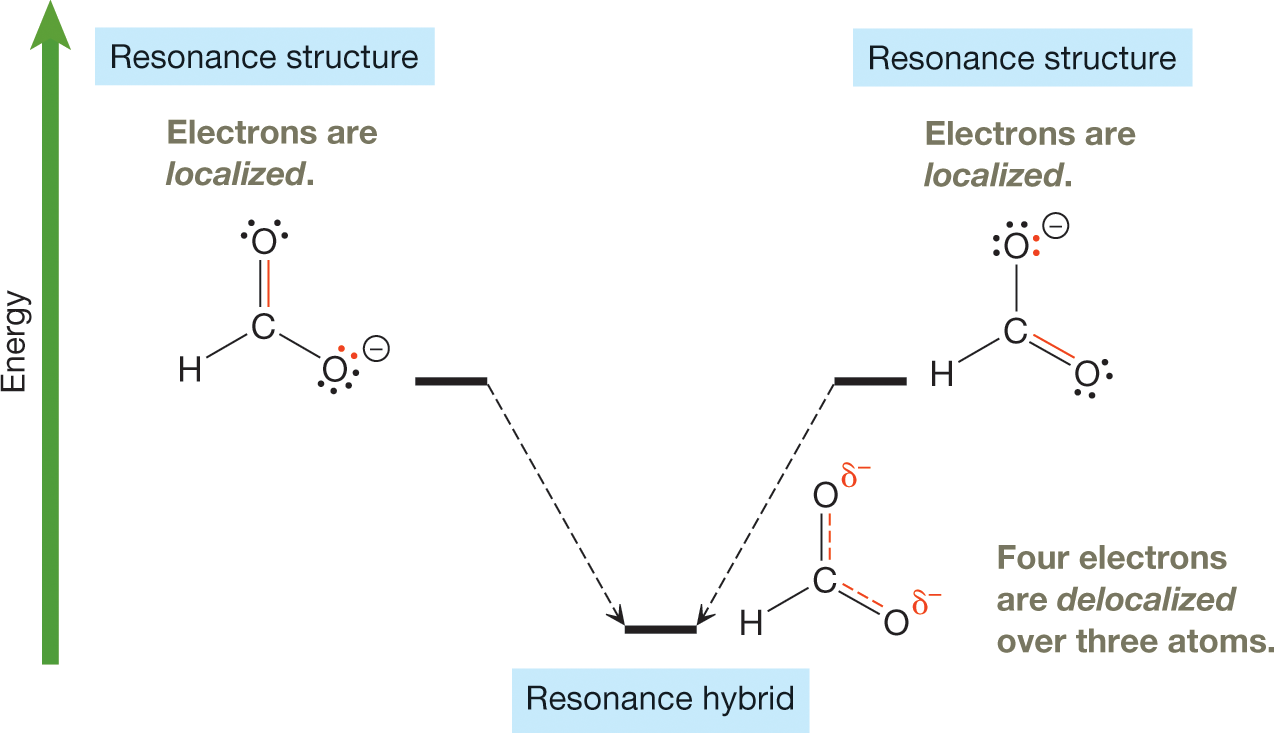
  (Fig. 1-21b) shows one C—O single bond and one C═O double bond, suggesting that the two bonds are different. Furthermore, experiments show that both oxygen atoms carry an identical partial negative charge (δ–), whereas the Lewis structure suggests that one oxygen atom bears a full negative charge and the other is uncharged. In other words, the Lewis structure suggests that the C═O double bond and the –1 charge are both confined to a specific region in space, or localized, whereas in the real species, they are spread out, or delocalized.
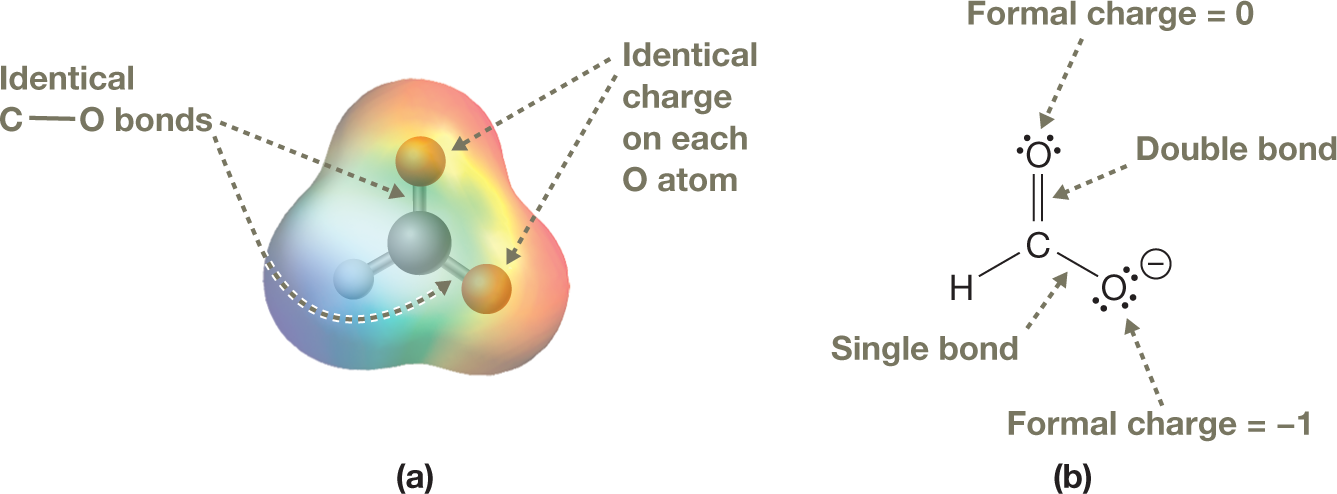
How, then, do we reconcile the differences between the Lewis structures of species like  and their observed characteristics? The answer is through resonance theory, the key points of which can be summarized by the following rules:
Rule 1
Resonance exists in species for which there are two or more valid Lewis structures.
For such species, each valid Lewis structure is called a resonance structure or a resonance contributor. In  , there are two possible resonance contributors. As we can see on the next page, they differ in how we apply Step 5 for drawing Lewis structures—that is, which neighboring lone pair is used to construct the C═O double bond.
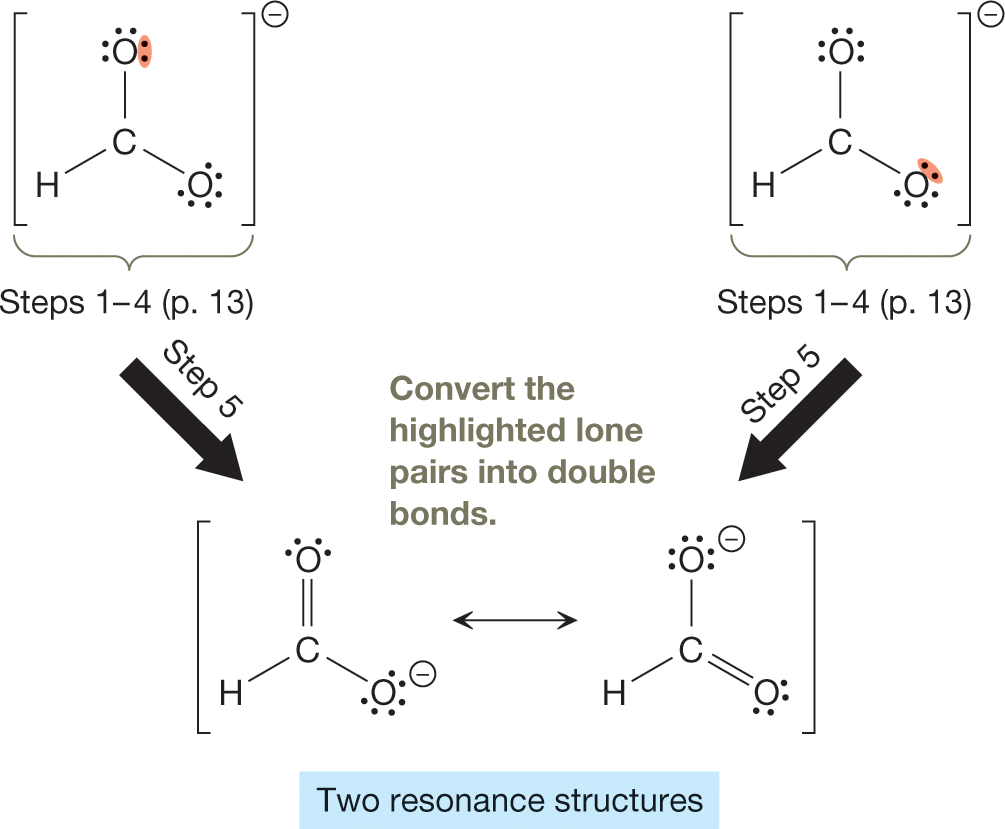
As a result:
Resonance structures differ only in the placement of their valence electrons, not their atoms.
Rule 2
Resonance structures are imaginary; the one, true species is represented by the resonance hybrid.
A resonance hybrid is a weighted average of all resonance structures. In the case of  , the hybrid is an average of two resonance structures:
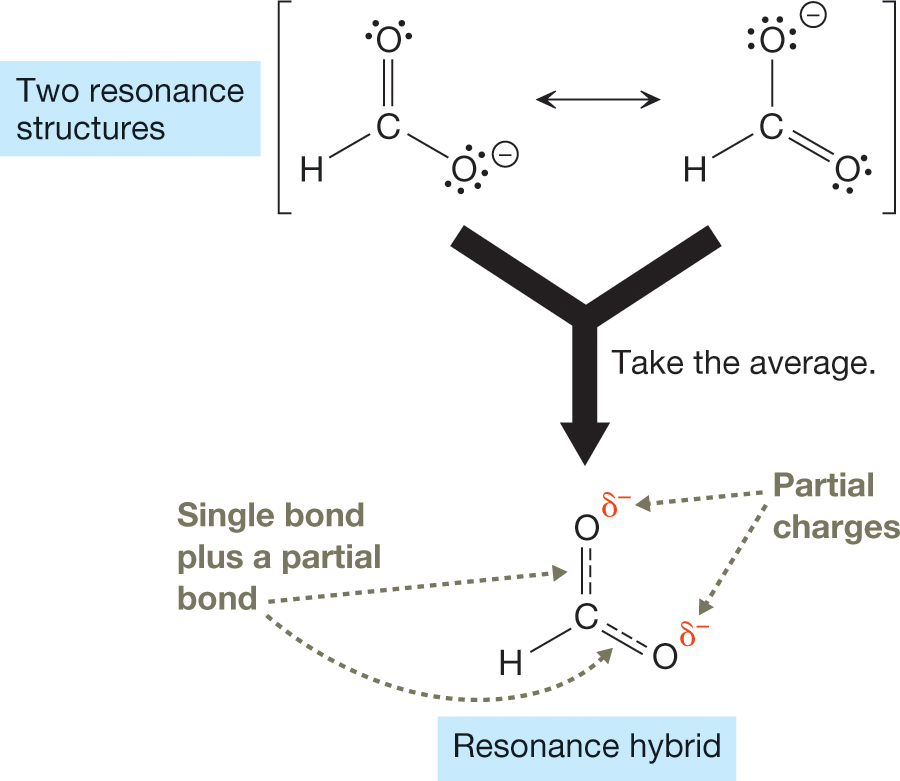
Averaging the two C—O bonds (a single and a double bond) makes each one an identical 1.5 bond—more than a single bond, but less than a double bond. (A partial bond is represented in a resonance hybrid by a dashed line connecting the two atoms.) Averaging the charge on each oxygen atom gives each an identical –0.5 charge. This resonance hybrid is now consistent with experimental results.
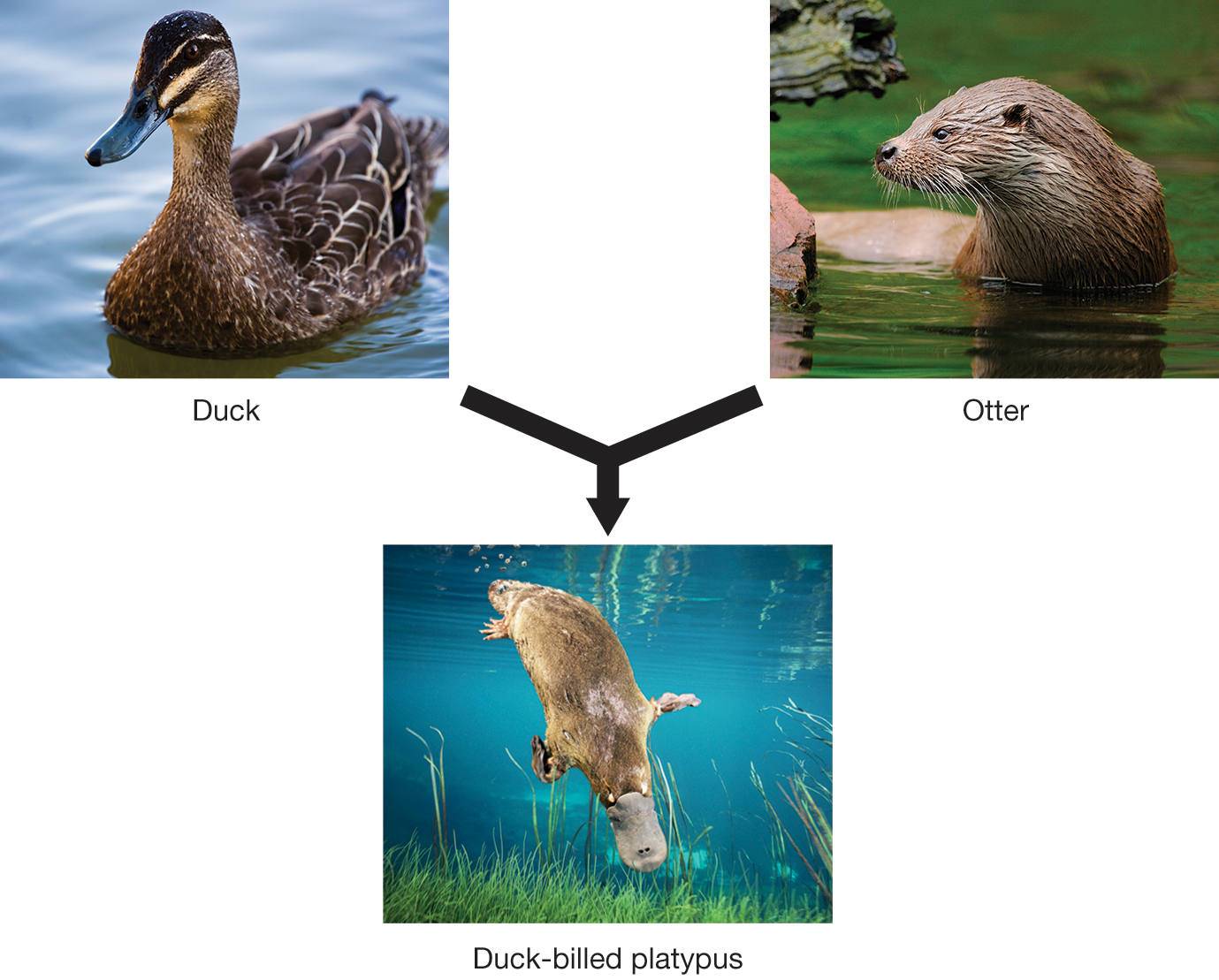
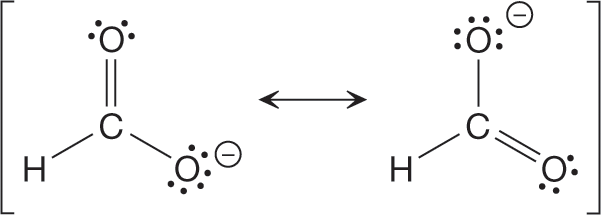
To help us remember that resonance structures are imaginary, we draw square brackets, [ ], around the group of resonance structures and we place double-headed single arrows (↔) between them, as shown at the right. These are not equilibrium arrows (⇌), which indicate a chemical reaction, because a compound does not rapidly interconvert between its resonance structures. Rather, think of a resonance hybrid in the same way as you might think of a duck-billed platypus (Fig. 1-22). That is, a platypus has characteristics of both a duck and an otter, but it is a unique species that does not rapidly interconvert between those two animals!
Rule 3
The resonance hybrid looks most like the lowest energy (most stable) resonance structure.
The two resonance contributors of  are equivalent. Each is composed of one H—C bond, one C═O double bond, and one C—O single bond, and each has a –1 formal charge on the singly bonded O. As a result, each structure contributes equally to the resonance hybrid.
In cases in which resonance structures are inequivalent, we must be able to determine their relative energies to determine their relative contributions to the hybrid. In general:
A resonance structure is lower in energy (i.e., more stable) with:
● a greater number of atoms having an octet
● more covalent bonds
● fewer atoms having a nonzero formal charge
The issues surrounding formal charge and resonance structures are covered in greater detail in Chapter 6.
Connections Cationic species like this are reactive intermediates in various organic reactions, including substitution (Chapter 8), elimination (Chapter 8), and addition reactions (Chapter 11).
Solved Problem 1.18
Which of these resonance structures makes a greater contribution to the resonance hybrid?

|
Think |
SHOW SECTION
|
Are both resonance structures equivalent? If not, which has more atoms with an octet? Which structure has more bonding pairs of electrons? Which structure has fewer atoms with a nonzero formal charge?
|
Solve |
SHOW SECTION
|
The resonance structures are inequivalent. In the structure on the right, all nonhydrogen atoms have an octet, whereas in the structure on the left, the central carbon atom has less than an octet. Additionally, there is one additional bond in the structure on the right, between the C and O. For both of these reasons, the structure on the right makes a much greater contribution to the overall resonance hybrid.
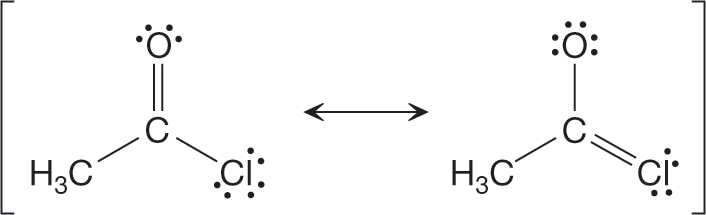
problem 1.19 Which of these resonance structures makes a greater contribution to the resonance hybrid? Note: Formal charges are not shown.
Rule 4
Resonance provides stabilization.
The stabilization due to resonance results from the delocalization of electrons; that is, electrons have lower energy when they are less confined. In , four electrons are delocalized over three atoms (Fig. 1-23). In a single resonance structure, on the other hand, those electrons are localized. The extent by which a species is stabilized in this fashion is called its resonance energy or its delocalization energy.
Rule 5
Resonance stabilization is usually large when resonance structures are equivalent.
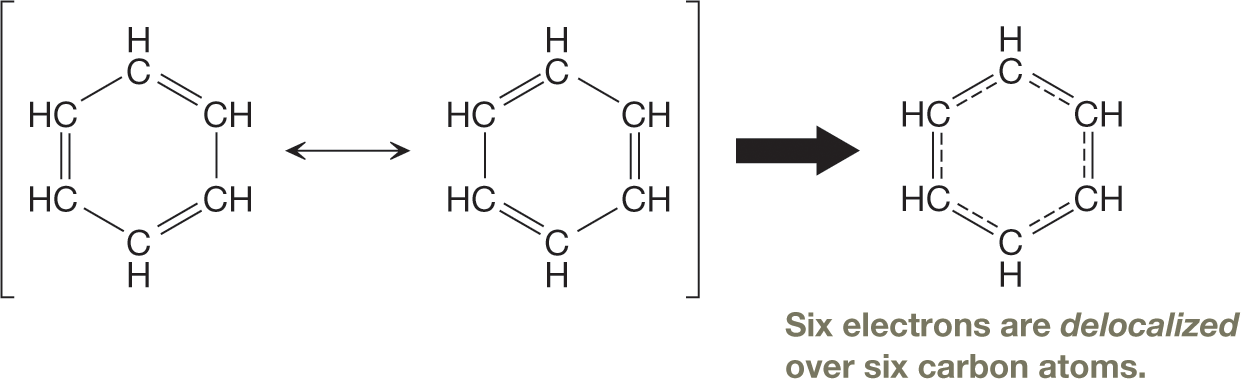
Connections Benzene (Fig. 1-24) is an aromatic hydrocarbon that is naturally found in crude oil and, because of its high octane number, is an important component of gasoline.
Rule 5 is an outcome of Rules 3 and 4. If resonance structures are equivalent, then they will contribute equally to the hybrid, allowing electrons the greatest possible delocalization. The two resonance structures of  are equivalent, so its resonance energy is quite substantial. Another example is benzene, whose resonance structures and hybrid are shown in Figure 1-24. Benzene’s resonance energy is estimated to be about 150 kJ/mol (36 kcal/mol), which is nearly half the energy of a C—C bond! We discuss benzene in much greater depth in Chapter 14, where we explain that much of benzene’s resonance energy is due to a phenomenon called aromaticity.
Acetic acid (CH3CO2H) is not stabilized greatly by resonance. Although it has two resonance structures, only the one on the left in Figure 1-25 contributes significantly. The one on the right is much higher in energy because of the presence of the two charges. Therefore, the electrons involved in resonance are not very highly delocalized.
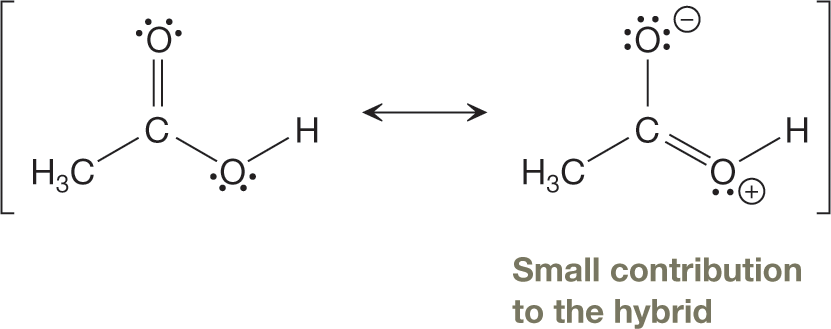
Connections Acetic acid, when it is diluted to about 5% by volume, is familiar to us as vinegar. In organic chemistry, acetic acid is used as a reagent in a wide variety of organic reactions. It can also be used as a solvent.

Rule 6
All else being equal, the greater the number of resonance structures, the greater is the resonance stabilization.
Rule 6 is an outcome of Rule 4, because additional resonance structures mean electrons are more widely delocalized, which lowers the energy even more.
- Localized
describes an electron or charge that is confined to a particular location within a molecular species.
- Delocalized
describes an electron or charge that is not confined to a particular location within a species.
- Resonance theory
the theory that reconciles the differences between a species’ multiple Lewis structures and its observed characteristics. Resonance exists when two or more valid Lewis structures can be drawn for a given molecular species.
- Resonance structure
(also known as resonance contributor) one of two or more valid Lewis structures that represent a species. Resonance structures are imaginary and are related by the movement of valence electrons, not atoms; the one, true species is represented by the resonance hybrid.
- Resonance contributor
See resonance structure.
- Resonance hybrid
a weighted average of all resonance structures that can be drawn for a species.
- Delocalization
the phenomenon of electrons or charges being less confined to a particular location within a species. Delocalization is generally stabilizing.
- Resonance energy
(also known as delocalization energy) the extent by which a species is stabilized due to the delocalization of electrons or charge.
- Delocalization energy
See resonance energy.