A.1 The Need for Systematic Nomenclature: An Introduction to the IUPAC System

Learning how to name specific substances—that is, learning nomenclature—is an essential task. Nomenclature is not unique to chemistry; every discipline of study, from accounting and art history to zoology, has its specialized vocabulary. Many terms in these fields can be as technical as anything in the physical sciences.

Biology, for example, includes taxonomy, the classification of organisms and the study of their relationships. The number of species living on our planet is conservatively estimated at 1.5 million (other estimates exceed 30 million). To deal with this great diversity, scientists have adopted, by international agreement, a single language to be used on a worldwide basis. All organisms are given a specific name in Latin, such as Homo sapiens (human beings),Canis familiaris (the domestic dog), or Escherichia coli (a common bacterium of the human digestive system). Like any language, the language of taxonomy evolves with use; some terms commonly used at one time are later declared obsolete and replaced with more precise or more relevant ones.

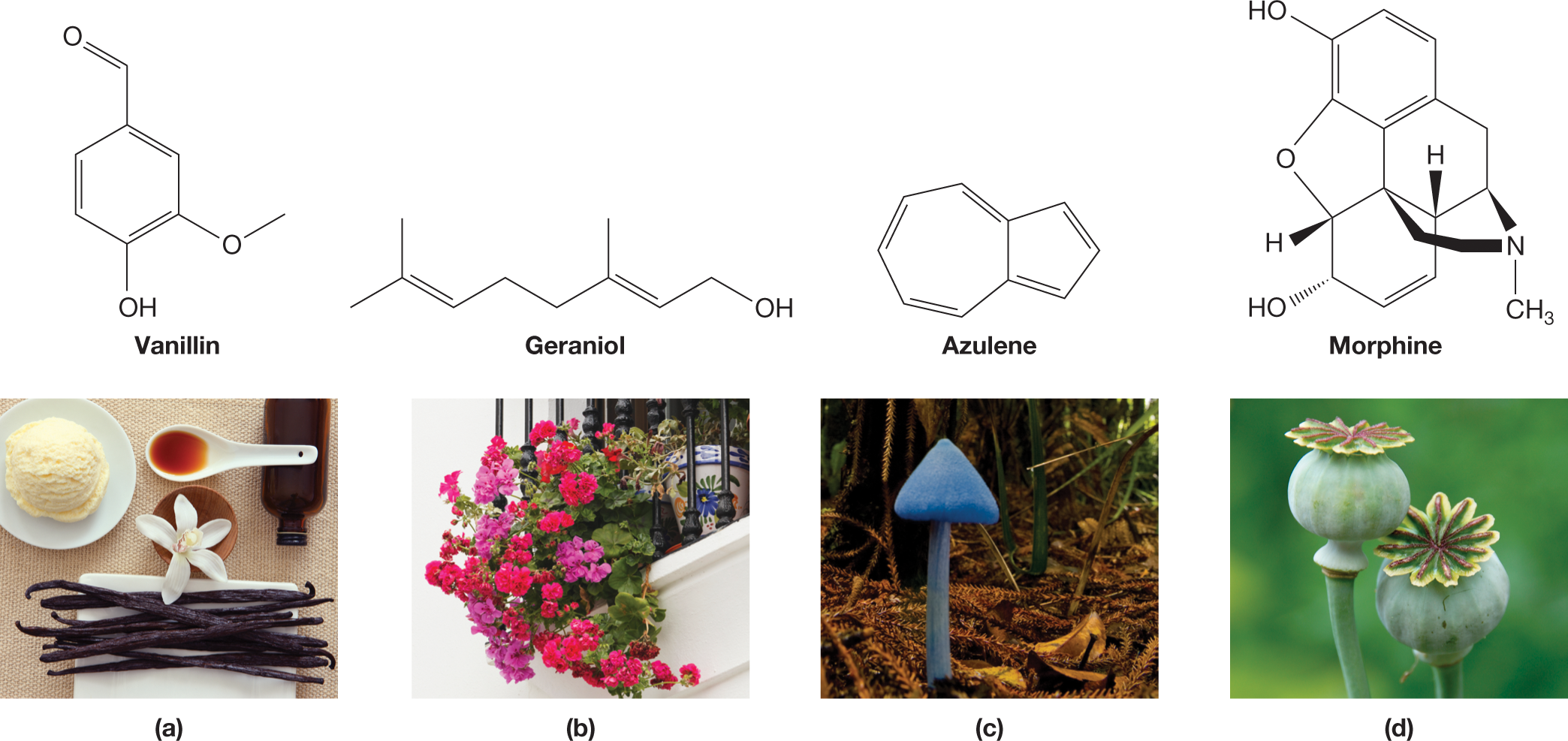
Organic chemistry is not very different. There are millions of organic compounds, a number comparable to the number of known biological species. In ancient and medieval times, chemists or alchemists sometimes assigned a name to a newly discovered substance that indicated its natural animal or plant source. Vanillin, for example, is the primary component extracted from the vanilla bean, and geraniol is derived from the geranium plant (Fig. A-1a and A-1b). In other cases, the name for a substance was suggested by its physical characteristics or by its chemical or medicinal properties. For example, azulene, which is a dark blue crystalline solid, derives its name from azul, the Spanish word for “blue” (Fig. A-1c). And morphine, a powerful sedative isolated from opium, was named for Morpheus, the Greek god of dreams (Fig. A-1d).
Four illustrations of the skeletal structural formulas of organic compounds and photos of their natural sources. The first structure shows vanillin, which consists of a benzene ring with carbon 1 bonded to an aldehyde group, carbon 3 bonded to a methoxy group, and carbon 4 bonded to a hydroxyl group. The accompanying photo shows a tablespoon of vanilla extract beside a scoop of ice cream. The second structure shows geraniol, which consists of an eight-carbon chain with carbon 1 bonded to a hydroxyl group, and carbons 3 and 7 each bonded to a methyl group. Double bonds exist between carbons 2 and 3, and carbons 6 and 7. The accompanying photo shows a geranium plant. The third structure shows azulene, which consists of a seven-carbon ring fused with a five-carbon ring. Double bonds exist between carbons 1 and 2, carbons 3 and 4a, carbons 4 and 5, carbons 6 and 7, and carbons 8 and 8a. The accompanying photo shows a blue mushroom. The fourth structure shows morphine, which consists of five rings fused together. Ring A is a benzene ring with carbon atoms 1, 2, 3, 4, 12, and 11, where carbon 3 is bonded to a hydroxyl group. Ring B is a hexagonal six-carbon ring with carbon atoms 9, 10, 11, 12, 13, and 14, where carbon 14 is bonded to a hydrogen atom by a solid wedge bond. Ring C is a six-carbon ring with carbon atoms 5, 6, 7, 8, 13, and 14, where carbon 6 is bonded to a hydroxyl group by a dashed wedge bond and carbon 5 is bonded to a hydrogen atom by a solid wedge bond. Ring D is a six-membered ring with five carbons, 9, 14, 13, 15, and 16, and one nitrogen atom, which is bonded to a methyl group. The bonds between carbon 9 and the nitrogen atom, between carbon 16 and the nitrogen atom, between carbon 15 and 16, and carbon 13 and 15, are all represented by solid wedged. Ring E is a five-membered ring made of carbons 4, 12, 13, and 5, and an oxygen atom. The accompanying photo shows the opium poppy plant. The caption reads, Naturally occurring organic compounds: a. Vanillin can be isolated from vanilla extract. b. Geraniol occurs in geranium oil. c. Azulene gives this mushroom its blue color. d. Morphine is derived from opium poppy.| An illustration shows the skeletal structural formula of vanillin and a photo of its natural source. Vanillin consists of a benzene ring with carbon 1 bonded to an aldehyde group, carbon 3 bonded to a methoxy group, and carbon 4 bonded to a hydroxyl group. The accompanying photo shows a tablespoon of vanilla extract beside a scoop of ice cream. The caption reads, Naturally occurring organic compounds: Vanillin can be isolated from vanilla extract. | An illustration shows the skeletal structural formula of geraniol and a photo of its natural source. Geraniol consists of an eight-carbon chain with carbon 1 bonded to a hydroxyl group, and carbons 3 and 7 each bonded to a methyl group. Double bonds exist between carbons 2 and 3, and carbons 6 and 7. The accompanying photo shows a geranium plant. The caption reads, Naturally occurring organic compounds: Geraniol occurs in geranium oil. | An illustration shows the skeletal structural formula of azulene and a photo of its natural source. Azulene consists of a seven-carbon ring fused with a five-carbon ring. Double bonds exist between carbons 1 and 2, carbons 3 and 4a, carbons 4 and 5, carbons 6 and 7, and carbons 8 and 8a. The accompanying photo shows a blue mushroom. The caption reads, Naturally occurring organic compounds: Azulene gives this mushroom its blue color. | An illustration shows the skeletal structural formula of morphine and a photo of its natural source. Morphine consists of five rings fused together. Ring A is a benzene ring with carbon atoms 1, 2, 3, 4, 12, and 11, where carbon 3 is bonded to a hydroxyl group. Ring B is a hexagonal six-carbon ring with carbon atoms 9, 10, 11, 12, 13, and 14, where carbon 14 is bonded to a hydrogen atom by a solid wedge bond. Ring C is a six-carbon ring with carbon atoms 5, 6, 7, 8, 13, and 14, where carbon 6 is bonded to a hydroxyl group by a dashed wedge bond and carbon 5 is bonded to a hydrogen atom by a solid wedge bond. Ring D is a six-membered ring with five carbons, 9, 14, 13, 15, and 16, and one nitrogen atom, which is bonded to a methyl group. The bonds between carbon 9 and the nitrogen atom, between carbon 16 and the nitrogen atom, between carbon 15 and 16, and carbon 13 and 15, are all represented by solid wedged. Ring E is a five-membered ring made of carbons 4, 12, 13, and 5, and an oxygen atom. The accompanying photo shows the opium poppy plant. The caption reads, Naturally occurring organic compounds: Morphine is derived from opium poppy.
FIGURE A-1 Naturally occurring organic compounds (a) Vanillin can be isolated from vanilla extract. (b) Geraniol occurs in geranium oil. (c) Azulene gives this mushroom its blue color. (d) Morphine is derived from opium poppy.

About 100 years ago, chemists realized the necessity for standardizing the names of substances, as well as other chemical terms. Consequently, the International Union of Pure and Applied Chemistry (IUPAC) was established in 1919. Immediately, work began on adopting a system of nomenclature for both inorganic and organic substances. Today, while many substances are known by more than one name, there is one standard chemical name. More specifically, that name is based on rules that relate to the molecule’s structure. Consequently:

 Given a molecular structure, you can derive its IUPAC name, piece by piece.

 Given the IUPAC name, you can draw its structure, piece by piece.

In the sections that follow, we step through the various nomenclature rules and provide several examples, and you will have many opportunities to practice those rules.