2.2 Dash–Wedge Notation

Although molecules are three-dimensional, representing them on paper is confined to the two dimensions of the page. To work around this problem, chemists use dash–wedge notation, which provides a means to represent atoms both in front of and behind the plane of the paper. Dash–wedge notation has three components:

Rules for Dash–Wedge Notation

 A straight line () represents a bond that is in the plane of the paper.

 ● Atoms at either end of the bond are also in the plane of the paper.

 A wedge () represents a bond that comes out of the plane of the paper and points toward you.

 ● In general, the atom at the thinner end of the wedge is in the plane of the paper, whereas the atom bonded at the thicker end is in front of the page.

 A dash () represents a bond that is pointed away from you.

 ● In general, you may assume in this book that the atom bonded at the thicker end of the dash is behind the plane of the paper. (You may see different conventions in other books.)

Using this dash–wedge notation, Figure 2-5a and 2-5b shows two ways to represent the tetrahedral atom in CH4. Both illustrations represent the same molecule with the same 109.5° bond angles. The only difference is the vantage point from which you view the molecule. Figure 2-5a is the most common representation, whereas Figure 2-5b is the basis for a shorthand notation of tetrahedral carbon atoms, called the Fischer projection, which we introduce in Chapter 5. In Figure 2-5b, only the central C atom lies in the plane of the paper. The atoms at the ends of the wedge bonds are in front of the plane of the paper and the atoms at the ends of the dash bonds are behind.
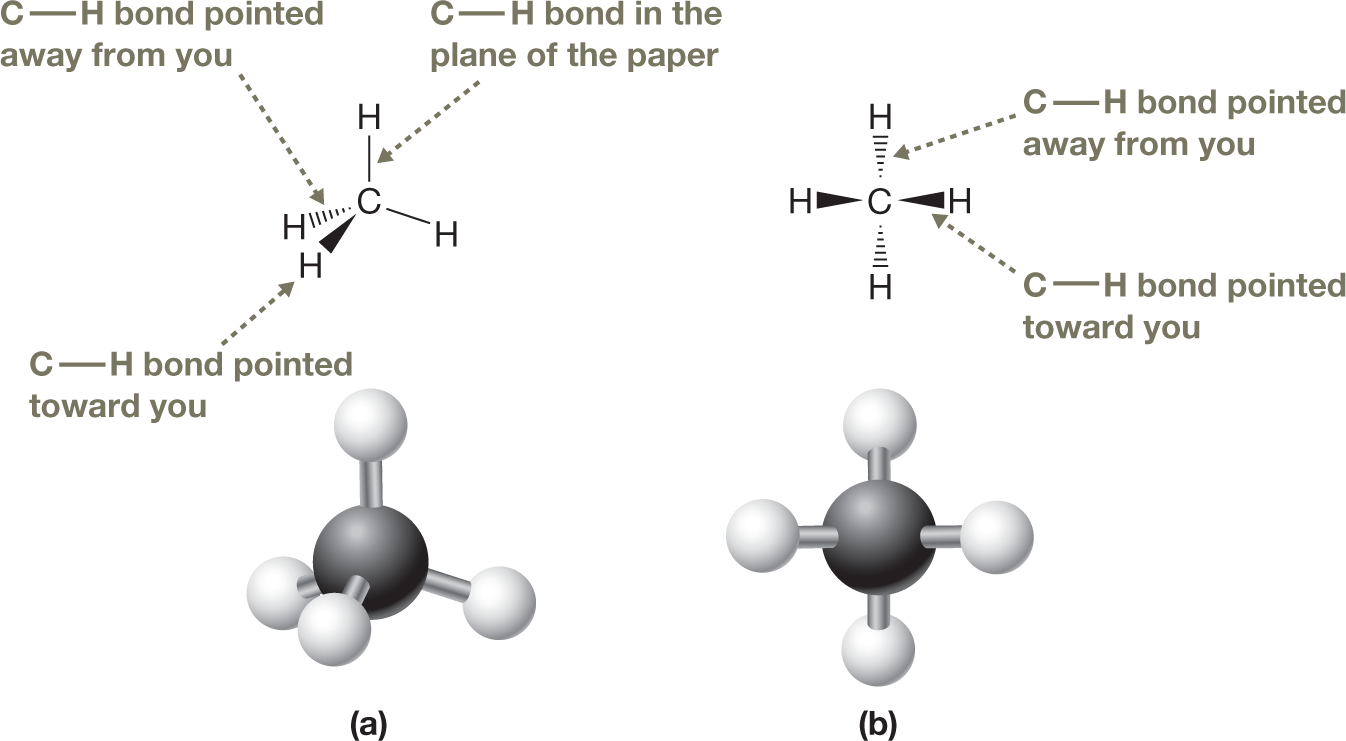
Condensed structural formulas with dash-wedge notation and ball-and-stick models of methane viewed from two different angles. Both illustrations show a methane molecule, with a central carbon atom bonded to two hydrogen atoms. The first illustration shows two C-H bonds in the plane of the paper, represented by solid lines. Another C-H bond points toward the reader and is represented by a solid wedge. The fourth C-H bond points away from the reader and is represented by a dashed wedge. The accompanying ball-and-stick model shows a three-dimensional view of the molecule from the same angle. The second illustration shows two C-H bonds pointing toward the reader, each represented by a solid wedge, and two C-H bonds pointing away from the reader, each represented by a dashed wedge. The accompanying ball-and-stick model shows a three-dimensional view of the molecule from the same angle. The caption reads, �Representations of CH4 using dash�wedge notation: The two different depictions imply views of the molecule from different vantage points.�
FIGURE 2-5 Representations of CH4 using dash–wedge notation The two different depictions imply views of the molecule from different vantage points.

YOUR TURN 2.3

SHOW ANSWERS

Ball-and-stick representations of from two different vantage points are provided. Next to each one, draw the corresponding cation using dash–wedge notation.
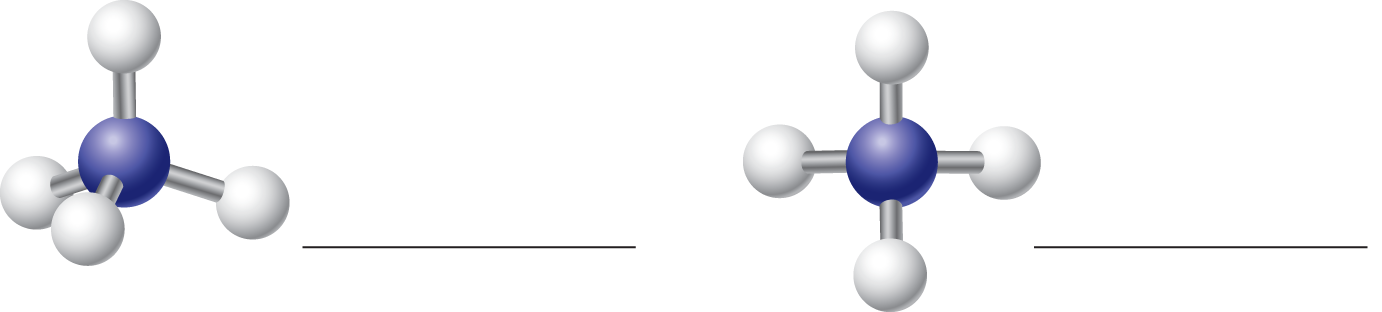
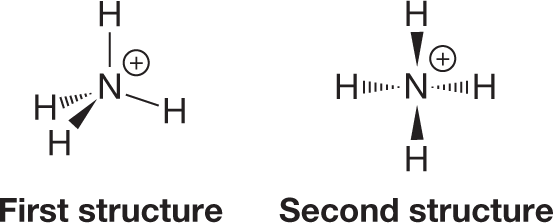
An illustration shows two ball-and-stick models of ammonium cation from different angles with a space next to each model. The first ball-and-stick model shows a nitrogen atom bonded to three hydrogen atoms by single bonds. Two of the N-H bonds are in the plane of the paper, one N-H bond is pointed away from the reader, and the other N-H bond is pointed toward the reader. The second ball-and-stick model shows the same molecule in a different angle, with two N-H bonds pointing toward the reader and two N-H bonds pointing away from the reader.

An illustration shows two structures of ammonium ion using dash-wedge notation. The first structure shows a central nitrogen atom with positive charge is single bonded to two hydrogen atoms. The nitrogen atom is also single bonded to a hydrogen atom by a dash bond and single bonded to a hydrogen atom by a wedge bond. The second structure shows a central nitrogen atom with positive charge is single bonded to four hydrogen atoms. Two are bonded by wedge bonds and the other two are bonded by dash bonds.

Notice in Figure 2-5 that the four bonds of a tetrahedral atom define two perpendicular V shapes (i.e., each HCH angle). Keep this in mind whenever you draw the depiction in Figure 2-5a.

 One V is in the plane of the paper, whereas the other is perpendicular to the plane of the paper.

 The Vs must open in opposite directions! This is shown explicitly in Figure 2-6.
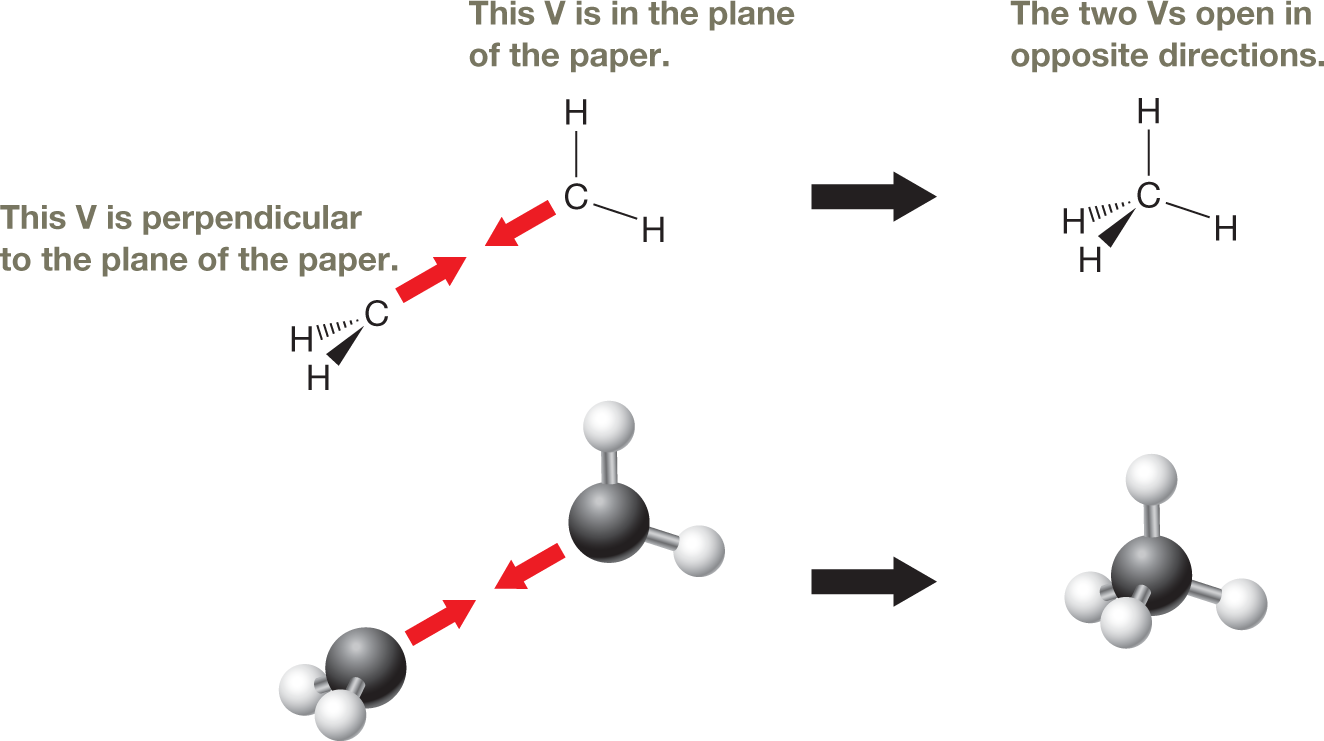
Condensed structural formulas and ball-and-stick models show the formation of a tetrahedral atom from two V-shaped portions. The structural formulas each show two V-shaped structures each with a carbon atom bonded to two hydrogen atoms. One of these V-shaped structures is on the plane of the paper, with the C-H bonds represented by solid lines, while the other is perpendicular to the plane of the paper, with one C-H bond represented by a solid wedge and the other by a dashed wedge. Two arrows pointing toward one another, one from each of these V-shaped structures, shows that the two segments combine to form a tetrahedral structure, where the two Vs open in opposite directions. Here, the central carbon atom is bonded to four hydrogen atoms, with two C-H bonds in the plane of the paper, represented by solid lines. Another C-H bond points toward the reader and is represented by a solid wedge. The fourth C-H bond points away from the reader and is represented by a dashed wedge. The accompanying ball-and-stick model shows a three-dimensional view of how the two Vs combine to form a tetrahedral atom. The caption reads, Tetrahedral geometry viewed as two perpendicular Vs: A tetrahedral atom can be viewed as the fusing together of two V shapes that are in perpendicular planes with one in the plane of the paper and one perpendicular to the plane of the paper. The two Vs must open in opposite directions.
FIGURE 2-6 Tetrahedral geometry viewed as two perpendicular Vs A tetrahedral atom can be viewed as the fusing together of two V shapes that are in perpendicular planes—one in the plane of the paper and one perpendicular to the plane of the paper. The two Vs must open in opposite directions.

Connections Butan-2-ol (Fig. 2-7) is used industrially as a precursor to butan-2-one, which has applications as an industrial solvent and as a welding agent for connecting polystyrene parts of scale models.

YOUR TURN 2.4

SHOW ANSWERS

In the Lewis structure in the upper right corner of Figure 2-6, trace the V that is in the plane of the page and draw an arrow in the direction in which it opens. Do the same to the V that is perpendicular to the page.
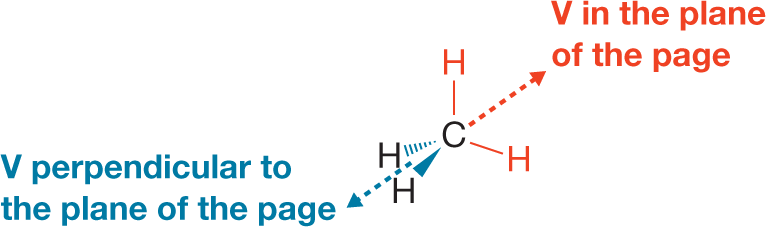
Condensed structural formula shows the formation of a tetrahedral atom. The structural formula shows two V-shaped structures with a carbon atom bonded to four hydrogen atoms. It shows two Vs open in opposite directions. The first V shows two C-H bonds in the plane of the page, represented by solid lines labeled as �V in the plane of the page�. The second V shows two C-H bonds - one points toward the reader and is represented by a wedge bond and the other C-H bond points away from the reader and is represented by a dash bond. This V structure is labeled as �V perpendicular to the plane of the page�.

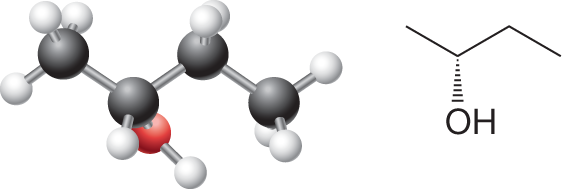
Dash–wedge notation can be combined with line structures to illustrate the three-dimensional geometry of more complex molecules, such as butan-2-ol shown in Figure 2-7.
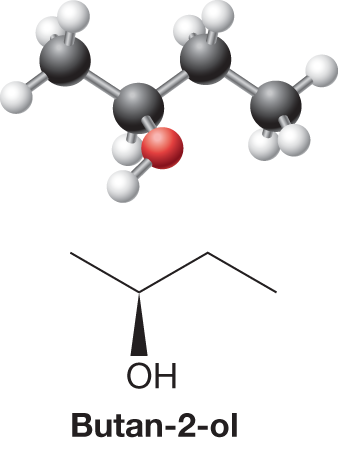
Ball-and-stick model and dash-wedge representation of butan-2-ol. The ball-and-stick model shows four carbon atoms bonded together in a zigzag fashion. Carbon 2 is bonded to a hydroxyl group where the C-O bond points toward the reader. The dash-wedge representation shows a zigzag line with two crests and two troughs. A solid wedge connects the atom in the second position to a hydroxyl group. The caption reads, �Line structures combined with dash�wedge notation: The line structure indicates a chain of four tetrahedral carbon atoms. The wedge indicates that the bond to OH points toward you.�
FIGURE 2-7 Line structures combined with dash–wedge notation The line structure indicates a chain of four tetrahedral carbon atoms. The wedge indicates that the bond to OH points toward you.

YOUR TURN 2.5

SHOW ANSWERS

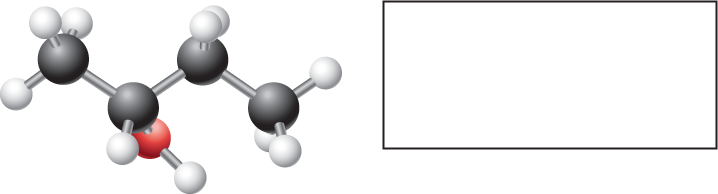
In the box provided, draw the line structure of butan-2-ol using dash–wedge notation. Note that the CO bond points away from you.

Ball-and-stick model of butan-2-ol, with an empty box provided beside it. The ball-and-stick model shows four carbon atoms bonded together in a zigzag fashion. Carbon 2 is bonded to a hydroxyl group where the C-O bond points away from the reader.
Two structures show the ball-and-stick model and dash-wedge representation of butan-2-ol. The ball-and-stick model shows four carbon atoms bonded together in a zigzag fashion. Carbon 2 is bonded to a hydroxyl group where the C-O bond points away from the reader. The dash-wedge representation shows a zigzag line with two crests and two troughs. A dash bond connects the atom in the second position to a hydroxyl group.

problem 2.3 Draw line structures of each of these molecules using dash–wedge notation. Assume that no atoms have formal charges. Note: Black = carbon, white = hydrogen, green-yellow = chlorine, and blue = nitrogen.
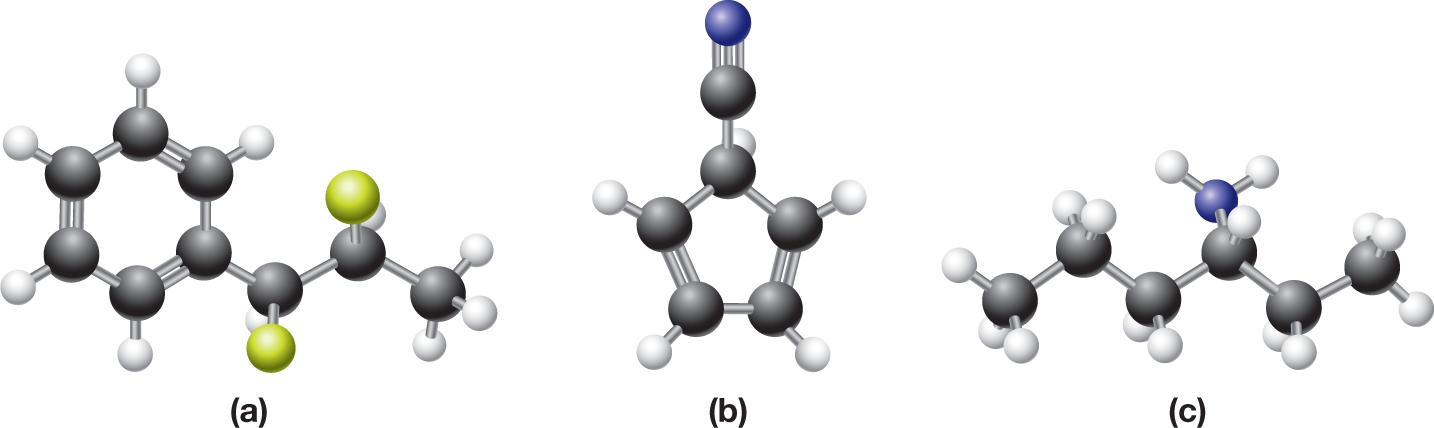
Ball-and-stick models of three organic compounds. The first shows a hexagonal ring with six carbon atoms bonded by alternating single and double bonds. One of the carbon atoms is bonded to a propyl group with carbons 1 and 2 bonded to a chlorine atom each. Both the C-Cl bonds point toward the reader. The second model shows a five-carbon ring with double bonds between carbons 2 and 3 and carbons 4 and 5. Carbon 1 is bonded to a carbonitrile group, where a carbon atom is bonded to a nitrogen atom by a triple bond that lies in the plane of the paper. The third model shows six carbon atoms bonded together in a zigzag manner. Carbon 3 is bonded to an amine group, and this C-N bond points away from the reader.

problem 2.4 This shows a common mistake made with dash–wedge notation. Explain what is incorrect about the structure and then fix it. (It may help to build a model of it.)
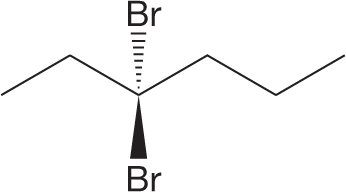
An illustration shows a dash-wedge representation of an organic compound. The structure shows a zig-zag line with three crests and three troughs. The atom in the third position is bonded to two bromine atoms. One of these bonds points toward the reader and is represented by a solid wedge, and the other bond points away from the reader and is represented by a dashed wedge.