2.10 Soaps and Detergents

Soaps and enzyme-free detergents belong to a class of compounds called surfactants. They remove dirt and oil from our hands, clothes, and dinnerware, all with no chemical reaction occurring in the process (i.e., no covalent bonds are broken or formed). Instead, the cleansing ability of soaps and detergents depends entirely on intermolecular interactions.

The molecules specifically responsible for a soap’s cleansing properties are typically salts of fatty acids, which are ionic compounds of the form Na+ or K+. In these compounds, R is a long hydrocarbon chain, and the fatty acid salts generally contain from 12 to 18 carbons. Examples include potassium oleate and sodium palmitate:

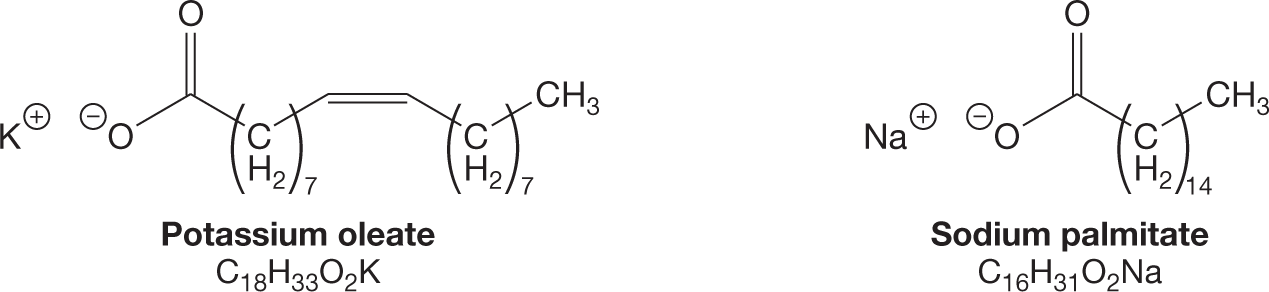
Condensed structural formulas show the ions in potassium oleate and sodium palmitate. The structure of potassium oleate shows a potassium cation and oleate anion, which shows a carbon atom 1 bonded to an oxygen atom by a single bond and to another oxygen atom by a double bond. This carbon is further bonded to a chain of seven carbon atoms, from carbon 2 to carbon 8, each bonded to two hydrogen atoms. Carbon 8 is bonded to carbon 9, which is bonded to carbon 10 by a double bond. Carbon 10 is further bonded to a chain of seven carbon atoms, from carbon 11 to carbon 17, each bonded to two hydrogen atoms. Carbon 17 is bonded to carbon 18, which is bonded to three hydrogen atoms. A note below the structure reads, �Potassium oleate, C18H33O2K.� The structure of sodium palmitate shows a sodium cation and a palmitate anion, which shows a carbon atom 1 bonded to an oxygen atom by a single bond and to another oxygen atom by a double bond. This carbon is further bonded to a chain of fourteen carbon atoms, from carbon 2 to carbon 15, each bonded to two hydrogen atoms. Carbon 15 is bonded to carbon 16, which is bonded to three hydrogen atoms. A note below the structure reads, �Sodium palmitate, C16H31O2Na.�

When a soap dissolves in water, it does so as its individual ions: the metal cation (Na+ or K+) and the carboxylate anion (). Of these two species, the carboxylate anion is the one that is directly responsible for the soap’s cleansing properties, because it has vastly different characteristics at its two ends (Fig. 2-26). Specifically:

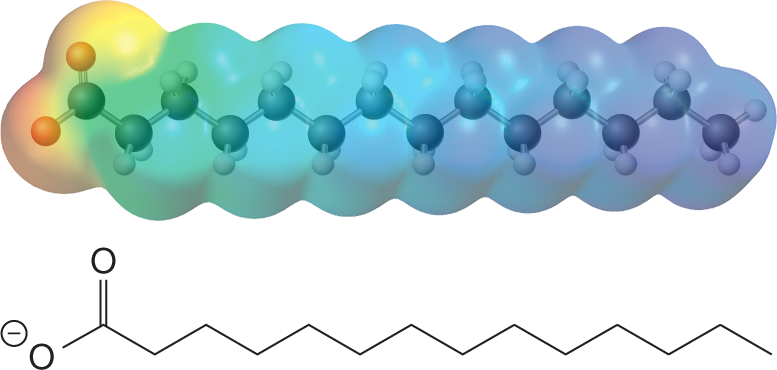
Electrostatic potential map and skeletal structural of the carboxylate anion in the hydrocarbon chain of a fatty acid. The electrostatic potential map is drawn around a ball-and-stick model of the carboxylate anion in the hydrocarbon chain, which shows a chain of fourteen carbon atoms. Carbon 1 is bonded to an oxygen atom by a single bond and to another oxygen atom by a double bond. Carbons 2 to 13 are each bonded to two hydrogen atoms, while carbon 14 is bonded to three hydrogen atoms. The electrostatic map is shaded in red around the left end of the chain representing the oxygen atoms, and in blue on the opposite end of the chain representing carbon 14. Moving from carbon 1 to 14, the central portion is shaded in yellow, green, and turquoise. The skeletal structure of the anion shows a zigzag line with seven crests and eight troughs. An oxygen atom carrying a negative charge occupies the position at the first trough, and another oxygen atom is double-bonded to the atom at the first crest. The caption reads, Electrostaticpotential map of a fatty acidcarboxylate anion: A significantnegative charge is located on theportion of the ion containing the carboxylate group, which is the ionic head group, makingit hydrophilic. At the same time, thehydrocarbon tail is very nonpolar,making it hydrophobic.�
FIGURE 2-26 Electrostatic potential map of a fatty acid carboxylate anion A significant negative charge is located on the portion of the ion containing the – group (the ionic head group), making it hydrophilic. At the same time, the hydrocarbon tail is very nonpolar, making it hydrophobic.

Soaps work because one end of the molecular species is very hydrophilic and the other end is very hydrophobic.

In the case of fatty acid carboxylates, the hydrophilic end is the one with –, called the ionic head group, and the hydrophobic end is the one with the nonpolar hydrocarbon tail.

YOUR TURN 2.18

SHOW ANSWERS

On the electrostatic potential map in Figure 2-26, circle the hydrophilic region and label it. Circle the hydrophobic region and label it.

The (red/orange region) is hydrophilic and the hydrocarbon tail (blue/green region) is hydrophobic.

An illustration shows the electrostatic potential map of a carboxylate anion in which the hydrophobic and hydrophilic regions are highlighted. The electrostatic potential map is drawn around a ball-and-stick model of the carboxylate anion in the hydrocarbon chain, which shows a chain of fourteen carbon atoms. Carbon 1 is bonded to an oxygen atom by a single bond and to another oxygen atom by a double bond. Carbons 2 to 13 are each bonded to two hydrogen atoms, while carbon 14 is bonded to three hydrogen atoms. The electrostatic map is shaded in red around the left end of the chain representing the oxygen atoms. This region is circled and labeled as �Hydrophilic�. The electrostatic map is shaded in blue on the opposite end of the chain representing carbon 14. Moving from carbon 1 to 14, the central portion is shaded in yellow, green, and turquoise. The region from carbon 2 to 14 are circled and labeled as �Hydrophobic�.

In water, the carboxylate anions from the fatty acid salts form spherical aggregates, called micelles (Fig. 2-27). In a micelle, the nonpolar tails are on the inside of the sphere, where they can interact with one another via extensive induced dipole–induced dipole interactions, whereas the charged head groups are on the outside, where they can form the greatest number of ion–dipole interactions with the surrounding water molecules. As a result, micelles are highly solvated (Section 2.7a).
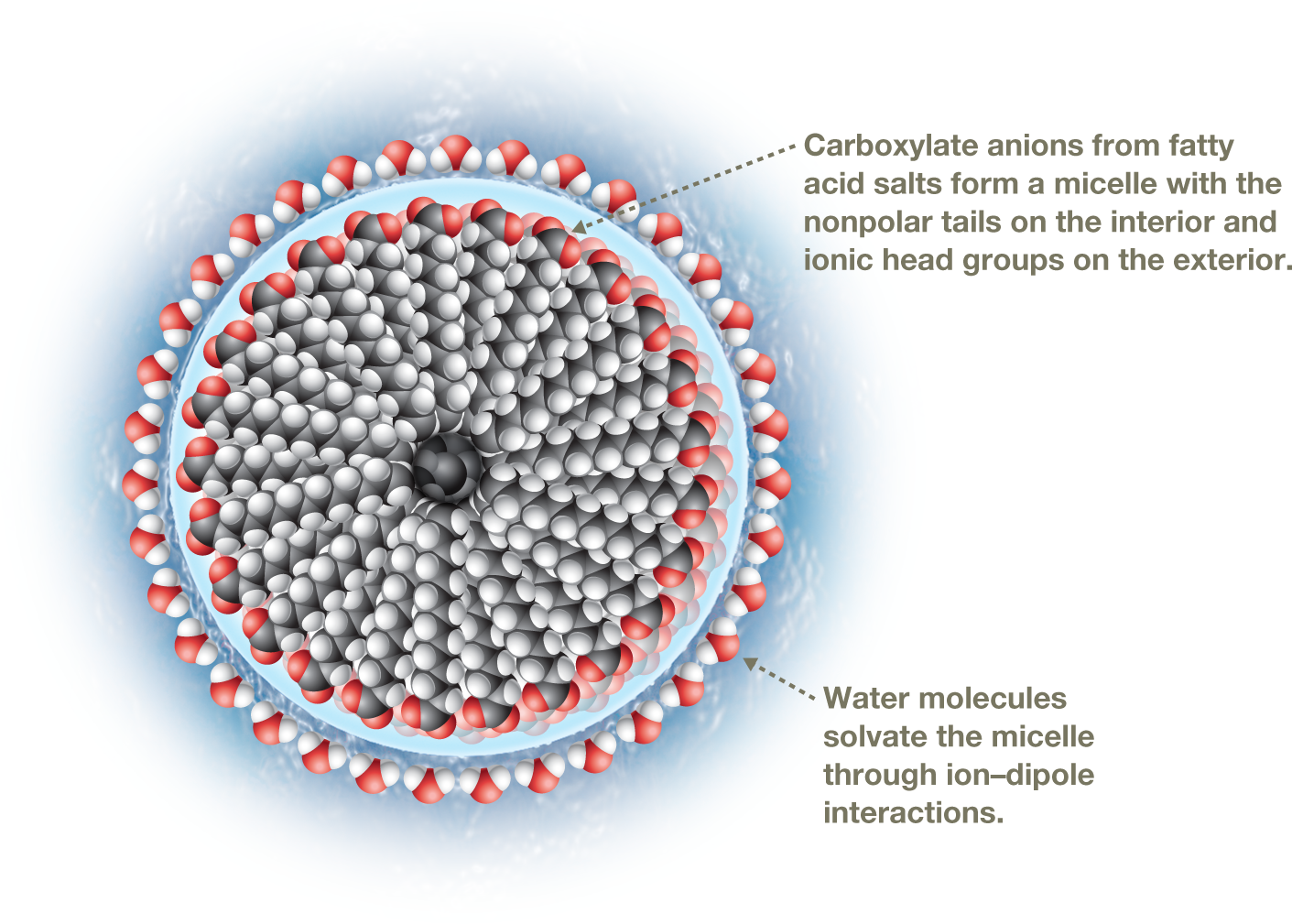
Space-filling model showing structure of a micelle. The structure shows an array of hydrocarbon chains arranged in a circular manner around the center of the micelle. The polar head of each chain, consisting of the carbon atom bonded to an oxygen atom by a single bond and to another oxygen atom by a double bond, lies along the outer edge of the circle, while the nonpolar, tail end of each chain points toward the center. Surrounding the micelle are water molecules arranged along the outer edge of the circle. An arrow pointing toward the polar end of a carboxylate anion shows a note that reads, �Carboxylate anions from fatty acid salts form a micelle with the nonpolar tails on the interior and ionic head groups on the exterior.� An arrow pointing to the water molecules shows a note that reads, �Water molecules solvate the micelle through ion�dipole interactions.� The caption reads, The structure of a micelle: In water, carboxylate anions,R-CO2 minus, from fattyacid salts form micelles, in which the nonpolar tails are on the inside and the ionic headgroups are on the outside. Micelles are soluble in water because they are heavily solvateddue to the extensive ion�dipole interactions that take place between the ionic head groupsand the water molecules of the surrounding solution.
FIGURE 2-27 The structure of a micelle In water, carboxylate anions (RCO2-) from fatty acid salts form micelles, in which the nonpolar tails are on the inside and the ionic head groups are on the outside. Micelles are soluble in water because they are heavily solvated due to the extensive ion–dipole interactions that take place between the ionic head groups and the water molecules of the surrounding solution.

Enzyme Active Sites: The Lock-and-Key Model

Enzymes are proteins that catalyze biological reactions. In many cases, enzymes enhance reaction rates by several orders of magnitude. What is particularly fascinating is how specific each enzyme’s role is, so much so that the name of an enzyme derives from the reaction that it catalyzes. Consider the enzyme fructose 1,6-bisphosphate aldolase, which is responsible for cleaving fructose 1,6-bisphosphate into dihydroxyacetone phosphate and glyceraldehyde-3-phosphate—a reaction that is integral in breaking down sugars.

The general model that accounts for the specificity of enzymes is often referred to as the lock-and-key model. An enzyme, which is typically a rather large molecule, assumes a three-dimensional shape that defines an active site—a pocket in which the reaction takes place. The substrate (i.e., the reactant) docks with the enzyme in the active site to form an enzyme–substrate complex, the reaction takes place, and subsequently the products are released. Under the lock-and-key model, only certain, specific substrates fit into the active site.

Fitting into an active site means more than just spatial fitting; it means that the active site is specially designed to provide optimal intermolecular interactions for the substrate. We can see this by examining a portion of the enzyme–substrate complex in the fructose 1,6-bisphosphate aldolase reaction.

An illustration shows the three-dimensional model and the skeletal structural formula of fructose 1,6-biphosphate aldolase. The three-dimensional model shows the central portion constituted by fructose 1,6-biphosphate as a space filling model. The amino acid groups bonded to fructose 1,6-biphosphate are shown as ball-and-stick models. The structural formula of fructose 1,6-biphosphate aldolase shows a six-carbon chain where carbon 2 is bonded to an oxygen atom by a double bond and carbons 3, 4, and 5 are each bonded to a hydroxyl group. Carbons 1 and 6 are each bonded to the oxygen atom in a phosphate group. In each of the two phosphate groups, a central phosphorous atom is bonded to an oxygen atom by a double bond, and to three oxygen atoms by single bonds. Two of these oxygen atoms each carry one unit of negative charge, and the third oxygen is bonded to the six-carbon chain. In the phosphate group bonded to carbon 1, the double-bonded oxygen atom is connected by a dashed line to an amine group, where the nitrogen atom is bonded to an arginine molecule and to a carbonyl group that is bonded to another arginine molecule. One of the negatively charged oxygen atoms is connected by a dashed line to a hydroxyl group that is bonded to serine. The same oxygen atom is connected by two dashed lines to an amine group and a hydroxyl group. The nitrogen in the amine group is bonded to a carbon atom, which is bonded to the oxygen in the hydroxyl group and to a carbonyl group that is bonded to serine. The nitrogen in the amine group is also bonded to another serine molecule. The other negatively charged oxygen atom in the phosphate group is bonded by a dashed line to an amine group which is bonded to two arginine molecules. The oxygen atom double bonded to carbon 2 is connected by a dashed line to a hydrogen atom, which is bonded to an amine group where the nitrogen atom carries a positive charge and is bonded to a lysine molecule. The hydroxyl group bonded to carbon 3 is connected by a dashed line to an oxygen atom with three lone pairs of electrons, carrying a negative charge. This oxygen atom is bonded to a carbonyl group that is bonded to a glutamic acid molecule. The hydroxyl group bonded to carbon 4 is connected by dashed lines to two amine groups in each of which the nitrogen atom has one lone pair of electrons. These two amine groups are both bonded to a common imine group, which is bonded to an arginine molecule. The hydroxyl group bonded to carbon 5 is connected by a dashed line to an amine group, where the nitrogen atom has one lone pair of electrons. This amine group is bonded to a lysine molecule. In the phosphate group bonded to carbon 6, the double-bonded oxygen atom is connected by a dashed line to a hydroxyl group which is bonded to a serine molecule. One of the negatively charged oxygen atoms is connected by two dashed lines to an amine group and a hydroxyl group. The nitrogen in the amine group is bonded to a carbon atom, which is bonded to the oxygen in the hydroxyl group and to a carbonyl group that is bonded to serine. The nitrogen in the amine group is also bonded to another serine molecule. The other negatively charged oxygen atom in the phosphate group is bonded by a dashed line to a hydrogen atom which is bonded to an amine group where the nitrogen atom carries a positive charge and is bonded to a lysine molecule. The fructose 1,6-biphosphate portion is shown in red, and the amino acid groups are shown in black.

On the left, fructose 1,6-bisphosphate appears as a space-filling model, and the important side groups of some amino acids in the active site appear as ball-and-stick models. On the right, the substrate and side groups appear as line structures. Notice how the locations of the side groups are optimal for numerous specific hydrogen-bonding and ion–dipole interactions.

problem 2.28 Ethyl ethanoate (ethyl acetate, CH3CO2CH2CH3), a relatively small ester, is insoluble in water. Knowing this, would you expect the following compound to form micelles in water? Explain.

Line structure of an organic compound. The structure shows a zigzag line with eight crests and nine troughs. An oxygen atom occupies the third position, and the atom at the fourth position is bonded to another oxygen atom by a double bond.

Dirt, grease, and oils are nonpolar substances, so they are insoluble in pure water. They are soluble in a solution of soap and water, however, because the hydrophobic tails of the soap molecules dissolve in droplets of oil or grease, leaving their hydrophilic head groups available for solvation by water (Fig. 2-28). Soap is said to emulsify such substances—that is, it disperses them in a solvent (water) in which they are normally insoluble. Such emulsified particles can then be washed away by water.
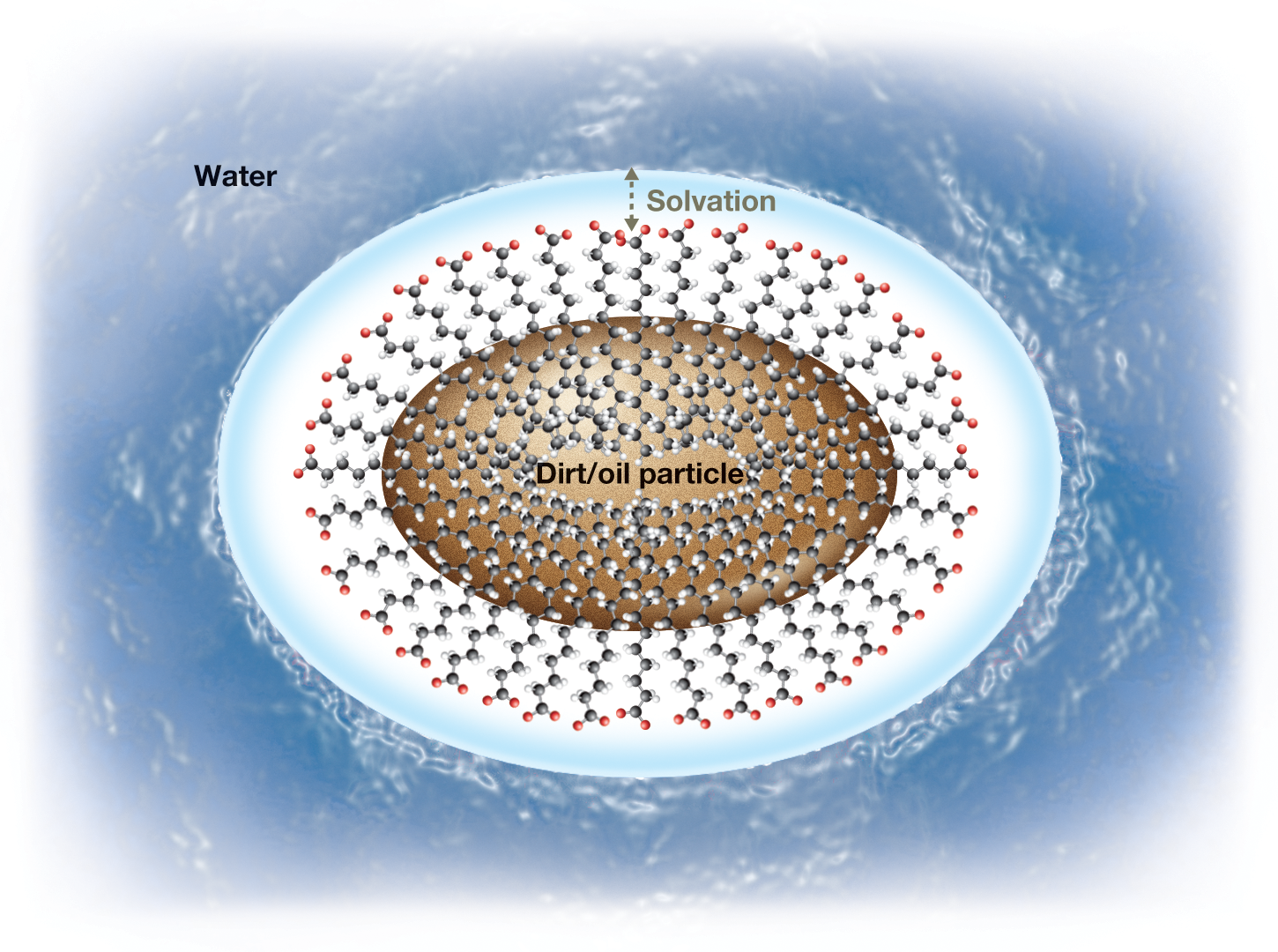
An illustration shows how soap molecules act on a particle of oil or dirt. The oil or dirt particle is represented by a brown, elliptical structure with the molecules of the particle clustered together. Surrounding this particle are chains of soap molecules. The nonpolar tail ends of these chains point toward the oil or dirt particle, and the polar heads of the chains point away from the particle. Surrounding the chains of the soap molecules is water. There is a small gap labeled �solvation,� running along the elliptical figure, separating the soap molecules from the water surface. The caption reads, �An oil dropletemulsified in water by soap: Thenonpolar tails of soap moleculesdissolve in a droplet of oil, whichcan then be washed away by watermolecules interacting with theexposed hydrophilic head groups.�
FIGURE 2-28 An oil droplet emulsified in water by soap The nonpolar tails of soap molecules dissolve in a droplet of oil, which can then be washed away by water molecules interacting with the exposed hydrophilic head groups.

problem 2.29 Would you expect the following hypothetical compound to act as a soap? Why or why not?
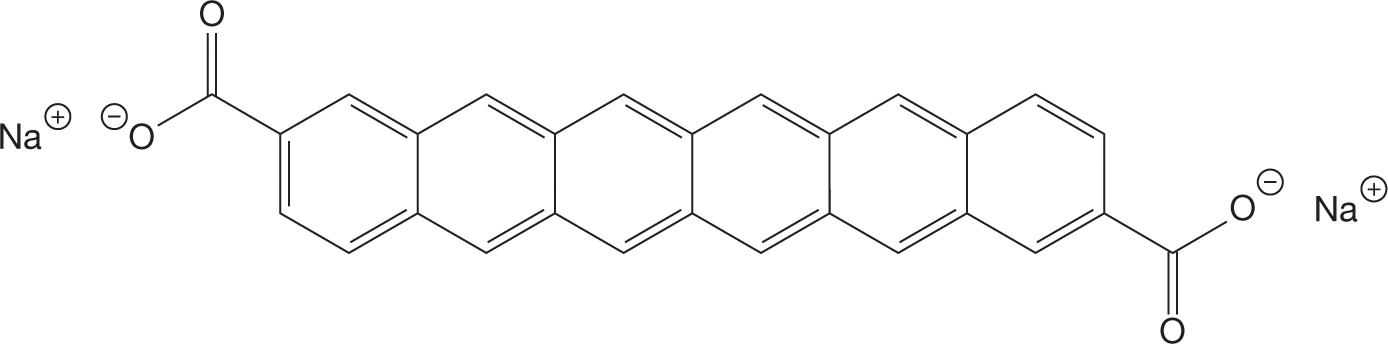
Line structure of a hypothetical organic compound. The structure shows six hexagonal, six-carbon rings fused together in a linear manner. The first ring has alternate single and double bonds. In each of the other five rings, double bonds exist between the carbon atoms in the first and second positions, and the carbons in the third and fourth positions. The carbon in the first position in the first ring and the carbon in the third position in the last ring are each bonded by a single bond to a carbon atom, which is bonded to an oxygen atom by a double bond and to another oxygen with a negative charge by a single bond. On either side of this structure is a sodium cation.

Hard water poses a problem for soaps. Water is considered hard if it contains a significant concentration of Mg2+ or Ca2+ ions. These ions bind more strongly to the negative charge of the carboxylate than Na+ or K+ ions do (see Problem 2.58 at the end of the chapter), causing the long-chain fatty acids to precipitate from water (Equation 2-3).

An equation uses line structures to show the formation of soap scum from carboxylate anions and calcium cations in hard water. The side of the reactants shows a calcium cation with two units of positive charge combining with two units of hydrocarbon chains with a carboxylate ion at their heads. The chains show a zigzag line with seven crests and eight troughs, with an oxygen atom at the first trough and another oxygen atom double-bonded to the at the first crest. This portion forms the carboxylate ion, which is shown in red. An arrow from the reactants leads to the product, which shows a compound made of calcium and the hydrocarbon chain with the carboxylate anion. A note below the product reads, �soap scum, insoluble in water.�
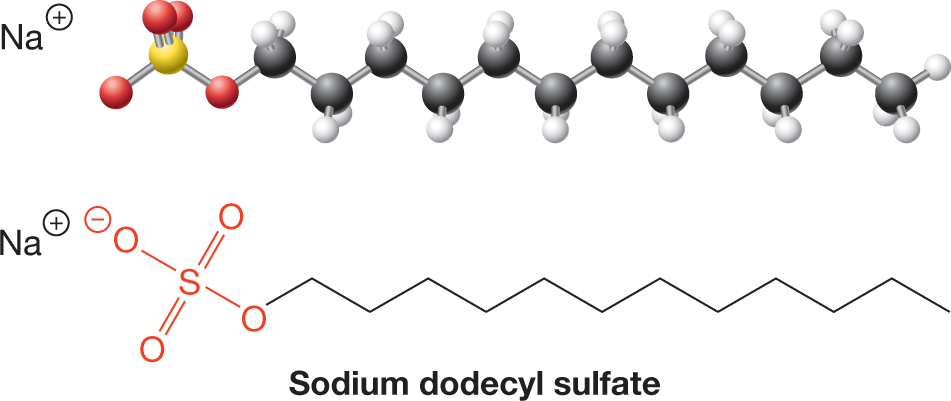
An illustration shows the ball-and-stick model and the skeletal structural formula of sodium dodecyl sulfate. The structure of the compound shows a sodium cation next to a chain of twelve carbon atoms, where carbon 1 is bonded to a sulfate ion and two hydrogen atoms. Carbons 2 to 11 are each bonded to two hydrogen atoms, and carbon 12 is bonded to three hydrogen atoms. The caption reads, Detergents: In a detergent such as sodiumdodecyl sulfate, the OSO3 minus head group is very hydrophilicand the long nonpolar tail is hydrophobic.
FIGURE 2-29 Detergents In a detergent such as sodium dodecyl sulfate, the —OSO2- head group is very hydrophilic and the long nonpolar tail is hydrophobic.

Not only does this decrease the effectiveness of soap, but the precipitate is a nuisance known as soap scum. A common way to combat this problem is to first run water through a water softener, which contains an ion-exchange resin that removes hard water ions and replaces them with Na+ ions.

Unlike soaps, detergents are effective cleansers in hard water. Detergents such as sodium dodecyl sulfate are similar in structure to soaps, containing an ionic head group (sulfate, ) and a nonpolar hydrocarbon tail (Fig. 2-29). As a result, they behave in much the same way as soaps, forming micelles in solution that are capable of emulsifying dirt, grease, and oils. The main difference is that metal ions in hard water do not bind to the sulfate portion of detergents as strongly as they do to the carboxylate portion of soaps. (See Problem 2.59 at the end of the chapter.) This allows detergents to remain active even in hard water.