Section 1.1 Objectives
You will be able to:
- Distinguish organic compounds from inorganic ones.
- Explain why organic compounds are not limited to those synthesized by living things.
Organic chemistry is the branch of chemistry involving organic compounds. What, then, is an organic compound?
In the late 1700s, scientists defined organic compounds as ones that could be obtained from a living organism: compounds such as glucose (a sugar), testosterone (a hormone), and deoxyribonucleic acid (DNA; genetic material) (Figure 1-1). According to a theory called vitalism, only living systems could summon up a mysterious “vital force” needed to synthesize organic compounds. All other compounds, including ones synthesized in the lab, were defined as inorganic.
The vitalist definition of organic compounds became obsolete in 1828, when Friedrich Wöhler (1800–1882), a German physician and chemist, synthesized urea by heating a solution of ammonium cyanate (Eq. 1-1); urea is a major component of mammalian urine and is organic, but ammonium cyanate is inorganic.
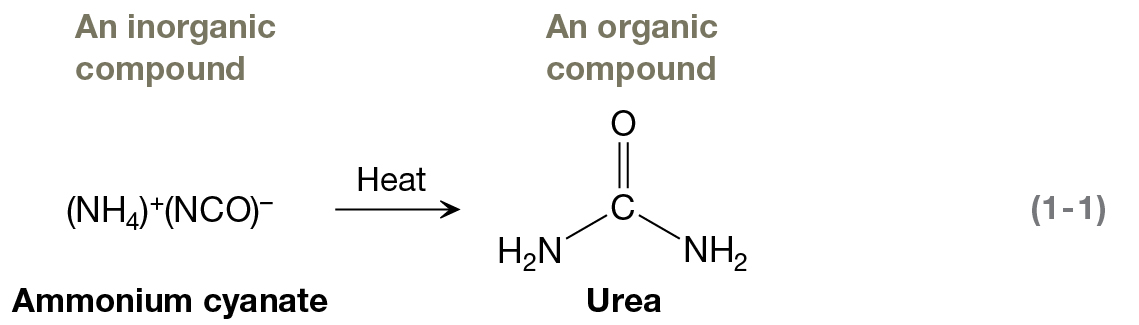
An equation shows the conversion of ammonium cyanate, an inorganic compound, to urea, an organic compound, in the presence of heat. The condensed structural formula of ammonium cyanate shows a positively charged ammonium ion bonded to a negatively charged cyanate ion. When heat is applied, ammonium cyanate is converted to urea, which consists of a carbon atom bonded to two amine groups by single bonds and to an oxygen atom by a double bond.
If vitalism couldn’t account for the distinction between organic and inorganic compounds, what could? Gradually, chemists arrived at our modern definition:
An organic compound contains a substantial amount of carbon and hydrogen, whereas an inorganic compound does not.
This definition is still imperfect because it leaves some room for interpretation, but it does allow chemists to classify most molecules.
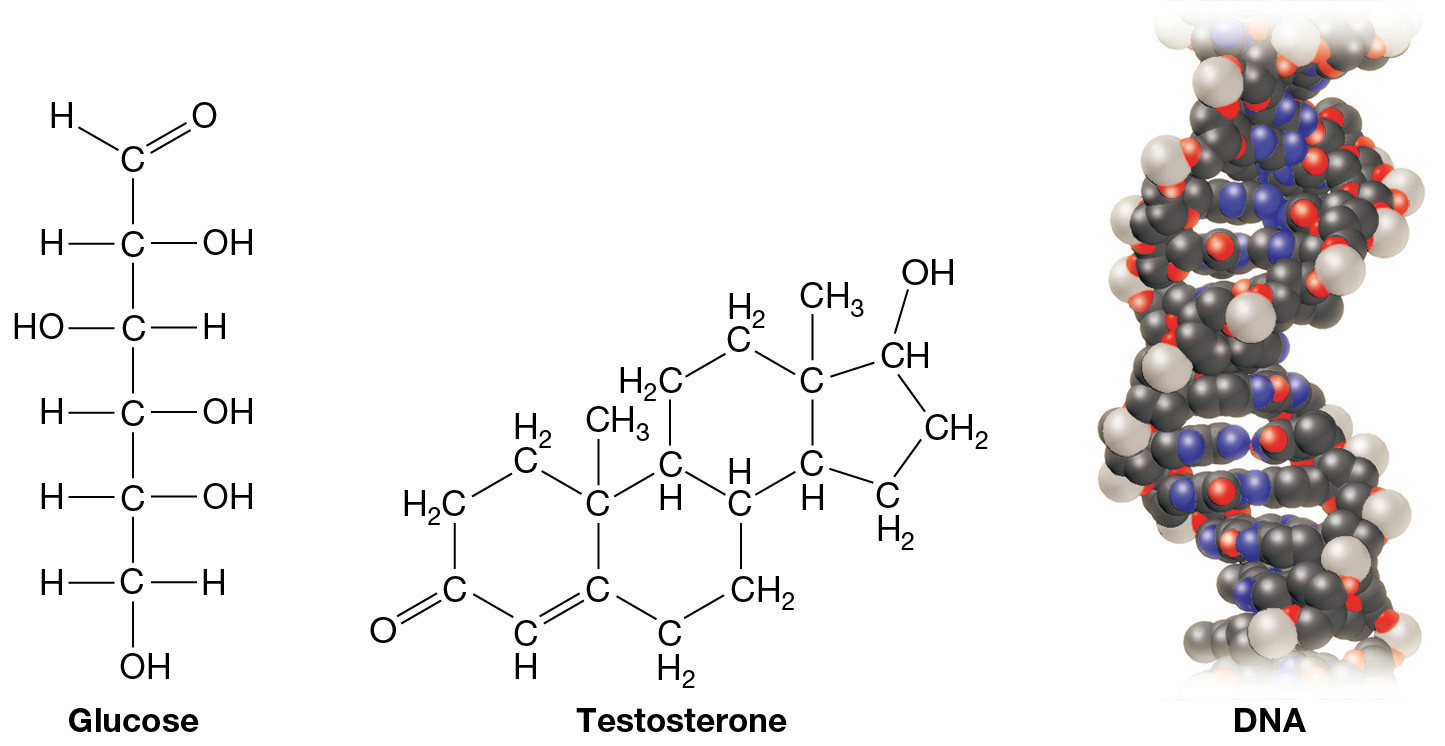
Structures of glucose, testosterone and a model of D N A. The structural formula of glucose shows a linear chain of six carbon atoms. The carbon atom in the first position is bonded to an oxygen atom by a double bond and to a hydrogen atom by a single bond. The carbon atom in the third position is bonded to a hydroxyl group and a hydrogen atom by single bonds. The carbon atom in the second, fourth, and fifth positions are bonded to a hydrogen atom and a hydroxyl group each by single bonds, in reverse order to the carbon atom in the third position. The carbon atom in the sixth position is bonded to two hydrogen atoms and a hydroxyl group. The condensed structural formula of testosterone shows two cyclohexane rings fused together. The first ring is fused with a cyclohexene ring, and the second is fused with a cyclopentane ring. A double bond exists between the carbon atoms in the fourth and fifth positions. An oxygen atom is double-bonded to the carbon atom in the third position, a hydroxyl group is bonded to the carbon atom in the seventeenth position, and a methyl group is bonded to the carbon atoms in the tenth and thirteenth positions. The third illustration shows a space-filling model of the double helical structure of D N A. The caption reads, “Some familiar organic compounds: Glucose, testosterone, and DNA are organic compounds produced by living organisms.”
CONNECTIONS 1.1
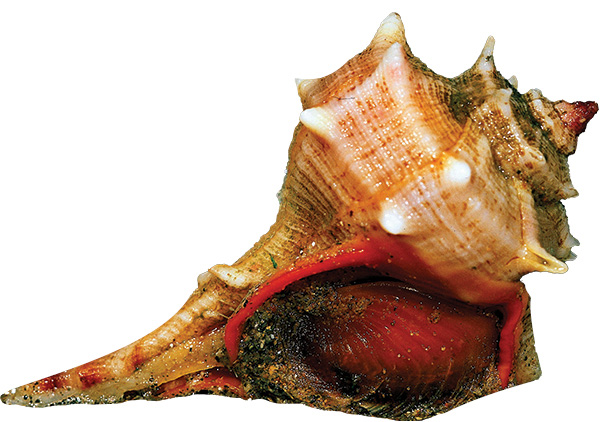
A photo of a seashell. It is wide at one end and narrow at the other.
Organic compounds in ancient civilizations Royal purple, also called Tyrian purple, is a natural dye that was obtained by ancient Phoenicians from the aquatic snail Bolinus brandaris, shown here. About 10,000 of these snails had to be processed to obtain a single gram of dye.
The birth of organic chemistry as a distinct field occurred around the time that vitalism was dismissed, making the discipline less than 200 years old. However, humans have taken advantage of organic reactions and the properties of organic compounds for thousands of years! Since about 6000 BCE, for example, civilizations have fermented grapes to make wine. Some evidence suggests that Babylonians, as early as 2800 BCE, could convert oils into soaps.
Organic chemistry has matured tremendously since its inception. Today, we can not only use organic reactions to reproduce complex molecules found in nature but also engineer new molecules never before seen.