Section 1.5 Objectives
You will be able to:
- Evaluate whether a given structure is a valid Lewis structure.
- Draw the Lewis structure for a small molecule or molecular ion, given its molecular formula.
To understand a molecule’s chemical behavior, it is necessary to know its connectivity: that is, which atoms are bonded together and by what types of bonds (single, double, or triple). It is also useful to know which valence electrons participate in bonding and which do not. Lewis dot structures (or Lewis structures) are a convenient way to convey this information. Let’s review some basic conventions of Lewis structures.
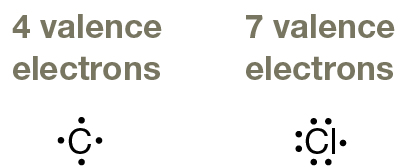
Two Lewis structures show the four valence electrons in a carbon atom and seven valence electrons in a chlorine atom.
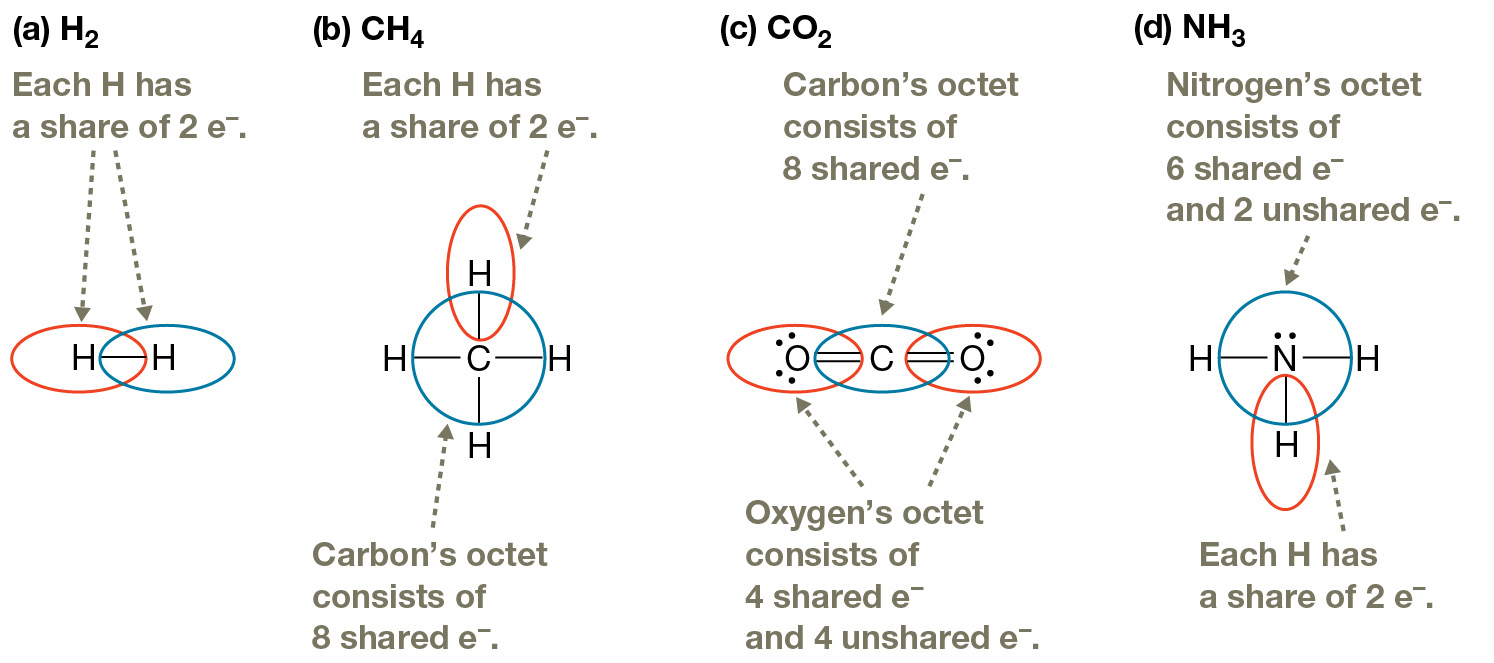
Four illustrations show covalent bonding in various molecules, with the octet for the atoms represented by circles. The first illustration is of H 2. It shows a hydrogen molecule where two hydrogen atoms are connected by a single bond. Each hydrogen atom has a share of the two electrons in the bond, and the octet circle for each atom includes the bond. The second illustration is of C H 4. It shows a methane molecule where a carbon atom is bonded to four hydrogen atoms by single bonds. The carbon’s octet includes the eight shared electrons, and the circle representing this octet includes four bonds connecting it to the hydrogen atoms. The hydrogen’s octet includes the bond connecting it to the carbon atom. The third illustration is of C O 2. It shows a carbon dioxide molecule where a carbon atom is double-bonded to two oxygen atoms in a linear fashion. The carbon’s octet includes the eight shared electrons, and the circle representing this octet includes two double bonds connecting it to the two oxygen atoms. Each oxygen’s octet includes four shared electrons and four unshared electrons, which are represented by dots. The fourth illustration is of N H 3. It shows an ammonia molecule where a nitrogen atom is bonded to three hydrogen atoms by single bonds. The nitrogen’s octet includes the six shared electrons and two unshared electrons, which are represented by dots. The circle representing this octet includes the bonds connecting it to the hydrogen atoms. The hydrogen’s octet includes the bond connecting it to the nitrogen atom. The caption reads, Covalent bonding: Sharing electrons to produce full valence shells: In each of these molecules, all atoms have completely filled valence shells: Hydrogen has a share of two electrons, whereas carbon, oxygen, and nitrogen each have an octet of electrons made up of a total of 8 shared and unshared valence electrons.
CONNECTIONS 1.4

An image of a globe shows an ozone hole over Antarctica. The area around the south pole is shaded in deep blue, with a turquoise border. The rest of the globe is shaded in green.
Chlorine radicals and the ozone hole Chlorine radicals (Fig. 1-15) in the stratosphere catalyze the breakdown of stratospheric ozone. Unnaturally high concentrations of chlorine radicals in the stratosphere, produced from synthetic coolants called chlorofluorocarbons (CFCs), have, since the middle of the 20th century, led to the development of the ozone hole over Antarctica (shown in blue).
YOUR TURN 1.5
Using Figure 1-16 as your guide, circle the electrons in the Lewis structure of CH3OH that represent carbon’s octet, oxygen’s octet, and each hydrogen’s duet.
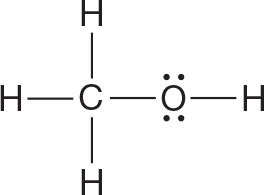
Condensed structural formula of methanol. The condensed structural formula of methanol consists of a carbon atom, single bonded to three hydrogen atoms and an oxygen atom carrying a lone pair of electrons. The oxygen atom is further attached to a hydrogen atom by a single bond.
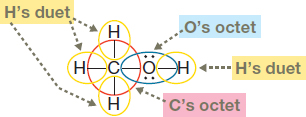
Condensed structural formula of methanol. The condensed structural formula of methanol consists of a carbon atom, single bonded to three hydrogen atoms and an oxygen atom carrying a lone pair of electrons. The oxygen atom is further attached to a hydrogen atom by a single bond. The hydrogen atoms are labeled as H’s duet, the oxygen atoms are labeled as O’s octet, and the carbon is labeled as C’s octet.
CONNECTIONS 1.5
Methanol and its uses Methanol (CH3OH, Your Turn 1.5), also called methyl alcohol or wood alcohol, is used industrially as a feedstock to produce formaldehyde, which is integral in the production of some plastics, paints, and explosives. Methanol is also the primary fuel used in many types of racing vehicles.

A photo shows a Formula One car emitting smoke on a racetrack.
Because of their widespread use in organic chemistry, you must be able to draw Lewis structures quickly and accurately. The following steps allow you to do so in a systematic way:
Steps for Drawing Lewis Structures
SOLVED PROBLEM 1.4
How to draw the Lewis structure of a small molecule or molecular ion
Break It Down Draw a Lewis structure of HCO2–, where carbon is the central atom.
|
Think |
Solve |
|
|
How many total valence electrons are there? |
➤ |
The number of valence electrons each atom contributes is the atom’s group number. The –1 charge represents one additional electron. 1 H atom: 1 × 1 valence electron = 1 valence electron 1 C atom: 1 × 4 valence electrons = 4 valence electrons 2 O atoms: 2 × 6 valence electrons = 12 valence electrons –1 charge: 1 × 1 valence electron = 1 valence electron Total: = 18 valence electrons |
|
How should you draw the skeleton? How many electrons must still be accounted for after drawing the skeleton? |
➤ |
The carbon is given as the central atom. Therefore, the central carbon is connected by a single bond to hydrogen and to each oxygen, which accounts for six valence electrons. That leaves 12 valence electrons still to account for. 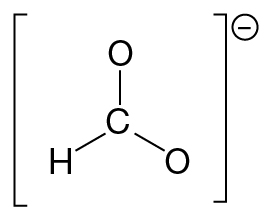
More informationAn illustration shows that structural formula of H C O 2 minus. A carbon atom is at the center of the structure. There are three single bonds extending out from the carbon atom. One leads to a hydrogen atom and the other two lead to oxygen atoms. The whole molecule is marked with a negative charge. |
|
How should the remaining electrons be added? Can each non-hydrogen atom achieve an octet? |
➤ |
The 12 remaining electrons are added as lone pairs to the oxygen atoms, as shown in the first structure, which gives each oxygen atom an octet. To give carbon an octet, convert a lone pair from one oxygen into a bonding pair to create a double bond, as shown in the second structure. 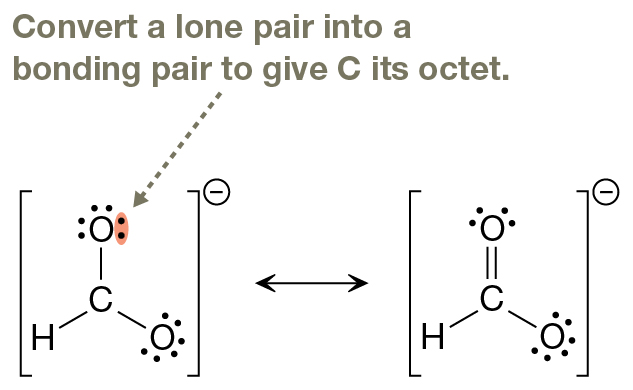
More informationA two-part illustration shows the conversion of a lone pair of an atom to a bonding pair. The first part shows an anion that consists of a central carbon atom, single bonded to a hydrogen atom and two oxygen atoms, each carrying three lone pairs of electrons. A lone pair of electrons in one of the oxygen atoms is labeled, convert a lone pair into a bonding pair to give carbon its octet. The second part shows the anion with the converted bonding pair. This bonding pair exists as the double bond between the central carbon atom and the oxygen atom carrying two lone pairs of electrons. The central carbon atom also single bonded to the hydrogen atom and the oxygen atom carrying three lone pairs of electrons. The two anions are in equilibrium with each other. |
|
Try ItDraw a Lewis structure for C2H3N. One carbon is bonded to three hydrogen atoms and to the second carbon. The nitrogen atom is bonded only to a carbon atom. |
||
CONNECTIONS 1.6
You’ll get a charge out of thionyl chloride Thionyl chloride (SOCl2, Fig. 1-17c) is used in lithium–thionyl chloride batteries, where it acts as the positive electrode.
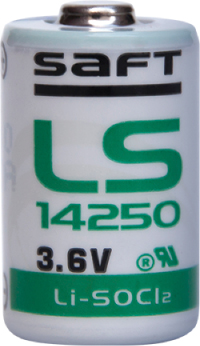
A photo shows a 3.6-volt lithium-thionyl chloride battery.
Some molecular species do not have enough electrons to allow all atoms to have a complete valence shell. In borane (BH3, Figure 1-17a), for example, the B atom has a share of only six valence electrons. The same is true of C+ in the methyl cation (H3C+, Fig. 1-17b), a species characterized as a carbocation due to its positively charged carbon. Similarly, in thionyl chloride (SOCl2, Fig. 1-17c), the S atom has a share of 10 electrons but, being in the third row of the periodic table, its valence shell can contain up to 18 electrons.
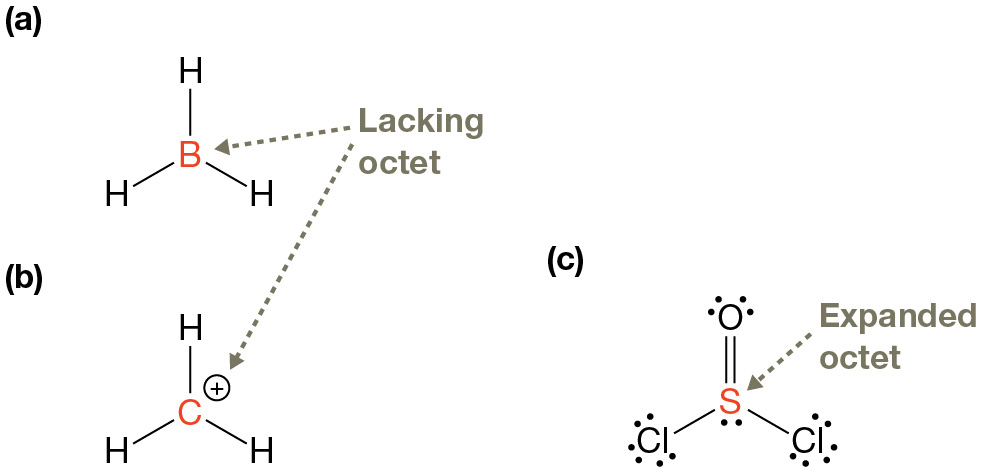
Condensed structural formula of three molecules, B H 3, C H 3 and S O C l 2. The condensed structural formula of B H 3 consists of a central boron atom, attached to three hydrogen atoms by single bonds. The boron atom is labeled, lacking octet. The structural formula of C H 3 consists of a central carbon atom attached to three hydrogen atoms by single bonds. The carbon atom is labeled, lacking octet. The condensed structural formula of S O C l 2 consists of a central sulfur atom carrying a lone pair of electrons, double bonded to an oxygen atom carrying two lone pairs of electrons and single bonded to two chlorine atoms, each carrying three lone pairs of electrons. The sulfur atom is labeled, expanded octet. The caption reads, “(a) Boron and (b) carbon are in the second row and have less than an octet. (c) Sulfur is in the third row and has an expanded octet.”
Even though atoms in the third row and below can have more than eight electrons in their valence shell, we often apply the idea of an octet to those atoms, too. In SOCl2, for example, both Cl atoms have a share of eight valence electrons, so we say that each Cl atom has an octet. The S atom, on the other hand, has a share of 10 electrons, so we say that S has an expanded octet. Be careful, however, when using this terminology, because only atoms in the third row and below can have an expanded octet:
Atoms in the second row cannot exceed the octet!