Section 1.9 Objectives
You will be able to:
- Calculate the formal charge of an atom in a molecule or molecular ion, given the Lewis structure.
- Determine the number of bonds and lone pairs an atom has from its formal charge.
In an isolated atom or atomic ion, charge is determined by the difference between the atom’s group number and the actual number of valence electrons it possesses. A carbon atom, for example, has zero charge if it possesses four valence electrons, because its group number is 4. It carries a charge of –1 if it has five valence electrons, and it carries a charge of +1 if it has only three valence electrons.
YOUR TURN 1.8
Fill in the table below for a carbon nucleus that has 3, 4, or 5 valence electrons.
|
Number of Valence Electrons |
Total Number of Electrons |
Number of Protons |
Charge |
|
3 |
|||
|
4 |
|||
|
5 |
Number of valence electrons (total number of electrons, number of protons, charge): 3 (5, 6, + 1); 4 (6, 6, 0); 5 (7, 6, –1)
CONNECTIONS 1.7
The formate anion in the body The formate anion, HCO2– (Solved Problem 1.8), is produced in significant amounts in the mitochondria of embryonic liver cells and also in cancer cells. Mitochondrial formate contributes the majority of the one-carbon units that are used for an important biochemical process called methylation.
CONNECTIONS 1.8
Oximes and their uses Oximes (Solved Problem 1.8, Try It) are important intermediates in organic synthesis, including the industrial production of nylon-6. Some oximes are used as nerve-agent antidotes, and one (perillartine) is an artificial sweetener that is 2000 times sweeter than sucrose.
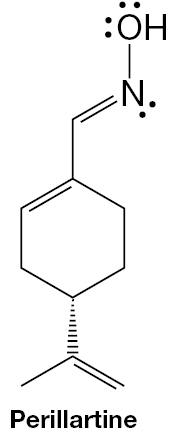
An illustration shows the structural formula of perillartine. There is a closed six ring structure. Off of carbon 1 a chain extends. This chain contains C N O H. The C and the N are linked by a double bond. The N has one lone pair of electrons. The O had two pairs of lone electrons. Going back to the ring structure, there is a double bond between carbons 1 and 2. Carbon 4 had a dashed wedge extending out. The wedge ends at another carbon atom. This carbon atom is single bonded to a C H 3 group and double bonded to a C H 2 group.
How do we determine the charge of an atom in a molecule, where electrons that make up covalent bonds are being shared between atoms? One way is to use the rules for formal charge to assign electrons:
Formal Charge
Solved Problem 1.8 shows how to apply these rules to a Lewis structure of HCO2-.
SOLVED PROBLEM 1.8
How to calculate the formal charge of an atom in a molecular species
Break It Down Determine the formal charge on every atom in the formate anion, HCO2–, shown here.
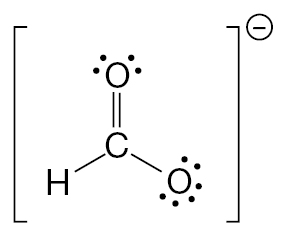
A condensed structural formula of formate anion. The condensed structure shows a central carbon atom, single bonded to a hydrogen atom and double bonded to two oxygen atoms, one carrying two lone pairs of electrons and the other carrying three lone pairs of electrons. The overall charge is minus one.
|
Think |
Solve |
|
|
How are lone pairs and bonding pairs assigned to atoms? |
➤ |
Lone pair electrons are assigned to the atom on which they appear. Electrons that make up a covalent bond are equally divided between the two atoms in the bond. So, in the H—C bond, one of the two electrons is assigned to H and the other to C; similarly, we assign one of the two electrons from the C—O bond to C and the other to O. We assign two of the four electrons from the C═O bond to C and the remaining two to O. |
|
How is an atom’s formal charge computed from the number of electrons it is assigned? |
➤ |
We compare each atom’s group number with the number of electrons it is assigned. As seen in the diagram, the H atom, the C atom, and the double-bonded O atom are assigned formal charges of 0 because they have the same number of valence electrons as their corresponding group numbers. The single-bonded O is assigned seven valence electrons, which is one more than its group number of 6. It is therefore assigned a formal charge of –1. 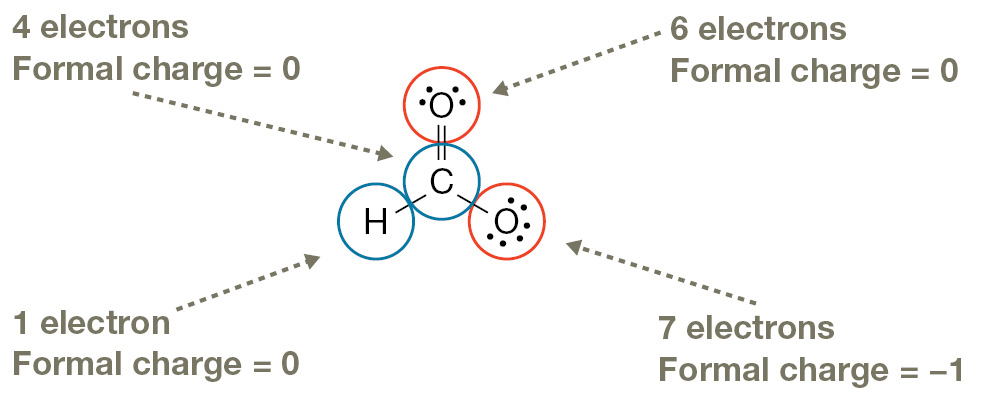
More informationA condensed structural formula of carboxyl group, labeled with number of electrons and formal charge on its atoms. The condensed structural formula of the formate ion shows a central carbon atom, single bonded to a hydrogen atom and double bonded to two oxygen atoms, one carrying two lone pairs of electrons and the other carrying three lone pairs of electrons. The carbon atom has four electrons with zero formal charge. The hydrogen atom has one electron with zero formal charge. The oxygen atom carrying two lone pairs of electrons has six electrons with zero formal charge. The oxygen atom carrying three lone pairs of electrons has seven electrons with a formal charge of negative 1. |
|
Try ItDetermine the formal charge of each atom in the molecule shown here, which belongs to a class of compounds called oximes. 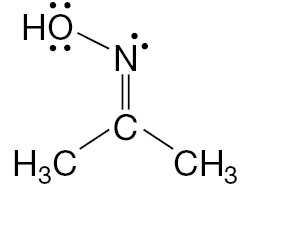
More informationA condensed structural formula of a molecule. The condensed structure shows a central carbon atom, single bonded to two methyl groups and double bonded to a nitrogen atom. This is shown further attached to the oxygen of a hydroxyl group by a single bond. The oxygen has two lone pairs of electrons. The nitrogen has one lone pair of electrons. |
||
Assigning formal charges to atoms is simply a way of distributing the electrons that are already present within a particular species. Therefore:
The formal charges of all atoms must sum to the total charge of the species.
YOUR TURN 1.9
Sum the formal charges assigned in Solved Problem 1.8. What do you notice?
Sum of formal charges: 0 + 0 + 0 + (–1) = –1. Sum equals the overall charge on HCO2– ion, –1.