Section 2.2 Objectives
You will be able to:
- Outline the basic rules of dash–wedge notation.
- Use dash–wedge notation to accurately depict the three-dimensional nature of tetrahedral atoms.
Molecules are three-dimensional, but the page on which we draw them is two-dimensional. To work around this problem, chemists use dash–wedge notation (see Looking Ahead box), which allows us to represent atoms both in front of and behind the plane of the paper. Dash–wedge notation has three basic rules:
Rules for Dash–Wedge Notation
 ) represents a bond that lies in the plane of the page.
 ) represents a bond that points toward you.
 ) represents a bond that points away from you.
▶ LOOKING AHEAD
In Chapter 5, we will see how dash–wedge notation is used to distinguish stereoisomers, which are types of isomers that differ by the spatial arrangements of their atoms. Distinguishing stereoisomers is important, especially because they can have vastly different properties in the body.
Using dash–wedge notation, Figure 2-5 shows two ways to represent the tetrahedral atom in CH4. Both illustrations represent the same molecule with the same 109.5° bond angles. The only difference is the vantage point from which you view the molecule. Figure 2-5a is the most common representation, whereas Figure 2-5b is the basis for a shorthand notation of tetrahedral carbon atoms, called the Fischer projection, which we will introduce in Chapter 5.
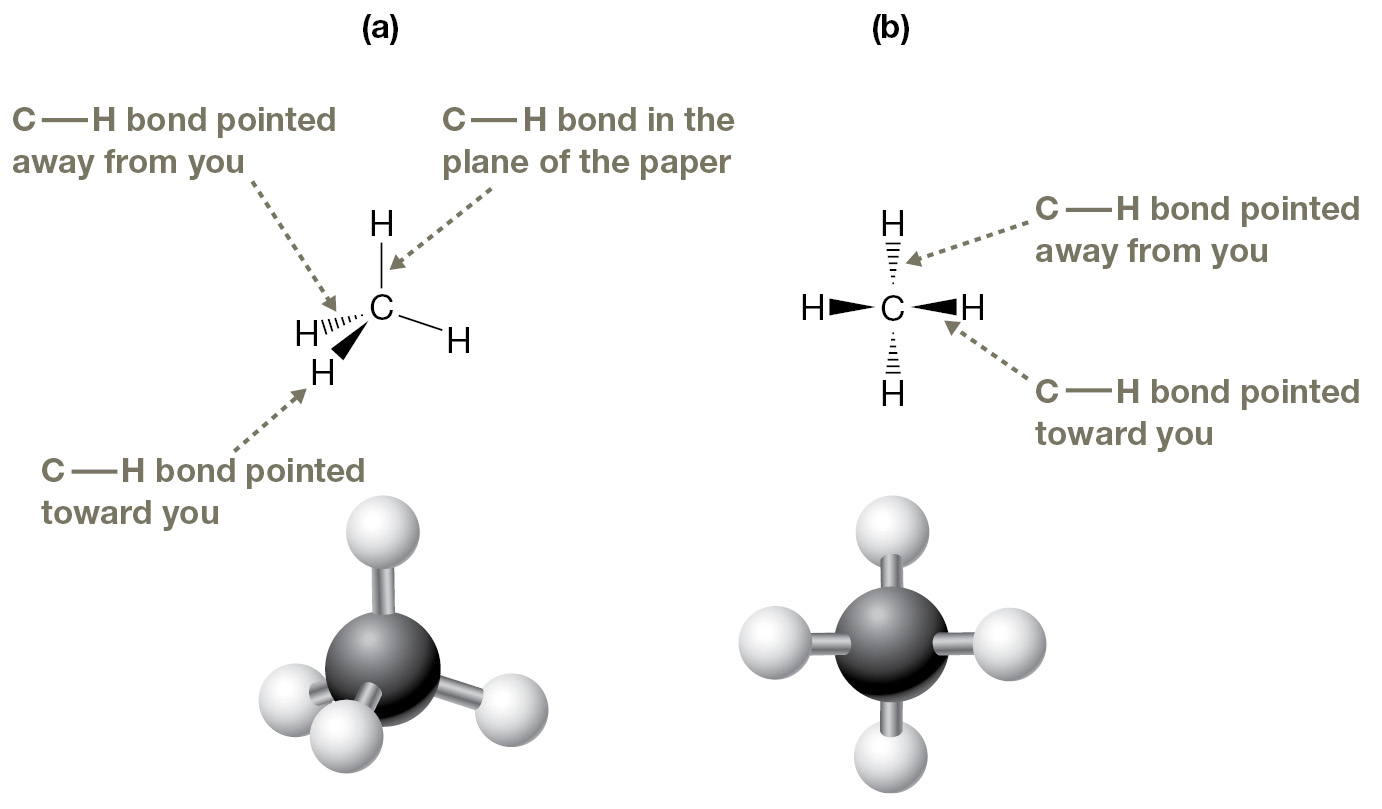
Condensed structural formulas with dash-wedge notation and ball-and-stick models of methane viewed from two different angles. Both illustrations show a methane molecule, with a central carbon atom bonded to two hydrogen atoms. The first illustration shows two C-H bonds in the plane of the paper, represented by solid lines. Another C-H bond points toward the reader and is represented by a solid wedge. The fourth C-H bond points away from the reader and is represented by a dashed wedge. The accompanying ball-and-stick model shows a three-dimensional view of the molecule from the same angle. The second illustration shows two C-H bonds pointing toward the reader, each represented by a solid wedge, and two C-H bonds pointing away from the reader, each represented by a dashed wedge. The accompanying ball-and-stick model shows a three-dimensional view of the molecule from the same angle. The caption reads, “Representations of CH 4 using dash—wedge notation: The two different depictions imply views of the molecule from different vantage points.”
YOUR TURN 2.4
Ball-and-stick representations of NH4+ from two different vantage points are provided. Next to each one, draw the corresponding cation using dash–wedge notation.

An illustration shows two ball-and-stick models of ammonium cation from different angles with a space next to each model. The first ball-and-stick model shows a nitrogen atom bonded to three hydrogen atoms by single bonds. Two of the N-H bonds are in the plane of the paper, one N-H bond is pointed away from the reader, and the other N-H bond is pointed toward the reader. The second ball-and-stick model shows the same molecule in a different angle, with two N-H bonds pointing toward the reader and two N-H bonds pointing away from the reader.
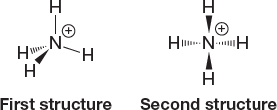
Condensed formula for two N H 4 structures. The first structure shows a central nitrogen with a positive charge bonded to four hydrogens, one which is on a solid wedge and one which is on a dashed wedge. The second structure shows a central nitrogen with a positive charge bonded to four hydrogens, two of which are on a solid wedge and the other two on a dashed wedge.
CONNECTIONS 2.3
Butan-2-ol and its use in industry Butan-2-ol (Fig. 2-6) is used industrially as a precursor to butan-2-one, which has applications as an industrial solvent and as a welding agent for connecting polystyrene parts of scale models.
Dash–wedge notation can be combined with line structures to illustrate the three-dimensional geometry of more complex molecules such as butan-2-ol, shown in Figure 2-6.
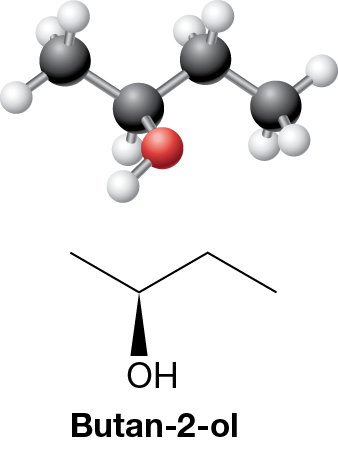
Ball-and-stick model and dash-wedge representation of butan-2-ol. The ball-and-stick model shows four carbon atoms bonded together in a zigzag fashion. Carbon 2 is bonded to a hydroxyl group where the C-O bond points toward the reader. The dash-wedge representation shows a zigzag line with two crests and two troughs. A solid wedge connects the atom in the second position to a hydroxyl group. The caption reads, “Line structures combined with dash—wedge notation: The line structure indicates a chain of four tetrahedral carbon atoms. The wedge indicates that the bond to O H points toward you.”
YOUR TURN 2.5
In the box provided, draw the line structure of butan-2-ol using dash–wedge notation. Note that the C—O bond points away from you.
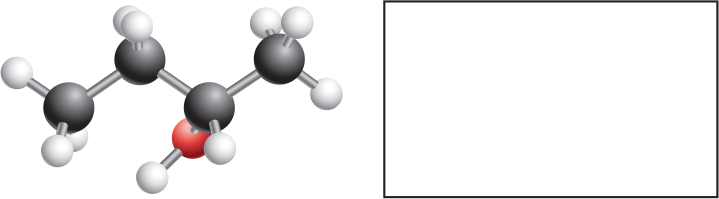
Ball-and-stick model of butan-2-ol, with an empty box provided beside it. The ball-and-stick model shows four carbon atoms bonded together in a zigzag fashion. Carbon 2 is bonded to a hydroxyl group where the C-O bond points away from the reader.

Condensed structural formula. The structure shows a four carbon chain, the second carbon is bonded to a hydroxyl group on a dashed wedge.
When drawing the dash–wedge notation for a tetrahedral atom, it is important to add the dash and wedge bonds accurately. Looking back at Figure 2-5a, notice that only two of the four bonds can be in the plane of the page. One of the remaining two bonds points toward you, and it is in front of the final bond that points away. To remember this, it helps to see that the four bonds make up two Vs that are perpendicular to each other, as shown in Figure 2-7.
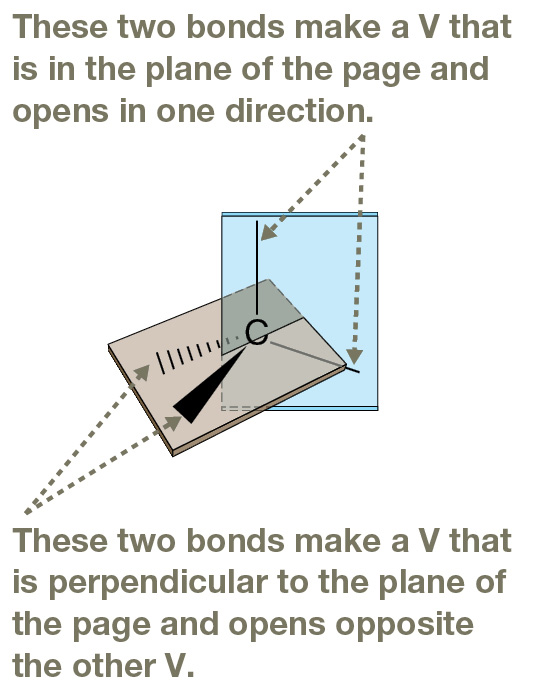
An illustration shows the perpendicular planes that the bonds of a tetrahedral atom lie in. A dashed-wedge notation shows a carbon with two single bonds represented as lines that are within a blue rectangle. A label reads these two bonds that make a V that is in the plane of the page and opens in one direction. There are two other single bond off of the carbon atom. One is shown as a dashed wedge and one is shown as a solid wedge. They are within a different blue box. A label reads these two bonds make a V that is perpendicular to the plane of the page and opens opposite the other V.
YOUR TURN 2.6
A common mistake is made in the dash–wedge notation at the right. Explain what is incorrect about the structure and then fix it. (It may help to build a model of it.)
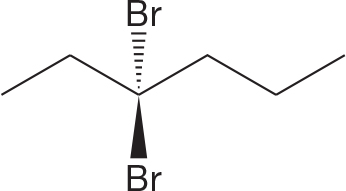
An illustration shows a dash-wedge representation of an organic compound. The structure shows a zig-zag line with three crests and three troughs. The atom in the third position is bonded to two bromine atoms. One of these bonds points toward the reader and is represented by a solid wedge, and the other bond points away from the reader and is represented by a dashed wedge.
The two Vs (red and blue) that make up the four bonds of the tetrahedral atom must be perpendicular and open in opposite directions. On the left, that is not the case. The problem is fixed in the structure on the right, where the red V is in the plane of the paper and opens upward, and the blue V is perpendicular and opens downward.
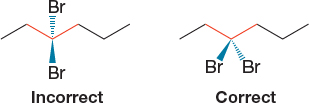
Condensed structure of the incorrect and correct formula. The incorrect structure shows a chain of six carbons, the third carbon is bonded to a bromine on top by a dashed wedge and another bromine by a solid wedge on bottom. The correct formula shows a six carbon chain, the third carbon is bonded to a bromine below and on the left by a solid wedge and another bromine below and to the right on a dashed wedge.