Section 2.3 Objectives
You will be able to:
- Construct a molecular model accurately, given the dash–wedge notation of a molecule.
- Use a molecular model to help draw the dash–wedge notation of a molecule accurately.
Much of organic chemistry requires us to manipulate molecules in three dimensions. Unfortunately, we are limited to two dimensions when we represent a molecule on paper, even when we use dash–wedge notation. Molecular modeling kits can help. Instead of having to rotate a three-dimensional image mentally, you can construct real models and rotate them in your hands. For example, let’s use a modeling kit to determine what the following cyclopentane derivative looks like after it has been flipped over vertically.
Strategies for Success: The Molecular Modeling Kit
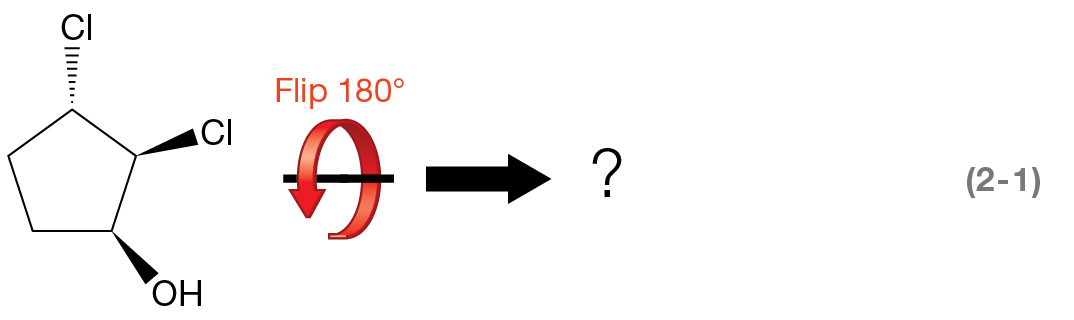
An equation shows a cyclopentane derivative molecule flipped over vertically to reveal an unknown orientation represented by a question mark. The cyclopentane derivative shows a pentagonal five-carbon ring with carbon 1 bonded to a hydroxyl group and carbons 2 and 3 bonded to a chlorine atom each. The bonds between carbon 1 and the oxygen in the O-H group, and between carbon 2 and the chlorine atom both point toward the reader and are represented by solid wedges, while the chlorine-carbon 3 bond points away from the reader and is represented by a dashed wedge. A curved arrow beside this structure shows a 180-degree flipping, and an arrow from this leads to a question mark.
You may develop your own process for these kinds of manipulations, but for now carry out the following steps, which are depicted in Figure 2-8:

Illustration shows the 180-degree flip of a cyclopentane derivative using 3-D models. The original cyclopentane derivative shows a pentagonal five-carbon ring with carbon 1 bonded to a hydroxyl group and carbons 2 and 3 bonded to a chlorine atom each. The bonds between carbon 1 and the oxygen in the O-H group, and between carbon 2 and the chlorine atom both point toward the reader and are represented by solid wedges, while the chlorine-carbon 3 bond points away from the reader and is represented by a dashed wedge. An arrow labeled “1. construct” leads from this structure leads to a photo showing a three-dimensional ball-and-stick model of the cyclopentane derivative. A curved arrow showing a 180-degree flipping leads from this photo to another, which shows the 3-D ball-and-stick model flipped over vertically. The arrow is labeled “2. Flip 180 degrees.” An arrow labeled “3. redraw” leads from the second photo to the structural formula of the cyclopentane derivative after it has been flipped over. This structure is similar to the original, except that the bonds between carbon 1 and the oxygen in the O-H group, and between carbon 2 and the chlorine atom both point away from the reader and are represented by dashed wedges, while the chlorine-carbon 3 bond points toward the reader and is represented by a solid wedge. The caption reads, Model kits and 3-D manipulations: To draw the molecule in Equation 2-1 after it is flipped 180 degrees, first, construct the molecule with a model kit, second, flip the molecule over 180 degrees, and third, use the model as a guide to redraw the molecule in dash—wedge notation.
YOUR TURN 2.7
Construct the molecule shown here, using a molecular modeling kit, and then draw its structure using dash–wedge notation after each successive 180° flip.
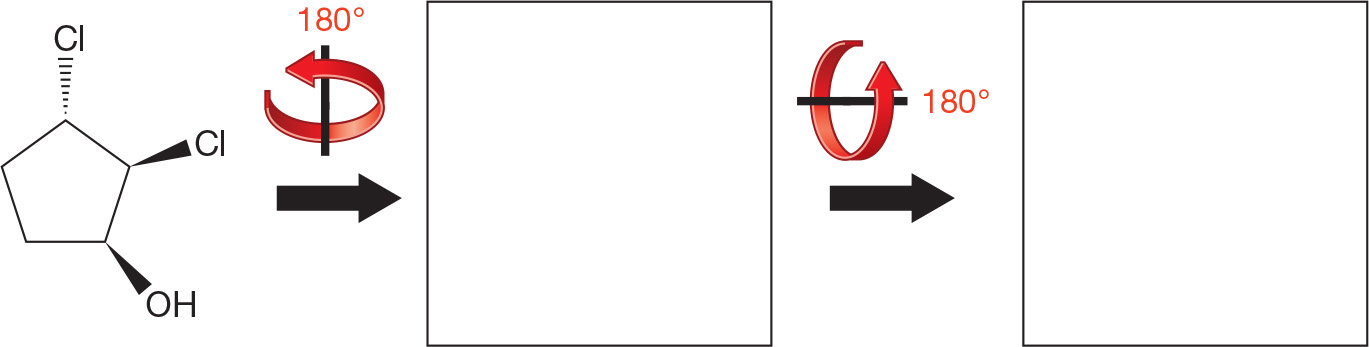
An illustration shows a cyclopentane derivative that is flipped over by 180 degrees two times. The cyclopentane derivative shows a pentagonal five-carbon ring with carbon 1 bonded to a hydroxyl group and carbons 2 and 3 bonded to a chlorine atom each. The bonds between carbon 1 and the oxygen in the O-H group, and between carbon 2 and the chlorine atom both point toward the reader and are represented by solid wedges, while the chlorine-carbon 3 bond points away from the reader and is represented by a dashed wedge. A curved arrow beside this structure shows a horizontal, 180-degree flipping, and an arrow from this leads to an empty box. A curved arrow beside this box shows a vertical, 180-degree flipping, and an arrow from this leads to another empty box.
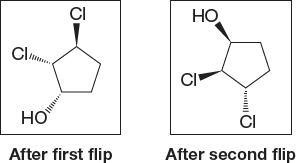
Condensed structural formula after flipping twice. After the first flip, the structure is a cyclopentane ring, the first carbon is bonded to a chlorine atom on a solid wedge, the second carbon is bonded to a chlorine on a dashed wedge, and the third carbon is bonded to a hydroxyl group on a dashed wedge. After the second flip, the structure is the same, but the solid wedges become dashed, and the dashed wedges become solid.