2.8 Strategies for Success: Ranking Boiling Points and Solubilities of Structurally Similar Compounds
Section 2.8 Objectives
You will be able to:
Rank the boiling points of several structurally similar compounds, on the basis of intermolecular forces.
Predict the order of solubility of several structurally similar solutes in a given solvent, on the basis of intermolecular forces.
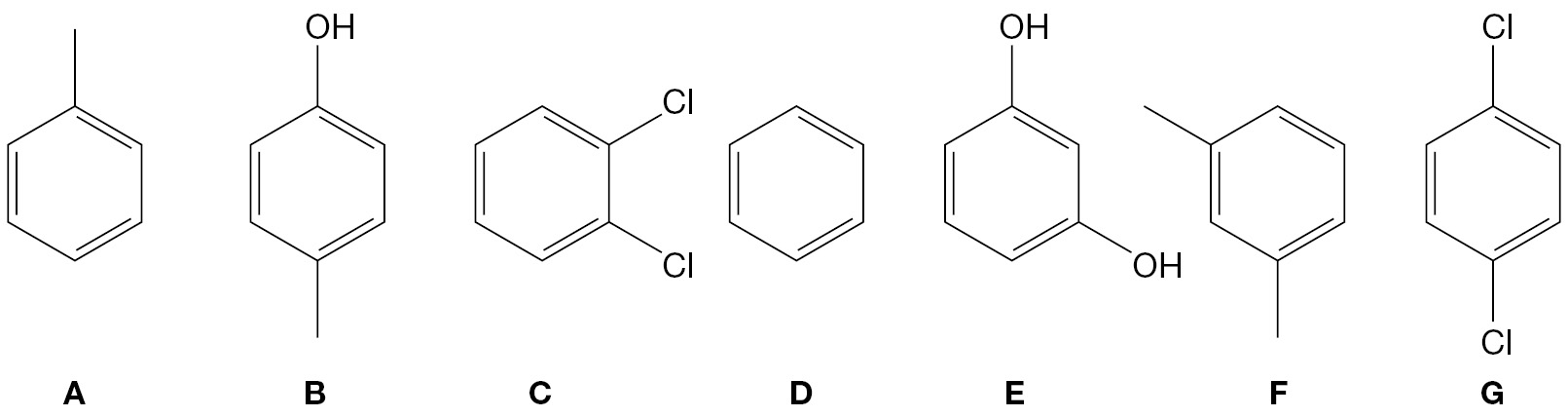
One type of problem you will face is ranking the boiling points, melting points, or solubilities of a set of compounds, given only their molecular structures. Suppose, for example, that you were asked to rank the boiling points of the compounds in Figure 2-25, from lowest to highest.
More information
Skeletal structural formulas of seven molecules labeled from A to G. Each structure shows a benzene ring. Structure A shows a single bond arising from one atom. Structure B shows one atom bonded to a hydroxyl group, and a single bond arising from the atom at the para position. Structure C shows two chlorine atoms bonded to two atoms in the ring at ortho positions. Structure E shows two hydroxyl groups bonded to two atoms in the ring at meta positions. Structure F shows single bonds arising from two atoms at meta positions. Structure G shows two chlorine atoms bonded to two atoms in the ring at para positions.
FIGURE 2-25Compounds A–G to rank in order of boiling point
Strategies for Success: Ranking Boiling Points and Solubilities of Structurally Similar Compounds
Because there are a number of factors at play simultaneously, you should find ways to break this large problem into smaller, more manageable pieces. The following method can help, but you might also discover another method that suits you better:
Ranking Boiling Points
Identify the most important intermolecular interactions in each pure compound and group the compounds accordingly.
Arrange those groups of compounds according to the typically observed strength of the intermolecular interactions, which increase from low to high as follows:
Within each group, arrange the compounds according to the major factor that dictates the strength of the interaction. For example,
Induced dipole–induced dipole interactions become stronger with greater polarizability.
Dipole–dipole interactions become stronger with larger dipoles.
Hydrogen bonding becomes more extensive with greater numbers of potential H-bond donors and H-bond acceptors.
Assign the relative boiling points the same overall order because, to overcome stronger intermolecular interactions, more heat energy is required.
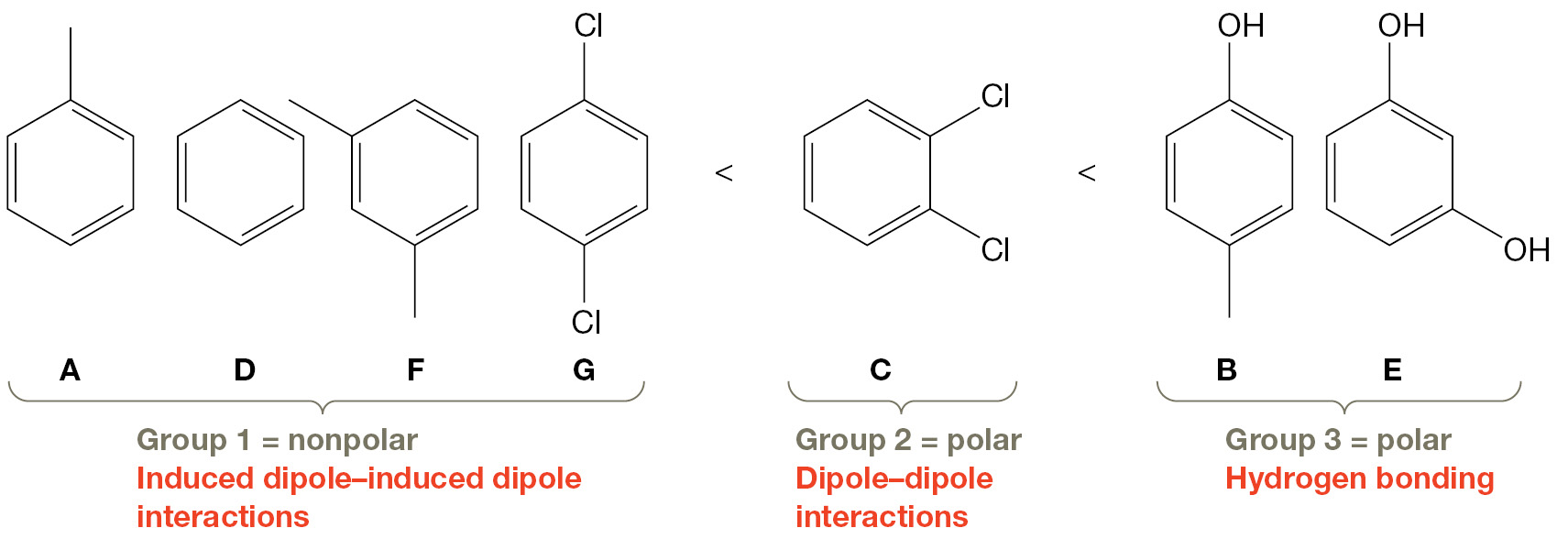
Applying Steps 1 and 2 to compounds A–G, we arrive at the groupings in Figure 2-26:
More information
Skeletal structural formulas of seven molecules labeled from A to G, grouped in order of increasing intermolecular strength. Each structure shows a benzene ring. Structure A shows a single bond arising from one atom. Structure B shows one atom bonded to a hydroxyl group, and a single bond arising from the atom at the para position. Structure C shows two chlorine atoms bonded to two atoms in the ring at ortho positions. Structure E shows two hydroxyl groups bonded to two atoms in the ring at meta positions. Structure F shows single bonds arising from two atoms at meta positions. Structure G shows two chlorine atoms bonded to two atoms in the ring at para positions. The seven structures are sorted into three groups of increasing strength of intermolecular interaction. Structures A, D, F, and G make up the first group, with a note below that reads, “Group 1 equals nonpolar: Induced dipole—induced dipole interactions.” Structure C is in the second group, with a note below that reads, “Group 2 equals polar: Dipole—dipole Interactions.” Structures B and E make up the third group, with a note below that reads, “Group 3 equals polar: Hydrogen bonding.”
FIGURE 2-26Compounds A–G grouped by dominant intermolecular interactions
Next we apply Step 3 to each group of molecules. For the nonpolar molecules in group 1, polarizability dictates the strength of the induced dipole–induced dipole interactions, and polarizability tends to increase with the number of total electrons. Therefore, the strength of the intermolecular interactions increases in the order D<A<F<G.
For the group 3 molecules, which undergo hydrogen bonding, we examine the number of potential donors and acceptors in a pair of each. In a pair of molecules B, there are two donors and two acceptors, whereas in a pair of molecules E, there are four of each. Therefore, H-bonding is more extensive in E than in B.
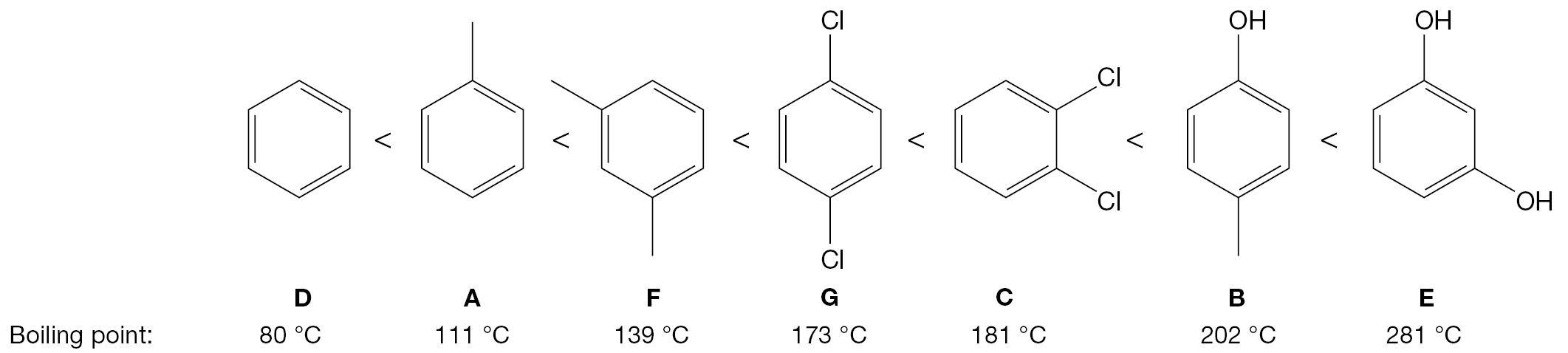
Putting it all together, we predict that the strength of intermolecular interactions increases as shown in Figure 2-27:
More information
Skeletal structural formulas and boiling points of seven molecules labeled from A to G, arranged in order of increasing intermolecular strength. Each structure shows a benzene ring. Structure A shows a single bond arising from one atom. Structure B shows one atom bonded to a hydroxyl group, and a single bond arising from the atom at the para position. Structure C shows two chlorine atoms bonded to two atoms in the ring at ortho positions. Structure E shows two hydroxyl groups bonded to two atoms in the ring at meta positions. Structure F shows single bonds arising from two atoms at meta positions. Structure G shows two chlorine atoms bonded to two atoms in the ring at para positions. The seven structures are arranged in the following order of increasing strength of intermolecular interaction — D, A, F, G, C, B, and E. The boiling points of these molecules are shown in increasing order as follows. Structure D: 80 degrees Celsius, Structure A: 111 degrees Celsius, Structure F: 139 degrees Celsius, Structure G: 173 degrees Celsius, Structure C: 181 degrees Celsius, Structure B: 202 degrees Celsius, Structure E: 281 degrees Celsius.
FIGURE 2-27Compounds A–G in order of increasing boiling point
We therefore predict that the boiling points of these compounds increase in the same order (actual boiling points are included for comparison).
YOUR TURN 2.19
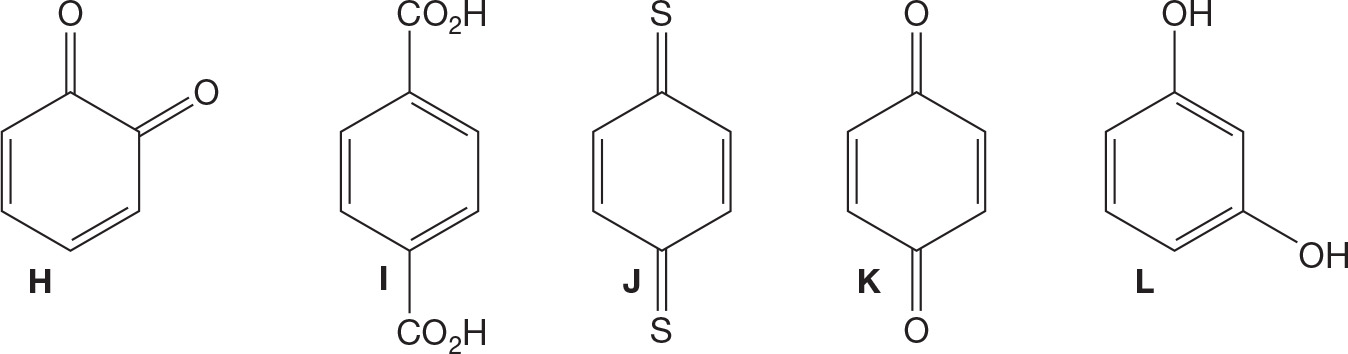
Rank compounds H–L in order of increasing boiling point.
More information
Five structural formulas are shown for compounds labeled H through L. Each compound shows a closed 6 ring structure. In compound H an oxygen is double bonded to carbon 1. Another oxygen is double bonded to carbon 2. A double bond exists between carbon 3 and carbon 4. A double bond exists between carbon 5 and carbon 6. Compound I shows a benzene ring. Two C O 2 H groups are linked to the ring so that there are in para positions. Compound J shows two S atoms linked to the ring by double bonds. They are in para positions relative to each other. There are double bonds between the carbons that are not linked to an S. Compound J shows two O atoms linked to the ring by double bonds. They are in para positions relative to each other. There are double bonds between the carbons that are not linked to an O. Compound L shows a benzene ring. Two O H groups are linked by single bonds to carbons 1 and 3.
SHOW ANSWERHIDE ANSWER
Boiling point is directly related to the strength of the intermolecular interactions, so the compounds arranged from lowest to highest boiling point are as follows: K < J < H < L < I.
In solving the previous ranking problem, we assumed that the molecules possessing only induced dipole–induced dipole interactions (group 1) had the weakest intermolecular interactions and the lowest boiling points. This was a good assumption in that case because the polarizabilities of all the molecules were sufficiently similar. As Solved Problem 2.7 shows, however, in other cases we must take into account significant differences in polarizability.
SOLVED PROBLEM 2.7
How to deal with exceptions when considering relative boiling points
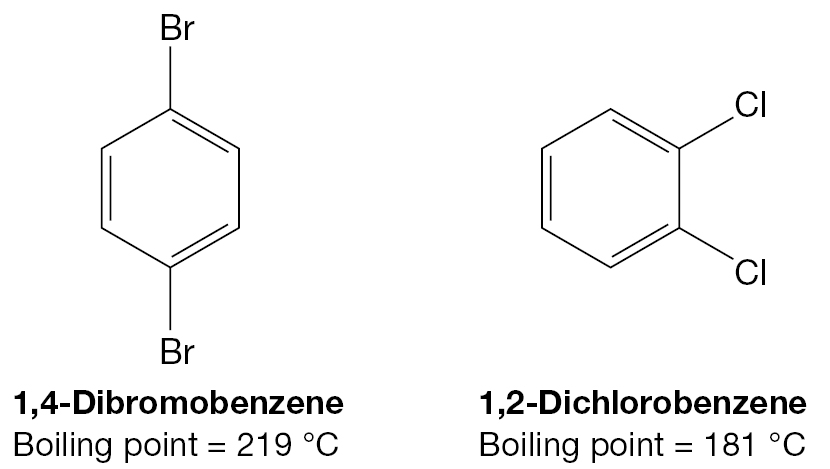
Break It Down The boiling point of 1,4-dibromobenzene, a nonpolar compound, is 219 °C, whereas the boiling point of 1,2-dichlorobenzene, a polar compound, is 181 °C. Explain.
More information
Skeletal structural formulas of 1,4-Dibromobenzene and 1,2-Dichlorobenzene. Each structure shows a benzene ring. 1,4-dibromobenzene shows two bromine atoms bonded to two atoms in the ring at para positions. A note below the structure reads, “1,4-Dibromobenzene: Boiling point equals 219 degrees Celsius.” 1,2-dichlorobenzene shows two chlorine atoms bonded to two atoms in the ring at ortho positions. A note below the structure reads, “1,2-Dichlorobenzene: Boiling point equals 181 degrees Celsius.”
Think
Solve
What intermolecular interactions are present in each compound?
➤
1,4-Dibromobenzene is nonpolar, so it has only induced dipole–induced dipole interactions. 1,2-Dichlorobenzene, on the other hand, is polar, so it has both dipole–dipole interactions and induced dipole–induced dipole interactions.
Are the intermolecular interactions of similar strength in each compound?
➤
Dipole–dipole interactions are generally assumed to be the more important interaction when comparing compounds with similar polarizabilities. In this case, however, the two molecules should have different polarizabilities. More specifically, 1,4-dibromobenzene should be significantly more polarizable than 1,2-dichlorobenzene because it has 36 more electrons (146 vs. 110), the difference between two Br atoms and two Cl atoms. As a result, induced dipole–induced dipole interactions are stronger in 1,4-dibromobenzene: enough to give 1,4-dibromobenzene the higher boiling point.
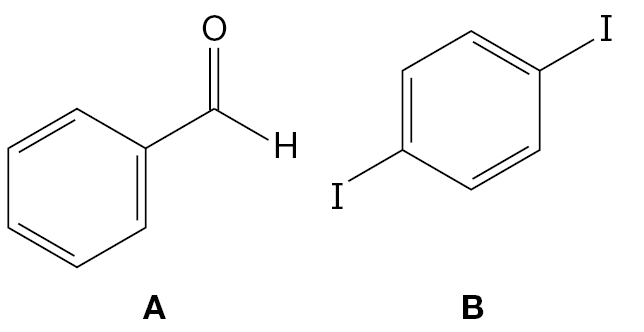
Try ItWhich of the compounds shown here do you think has the higher boiling point? Explain.
More information
Skeletal structural formulas of two molecules labeled A and B. Each structure shows a benzene ring. The first shows an aldehyde group bonded to one of the atoms of the ring. The second shows two iodine atoms bonded to the ring at para positions.
We can apply a similar strategy to predict relative solubilities in a given solvent. In doing so, however, we must consider the disruption of intermolecular interactions in the pure separated substances as well as the formation of intermolecular interactions in the mixture. This is illustrated in Solved Problem 2.8.
SOLVED PROBLEM 2.8
How to predict relative solubilities of several compounds in a given solvent
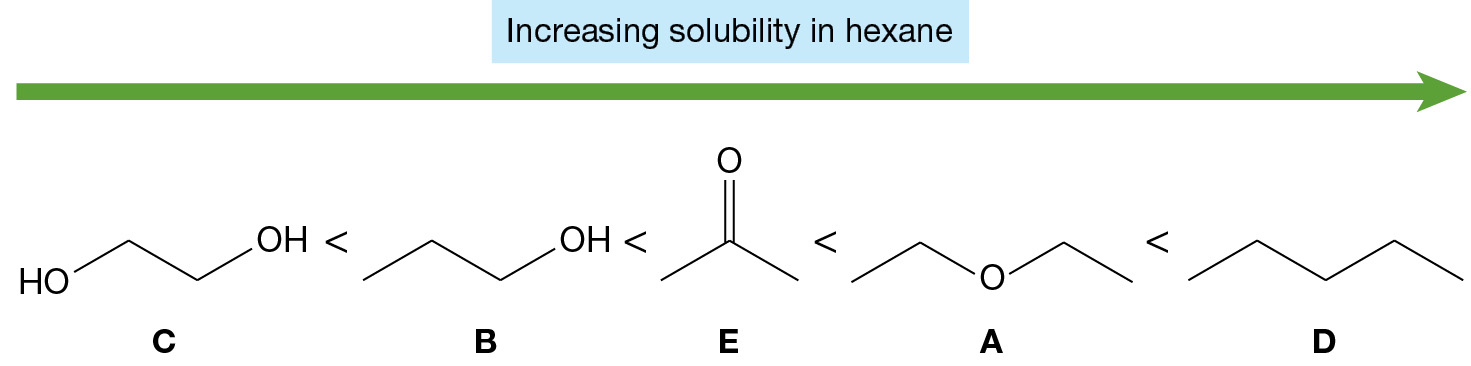
Break It Down Rank compounds A–E from lowest solubility in hexane, CH3(CH2)4CH3, to highest solubility in hexane.
More information
Skeletal structural formulas of five molecules labeled from A to E. Structure A shows an oxygen atom bonded to two chains, each shaped like inverted V. Structure B shows a zigzag line with two crests and troughs, with a hydroxyl group at one crest. Structure C shows a zigzag line with two crests and troughs, with a hydroxyl group each end. Structure D shows a zigzag line with two crests and troughs. Structure E shows an inverted V with an oxygen atom double-bonded to the central atom.
Think
Solve
What are the most important intermolecular interactions that would be lost from the pure solutes? From the pure solvent? What are their relative strengths?
➤
For pure solutes:
Compound D (nonpolar) would lose London dispersion forces.
Compounds A and E (polar) would lose dipole–dipole interactions; these would be stronger in E because it has a larger dipole.
Compounds B and C would lose hydrogen bonding, this would be more extensive in C because C has more H-bond donors and acceptors.
The hexane solvent (nonpolar) would lose only London dispersion forces.
What are the most important intermolecular interactions that would be gained in each solution?
➤
Hexane is nonpolar, so London dispersion forces will be the only intermolecular interactions gained in each solution.
Which intermolecular interactions have the greatest impact on solubility: the ones lost from the pure solutes, lost from the pure solvent, or gained in the solutions?
➤
Only London dispersion forces (the weakest of the intermolecular interactions) would be lost from the pure solvent or gained in the solutions, so the intermolecular interactions lost from the pure solutes (compounds A–E) will dictate the relative solubilities. The solutes with weaker interactions will be more soluble, so solubility will increase in the following order:
More information
Skeletal structural formulas of five molecules labeled from A to E, arranged in order of increasing solubility in hexane. Structure A shows an oxygen atom bonded to two chains, each shaped like inverted V. Structure B shows a zigzag line with two crests and troughs, with a hydroxyl group at one crest. Structure C shows a zigzag line with two crests and troughs, with a hydroxyl group each end. Structure D shows a zigzag line with two crests and troughs. Structure E shows an inverted V with an oxygen atom double-bonded to the central atom. An arrow from left to right is labeled, “increasing solubility in hexane,” and the molecules are arranged in the following order: C, B, E, A, and D.
Try ItRank compounds A–E above in order from least to most soluble in water.