Section 3.2 Objectives
You will be able to:
- Identify the hybridization of an atom that has a tetrahedral electron geometry.
- Describe the orbitals that such an atom contributes to the VB picture of a molecule.
- Draw the VB picture of an alkane.
Section 3.2 Objectives
You will be able to:
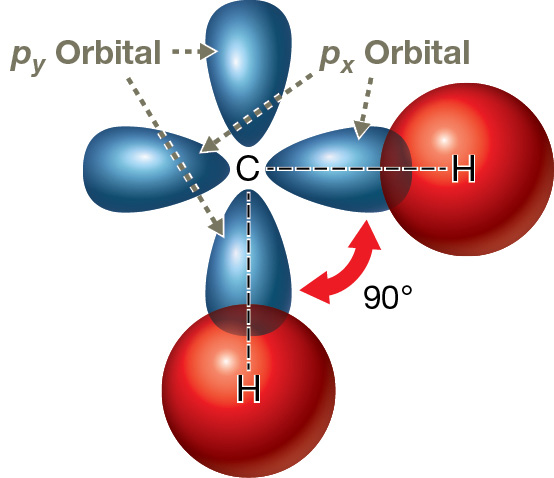
An illustration shows the orbitals and hypothetical H C H angle in C H 4. A C is shown with four lobes. Two lobes extend along the vertical axis, one above the C and one below the C. These are labeled p y orbital. Two lobes extend along the horizontal axis, one the right of the C and one to the left of the C. These are labeled p x orbital. There are two hydrogen atoms with spherical orbitals. One overlaps with the lobe below C. One overlaps with the lobe to the right of C. Two dashed lines connect the C to each of the Hs. A curved arrow points from the one dashed line to the other dashed line. The arrow is labeled 90 degrees which indicates the angle between the bonds.
When we apply VB theory to methane (CH4), we immediately run into an issue concerning the number of bonds possible and the geometry. In an isolated C atom, the ground state electron configuration is 1s22s22p2. Therefore, the s orbital in the valence shell is filled and two of the valence p orbitals are half-filled. If only those half-filled p orbitals are used to form C—H bonds, then carbon would be able to form only two bonds. Moreover, as shown in Figure 3-4, those C—H bonds would be 90° apart because the p orbitals are perpendicular. However, the carbon in CH4 forms four bonds and the actual H—C—H bond angle is 109.5°. How, then, does VB theory account for the tetrahedral geometry of CH4?
We begin by invoking the concept of hybridization, where we consider pure (unhybridized) s and p orbitals from the valence shell mixing together to form new orbitals, called hybrid orbitals. We will discuss hybridization and orbital mixing in greater detail in Section 3.10. For now, it will suffice to know that each hybrid orbital that results from mixing s and p orbitals has character of both an s and a p orbital, so its shape is somewhat different from either. Specifically, as shown in Figure 3-5 (next page), each hybrid orbital consists of one large lobe and one small lobe.
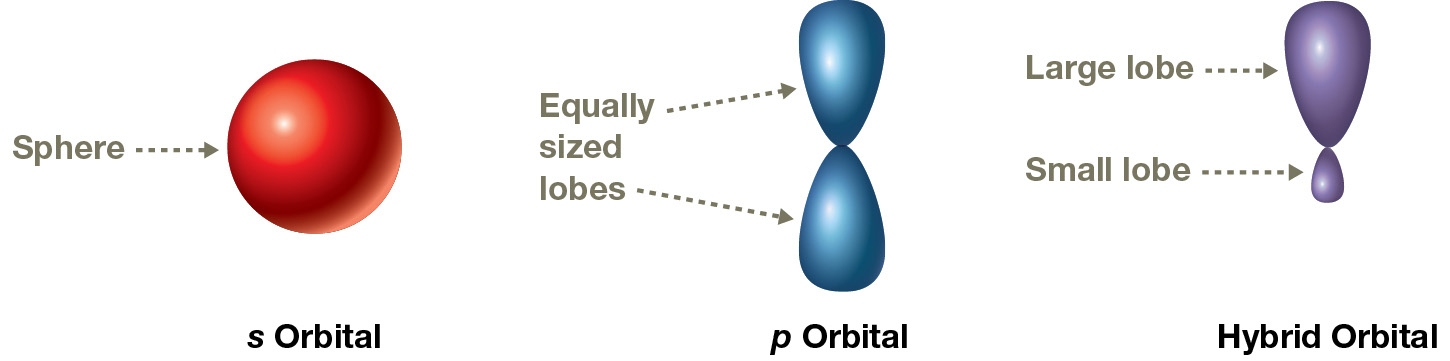
An illustration shows a hybrid orbital compared to an s orbital and a p orbital. The s orbital is a sphere. The p orbital is dumbbell shaped and has two equally sized lobes. The hybrid orbital also has two lobes but one is large and one is small.
In the case of CH4, we consider all four of carbon’s valence orbitals (the 2s orbital and all three 2p orbitals) mixing together in what is called sp3 hybridization (viewed as s1p3, the superscripts indicate that one s orbital and all three p orbitals are used). Four new orbitals are produced, called sp3 hybrid orbitals, as shown in the energy diagrams in Figure 3-6, and the carbon atom is said to be sp3-hybridized:
Any atom that has a tetrahedral electron geometry is sp3-hybridized.
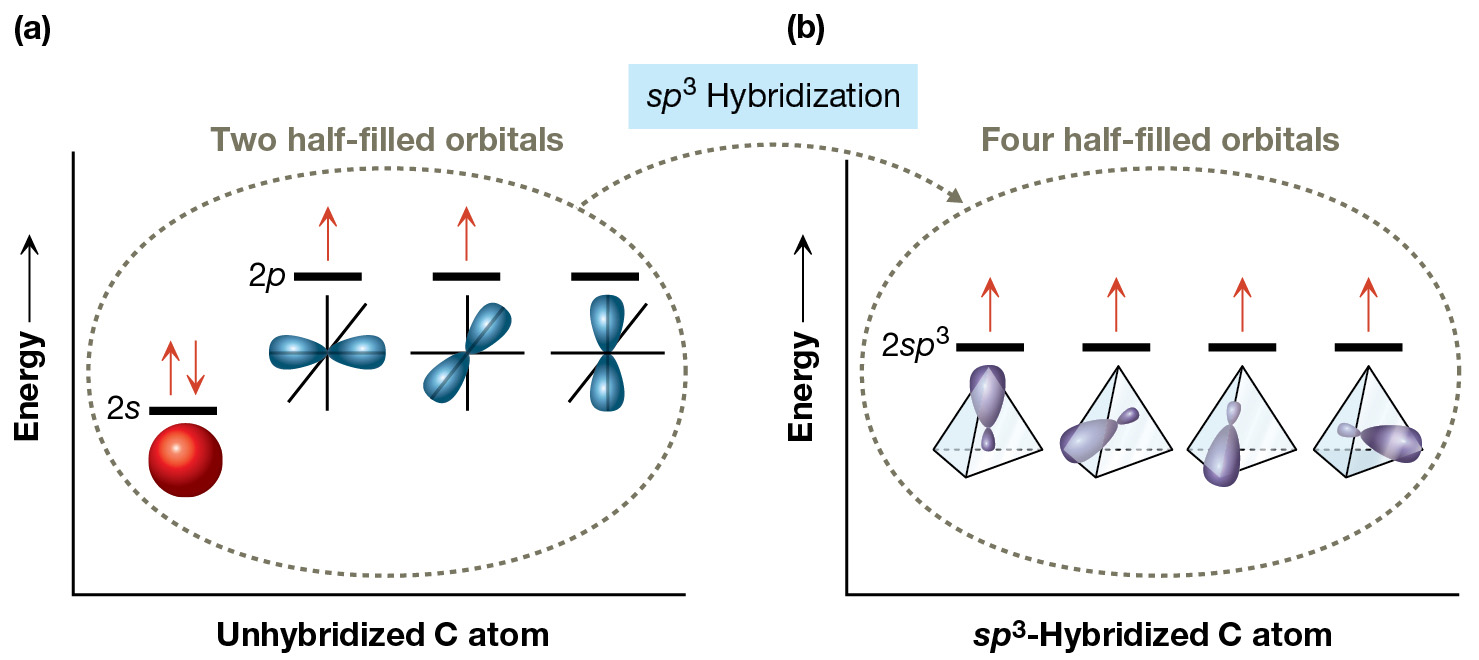
Two charts show the energy levels of electrons in an unhybridized carbon atom and an s p 3 hybridized carbon atom. Both have four valence electrons. The first chart is of an unhybridized C atom. Two electrons occupy the 2 s orbital. The s orbital is shown as a sphere. The s orbital has a low energy level. There are three p orbitals all shown as dumbbells along one of the 3 axes. Two are half filled with only one electron each and the other is empty. These orbital all have high energy levels. An arrow points from the first chart to the second chart and is labeled s p 3 hybridization. The second chart has 4 2 s p 3 orbitals all at intermediate energy levels. Each orbital has one large lobe and one small lobe and are pointed in different directions within a prism. Each orbital has one valence electron in it.
CONNECTIONS 3.2
The good and bad of methane Methane (Fig. 3-4) is the principal fuel in natural gas, which accounts for roughly one-quarter of all energy usage in the United States. Care must be taken to avoid the release of methane into the atmosphere, because it is a greenhouse gas at least 30 times more potent than carbon dioxide.

A photo of a woman cooking at a gas stove. The stove is on. Flames are rising up from the pan the woman is holding over the stove.
CONNECTIONS 3.3
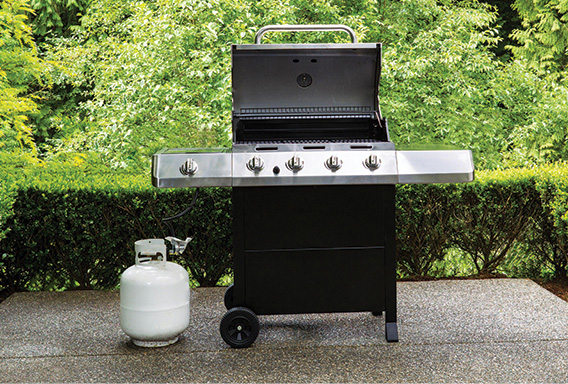
Uses of ethane and propane Ethane and propane (Solved Problem 3.2) are two common alkanes. The principal use of ethane is in the industrial production of ethene, H2C═CH2, which has a wide variety of uses. Propane is commonly used as a fuel for barbecues and to heat homes where natural gas pipelines are unavailable.
With the four sp3 hybrid orbitals accounting for carbon’s tetrahedral geometry, we can construct the VB picture of CH4 shown in Figure 3-7. We begin by adding the atoms in the proper locations along with the valence orbitals that they contribute. Figure 3-7a shows the four sp3 hybrid orbitals (purple) from the carbon atom arranged in a tetrahedron. (Notice that the small lobe from each hybrid orbital is omitted to avoid cluttering the picture.) The four half-filled 1s orbitals (red) are also included: one from each of the four hydrogen atoms. Figure 3-7b shows the resulting orbitals (green) in the CH4 molecule, all of which result from the buildup along the bonding axes identified in Figure 3-7a. Therefore, each pair of bonding electrons makes up a σ bond, in agreement with the observation made earlier that all single bonds are σ bonds.
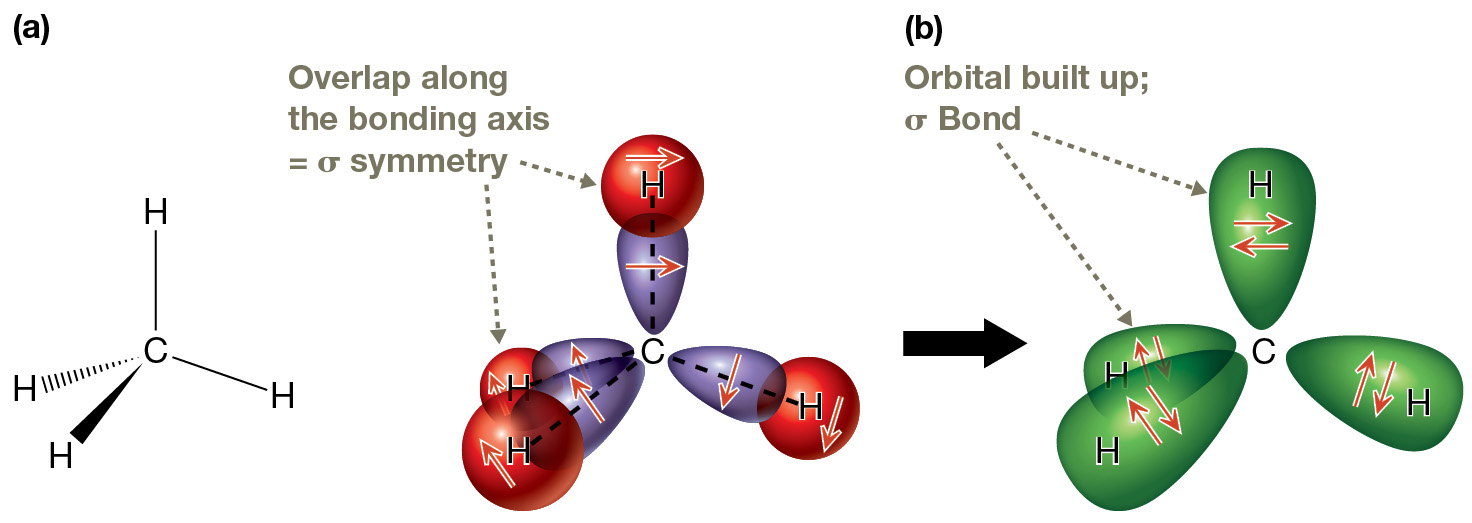
An two part illustration shows the structural formula of methane and the valence orbitals. In the first part, the structural formula shows C binds to four Hs with single bonds and forms a tetrahedral shape. The next illustration shows the orbitals of each atom. The carbon atom has four lobes each with one electron. Each hydrogen atom has a spherical orbital with one electron. Each of the lobes of the carbon overlaps with one of the hydrogen orbitals. Dashed lines connect each hydrogen nucleus to the carbon nucleus. Overlap occurs along the bonding axis which characterizes sigma symmetry. An arrow points from this diagram to a new diagram. This diagram shows four larger lobes surrounding the carbon nucleus. Each lobe has two electrons and also contains a hydrogen nucleus. The orbitals are build up and four sigma bonds have formed.
YOUR TURN 3.1
Draw the valence bond picture that describes the ammonium ion, NH4+, using the valence bond picture of CH4 (Fig. 3-7) as a guide.
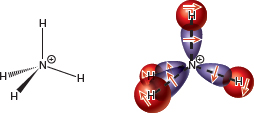
Condensed and orbital structure. The condensed structure is a central nitrogen with a positive charge bonded to four hydrogens. The orbital structure shows the same structure, but each hydrogen is in a red sphere, and each bond between nitrogen and hydrogen is in a purple teardrop shape. Each teardrop and sphere also has an arrow pointing to the left.
VB theory can be used to describe larger alkanes, too. Solved Problem 3.2, for example, shows you how to draw the VB picture of ethane (CH3CH3) and then challenges you to do the same for propane (CH3CH2CH3).
SOLVED PROBLEM 3.2
How to draw the valence bond picture of an alkane
Break It Down Draw the VB picture of ethane, CH3CH3. How many σ bonds does the molecule have?
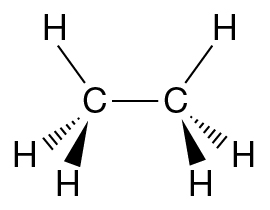
An illustration shows the sigma bonds in a molecule of ethane. The structure of ethane shows a two-carbon chain where each carbon is bonded to a hydrogen atom by a solid line, to a second hydrogen atom by a dashed wedge, and to a third hydrogen atom by a solid wedge.
|
Think |
Solve |
|
|
What is the hybridization of each C atom, and what valence orbitals does it contribute? What orbital does each H atom contribute? |
➤ |
Each C atom has a tetrahedral electron geometry, so each is sp3-hybridized and contributes four half-filled sp3 hybrid orbitals that point to the corners of a tetrahedron. Each H atom contributes a half-filled 1s orbital. |
|
How many regions of orbital overlap are there along bonding axes? What type of bond does that kind of overlap characterize? |
➤ |
To help draw the locations of the atoms and the orientations of the orbitals, use the dash–wedge notation above as a guide. To better visualize the dash–wedge notation, you should use a modeling kit to build a model of the molecule. There are seven regions of orbital overlap along the bonding axes: six along the H—C bonding axes and one along the C—C bonding axis. Each of those will produce a σ bond. 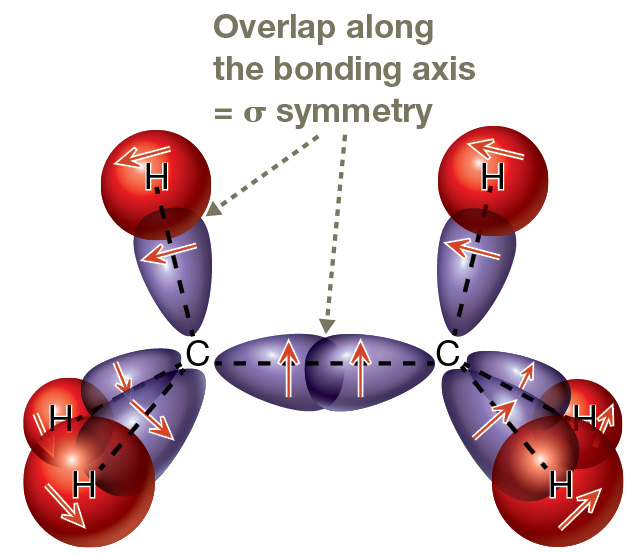
More informationAn illustration shows the overlap of orbitals in ethane. Each of the two carbon atoms has four lobes around it, aligned along the directions of its bonds. Around each hydrogen atom is a spherical orbital. One lobe orbital from each carbon overlaps the other in the carbon-carbon bond. The other lobe orbitals from each carbon overlap with the spherical orbital from the hydrogen in each carbon-hydrogen bond. Each orbital contains one electron. Overlap occurs along the bonding axes which characterizes sigma symmetry. |
|
How is each resulting orbital derived from that overlap? |
➤ |
Each overlap results in an orbital that has been built up in the region of overlap. 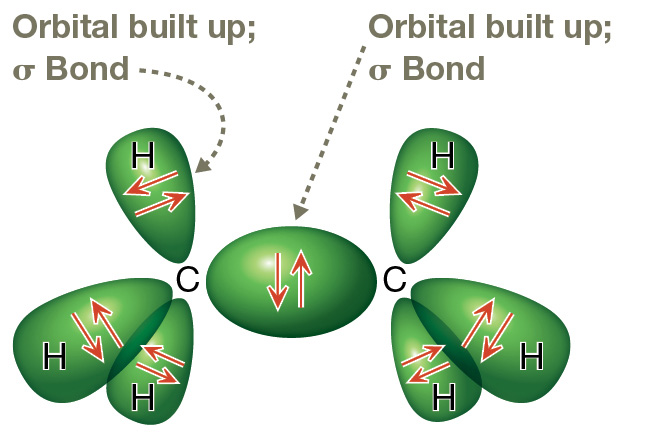
More informationAn illustration shows the resulting orbitals in ethane. All orbitals have two electrons. All orbitals represent sigma bonds. There is a large oval orbital between the two carbon nuclei. Around each of the carbon nuclei there are three other large lobes. Each of these lobes contains a hydrogen nucleus. |
|
Try ItDraw the VB picture of propane, CH3CH2CH3. How many σ bonds does the molecule have? |
||
YOUR TURN 3.2
In Solved Problem 3.2, the graphic that shows the contributing orbitals has two regions of overlap labeled as characterizing σ symmetry. Identify and label the remaining regions of overlap that characterize σ symmetry.
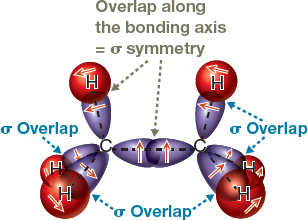
Orbital structure of C 2 H 6. Each carbon is bonded to three hydrogens and the carbons are bonded to each other. The hydrogens are inside a red sphere. Each bond between carbon and hydrogen is inside a purple teardrop shape. The bond between the carbons shows two overlapping purple tear drops. The overlap between the spheres and teardrops is labeled as overalp along the bonding axis which equals sigma symmetry.